


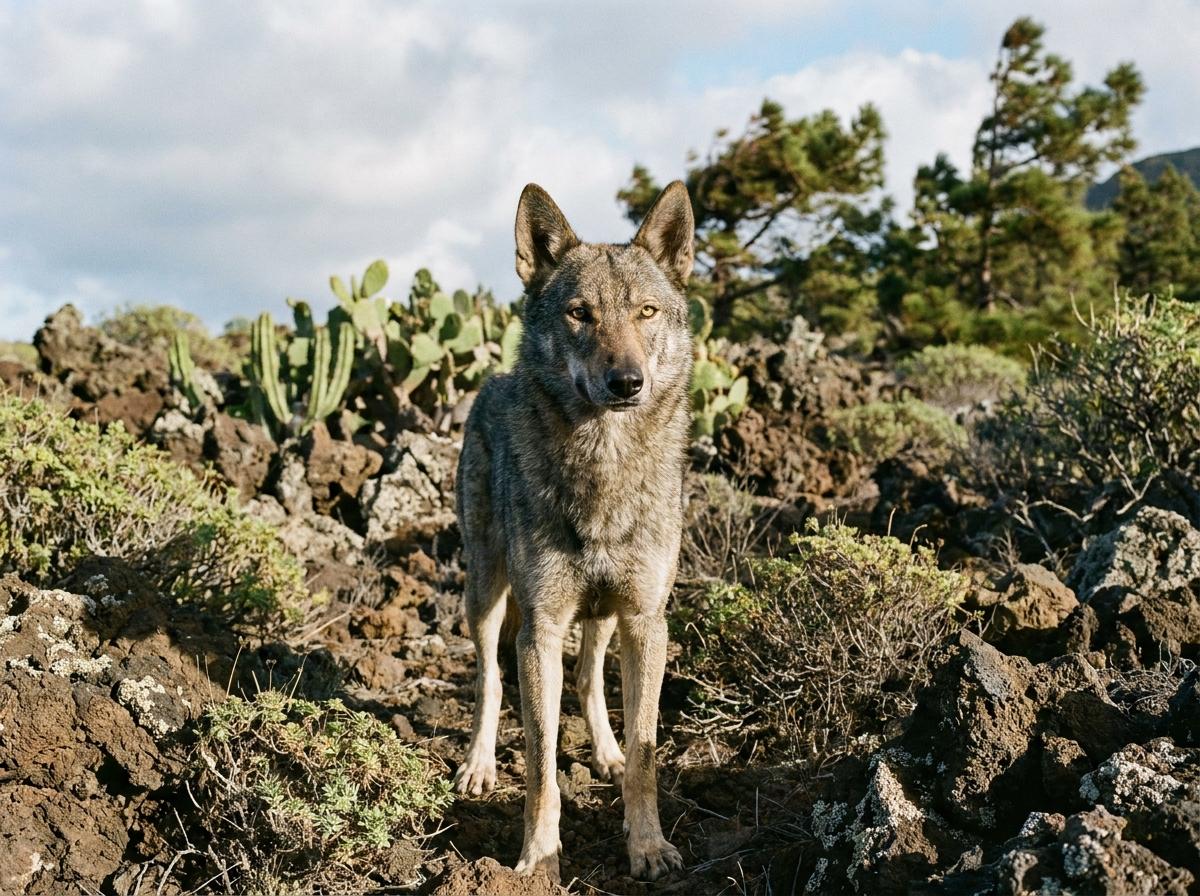
Lobito Herreño
Author: Elliott Garber, DVM · Published
The Lobito Herreño is a rare wolf-like herding dog from El Hierro, the smallest and westernmost of the main Canary Islands. The name means “little wolf of El Hierro,” and the look earns it: a lean, medium-sized dog in wolf grey with upright triangular ears, a long narrow muzzle, and a light, ground-skimming trot, shaped by island shepherds to move sheep and goats across steep volcanic pasture. It is not yet an officially recognized breed. Spain’s national kennel club lists it as a canine ethnic group, a formal step below full breed status, and as of mid 2026 the Canary Islands government and the breed association are finishing the paperwork to change that. The dog itself nearly disappeared in the 1970s and was rebuilt from a handful of animals by a patient local recovery effort, so knowing which numbers are solid and which are not matters more here than in almost any other breed profile. Below you will find what the Lobito Herreño is, where it comes from, what the draft standard actually says it looks like, where recognition genuinely stands, and what to expect if you ever try to find one, with clear flags wherever the record is thin. If you are weighing herding dogs more broadly, the Creatures dog species page is the place to compare this rarity against better-documented working breeds.

| Also called | Perro Lobo Herreño, Perro de Pastor Herreño (Herreño shepherd dog) |
|---|---|
| Origin | El Hierro, Canary Islands, Spain; smaller numbers on Tenerife, Gran Canaria, and La Palma |
| Primary use | Herding sheep and goats; increasingly kept as a companion |
| Height | About 52 to 54 cm at the withers (roughly 20 to 21 in), per the draft standard |
| Weight | About 18 to 22 kg (roughly 40 to 49 lb); anything over 30 kg is disqualifying |
| Coat | Short and dense, longer in winter; wolf grey or reddish with a pale muzzle mask, solid white or cream also accepted |
| Recognition | RSCE canine ethnic group (2015); Spanish native-breed recognition in progress as of 2026; not FCI or AKC recognized |
| Population | Very small; recovered from near extinction in the 1970s, with the working core still on El Hierro |
Browse listings, public profiles, breeders, or add your animal.
What is a Lobito Herreño?
The Lobito Herreño is the traditional herding dog of El Hierro, a volcanic island of a little over 10,000 people at the far southwestern edge of the Canary archipelago. Islanders have long called it the lobito, the little wolf, or the perro lobo, the wolf dog, for its grey coat and lupine outline. The Real Sociedad Canina de España (RSCE), Spain’s national kennel club, files its draft standard under the fuller name Perro de Pastor Herreño, the Herreño shepherd dog, which describes the job: for generations these dogs have moved flocks of sheep and goats for the island’s shepherds, work that still underpins El Hierro’s cheese-making and livestock culture today.
According to the RSCE’s breed documentation, the largest population lives on El Hierro itself, with smaller numbers on Tenerife, Gran Canaria, and La Palma. It is a working landrace rather than a show creation: what fixed its type was usefulness to shepherds on steep, rocky, walled volcanic terrain, where a light, quick, tireless dog is worth more than a big imposing one. That history also explains why the breed’s story is really two stories, one about centuries of quiet herding work and one about a modern rescue from the edge of extinction.
Origin and history
Nobody can say precisely how old the Lobito Herreño is, and the RSCE’s own draft standard is unusually candid about that. It states that the animal’s origins are not fully clear and that a presence in the islands before the fifteenth-century Castilian conquest cannot be affirmed, while noting that historians such as Abreu y Galindo recorded dogs in the Canaries before the conquerors arrived. Chroniclers of the conquest described islands populated by dogs “like wolves but smaller,” and accounts collected by the breed’s supporters connect today’s lobito to those early island dogs. Others suggest the population descends mainly from dogs brought over in later centuries of settlement. The dog has been part of El Hierro’s pastoral life for at least a couple of centuries, and anything earlier is plausible but unproven.
What is well documented is how close it came to vanishing. From the 1970s, as island herding declined and imported breeds arrived and crossed freely with local stock, the distinctive little grey shepherd dog nearly disappeared. Island dogs have been lost this way before: the Hawaiian Poi Dog, another isolated island landrace, went extinct entirely in the early 1900s through exactly this kind of dilution. El Hierro’s dog was headed for the same fate.
The rescue began with the Asociación para la Recuperación del Lobo Herreño, known as Amilobo, founded in 1988. Its president, Manuel Pérez Ramírez, has said that when the recovery started there were barely half a dozen good examples left on the island, a figure worth treating as the founder’s own account rather than a formal census. The association gathered what remained, bred carefully to rebuild numbers while limiting inbreeding, and brought in science to test whether the lobito was really a distinct population at all. A 2011 morphometric study by the Canarian Institute of Agricultural Research and the University of Las Palmas de Gran Canaria measured the dogs systematically, and mitochondrial DNA samples from 52 dogs, analyzed at the university’s veterinary faculty, supported the association’s case that this is a coherent, distinct dog population rather than a recent mix. In 2013 the first animals entered an official register on the strength of morphological exams and DNA testing, and the RSCE published a draft standard. In 2015 the RSCE formally recognized the Lobito Herreño as a canine ethnic group.
The final chapter is being written now. In June 2026 the Government of the Canary Islands announced that it is working with Amilobo to complete the file seeking the lobito’s incorporation into Spain’s official catalog of livestock breeds, maintained by the national Ministry of Agriculture. The regional government called the recognition a way to protect genetic, livestock, and cultural heritage belonging to El Hierro and the Canaries as a whole.
What a Lobito Herreño looks like
The RSCE’s published document is a proyecto de estándar, a draft standard, so treat the numbers below as the working description of the recovered population rather than a long-settled show standard. It describes a lupoid dog of medium type with a straight profile and a primitive, wolf-like appearance. The diagnostic features:
- Wolf-grey coat with a pale mask. The most common color is grey, from light to dark, with reddish tones also accepted. Grey and red dogs must show a pale mask around the mouth that stops short of the top of the muzzle, plus pale rings around the eyes. Solid white or light cream dogs are also accepted, and those carry no mask. Yellow is a disqualifying color, as is a very long coat.
- A short, seasonal double coat. The coat is short and dense, noticeably longer and thicker in winter than in summer, which suits an outdoor working life in the islands’ mild but windy uplands.
- Short upright triangular ears. The ears are small, triangular, set high toward the back of the skull, and carried erect, angled slightly outward and forward. Drooping ears are a disqualification.
- A long, narrow, wolfish head. The skull is triangular and forms a truncated wedge, with an elongated narrow muzzle, tight dark lips, small chestnut-brown eyes, and a scissors or level bite with the full 42 teeth. The nose is generally black, with liver noses appearing in lighter coppery coats.
- A dark-tipped tail. The tail is broad at the base, with a black tip and a dark patch about halfway along, a small signature detail the standard calls out specifically.
- A light, agile frame. The topline is straight with a slight fall to the croup, the belly is tucked, and the bone is fine to medium. The described movement is a harmonious, easy, ground-covering trot with the head and neck carried near horizontal, which is exactly how a herding dog conserves energy over a long day.
On size, the draft standard gives average heights of 54 cm for males and 52 cm at the withers for females (roughly 20 to 21 inches) and average weights of 22 kg and 18 kg respectively (roughly 40 to 49 pounds), with anything over 30 kg disqualifying. The 2011 morphometric study measured working dogs at means of 21.9 kg for males and 21.1 kg for females, which fits the standard closely. This is a genuinely moderate dog, bigger than a Corgi, far smaller than a livestock guardian, and built for agility rather than power.

Recognition status
Plenty of pages describe the Lobito Herreño as a Spanish breed without qualification, so it is worth being precise about what its status actually is.
The RSCE sorts Spain’s native dogs into fully recognized breeds and grupos étnicos, ethnic groups. On the RSCE’s Spanish breeds listing, four Canarian dogs hold full breed recognition: the Presa Canario, the Podenco Canario, the Perro de Pastor Garafiano from neighboring La Palma, and the Perro Majorero of Fuerteventura. The first two are recognized internationally by the FCI as well. The Garafiano and the Majorero are not, and the listing says so on its face: both sit under Grupo 11, the section the club heads “razas no reconocidas por la FCI,” breeds not recognized by the FCI. That tier is the relevant one here, because it is where a promoted Lobito Herreño would land first, a Spanish breed at home and still unrecognized abroad.
The lobito itself sits a step below all four, in the ethnic-group category, which the club uses for regional dog populations with consistent traits fixed by working selection that have not yet completed the standardization, multi-generation registry, and genetic-stability work a modern breed requires. The RSCE names the Lobito Herreño among the ethnic groups now working through its published route to official breed status. Ethnic-group status, granted in 2015, is real recognition of the population’s distinctness, and it is also not the same thing as breed status.
Full recognition is the current project. The application under preparation in 2026 seeks the lobito’s entry in Spain’s official catalog of livestock breeds as a native breed, alongside the Canarian dogs already listed there. Amilobo’s president told the regional government in June 2026 that the documentation is essentially complete and that recognition could arrive within a year or so. Treat that as a hopeful forecast rather than a date: back in 2023 the association was hoping for recognition in 2024, and these files move at the speed of ministries.
Two practical consequences for anyone outside the recovery effort. First, the Lobito Herreño is not recognized by the FCI, the AKC, or any major international kennel club, so there are no internationally recognized pedigrees, no championship show classes, and no kennel-club registration path abroad. Papers, where they exist, come from the Spanish registry work begun in 2013 and the association’s own records. Second, standards and status can genuinely change as the recognition file completes, so anything you read about this dog, this page included, deserves a freshness check against the RSCE and Canarian government sources linked here.
A herding dog at work
The lobito’s job is what the standard calls ganado menor, small livestock, meaning El Hierro’s sheep and goats. The island’s high pastures sit on old lava flows cut by dry stone walls, and flocks move between grazing, milking, and the communal gatherings that are part of Herreño livestock tradition. A dog working that ground all day needs to be light on its feet, quick to turn, economical in its movement, and sensible enough to pressure stock without hurting it. Shepherds kept breeding the dog that could do this, and the result is the moderate, tireless, close-working animal the draft standard describes.
That working population is small but real. In late 2023 the association reported 56 shepherds on El Hierro working 66 Lobitos Herreños with their flocks, with additional dogs living as companions on the other islands and beyond. Those are association figures relayed through the Spanish dog press rather than an official census, but they are the best public numbers available, and they capture the breed’s actual situation: a few dozen genuine working homes on one small island, plus a growing circle of admirers elsewhere. The recovery effort leans into the work, running education and training activity so that young dogs keep ending up behind flocks rather than only on sofas. Working landraces survive on demand for the work, a dynamic just as visible in the Bakharwal dog, the Himalayan flock guardian facing the same question at much larger scale.

Temperament
The draft standard’s behavioral description is short and consistent with everything else written about the dog: an excellent herder of small livestock, faithful to its handler, and wary of strangers. Keepers and breed enthusiasts describe a lively, quick, observant dog with real endurance that learns fast and stays closely bonded to its own people. Treat that as practitioner observation rather than studied science; a population this small has no formal temperament research behind it, and the breed’s public profile is written mostly by the people working to save it.
The pattern it describes, however, is a familiar one: a primitive-type herding dog. Expect intelligence, sensitivity, quick reactions, reserve with unfamiliar people, and a strong need for occupation. Early, broad socialization matters for any naturally aloof breed, and a bored, underworked herding dog of any origin tends to invent projects its household will not enjoy. As traditional herding declines, more lobitos are living as companions, and the association’s whole model depends on those homes taking the dog’s working brain seriously.
Husbandry and care
There is no breed-specific care literature for the Lobito Herreño, so responsible keeping means applying sound active-dog husbandry to what is known about the type, and building your own records as you go. The notes below are structure, not veterinary advice; medical decisions belong with a veterinarian who can see the animal.
Exercise and work
This is a dog selected to cover steep ground all day. Plan on genuine daily exercise plus mental work: herding where possible, and otherwise long varied walks, hikes, scent work, trick training, or dog sports that reward thinking. A fit lobito is reported to be an easy keeper in motion, light and efficient rather than frantic, but it was never bred to be idle.
Housing and space
A home with secure outdoor space suits the breed far better than a small apartment. The short double coat handles mild, windy, damp island weather well, and a dry draft-free shelter covers the rest. Reserve with strangers means visitors should be introduced properly rather than letting the dog sort it out alone, and recall around livestock should be proofed before it is trusted; a herding dog that has never seen sheep still carries the wiring.
Feeding
Feed as you would any active medium-sized dog: a complete, appropriate diet portioned to body condition, with weight checked by hand and eye rather than by the bag’s chart. At 18 to 22 kg of working build, condition changes show quickly, and keeping a lean working weight protects joints in a dog built to move.
Coat care
The short dense coat is low-maintenance: weekly brushing most of the year, stepped up during the seasonal change when the thicker winter coat sheds out. No trimming is needed, and the standard in fact disqualifies very long coats, so there is no show-coat upkeep to speak of.
Health
No published health survey exists for this breed, and no page should pretend otherwise. The two structural things a buyer can reason about are the ones the recovery itself created: the population passed through a severe bottleneck in the 1970s, and the association has spent decades deliberately managing matings to limit inbreeding, which is exactly the right response. Buy through documented lines, ask directly about known issues in the pedigree, keep routine preventive care current, and record what you observe. Careful records from ordinary homes are how small recovering breeds first learn what their real health picture is.

Size, weight, and lifespan
Adults stand about 52 to 54 cm at the withers (roughly 20 to 21 inches) and weigh about 18 to 22 kg (roughly 40 to 49 pounds), males a touch taller and heavier than females, per the draft standard and the 2011 measurements. There is no authoritative lifespan figure for the breed; nobody has followed enough lobitos through full lives to publish one. Medium-sized, moderately built working dogs commonly live on the order of 12 to 14 years, and that general expectation, not a breed-specific promise, is the sensible planning number.
Cost and availability
There is no reliable public market price for a Lobito Herreño, and we will not invent one. The population is tiny, the working core lives with El Hierro’s shepherds, and placements happen largely through the association and island breeders rather than through open listings. If you pursue one, expect a direct relationship with the breed community, a possible wait, travel or transport costs from the Canary Islands, and prices set case by case for a rare dog whose keepers care intensely where it ends up.
Availability drops fast with distance. The dog is established on El Hierro, present in small numbers on the other Canary Islands, and reported by the regional government to have individual examples in mainland Spain, elsewhere in Europe, the United States, and Venezuela. Outside Spain, finding one is a project measured in patience, not a weekend search. You can watch the Creatures marketplace for the breed and search the breeder directory, and given the rarity, a saved listing alert (below) is the realistic way to hear about one without checking daily.
Buying considerations
A rare, almost-recognized landrace rewards careful buying more than almost any established breed. If you get the chance to acquire one:
- Verify what you are buying. Ask whether the dog or its parents are entered in the Spanish registry work begun in 2013 or in the association’s records, and ask to see the documentation. With a breed this rare, a grey prick-eared mix sold on the name is a genuine risk.
- Meet working relatives if you can. The best evidence for temperament and soundness in a landrace is its relatives doing the job. Ask what the parents do all day.
- Ask the health questions the paperwork cannot answer. Known issues in the line, the breeder’s approach to managing inbreeding in a small population, and the veterinary history of the individual dog matter more here than certificates that do not yet exist.
- Be honest about the home you offer. This is an active, reserved, work-minded dog. If your life cannot absorb that energy, admire the recovery from a distance and choose differently.
- Support the recovery either way. Buying from the community that saved the breed, on its terms, is part of what keeps the population viable.
Frequently asked questions
Is the Lobito Herreño part wolf?
No evidence supports that. It is a domestic herding dog whose grey coat, upright ears, and narrow muzzle earned it the wolf name. The DNA work done on the population was about confirming it as a distinct, coherent dog breed, not about wolf ancestry.
Is the Lobito Herreño an officially recognized breed?
Not yet. Spain’s national kennel club has recognized it as a canine ethnic group since 2015, a step below full breed status, and as of 2026 the Canary Islands government and the breed association are completing the application for recognition as a Spanish native breed. It is not recognized by the FCI or the AKC.
How many Lobitos Herreños are left?
Very few, and every figure comes from the recovery effort rather than from an official census. The recovery reportedly started from barely half a dozen dogs in the late 1980s, and in late 2023 the association reported 66 dogs actively herding for 56 shepherds on El Hierro, with more living as companions on other islands and abroad. No total census has ever been published.
What does a Lobito Herreño herd?
Sheep and goats, the small livestock of El Hierro’s pastoral economy. It works close, light, and low, suited to steep walled volcanic pasture rather than vast open range.
Is a Lobito Herreño a good family dog?
It can be, for an active family that respects what it is: loyal and closely bonded to its own people, reserved with strangers, and in need of real daily exercise and mental work. It is not a low-effort companion, and very few are available outside the Canary Islands.
How big does a Lobito Herreño get?
About 52 to 54 cm at the withers (20 to 21 inches) and 18 to 22 kg (40 to 49 pounds) per the draft standard, with males slightly larger than females.
Do this next on Creatures
Whether you are researching the breed, hoping to find one, or already sharing your life with an island dog, Creatures is the records, marketplace, and directory layer to do it in one place.
Get alerted. Lobito Herreño listings will always be rare, so set a free listing alert and we will tell you the moment one is posted. No account needed to start. How it works: saving searches and using your watchlist.
Find stock. Browse Lobito Herreño listings on the marketplace and search trusted breeders and kennels in the Creatures directory.
Add your dog. Already have a lobito, or any dog? Create a free animal profile in a few minutes, no account needed to start. The walkthrough is in adding an animal to Creatures.
Keep the records that rare breeds need. Add health, breeding, and care records as you go. The record sheet opens for any visitor to look around, and you will need a free account to save what you enter. See adding a record and health and medical records for the how-to.
List your kennel or farm. Breed or work these dogs, or run a rare-breed program of any kind? Create your organization’s profile, then get listed in the breeder directory so the people searching for this breed can reach you. If you manage the operation with others, read creating an organization and adding your team.
Compare breeds. Weigh the lobito against other dogs on the Creatures dog species page, including fellow rare working breeds like the Bakharwal.
If you breed or work these dogs, you can also list your kennel or farm in the Creatures directory so buyers searching for this hard-to-find breed can reach you.