




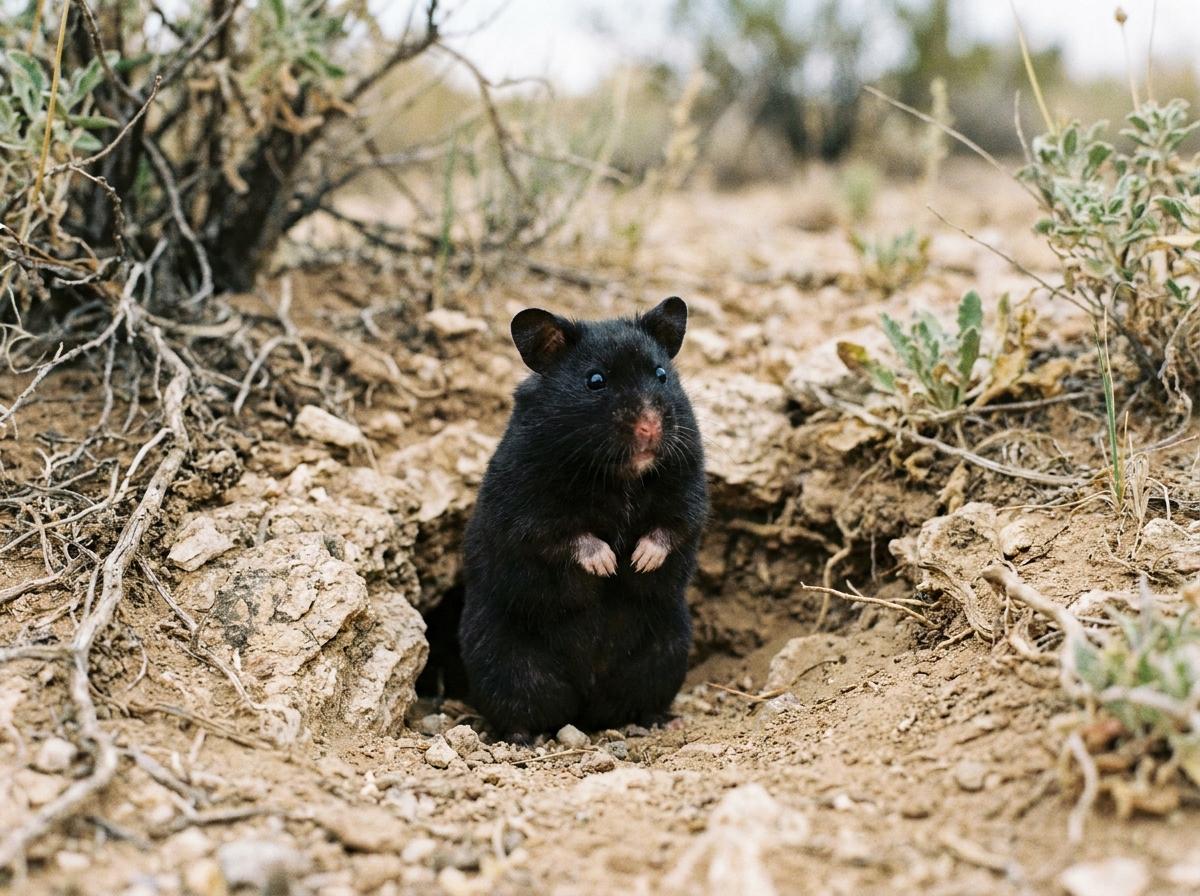
Black
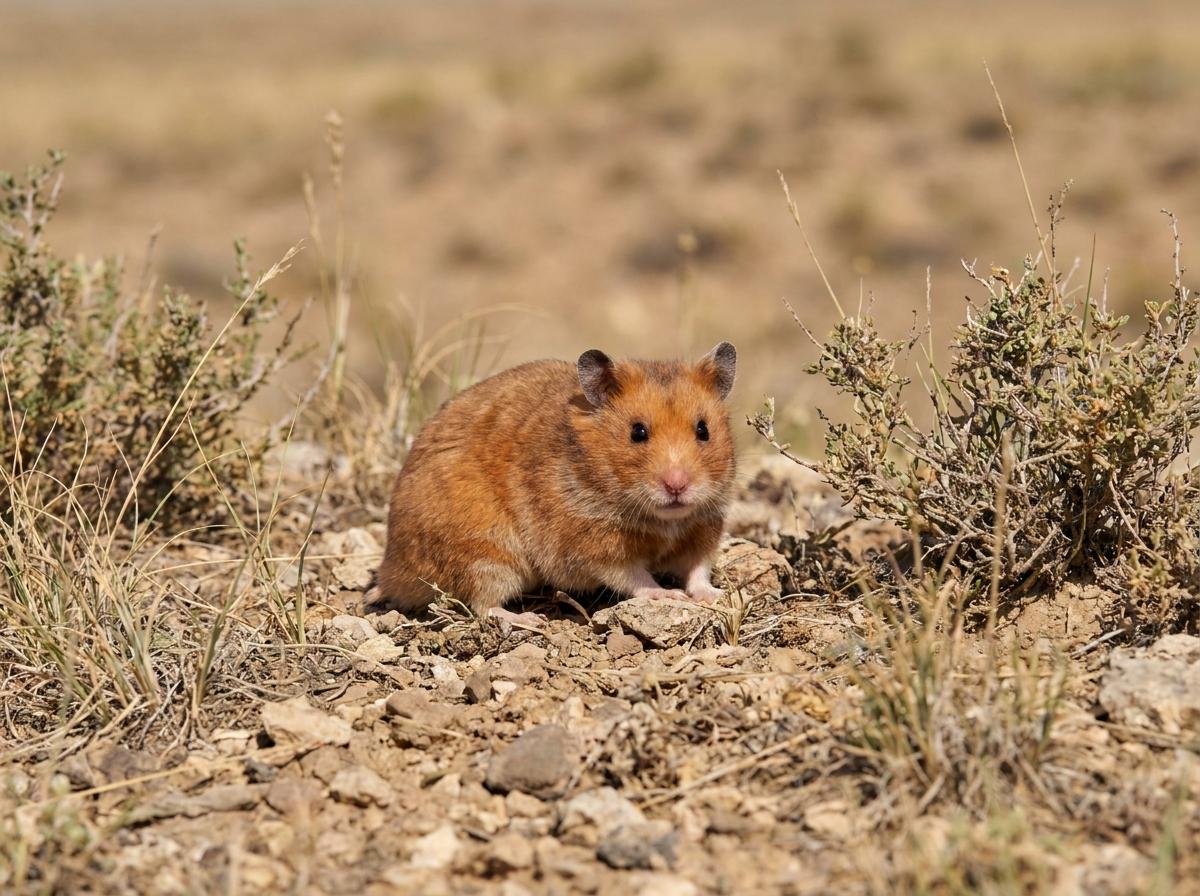
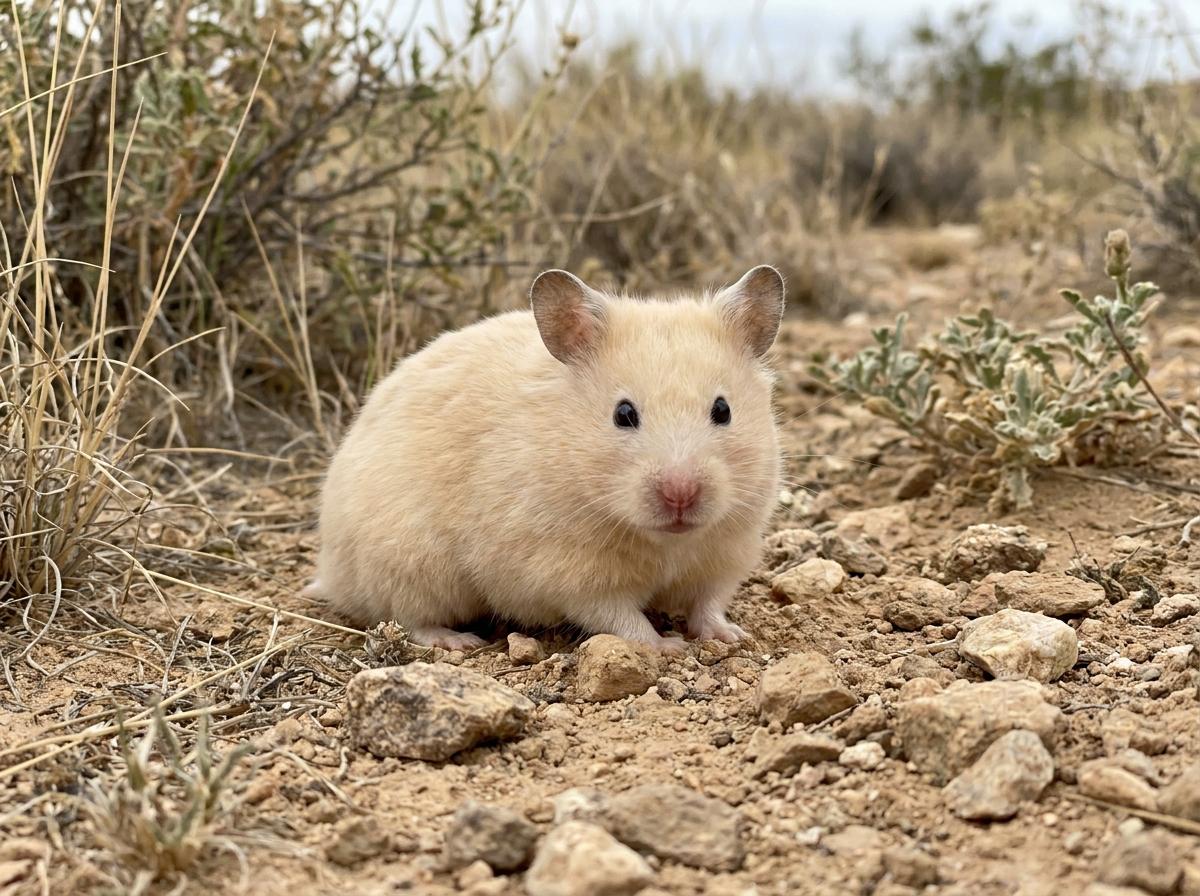
A black hamster is almost always a black Syrian hamster, and black is a color variety rather than a breed. The animal is Mesocricetus auratus, the same species sold as golden, fancy, teddy bear or black bear, carrying a recessive gene that replaces the banded gold and brown coat most people picture with a solid dark one. Everything else about it is a standard Syrian.
That distinction matters more than it sounds, because color is the part people search for and care is the part that goes wrong. This guide covers what the black gene is and how it behaves in a pairing, how to tell black from dark grey, sable and black tortoiseshell, why a black coat often warms to brown, and the housing and health facts that decide whether the animal gets a good two or three years. For the species background first, start on the Syrian hamster species page. If you are looking for one rather than reading up on one, skip ahead to the breeder and rescue directory.
One thing before all of it. Syrian hamsters live alone. Two in one enclosure will fight, and the fights are frequently serious. That holds for every color, black included.

| What it is | Syrian hamster (Mesocricetus auratus) in the black self color variety, not a separate species or breed |
|---|---|
| Also sold as | Black bear hamster, black fancy hamster, black teddy bear hamster (the long coated version) |
| Inheritance | Simple recessive, two copies needed, written aa in hamster club standards |
| Adult size | Head and body 170 to 180 mm, tail about 12 mm, 110 to 140 g, females larger than males |
| Lifespan | Typically 2 to 3 years |
| Housing | Always alone. 100 x 50 cm of unbroken floor is the usual published minimum, and a cage size study found welfare better again at 100 x 100 cm |
| Bedding and wheel | At least 25 cm of bedding to burrow in, deeper is better, and a solid surface wheel about 30 cm across |
| Care level | Straightforward animal, demanding enclosure. The setup is where most first attempts fall short |
Browse listings, public profiles, breeders, or add your animal.
Is the black Syrian hamster a breed?
No. Syrian hamsters are one species, and the hamster fancy sorts them by color, pattern and coat type instead of by breed. You can see that in how they are judged: the National Hamster Council, the governing body for the hobby in the UK, allocates 30 points for color and markings, 25 for type, 20 for fur, 10 for size, 10 for condition and 5 for eyes and ears. There is no breed column, because there are no breeds to put in it.
Web addresses on this site and most others file a color under “breed” because that is the slot the software has, so a page like this one sits at a breed style URL. Read it as a variety page. For contrast, the Belgian hare is a real breed, with its own body type, weight range and history, rather than one gene sitting on an otherwise ordinary animal.
The practical consequence is short. Choosing black is choosing a coat.
“Black bear hamster” and the other pet shop names
Pet shops sell Syrians under a family of soft marketing names, and they all describe the same species:
- Black bear hamster is a black or very dark Syrian.
- Teddy bear hamster is a long haired Syrian, so a black teddy bear hamster or a black long haired hamster is a black Syrian carrying the long haired coat gene.
- Golden, honey bear, panda and fancy are the same species, sold on color or pattern.
None of these is a breed, and none implies a calmer temperament, a bigger animal or a special diet. The only real difference in the list is coat length: a long coat picks up bedding and food, so check the rear of a long haired hamster regularly so nothing mats there.
What the black gene actually does
The National Hamster Council standard for black is unusually clear for a fancy standard. It asks for a black top coat, a black base color and black belly fur, with black eyes and black ears, and it describes the variety as “a melanistic black, produced by a simple recessive gene, and is capable of true breeding”. The club symbol for it is aa.
Recessive with two copies needed is the whole story for a pairing:
- Black to black gives an all black litter. The pair has nothing else to pass on at that gene.
- Black to a golden carrying no black gene gives a litter that all look golden. Every one of them carries black.
- Carrier to carrier gives roughly one black in four, and the goldens in that litter are a mix of carriers and non carriers you cannot tell apart by eye.
That last point catches people out. A carrier looks exactly like any other golden hamster, so if pedigree matters to you the parentage has to be recorded rather than guessed. If you keep or breed hamsters, you can record the pairing and the litter on a free animal profile so the carriers are still identifiable in two generations’ time.
Where the black came from, and what is actually documented
The hamster fancy’s own record is that black reached the UK in 1991, and that until it arrived the darkest hamsters available were sables, which were often called black by mistake. Earlier than that the variety is usually credited to a mutation in continental Europe, most often France, in the mid 1980s. Both dates come from club and hobby material rather than any published record, and the UK club page that carried the 1991 date is no longer online, so treat the whole origin story as the fancy’s account rather than documented history. What is not in doubt is what happened next, because the standards record it: combined with cinnamon, black gives dove, written aapp, and combined with rust it gives chocolate, written aabb.
What “aa” is at the DNA level
The symbol aa is the fancy’s working shorthand, but in this species it does map onto an identified mutation, which is unusual for a small pet color. While working out the genetics of sex linked yellow, Alizadeh and colleagues also pinned down recessive black (Genetics, 2009). They sequenced the coding region of the hamster Agouti gene, the gene for agouti signaling protein, and found a single base change in exon 4 that swaps a cysteine for a tyrosine at position 115 of the protein, written Cys115Tyr. It was present in the black hamsters in their colony and absent from the goldens, and it lands on a cysteine conserved across every known version of the gene, one that holds together the working loop the protein uses to block the melanocortin receptor. A comparable change in a mouse behaves like a dead gene, so this one is expected to knock out Agouti function.
The consequence is what you see on the animal. Agouti signaling protein is the switch that interrupts dark pigment partway up a growing hair and puts a gold band in it. Take the switch out and the band never appears, so every hair grows out dark from root to tip. That is the hamster the fancy calls nonagouti and the shops sell as black, and it is why the standard asks for black base color and black belly fur rather than black tips.
There is a second black in this species, and the two are easy to confuse. A laboratory mutant called black tremor produces a black coat alongside defective myelination in the central nervous system that shows up as a tremor, and Kuramoto and colleagues traced it to a loss of function insertion in the attractin gene (Mammalian Genome, 2002), which is a different gene doing a different job. Pet blacks do not tremor and are not that mutant. What you have is a well behaved simple recessive that breeders have worked with for thirty years, with a published mutation behind it.
Black, dark grey, sable and black tortoiseshell
Dark hamsters get mixed up constantly, and one trick settles almost all of it. Part the fur or blow gently into it and look at the base color, the color at the root of the hair rather than the tip. Show standards are written that way, in three layers: top coat, base color, belly fur.
- Black. Black top coat, black base color, black belly fur, black eyes, black ears. Solid all the way down.
- Sable. A black top coat carried well down over an ivory cream base, with fine ivory cream hairs ringing the eyes. The council standard says outright that sable “is not a solid jet black animal due to the presence of its undercolour”, and that browning is penalized. Sable is the variety that gets sold as black most often.
- Dark grey. A pearly grey top coat carried about a quarter of the way down over a dark slate grey base, with an ivory belly and ears that are dark grey, almost black. Darker than you expect in a photograph, obviously not black in the hand.
- Black tortoiseshell. Black plus the sex linked yellow gene, which breaks the coat into patches of black and yellow. Roy Robinson described sex linked yellow in this species in Nature in 1966, and because the gene sits on the X chromosome, tortoiseshell hamsters are female. A male tortoiseshell is not something to go looking for.
One more thing about pet black Syrians, because it usually gets reported the wrong way round. A lot of pet line blacks carry white toes and a small white patch on the chest. The council’s general rules state that “white feet shall be permissible on all colours”, so the toes cost nothing on a show bench. The chest patch does, because it is a white marking the black standard does not list. Neither is a health problem or a sign of poor breeding, and neither means anything at all in a pet.
Why a black hamster turns brown
This comes up constantly, and it is normal. Dark self coats warm in tone, and the fancy has known it long enough to build it into the rules: the standard for sable, the other very dark self color, states plainly that “Browning will be penalised”. Judges do not write that about something that happens rarely.
Breeders and judges attribute the browning to age, to molt and to sunlight. I could not find a controlled study measuring it in Syrian hamsters, so treat those as long standing observation rather than settled fact. Keeping the enclosure out of direct sun is worth doing anyway, since the PDSA asks for a steady 18 to 21 degrees C away from draughts and direct sunlight.

A coat that has warmed in tone is cosmetic. Fur that is thinning, patchy, scurfy, greasy or coming away in your hand is a different thing entirely, and it needs a veterinarian rather than a color explanation.
The care that actually matters
Color changes nothing here. This is every Syrian hamster.
One hamster, one enclosure
The RSPCA leaves no room in it: “Syrian and Chinese hamsters aren’t naturally sociable and should always live on their own.” The Merck Veterinary Manual notes that both males and females can be aggressive toward their own species.
There is field data behind that, not just assertion. When Gattermann and colleagues mapped wild golden hamster burrows in Syria (Journal of Zoology, 2001), they reported that none of the inhabited burrows contained more than one adult. Solitary is not a captivity artifact or a personality problem. It is how the animal lives.
So do not buy two for company, and treat a seller who suggests a pair as someone whose husbandry advice you should discount generally. Littermates are the one exception, and only briefly. Merck puts weaning at about 20 days and reproduction possible from 7 to 8 weeks, so a litter has to be split by sex well before that. No welfare body I could find publishes a single separation age, so ignore the confident numbers you will see quoted and use the deadline that matters, which is sexual maturity. That same figure explains a common surprise: mixed sex housing at a shop can send a pregnant female home as a single hamster.
Floor space
This is where most setups fall short, and the numbers have moved a long way from what starter cages assume. The PDSA gives a minimum of 100 x 50 cm, citing the German veterinary association for animal welfare, and adds that this is a minimum and bigger is always better. That is 5,000 square centimeters, or about 775 square inches.
The research goes further. Fischer, Gebhardt-Henrich and Steiger compared four cage sizes with golden hamsters (Animal Welfare, 2007): 1,800, 2,500, 5,000 and 10,000 square centimeters. Stereotypic wire gnawing appeared at every size, but hamsters in small cages gnawed significantly longer and more often, and the authors concluded that welfare seemed enhanced in cages of at least 10,000 square centimeters of ground floor area. That is 100 x 100 cm, double the usual quoted minimum.
Treat 100 x 50 cm as the floor and aim past it, and prioritize unbroken floor area over height, tubes and extra levels.

Bedding deep enough to burrow in
The PDSA asks for no less than 25 cm (10 inches) of bedding so the hamster can burrow, sleep and store food. Merck’s professional guidance goes considerably deeper, stating that cages with at least 40 to 80 cm of bedding enhance the welfare of Syrian hamsters.
Those numbers stop sounding extreme next to the wild animal. The burrows Gattermann’s team mapped ran from 36 to 106 cm deep, with a mean of 65 cm. Depth is also the strongest argument for a big enclosure, because a small cage physically cannot hold enough substrate, whatever it says on the box.
For material, paper based bedding and aspen are the two welfare guidance keeps returning to. Cedar and other aromatic softwood shavings are widely avoided for small mammals, and while I could not find a current welfare body statement putting a figure on that risk, there is no reason to pick them when paper and aspen are cheap and uncontroversial.
One material is a stated hazard rather than a preference. The RSPCA warns: “Don’t use nesting materials that can separate into thin strands such as cotton wool or similar ‘fluffy’ bedding products, as they pose a serious risk to the health and welfare of your pet”, and spells out the risk as limbs tangling and losing circulation, with amputation or euthanasia as the outcome. That cotton style nesting fiber is still sold in pet shops. Do not buy it.
The wheel
A Syrian needs a wheel big enough to run flat rather than arched. The PDSA gives at least 30 cm (12 inches) for a Syrian with a solid running surface rather than slats or bars a leg can drop through, and explains why: a wheel that is too small forces the hamster to run with a curve in its back, which can cause long term pain. The RSPCA adds that it should be axle free with a non slip surface, the kind of large diameter wheel intended for a rat.
Worth being straight about that 30 cm: it comes from veterinary welfare bodies, not from an experiment testing wheel diameter against spinal outcomes, and no such study appears to exist. It is the best figure available, from people who see the consequences, but it is not a measured threshold. The 27 cm and 28 cm numbers circulating on retail sites trace back to nothing at all.
One more piece of equipment: the RSPCA advises against exercise balls, which it says can be stressful for the hamster.
Sand bath, not a bath
Hamsters clean themselves. The RSPCA’s position is that they do not typically need grooming beyond their own self grooming and occasional access to a sand bath. Use a shallow dish of coarse reptile or chinchilla bathing sand rather than the fine dust sold for dust baths, and leave it in a few hours at a time.
Water is not part of this. No welfare body publishes an explicit ban on bathing a hamster, mostly because none treats it as a thing anyone would do: water bathing appears nowhere in published guidance, and sand is what those guides recommend instead. If something is stuck in the coat, spot clean it or ask a vet rather than putting a 120 gram animal in water.
Food, water and light
Merck asks for a complete, balanced, pelleted diet made for hamsters, and says generic seed mixes should be avoided because hamsters pick the seeds out and ignore the pellets. That is the one place where the cheap default and the veterinary advice part company, so it is worth getting right. Add small amounts of fresh vegetables, herbs and hay, keep sugary fruit occasional, and scatter part of the ration across the bedding so the foraging drive has something to do. Merck also notes that a Syrian’s broad muzzle often stops it eating from a hopper, so the pellets belong on the floor of the enclosure, which suits scatter feeding anyway. Fresh water always, and check the burrow for hoarded food going off.
Captive hamsters are nocturnal, and that decides whether one suits your household. Do not expect much at three in the afternoon, and never wake a sleeping one abruptly, which is how most bites happen. The nocturnal habit may be partly a captive one: Gattermann’s team found wild female golden hamsters were almost exclusively diurnal (Biology Letters, 2008).
Handling
Let a new hamster settle for several days. Then hand feed, let it walk onto an open palm in its own time, and keep early sessions short and low over a soft surface in case it jumps. Handle in the evening, wash your hands first so they do not smell like dinner, and never scoop a sleeping hamster.

Most Syrians become confident and easy to handle on that routine. Coat color has nothing to do with it.
Lifespan and health
Plan on two to three years. Merck gives Syrian hamsters a lifespan of 2 to 3 years and the PDSA says the same, while the RSPCA is more conservative at up to two years with some living longer. Anything past three is a good run, and a seller promising four is worth doubting. On size, Merck gives a head and body length of 170 to 180 mm with a 12 mm tail, and 110 to 140 g, females larger than males.
Wet tail. Merck describes proliferative ileitis as the most consequential intestinal disease of 3 to 10 week old Syrian hamsters, with high mortality. It moves fast. A wet, soiled rear end, diarrhea, hunching, lethargy or a hamster that stops eating is a same day veterinary call, not a wait and see. Recently bought young hamsters are the highest risk group, which is exactly what most new owners have.
Teeth and pouches. Incisors grow for life, so a hamster that drools, drops food or loses weight needs its mouth checked. Merck also lists impacted cheek pouches among things to look for. A full pouch is normally a sight to enjoy: Merck describes hamster pouches as opening inside the lips, extending well back of the shoulders, and more than doubling the width of the head and shoulders when filled. A pouch that stays full when the hamster has not been hoarding needs a vet.
Lumps. The PDSA notes most hamster tumors are benign. Merck notes that in older Syrian hamsters, lymphoma is the most frequently observed tumor of the blood forming system. Both are reasons to have a new lump looked at rather than watched.
Does the black gene carry any health risk? No known one. Black is a simple recessive with no reported linked defect, and black to black pairings are unremarkable. That is not true of every hamster variety. The National Hamster Council warns that care is needed when breeding patterned animals because some patterns carry the anophthalmic, or white bellied, gene, and states that two satin coated hamsters must never be mated together because it eventually produces almost naked hamsters. If you breed, that is where the genetic caution belongs. Not on color.
Find a veterinarian before you need one. Not every small animal practice sees hamsters routinely, the RSPCA advises registering with a practice before the animal comes home, and Merck suggests asking other owners and checking directories of exotic animal veterinarians. Any medical decision belongs to a vet who has examined the animal, not to a care article.
What a black Syrian costs and where to find one
Black Syrians turn up in general pet shops, with small specialist breeders, and in rescues, where hamsters are commonly given up and adults are routinely overlooked. A rescue is worth considering first, because the temperament is already known and the history comes with it.
On money, the useful thing is the shape of the spend rather than a price for the hamster. The animal is a small fraction of the first month and the enclosure is the real cost. A setup meeting the floor space, bedding depth and wheel size above costs several times what a pet shop starter cage does, and buying the small cage first and upgrading later is the most common and most expensive route. Price your own setup before you commit, because country, retailer and enclosure choice move the total too much for one figure to mean much.
To see what is around, browse Syrian hamster listings on the marketplace and search the breeder and rescue directory. Small pet inventory is thin in most regions, so an alert beats checking every week.
If this profile does not fit your household, that is a reasonable conclusion rather than a failure. Rats are the usual alternative, being social, awake more of the day and easier to interact with, and coat varieties work the same way there: the rex rat is a coat gene on an ordinary rat, not a separate breed.
Frequently asked questions
Is a black hamster rare?
Not any more. Black is recessive, which delayed its discovery, but it has been established in the hobby since the early 1990s. A shop not stocking one this week is not the same as rarity.
Is a black bear hamster a different animal from a black Syrian hamster?
No. Black bear is a pet trade name for a black or very dark Syrian. Same species, same care.
How long does a black Syrian hamster live?
Two to three years, per Merck and the PDSA. The RSPCA gives up to two years with some living longer. Color has no effect on lifespan.
Can two black Syrians live together if they are siblings?
No. Littermates can share briefly as juveniles but must be split by sex well before sexual maturity, which Merck puts at 7 to 8 weeks. Adults live alone permanently.
Why is my black hamster turning brown?
Dark self coats commonly warm with age, molt and sun exposure, and that is cosmetic. Hair loss, patchiness, scurf or a greasy coat is not, and warrants a vet.
Do black hamsters cost more than golden ones?
Sometimes a small premium at a shop for a less common color. It makes no difference to the cost of keeping one, which the enclosure dominates.
What is a black teddy bear hamster?
A black Syrian that also carries the long haired coat gene. Teddy bear refers to coat length, not color and not breed, and the coat is worth reading up on separately because males grow the full skirt and females mostly do not. That is covered on the long haired Syrian hamster page.
Are black hamsters good pets for young children?
Color is irrelevant, but the species profile matters: nocturnal, solitary, short lived, and needing an adult sized enclosure an adult buys and cleans. Good family animals with adult ownership and supervised evening handling.
Do this next on Creatures
Deciding on one, already keeping one, or breeding blacks and tracking carriers, Creatures is the records, marketplace and directory layer for it.
Start its profile. Bringing one home, or already have one? Create a free animal profile and keep its weight, coat changes and setup in one place. No account needed to start. The walkthrough is in adding an animal to Creatures.
Log weights and vet visits. Add a record for a weigh in, a lump you noticed, or a wet tail scare. The record sheet opens for any visitor to look around, and a free account is what saves it. See adding a record and health and medical records.
Do not miss the next check. A short lived animal rewards a routine, so set reminders and upcoming care for weigh ins and cage deep cleans.
Get told when one is listed. Small pet inventory is thin in most regions, so set a free black Syrian hamster listing alert instead of checking every week. No account needed to start. See saving searches and using your watchlist.
Look at what is available now. Browse black Syrian hamsters on the marketplace and search trusted breeders and rescues in the Creatures directory.
Breeding or running a rescue? List your operation so people searching for a specific color can find you, and read getting listed in the breeder directory. No account needed to start.