How Long Are Rats Pregnant? Rat Gestation, Due Dates, and Pup Care
Author: Elliott Garber, DVM · Published
Rats are pregnant for about three weeks: the Merck Veterinary Manual gives an average gestation of 21 to 23 days. If you know the day your doe and buck mated, the free Creatures rat gestation calculator adds 22 days for an estimated due date and marks the 21 to 23 day window on a calendar, no account needed.
The exception that catches out rat keepers is the second pregnancy. A doe can be mated again within a day or two of giving birth, and if she conceives while she is nursing, the new embryos wait to implant until her current litter is weaned. That second litter arrives well after the usual three weeks. So the short answer is “about 22 days”, and the full answer is “about 22 days, unless she was mated while nursing her last litter”.
This guide covers the gestation numbers and why the date moves, how to calculate a due date, how to tell if a rat is pregnant, what to settle before you breed, care through pregnancy and the first weeks, the warning signs that mean you call a veterinarian, and how to keep the whole thing straight on Creatures.
| Gestation | 21 to 23 days after mating (Merck) |
|---|---|
| Due date rule of thumb | Mating date plus 22 days, then plan for the whole 21 to 23 day window |
| If she was mated while nursing | Implantation is delayed until the earlier litter is weaned, so the birth comes later |
| When you can tell | Sometimes at about 2 weeks, from weight gain or mammary development (Merck) |
| Litter size | Usually 8 to 18 pups (Merck) |
| Pups at birth | Deaf and blind; fur by about day 7, eyes open at about 2 and a half weeks |
| Weaning | About 21 days after birth (Merck) |
| Sexual maturity | Males 6 to 10 weeks, females 8 to 12 weeks (Merck), but some males can breed at 5 weeks: separate male pups from females by 5 weeks at the latest (Queen’s University) |
How long is a rat pregnant?
The standard answer is 21 to 23 days. Merck’s owner guide gives that range, and so does its professional chapter on mice and rats as pets, which was fully reviewed in May 2026. Laboratory guidance agrees: the University of Ottawa’s rat breeding and colony management procedure gives the same 21 to 23 days. The Creatures calculator uses 22 days as the single best estimate, with the full range as its planning window.
In weeks, that is just over three. It is a little longer than a mouse, which Merck puts at 19 to 21 days (see our guide to how long mice are pregnant), and longer than a Syrian hamster, covered in how long hamsters are pregnant.
Why a nursing mother’s due date slips
Rats have a fertile heat right after giving birth. The Ottawa procedure says this postpartum heat comes within 48 hours of the birth and that matings at that time succeed more than half the time. Merck’s owner guide simply says females “can quickly become pregnant again after giving birth”. If the buck is still with her when the pups arrive, assume she has been mated again.
What happens next is the part to plan around. Merck’s professional chapter explains that when a rat conceives during that postpartum heat, implantation of the new embryos is delayed during lactation and happens at weaning, so the next litter is not born until the earlier one has been weaned. In practice:
- The calculator’s window will be too early. If she conceived while nursing, do not panic when day 23 passes. The birth follows the weaning of her current litter, not the mating date.
- Litters can come back to back. Merck notes that opposite-sex rodents kept together can produce a new litter every 3 to 5 weeks. Merck’s owner guide says it is not healthy for a doe to be pregnant and nursing at the same time, and recommends giving her at least 2 months of rest between pregnancies and rearing a litter.
How to calculate a rat’s due date
Add 22 days to the mating date for the estimate, 21 days for the start of the window and 23 days for the end.
A worked example: a doe mated on November 2 has an estimated due date of November 24, with a planning window of November 23 to 25. That is what the rat gestation calculator returned for that date when we ran it, with the window marked on a calendar and buttons to copy the results, print them or add them to your calendar.
Rats rarely let you see the mating, so most due dates are really ranges:
- If the pair lived together for several days, run the calculator for the first and the last day they were together. Your real window runs from the earliest start to the latest end.
- A copulatory plug is a clue, not proof. After mating, a plug forms at the entrance to the vagina. Queen’s University’s rat breeding and weaning procedure notes that a plug about 12 hours after pairing indicates mating, but not every plug means a pregnancy, and no plug does not rule one out, because it may have been absorbed.
- If she had a litter in the last three weeks, the calculator date is a minimum: the birth will follow weaning of that litter.
Merck also notes that a sterile mating can cause a false pregnancy (pseudopregnancy) lasting about 12 days, after which she comes back into heat.
How to tell if a rat is pregnant
With a three-week pregnancy you do not get much warning. Merck’s owner guide says pregnancy is “sometimes detectable at about 2 weeks” from three signs:
- Weight gain. Adult does weigh about 350 to 450 grams (12 to 16 ounces), according to Merck, so a steady climb on a kitchen scale over a week or two is one of the clearest signs an owner can see. Weigh at the same time every few days and write it down.
- Mammary development. The nipples become more noticeable as the birth approaches.
- A rounder belly felt by an experienced hand. The Ottawa procedure notes that trained staff can feel the fetuses from as early as day 10. Pressing on a pregnant rat’s belly is not something to learn on your own pet; if you need to know, ask a veterinarian who sees rats.
Nest building is the other sign to watch. Merck says pregnant females build a nest and should be given suitable material, and that tissue paper is excellent for it.
Before you breed: age, the buck, and the homes
Most rat pregnancies that owners deal with are not planned, and the reason is how young rats mature. Merck gives sexual maturity at about 6 to 10 weeks for males and 8 to 12 weeks for females, and says males and females should be housed separately from that age. Queen’s University’s laboratory procedure adds that males can impregnate a female as young as 5 weeks, though this is not common. If you bought a mixed group of young rats, sexing them early matters more than anything else on this page.
If you do plan a litter, settle these first.
The doe’s age. Sources differ, so here is what each says. Merck’s professional chapter gives rats a breeding life of about 9 to 12 months. The Ottawa laboratory procedure advises delaying a first breeding until a female is at least 90 days old and about 200 to 275 grams, depending on the strain, and Queen’s retires laboratory breeding females at about 9 months. The American Fancy Rat and Mouse Association, answering a breeder’s question on breeding ages and weights, says it has no set standard but that most of its breeders first breed a female at about 6 months, or from 4 months if she is a good size and weight. A pet doe is neither a lab rat nor a show rat, so talk to a veterinarian who sees rats before you breed an older female or one who has never had a litter.
Mammary tumors. Merck’s professional chapter notes that mammary tumors are common in older rats and that spaying a female before about 7 months of age reduces the chance of them forming. If you are not planning to breed her, ask your vet about it.
The buck. Merck notes that male rats raised together generally get along, but strange males fight if they are put in the same cage. Decide where your buck will live when he comes out of the breeding cage, with a male companion if possible, since rats are social animals. Our rat cage setup guide covers housing a pair or group.
The homes. Merck puts the usual litter at 8 to 18 pups. Every one of them needs a home, and within weeks the males and females need separate cages. Line up homes before you pair the rats, not after.
If you breed for coat or ear type, plan the pairing around the genes involved: our guides to the rex rat, the dumbo rat and the hairless rat explain how those traits are inherited and the welfare questions some of them raise.
Caring for a pregnant rat
A pregnant doe mostly needs good everyday rat care, kept calm and consistent.
A nest and somewhere quiet. Give her plenty of nesting material (Merck suggests tissue paper) and keep the cage in a quiet spot away from loud noise and household traffic.
The right cage. Merck’s professional chapter says aquariums are not suitable cages for rats because air circulation is poor and ammonia builds up, that wire-mesh floors should be avoided because rats can trap their feet, and recommends a minimum cage height of 30 to 38 cm (12 to 15 inches). Our rat cage setup guide has the full specification, including bar spacing narrow enough that a young rat cannot squeeze through. Keep her nest box on the cage floor rather than a high shelf, so newborn pups cannot fall from it.
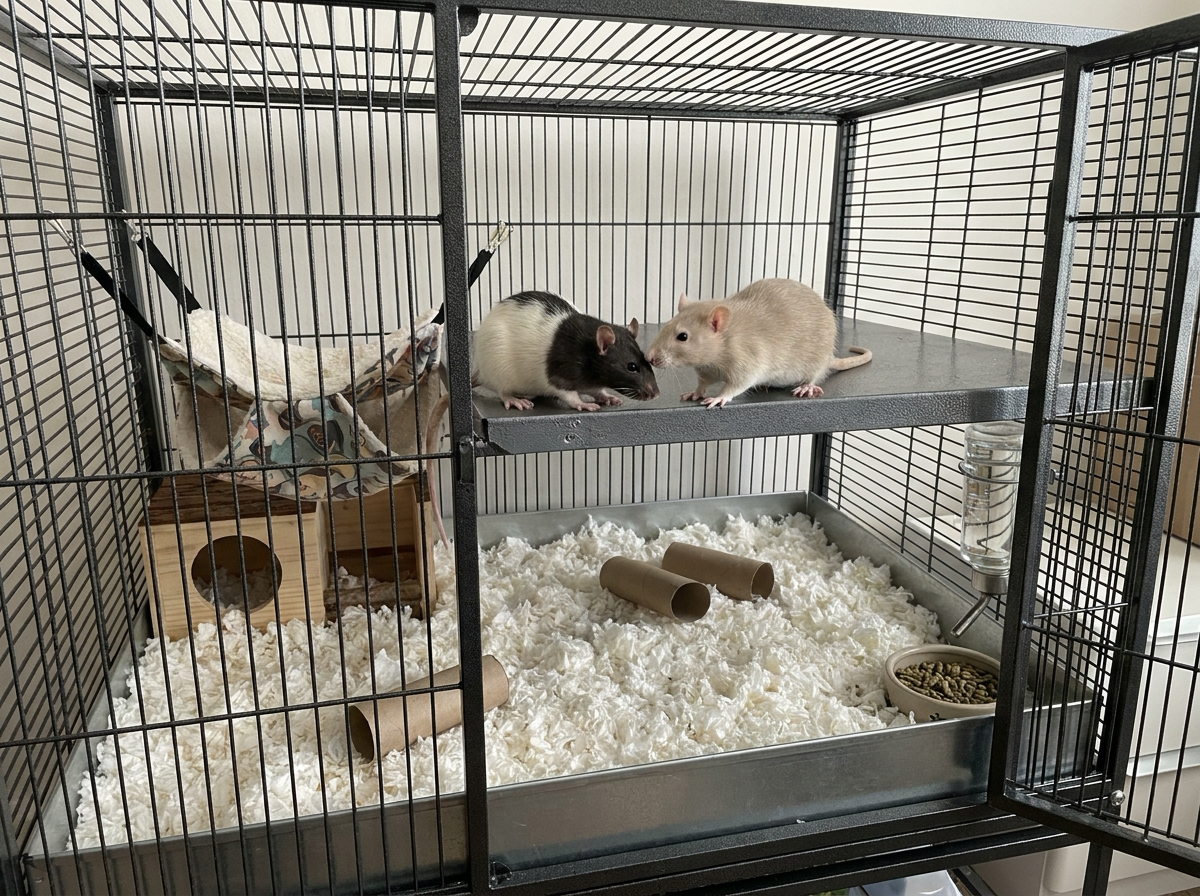
Food, water and temperature. Keep her on her usual complete rat diet (our guide to what pet rats eat covers the basics) and ask your veterinarian before changing it or adding supplements. Check the water bottle every day, and more often late in pregnancy and while she is nursing. Merck recommends keeping rats at 18 to 26°C (64 to 79°F) with relative humidity of 30 to 70 percent.
Move the buck out before the window. Because of the fertile heat within 48 hours of birth, a buck left in the cage will almost certainly mate her again. Moving him out a few days before day 21 avoids a pregnancy while she is nursing.
Handle her less. Keep handling to weighing and quick checks, and support her body fully when you lift her.
Birth and the first three weeks
Merck’s advice for afterwards is to keep the cage in a quiet place and leave the litter undisturbed for at least 7 days after birth, especially if it is the doe’s first. Merck lists the stresses that can lead a mother to abandon or eat her pups: not enough food or water, overcrowded group housing, too little nesting material, sick or deformed pups, and excessive noise. Most of what you can do is keep those things right and stay out of the nest.
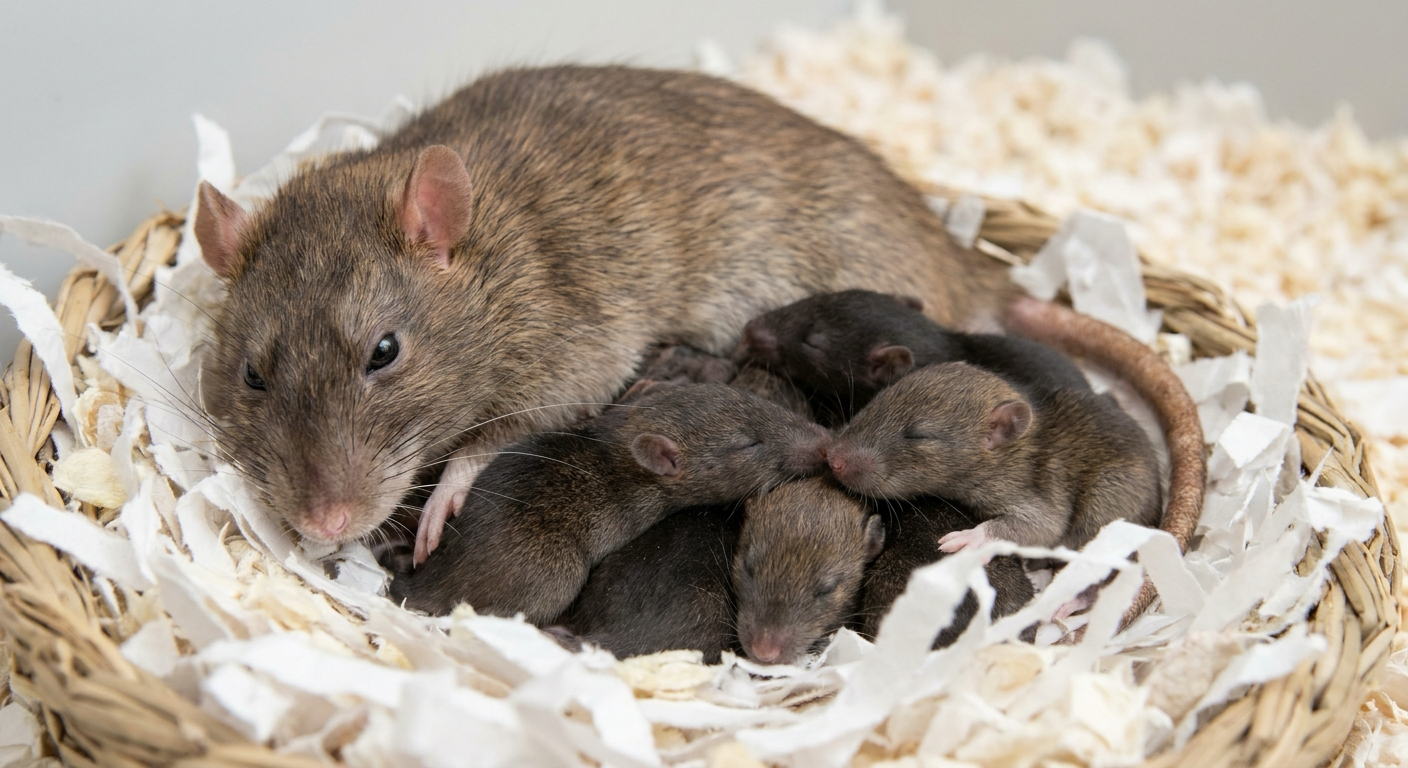
What you will see from the outside, using Merck and the control litters in a 2021 study of laboratory rat pup development:
- Birth: pups are born deaf and blind (Merck).
- About day 7: fur appears.
- About day 11: the lower front teeth come through.
- About day 13 to 14: the ear canals open.
- About day 17: the eyes open.
- About day 21: weaning (Merck); by now the pups are eating solid food alongside their mother.
Individual litters vary by a day or two either side of those averages. Sex the pups and separate the males from their mother and sisters by about 5 weeks at the latest, before the earliest of them can breed. If you need help telling them apart, your veterinarian can confirm. If you are naming a whole litter, the rat name generator gives you a long list to start from.
Warning signs: call a veterinarian now
Rats are small, and a difficult birth moves fast. We did not find a rat-specific birthing checklist from a veterinary body, so these are the general signs that a doe or her litter needs help today. Call a veterinarian who treats rats now if you see:
- Strong straining or contractions with no pup delivered
- A pup visibly stuck at the vaginal opening
- Bleeding that does not stop, or blood around her and in the cage
- A doe who is hunched, has a ruffled coat, is breathing hard, or stops eating or drinking around the birth
- Pups that are cold, scattered outside the nest and not being gathered, or not nursing in the first day
Also call your vet if she has not given birth a few days after the end of her window and she was not nursing a previous litter. Do not try to pull a pup or give any medicine yourself. Many general practices do not see rats, so find a clinic that does before the window opens and keep its number by the cage.
How to track a rat pregnancy on Creatures
A three-week pregnancy is easy to lose track of, especially with several does in a rattery. Creatures gives you a free way to calculate the dates and a free account to keep them, with reminders for the jobs that cannot slip.
1. Estimate the dates, no account needed. Enter the mating date in the rat gestation calculator. It returns the estimated delivery date, the 21 to 23 day window on a calendar, and buttons to copy, print or add the dates to your calendar. Calculators for 19 species live on the gestation calculators page, and using the gestation calculator explains the options. The result does not account for the nursing delay, so adjust for that yourself.
2. Save the breeding to the doe’s profile. Under the result, Track this breeding lets you create a free account and add the mom; Creatures keeps your calculation so you can check which dates belong in her record. Once she has a profile, add a Breeding & Reproduction record, keep Track as breeding cycle on, name the sire (a rat on Creatures or just a name you type) and enter the mating date, or a date range if the pair were together for several days. If she conceived while nursing and you know the litter will come later, enter your own estimate in Projected date override rather than changing the mating date. See recording a breeding.
3. Follow it on her Breeding tab. Her Breeding tab shows the pregnancy with her due date, window and what to expect, and Creatures schedules a due-date reminder. You can add progress photos as she grows. See tracking pregnancy and progress.
4. See every doe at once. The Breeding dashboard lists each expecting doe with her due date, and flags Due soon and Overdue. The labels describe timing, not whether a pregnancy is healthy.
5. Set reminders for the jobs that matter. Three are worth setting by hand: move the buck out before day 21, check the nest from a distance at day 7, and sex and separate the pups by 5 weeks. Log her weight as a measurement record so the gain shows as a trend. See reminders and upcoming care and track weight and growth.
6. Record the birth and the litter. When the pups arrive, record the birth with the numbers born alive and stillborn. With more than eight pups you do not have to make every profile on day one: create profiles for the ones you are keeping now, and add or connect the rest later, already linked to their mother. You can also keep a litter as a group tracked by number. See recording births and creating a litter and tracking animals without individual profiles.
Should you breed your rats?
For most pet owners the honest answer is no, or not without a plan. Merck’s advice is to house males and females apart from sexual maturity, because a pair left together can produce a litter every few weeks, and each litter can be well over ten rats who all need homes and same-sex housing within a month. Merck also recommends at least 2 months of rest between litters for a doe that is bred. If you do want to breed fancy rats, start with a healthy young doe, a separate home ready for the buck, a veterinarian who sees rats, and homes lined up before the pairing, and keep the dates written down.
If you are looking for a rat rather than breeding one, the rat species page covers the fancy varieties from the Manx to the double rex, along with lifespan, cost and care.
Frequently asked questions
How many weeks is a rat pregnant?
Just over three weeks. Merck gives 21 to 23 days. A doe that conceived while nursing a litter will give birth later, after that litter is weaned.
How many babies do rats have?
Merck gives a usual litter of 8 to 18 pups. The Ottawa laboratory procedure notes that strain and the mother’s age affect litter size, and that a doe’s second litter is typically her largest.
Can a rat get pregnant right after giving birth?
Yes. Rats come into heat within about 48 hours of giving birth, and Merck warns that being pregnant and nursing at the same time is not healthy for her. Move the buck out before she is due.
How can I tell if my rat is about to give birth?
She will be at her widest and busy with her nest. Births often happen when you are not watching, so the first sign is frequently the litter itself. Leave her alone, keep food and water topped up, and keep the room quiet.
When do baby rats open their eyes?
At about 17 days in the laboratory litters we cite, with fur appearing at about a week and the ear canals opening at about two weeks.
When can baby rats leave their mother?
Weaning happens at about 21 days (Merck). Separate the males from their mother and sisters by about 5 weeks at the latest, since some males can breed very young.
Do this next on Creatures
Expecting a litter, planning your first pairing, or keeping records for a whole rattery, these are the next steps on Creatures.
Get the dates. Run the free rat gestation calculator for the due date and planning window, then allow for the nursing delay if she was mated after a birth.
Add your doe. Create a free profile for your rat, no account needed to start. The walkthrough is in adding an animal to Creatures.
Record the breeding. Add a breeding, weight or vet record so the due date projects itself and her weight shows as a trend. The record sheet opens for any visitor, and a free account saves what you enter. See adding a record and health and medical records.
Breed fancy rats? Create your rattery’s profile, no account needed to start, then get listed in the breeder directory so people looking for rats can find you.
Get alerted. Fancy rats are listed only now and then, so set a free rat listing alert and we will email you when a new one is posted. No account needed to start. See saving searches and using your watchlist.
Looking for a rat? Check rat listings on the marketplace and look up trusted breeders in the Creatures breeder directory.