


Turbit
Author: Elliott Garber, DVM · Published
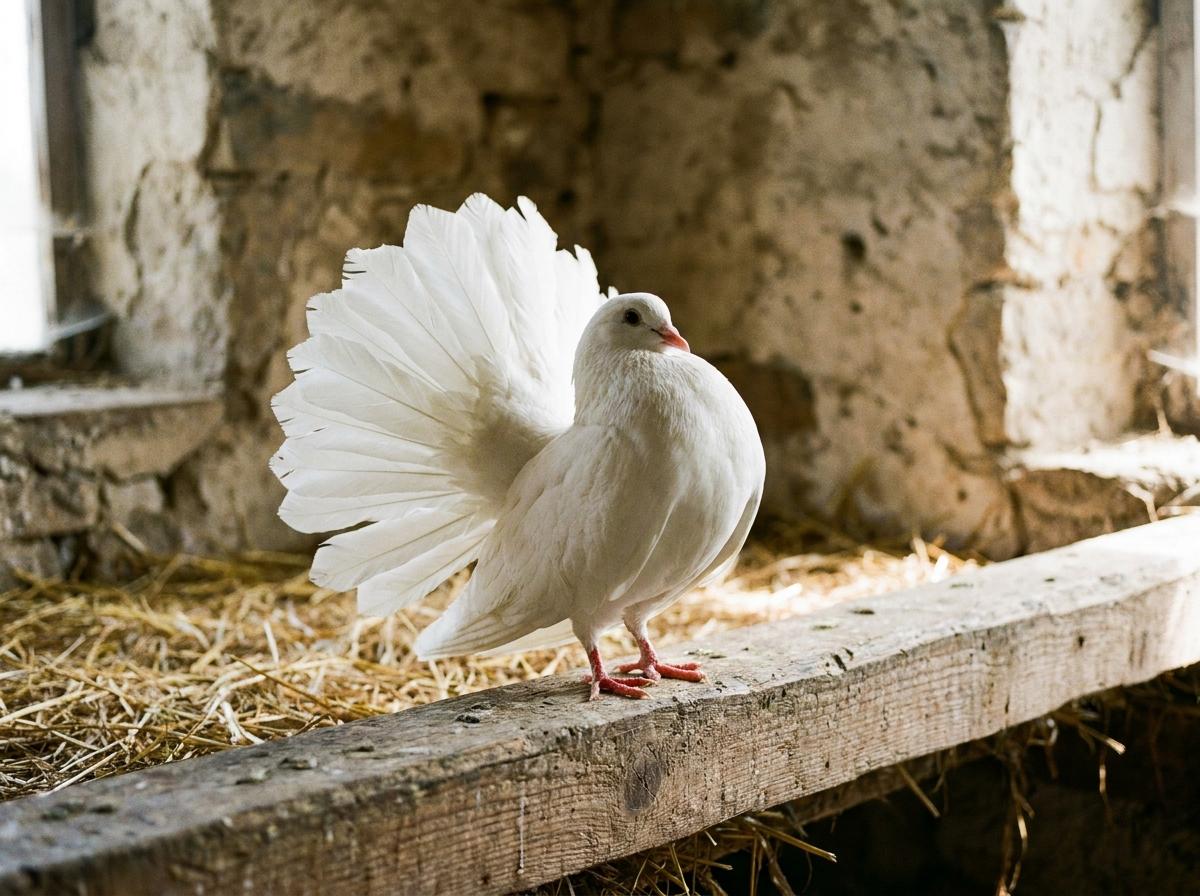
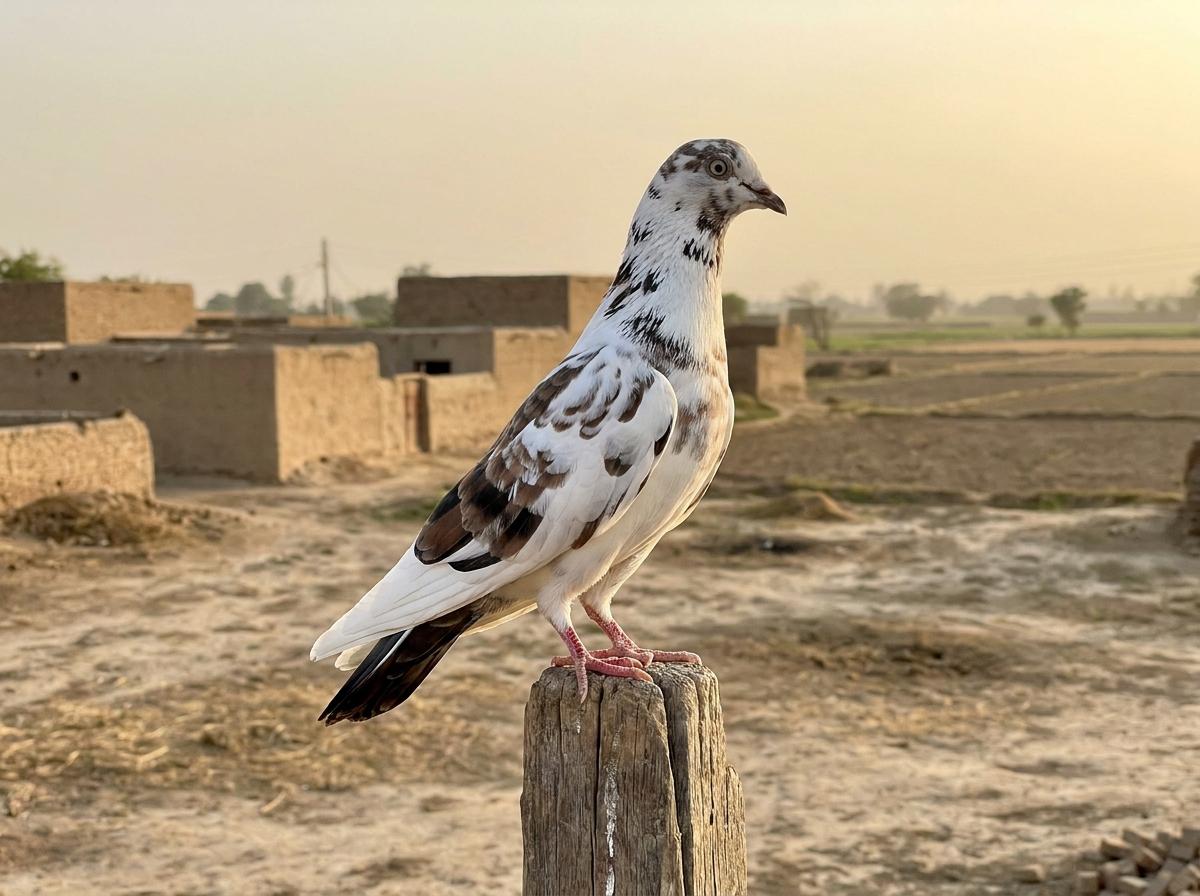
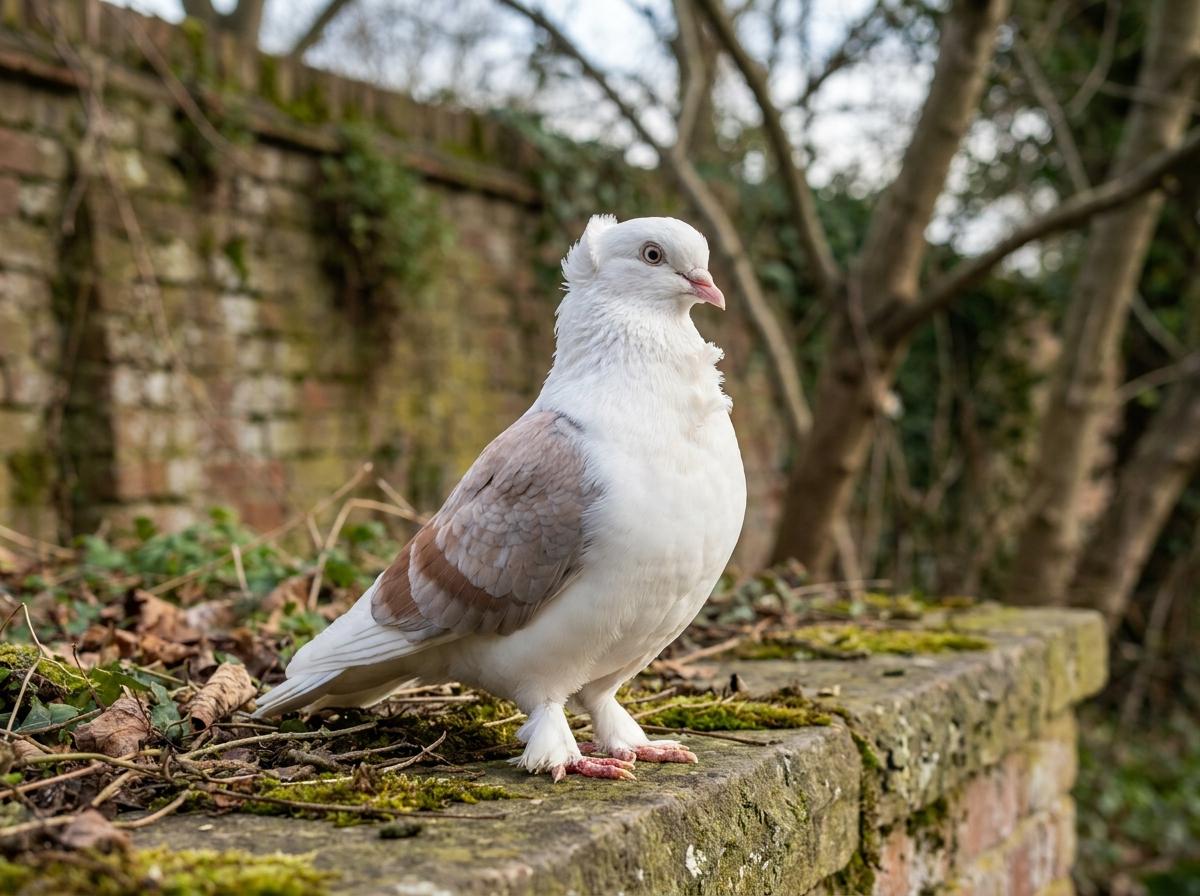
The Turbit is an old English show pigeon from the owl and frill group: a small, compact, upright bird with a short beak, a frill of reversed feathers down the breast, a narrow pointed crest at the back of the head, a white body carrying colored wing shields, and clean unfeathered legs. It has been an exhibition breed for centuries, not a racer, a homer, or a table bird. Two things trip people up, and this page settles both. The first is telling a Turbit from a Turbiteen and from the owl breeds it sits beside in the show pen. The second is the short beak, which is a genuine welfare question in short faced pigeons and deserves a straight answer rather than a compliment.
If you are working out where the Turbit fits among the other breeds, the Creatures pigeon species page is a good place to compare it against the owls, frills, and utility breeds. Below you will find what the breed is, how to identify it, where it came from, what the short beak actually means for a breeding loft, how to house and feed it, what it costs, and what to check before you buy one.

| Breed group | Owls and Frills in the United States, owl pigeons (Mövchentauben) in the German standard |
|---|---|
| Origin | England, developed over centuries; the modern bird carries Show Antwerp blood |
| Kept for | Exhibition and breed preservation, not racing, homing, or meat |
| Head | Narrow crest rising to a single point at the back of the crown |
| Beak | Short, and formally listed as a short beaked breed in the German standard |
| Breast | Frill, or jabot, of reversed feathers down the front of the neck and chest |
| Markings | White bird with colored wing shields; 18 shield colors recognized in Germany |
| Legs | Clean and bare below the hock, no muffs or stockings |
Browse listings, public profiles, breeders, or add your animal.
What a Turbit is
Take the four features one at a time, because all four have to be present before a bird is a Turbit rather than something adjacent.
- A short beak. Short enough that the standards treat it as a defining category, not a detail. The German breed register prints the Turbit with the note “Schnabel: kurz”, short beak, alongside its list of recognized colors (Bund Deutscher Rassegeflügelzüchter, Rassen- und Farbenschläge-Verzeichnis).
- A breast frill. The feathers along the front of the neck and chest grow outward instead of lying flat, so they part and stand away from the body. Fanciers call it a frill or a jabot. Darwin, who kept and dissected these birds, opened his account of the group with exactly this: “Feathers divergent along the front of the neck and breast; beak very short, vertically rather thick” (The Variation of Animals and Plants under Domestication, 1868).
- A peak crest. A narrow crest at the back of the crown that rises to a single point. The German standard sums the whole bird up as “kurze, etwas gedrungene, ziemlich kräftige Form, aufgerichtete, kokette Haltung; spitzkappig”: short, somewhat compact, fairly powerful in build, with an upright jaunty carriage, and peak crested (BDRG breed sheets).
- Shield markings. The bird is white except for the wing shields, which carry the color. Every one of the 18 shield colors the German standard recognizes works this way, running from solid black, dun, brown, khaki, red, and yellow through barred and chequered blue and its related shades.
Add clean legs and a dark bull eye and you have the breed. It is a small pigeon: German standards ring it at 8 mm, at the smaller end of the pigeon ring range (BDRG ring size register). In the United States the National Pigeon Association files it in the Owls and Frills class (NPA breed groups).
Turbit, Turbiteen, or owl?
This is where most of the confusion lives, and it is worth being precise, because the three names get used interchangeably online and they are not interchangeable.

The Turbiteen is a different breed with a different history. The German standard traces it to the Orient, with the exact origin unknown, and records that it reached Europe from Turkey in the second half of the nineteenth century. Its written summary calls for a bird that is short, broad, upright, and graceful, “bestrümpft”, meaning stockinged, with the so called three point head marking and a colored wing shield (BDRG breed sheets). The American classification separates them just as firmly: the NPA lists the Syrian Turbiteen in its Syrian class, while the Turbit sits in Owls and Frills (NPA breed groups).
So the two reliable separators are the legs and the head:
- Legs. A Turbiteen is stockinged, with feathering below the hock. A Turbit is clean legged, bare red skin and nothing else.
- Head markings. A Turbiteen carries color on the head, a forehead snip and cheek patches. A Turbit’s head is white.
Notice which feature is not on that list. The crest will not separate them, because the German standard recognizes peak crested Turbiteens as well as plain headed ones, and prints a full parallel set of colors “mit Spitzkappe” for the breed. If you are trying to identify a bird from a photograph, look at the feet and the face first.
The owls are the Turbit’s nearest relatives, and the crest is what divides them. Darwin grouped them together as a single race and then drew the line himself: “Turbits and Owls differ from each other slightly in the shape of the head, in the former having a crest, and in the curvature of the beak, but they may be here conveniently grouped together” (Variation, 1868). That still holds. The English Owl is a plain headed bird, described in the German standard as very powerful, short and broad, with the body tapering to the rear, and traced to an old English line already written about by Willughby in 1678 and Moore in 1735. The African Owl belongs to the self colored owls, which the German register lists under the name “Einfarbige Mövchen”, literally single colored owls, so it does not carry the Turbit’s white body and colored shields at all.
Two more names worth keeping straight. The Old Dutch Turbit is its own NPA breed in the same class, not a regional spelling of this one. And the Oriental Frill, along with its Satinette and Blondinette forms, is a separate frilled group with its own marking system; a Turbit is not an Oriental Frill with a plain tail.
Where the Turbit came from
The German standard puts the breed’s development in England, and describes it as bred there centuries ago, probably from Anatolian owls, noting that Turbits with colored tails once existed as evidence of that ancestry. It also names the cross used to make the modern bird: Show Antwerps were used in breeding up today’s Turbit (BDRG breed sheets).
The paper trail in English is long. Darwin, working through the older pigeon literature in 1868, wrote that “the Turbit, with its characteristic frill and bearing its present name, is described by Willughby in 1677; and the bill is said to be like that of the bullfinch” (Variation, 1868). He also thought the frill was a later addition to the breed rather than an original feature, observing that in the pigeons illustrated before 1600 you would have seen “the Turbit apparently without its frill.” The bullfinch comparison is a good one to hold on to, because it tells you the short beak was already the breed’s signature more than three hundred years ago.
Darwin went further and measured it. Comparing his birds against the wild rock pigeon, and correcting for body size, he recorded that “the beak of the Turbit is very short, being .28 of an inch shorter than that of the rock-pigeon.” He also noticed that a Turbit briefly puffs the upper part of its throat while displaying, which sets the frill moving, and described it as a far milder version of what a Pouter does.
The breed was popular enough in Victorian Britain to earn a book of its own, W. F. Lumley’s The Turbit Pigeon. It is a quieter breed now, which is the usual arc for a nineteenth century show pigeon, and one reason the specialist clubs matter.
The short beak, told straight
The Turbit’s beak is not an incidental charm. It is a selected trait with documented consequences, and the honest version is more interesting than the flattering one.

Start with where the breed sits officially. The German expert group on animal welfare and pet breeding, in its assessment of section 11b of the German Animal Welfare Act (the provision on breeding that causes suffering), lists the breeds it classes as short beaked. Among the owl pigeons it names the Turbit (“Turbitmövchen”) and the Turbiteen (“Turbiteenmövchen”) in the same short beaked category as the English Short-faced Tumbler and the Berlin Short-faced Tumbler (Gutachten zur Auslegung von § 11b des Tierschutzgesetzes, hosted by the German Federal Chamber of Veterinary Surgeons). That is worth sitting with. On paper this is not a mildly shortened beak in a breed that happens to look neat; it is the same classification as the most extreme short faced pigeons in the fancy.
The same document sets out what the classification is about. In pigeon breeding, it states, beak shortening pursued as a breeding goal has produced parent birds that can no longer rear their own young. In chicks of short beaked breeds, it reports hatching problems: because of the extreme shortening of the beak, or a malformed or missing egg tooth, the chick cannot break the shell, and such young die in the egg unless the breeder intervenes. It adds that selection for especially short beaks appears to encourage beak deformities. Its recommendation is not that anyone stop keeping these breeds, but that breeders select for beak shapes that support every beak function an adult and its young need for feeding themselves and reproducing.
The genetics point the same way. A University of Utah team mapped beak length in domestic pigeons by crossing a Racing Homer, whose beak is close to the ancestral rock pigeon’s, with an Old German Owl, a short beaked fancy breed in the same owl group as the Turbit, and identified a coding variant in the ROR2 gene associated with short beaks across many breeds (Boer and colleagues, Current Biology, 2021). The university’s own account of the work opens on the practical end of the trait, describing beaks “so short that they sometimes prevent parents from feeding their own young” (University of Utah School of Biological Sciences).
What this means in a real loft is less dramatic and more specific than either the horror version or the sales version. Individual birds vary a great deal inside a short beaked breed, and plenty of Turbit pairs hatch, feed, and wean their own squabs without anyone lifting a finger. Others do not. Fostering under a longer beaked pair, which fanciers call putting eggs under feeders or pumpers, is a normal tool in the short faced part of the hobby, and a keeper who uses it is not doing anything shameful. What matters is which way the selection points. Using feeders to rescue a round of youngsters is husbandry. Using feeders every round, for years, so that a line which cannot rear keeps reproducing, is how the problem gets built into the breed. If you are buying or breeding Turbits, the single most useful question you can ask is which of a breeder’s pairs raise their own young, and the single most useful record you can keep is the answer.
Any bird that is struggling to eat, has a beak that will not close properly, or is losing condition needs a veterinarian who sees birds, not a forum thread.
Housing, feed, and water
Nothing about the loft is exotic. The National Pigeon Association’s own housing guidance sets the bar plainly: a house that is free from drafts in winter, that can be kept clean and dry in wet weather, with enough room for the number of birds you keep, good ventilation, access to sunshine, and clean water and food (NPA housing notes). Scale is up to you; the breed is small and does not need a cathedral, but it does need room to move, perch, and get away from a pushy loft mate.

Feeding is where new keepers most often go wrong. The NPA’s care guidance calls for a whole grain or pellet mix of at least 13 percent protein as a maintenance diet, rising to 18 to 20 percent through breeding and molting, when growing squabs and new feathers both draw on it. It warns specifically that mixes sold for doves are usually too low in protein for pigeons to do well on. Birds also need a pigeon grit that includes oyster shell, salt, and minerals rather than plain stone grit (NPA care notes).
Water has one quirk worth knowing. Pigeons suck their water up rather than tipping it back, so a drinker has to hold at least about 1.5 inches, roughly 3.5 cm, of standing water for a bird to drink properly, and the NPA recommends scrubbing drinkers out at least weekly. Offer bathing water as well, in a separate wide shallow dish rather than the drinker. Turbits are mostly white, so a bird that cannot bathe looks tired long before it is unwell.
On health, the disease every pigeon keeper plans around is canker, caused by the protozoan Trichomonas gallinae. The Merck Veterinary Manual notes that pigeons and doves pass the infection to their offspring in contaminated crop milk, that feeders, baths, and waterers are major sources of infection, and that control rests on sanitation, frequent cleaning of feeders and waterers, and separating chronically infected birds from breeding birds (Merck Veterinary Manual, trichomonosis in birds). The NPA names canker, pigeon paramyxovirus (PMV-1), for which a vaccine exists, and coccidiosis as the three things to have a plan for. Build that plan with an avian veterinarian before you need it, and treat medication choices as veterinary decisions rather than loft folklore.
Keeping the loft record straight is the part people skip and then regret. You can add a Turbit’s profile on Creatures in a few minutes and log treatments, weights, and pairings against it, which turns “I think that hen had canker last spring” into something you can actually check.
Breeding, and what changes with a short beaked breed
The mechanics of pigeon breeding are the same for a Turbit as for any other pigeon, and they are worth knowing before you pair anything up. The NPA’s care guidance lays out the ordinary timetable: pigeons become sexually mature at five to seven months, though many keepers wait until a year; the hen lays two eggs, the second about 44 hours after the first; both parents incubate, the hen through the night and the cock through the middle of the day; hatching follows about 18 days after the second egg. Both parents produce crop milk for the first days, start adding grain at five to ten days, and are feeding straight grain by around fifteen days. Youngsters are rung between five and twelve days, wean at about 35 days, and the parents will often be back on eggs by day 21, so a second nest bowl needs to be there before you need it.
Three things change in a short beaked breed:
- Hatching deserves watching. The German welfare assessment records that short beaked chicks may be unable to break the shell and die in the egg without intervention. That does not mean helping every egg, which does more harm than good. It means knowing your pairs’ timing, checking pipped eggs, and asking a keeper with experience of the breed before you decide to assist.
- The first days of feeding are the test. A pair that fills its squabs on day two is telling you something useful about the line. A pair whose squabs are flat and empty needs a decision quickly, which is where an already sitting feeder pair earns its keep.
- The record is the selection tool. Which pair reared, which pair needed a feeder, which chick failed to hatch, which bird had a beak that would not meet. Written down over three or four seasons this is what lets a breeder move a line in the direction the welfare assessment recommends, instead of drifting the other way. Add a record is the fastest way to log a hatch, a treatment, or a fostering event as it happens; the record sheet opens for any visitor to look around, and a free account saves what you enter.
Cost, availability, and what to check when buying
There is no published market price for a Turbit and it would be dishonest to invent one. Birds move breeder to breeder, mostly as young stock after the show season, and what is asked tracks show quality, pedigree, and the seller’s reputation rather than any list price. For most people the birds are the cheap part; the loft, the flight, the feed bins, and the grit and medication shelf cost more than the pigeons in them.
Availability is the real constraint, and it is worth calibrating expectations. The owl and frill breeds are minority breeds now, kept going by small numbers of committed breeders. The German association’s 2025 breeding stock survey lists several of them with no returns at all, including the English Owl and the peak crested Turbiteen (BDRG Zuchttierbestandserfassung 2025). Treat a returns based survey as an indicator rather than a census, but the direction is clear: plan on a wait, a drive, and a conversation, not a next day purchase.
When you do find birds, check the animal rather than the photograph:
- Beak. It should meet and close cleanly along its length. A crossed or gaping beak is a defect, not a style.
- Nostrils and eye. Clear, clean, dry. No crusting, no discharge.
- Weight and behavior. Pick the bird up. It should feel firm over the keel and be alert and annoyed about being held.
- Breed points. Frill standing out from the breast, crest rising to a single point at the back, white head with no color on it, colored shields with a clean boundary, bare legs.
- Rearing history. Ask straight out how many rounds that pair reared themselves last season. A breeder who keeps the answer is the breeder you want.
You can watch for birds on the Creatures marketplace and look for lofts in the Creatures directory. Because supply is thin, a saved listing alert is usually more effective than checking back by hand. Another Creatures breed page covers an uncommon breed with a similarly small breeder pool, if that is the corner of the hobby you like: the Dong Tao chicken.
Frequently asked questions
What is a Turbit pigeon?
An English exhibition breed in the owl and frill group. It is small and upright, with a short beak, a frill of reversed feathers down the breast, a narrow crest rising to a point at the back of the head, clean unfeathered legs, and a white body carrying colored wing shields.
What is the difference between a Turbit and a Turbiteen?
Legs and head. A Turbiteen is stockinged, with feathering below the hock, and carries color on the head as a forehead snip and cheek patches. A Turbit is clean legged with a plain white head. They also come from different places: the Turbit was developed in England, while the German standard traces the Turbiteen to the Orient, reaching Europe from Turkey in the later nineteenth century. The crest is not a reliable separator, because peak crested Turbiteens are recognized too.
How is a Turbit different from an owl pigeon?
Chiefly the crest. Darwin put Turbits and owls in one group and separated them on the head, the Turbit having a crest and the owl not, plus a difference in the curve of the beak. In practice the marking helps as well: a Turbit is a white bird with colored shields, while the self colored owls carry one color over the whole bird.
Can Turbits feed their own squabs?
Many pairs can, and do. But the Turbit is formally classed as a short beaked breed, and the German welfare assessment of short beaked pigeons records both hatching failures in chicks and, at the extreme of the trait, parent birds that can no longer rear their own young. Fostering under longer beaked feeder pairs is a normal tool in the short faced fancy. Ask any seller which of their pairs rear unassisted, and select in that direction yourself.
Are Turbits a good beginner pigeon?
As birds to keep, yes. They are small, they ask for nothing unusual in feed or housing, and a sound dry loft suits them. As birds to breed, they are a step up, because a short beaked breed puts more weight on hatching, early feeding, and having a feeder pair available. A sensible first season is to keep a few and go to a show before you pair anything.
Do Turbits fly, or are they purely ornamental?
They are ordinary flying pigeons that happen to be bred for the show pen rather than for racing or homing. They are not a racing or homing breed and should not be expected to perform like one, but they need perches, headroom, and a flight or aviary the same as any other loft bird.
Do this next on Creatures
Whether you are identifying a bird, hunting for stock, or already running a loft, Creatures is the records, marketplace, and directory layer to do it in one place.
Add your birds. Keeping Turbits already? Create a free animal profile for each bird and keep ring numbers, pairings, and photographs together. No account needed to start, and the walkthrough is in adding an animal to Creatures.
Log hatches, treatments, and fostering. Add a record for a hatch, a canker treatment, a weight, or a round reared under feeders. The record sheet opens for any visitor to look around, and a free account saves what you enter. See adding a record and health and medical records for the full how to.
Get told when one is for sale. Turbits are thin on the ground, so set a free Turbit listing alert instead of refreshing by hand. No account needed to start. Saving searches and using your watchlist covers how alerts and the watchlist work together.
Look for birds now. Browse Turbit listings on the marketplace and search trusted lofts and breeders in the Creatures directory.
List your loft. Breeding Turbits and want buyers to find you? Create a loft or breeder profile, no account needed to start, then read getting listed in the breeder directory and creating an organization and adding your team if more than one person runs the loft.
Compare the neighbors. Read up on the English Owl, the African Owl, and the Oriental Frill before you commit to a breed, or start from the pigeon species page.