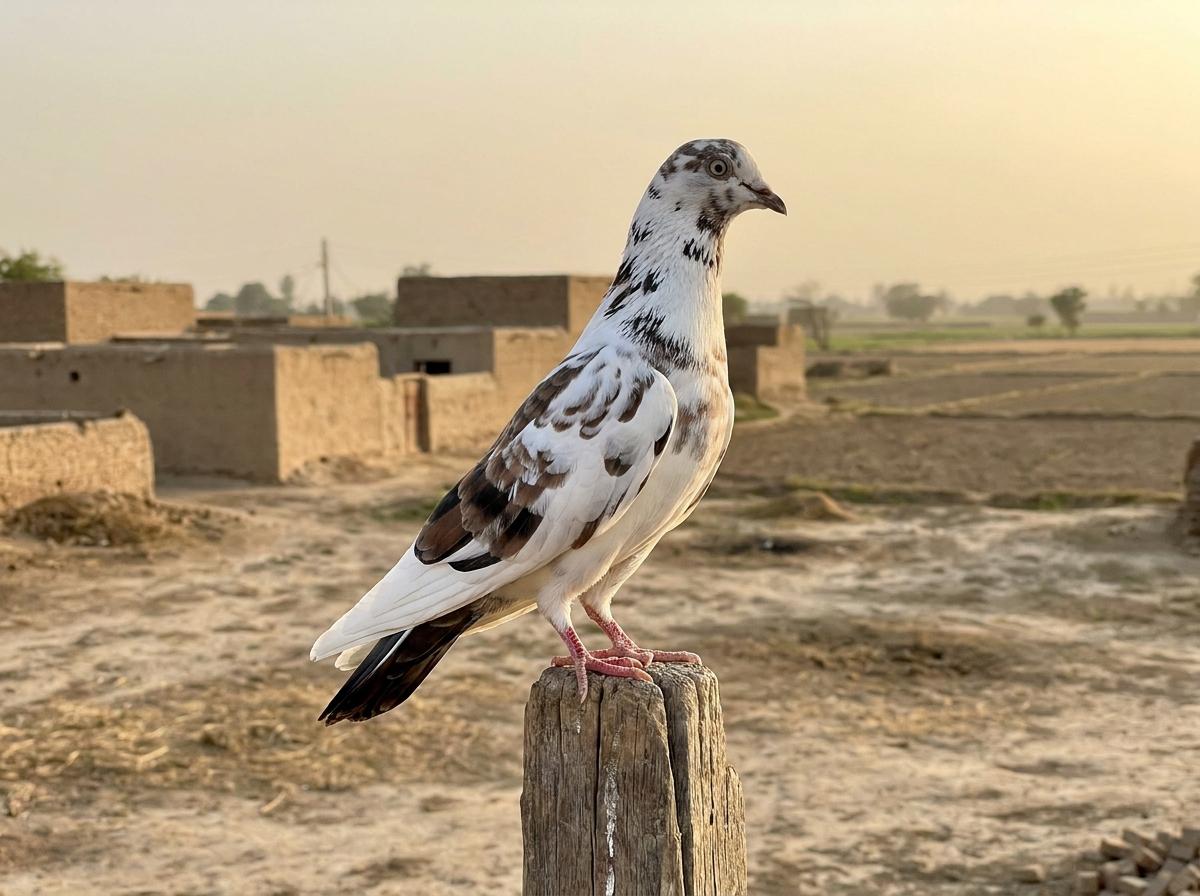
Runt
Author: Elliott Garber, DVM · Published
The Runt is the heavyweight of the domestic pigeon world. In the United States the breed is shown as the Giant Runt, under a National Pigeon Association (NPA) standard that sets no upper weight at all: it asks for the largest, heaviest birds possible, as long as correct type comes first. The weight figures we could find are guides rather than show rules. A 1920 USDA bulletin put a mature Runt cock at 2.5 to 3 pounds and a hen at 2 to 2.5 pounds, and the NPA’s own care notes say Runts can weigh in at 3.5 pounds. Either way, a good Runt is roughly three to four times the weight of an average rock pigeon.
Runts are exhibition birds today, with a past in American squab lofts. They are heavy and much less active than smaller breeds, and that shapes everything from the size of the nest box to the way you pick one up. Creatures has no Runt listings at the moment, so if you are looking for birds, set a free Runt listing alert (no account needed to start) and we will email you when one is posted. For the wider family of breeds, start at the pigeon species page.

| Also called | Giant Runt, American Giant Runt; older European types were known as Spanish and Roman Runts |
|---|---|
| Standard | National Pigeon Association, Form Pigeons group (Giant Runt) |
| Weight | No standard weight; bigger is better once type is right. USDA (1920): cocks 2.5 to 3 lb, hens 2 to 2.5 lb |
| Size check | About three to four times an average rock pigeon (roughly 360 g) |
| Type | Long, broad, wedge-shaped body, very deep straight keel, massive oval head, wings folded over the rump |
| Colors | Blue bar, silver, white, red, yellow, dun, black, grizzles, ash reds, checks, plus rare colors |
| Use | Exhibition today; once a squab breed, but less prolific than Kings or Carneaux |
| Breed clubs | Giant Runt Club of America and New England Giant Runt Club (NPA affiliates) |
Browse listings, public profiles, breeders, or add your animal.
What is a Runt pigeon?
“Runt” is an old name for a whole group of big pigeons, and only later the name of one breed. When Charles Darwin surveyed the domestic pigeon in his 1868 book The Variation of Animals and Plants under Domestication, he listed Runts as a race of their own, defined by a long, massive beak and a body of great size, inside a larger group they shared with the Carriers and Barbs. He also admitted the group was a mess. Runts varied wildly in wing, tail, leg and neck length, graded into the wattled Carriers at one end, and went by different names in different parts of Europe. Darwin separated at least five kinds, including the Scanderoon, the Spanish and Roman Runts, and an Italian giant known to him only from old descriptions.
In the United States today, “Runt” in practice means one standardized breed: the Giant Runt, sometimes called the American Giant Runt. The National Pigeon Association lists it in its Form Pigeons group, alongside the French Mondain, the Modena and the Show King.
The Runt is often confused with the other big utility pigeons, but they are separate breeds and noticeably smaller. In the 1920 USDA figures, a Runt cock was expected to weigh nearly twice as much as a White King cock (22 to 26 ounces) or a Carneau cock (20 to 24 ounces). If a bird is sold to you as a giant, the King pigeon guide and the French Mondain guide will help you tell those breeds apart from a true Runt.
How big is a Giant Runt?
Size is the question most people arrive with, and the honest answer has two parts: what the show standard asks for, and what the scales have actually recorded.

What the standard asks for. The NPA’s Giant Runt standard, published free in its Book of Standards, contains no weight figure. It asks for birds as large and heavy as possible, but it is firm that type makes the breed and comes before size. A perfectly typed bird that is too small for a Giant Runt can be marked down or even disqualified, and so can a very large bird of poor or sloppy type. The weight is meant to come from body and breast flesh, not fat, and a compact, well-fleshed, heavy-boned bird should beat a bigger, rawboned one. There is even a note for judges: if a well-made bird feels light, the judge may ask whether it has been shipped a long way and allow for the trip.
What the scales have recorded. These are the figures we could find in primary sources:
- 1860s England. Darwin reported a Runt exhibited by Mr. Gulliver at 1 lb 14 oz (about 850 g), and two Runts from the south of France shown at the Crystal Palace at 2 lb 2.5 oz each (about 980 g). A very fine rock pigeon from the Shetland Islands weighed only 14.5 oz (about 410 g). He added that a Runt had been known to weigh more than five times as much as a short-faced tumbler.
- 1920 United States. USDA Farmers’ Bulletin 684, Squab Raising, says the mature Runt cock should weigh 2.5 to 3 lb (about 1.1 to 1.4 kg) and the hen 2 to 2.5 lb (about 0.9 to 1.1 kg).
- Today. The NPA’s pigeon care page says Runts can weigh in at 3.5 lb, which is about 1.6 kg.
For scale, the University of Michigan’s Animal Diversity Web gives the average rock pigeon, the wild ancestor of every domestic breed, at 358.7 g (about 12.6 oz). A 3 lb Runt cock is close to four times that.
How to read those numbers. They come from different birds, different eras and no common weighing method, so treat them as a range rather than a target. They do suggest the breed has grown heavier as fanciers selected for size. Hens run smaller: the standard is written for the mature cock and tells judges to expect hens and young birds to show less power and more curves. If a seller’s main pitch is a weight figure, ask to see the bird stand and walk. A big bird with dragging wings or a crooked keel is not a good Runt, whatever it weighs.
Where the Runt came from
The giant pigeons of Europe are old. Darwin pointed to a coarse woodcut in Ulisse Aldrovandi’s ornithology, published in 1600, showing a great Italian pigeon with an elevated tail, short legs, a massive body and a short, thick beak, and to John Moore’s 1735 account of a “Leghorn Runt” with a beak very short for so large a bird. By Darwin’s time both of those forms seemed to be extinct in Europe.
Among the Runts Darwin saw in England were the Spanish and Roman types. He described them as heavy, massive birds with shorter necks, legs and beaks than the other Runts, bad flyers that were apt to tremble like Fantails. Of the two kinds seen in England, one was apparently the bird French writers called the Pigeon Romain ordinaire. He also argued that Runts and Carriers did not descend separately from the rock pigeon but from a shared parent stock that already had a moderately long beak and some bare, wattled skin around the eyes, which is why the two groups shade into each other. Our English Carrier guide covers the wattle side of that family.
In the early twentieth century the Runt found a job in American squab production. The 1920 USDA bulletin called it the largest well-known variety of pigeon kept for squab, but also much less active than the smaller breeds, usually less prolific and not so good a feeder of its young, although it noted that some Runts were very good producers. Runts were sometimes crossed onto smaller pigeons to enlarge the squabs, though the bulletin advised that keeping a pure breed gave better results over time. White Runts were the most popular color, followed by Blues, and although Runts were kept quite extensively, they were used for squab breeding far less than Homers, Carneaux and White Kings.
On the show bench, the NPA’s Giant Runt standard defines the modern type. A footnote in the current NPA standard records that the breed’s original colors were the wild-type blue and its dilute, silver, and that about 80 years ago pearl eyes were standard in all colors, with the American standard calling for dark “bull” eyes in whites.
Do not confuse the Giant Runt with the American Giant Rumbler, a separate breed in the NPA’s Form group. Its standard says it was created in the United States by H. Eric Buri and Wesley L. Conover in the 1950s and 1960s, recognized by the Canadian Pigeon Fanciers Association on June 3, 1984, and by the NPA on January 19, 1985.
The Giant Runt standard, point by point
The current NPA standard for the Giant Runt (a 2022 revision, published in the April 2025 edition of the Book of Standards) is written around an ideal drawing of a mature cock. In summary:
- Head. Large, massive and broad, showing strength and boldness. The top of the skull is oval, neither flat nor round, with a well-developed back skull that makes the head long.
- Beak. Broad, strong and fairly thick, medium to short, neither down-faced nor too straight. Black in blues and blacks, flesh colored in other colors.
- Wattle and eye cere. The wattle is small, oval and fine in texture. The cere is neat, not coarse: damson or plum in blues, red in other colors.
- Eyes. Bright and clear. Dark “bull” eyes in whites, pearl in other colors, with the color descriptions allowing golden-red or orange irises in some colors.
- Neck. Medium length, broad and full toward the breast, with no loose skin at the throat. Neck creases are desirable, but smooth necks are equally acceptable.
- Wings. Moderate length, folded close and wrapping over the rump like a flying pigeon’s, with strong wing butts. Sails or an open back are marked down, low wings are a fault, and dragging wings can be disqualified.
- Back and tail. The back is long and very broad at the shoulders, straight from the side and wedge-shaped from above. The tail follows the line of the back and is carried clear of the floor.
- Breast and keel. A very full, chesty breast over a very deep, long, straight keel. A crooked keel costs points, and a badly deformed one disqualifies.
- Body. Long, deep and extra full, tapering to the tail, with a tight belly and no looseness in the side view.
- Legs and feet. Medium-length shanks, thick in bone, with feathers coming part way down the leg. Legs are set well apart, with no bow legs or knock knees. Feet and toes are free of feathers.
- Feathering. Close enough to give a trim look; the size must come from the body, not from long feathers.
The NPA judges by deduction. The maximum cut is 20 points each for type and for body, breast and size; 15 each for head and wings; and 10 each for neck, the back, shoulders, rump and tail section, legs and feet, and color. A cut beyond any section’s maximum disqualifies. Birds are also disqualified if seriously impaired or diseased, badly crippled, too small, lacking Runt type, badly deformed or far out of condition.
Giant Runt colors
The standard recognizes a long color list, and it gives 10 points for color and markings in every standard color except white and mismarks, which carry no color cut.

- Blue bar. Deep, even blue, a darker neck with green sheen, a white rump, two black wing bars and a black tail bar.
- Silver. Silvery blue toward fawn, with darker bars and a lustrous neck.
- White. Pure white with dark eyes, a beet-red cere and pinkish-white beak and toenails.
- Red, yellow and dun. Rich, even colors; reds show green to beryl sheen on the neck, and yellows a golden sheen.
- Black. Deep raven black with a beetle-green sheen, golden-red eyes and a black beak.
- Grizzle. Blue and silver birds evenly flecked with white, most noticeable on the head, neck and body.
- Ash red. Bar, spread (a solid dark chestnut red with a clear ash-gray tail) and an ash-gray spread with dark flecking.
- Check. Blue check and brown check, with the check pattern covering much of the wing.
- Rare colors. Khaki, andalusian, indigo, almond and lavender. Unless a show offers a class for them, rare colors go into the any other color class.
A colored bird with white flights is disqualified from its color class or moved into the mismarked class. In the squab lofts of 1920, White Runts were the most popular, and the same bulletin notes that white squabs made attractive market birds because their pale pinfeathers were less objectionable than dark ones.
What Runts are used for today
Exhibition. The Giant Runt is shown under the NPA standard in the Form Pigeons group, and that standard puts its heaviest weightings on type and on body, breast and size. Giant Runts also turn up in youth projects: the Pima County 4-H pigeon project handbook, published through University of Arizona Cooperative Extension, lists Giant Runts with Kings, French Mondains and Carneaux as utility breeds and notes that these birds are big for small exhibitors’ hands. If a young person will be showing one, practice holding the bird at home first.
Squab. The Runt’s size made it a squab bird once, but it was never the most productive one. The University of Kentucky’s guide to raising pigeons in small and backyard flocks names White King, Red Carneau, French Mondain and Giant Homer as the common meat breeds today, and adds that show strains bred bigger and blockier than the utility birds they came from have lost some of the careful feeding of young and rapid reproduction of the originals. Read alongside the USDA note that Runts are usually less prolific, the practical advice is simple: if squab output is the goal, a production line of Kings or Carneaux is the usual choice, and Runts are for people who want the giant itself.
Keeping Runts: housing for a heavy pigeon
Runts need what every pigeon needs, a dry, draft-free, well-ventilated loft with clean food and water, which the pigeon species page covers in full. What changes with a Runt is scale, handling and how the birds get along.
One pair per breeding pen. The 1920 USDA bulletin says Runts were often kept in individual pens for each breeding pair, because in large flocks they injured one another fighting and could strike powerful blows with their wings.
More room than the usual guide. The University of Kentucky guide gives the common recommendation of 27 cubic feet of loft space per pair, and points out that each nest adds two birds during the breeding season. That figure is written for ordinary pigeons. A bird three to four times the weight of an average rock pigeon needs more floor, wider perches and bigger nest boxes, so treat 27 cubic feet as a floor, not a target.
Bigger nests, set low. The USDA bulletin describes typical squab-loft nest boxes about 12 inches square, with some breeders preferring them 15 to 18 inches deep, and nest pans 8 to 10 inches across and 3 to 4 inches deep. Those are the bulletin’s general sizes for a squab loft, where most birds were Homers, Carneaux and White Kings, about half the Runt’s weight or less. The NPA notes that the disposable paper nest bowls sold in feed stores work for all but the largest pigeons, so plan on wider, sturdier nest pans for Runts. Keep nest boxes and perches low, with a broad landing board, so a heavy bird is stepping down rather than dropping from a height, and keep a dry litter floor under them.
Two nests for every pair. Pigeons often go to nest again while the first squabs are still being fed. The NPA says most pairs have gone back to nest by about 21 days and the young are weaned by about 35 days, so give each pair a second nest bowl, as squab keepers have done for a century.
Plan for an aviary, not free flight. Darwin called the Spanish and Roman Runts of his day bad flyers, and the USDA described the Runt as much less active than smaller breeds. Plan for a loft with an attached aviary or fly pen rather than a bird that is let out to fly and expected to come home.
Feed, grit and water. The NPA recommends a pigeon grain or pellet mix of at least 13 percent protein for maintenance, rising to about 18 to 20 percent in the breeding and molting seasons, plus a pigeon grit that includes oyster shell, salt and minerals. Pigeons suck up water rather than tipping it down, so the NPA asks for drinkers with at least 1.5 inches of standing water, scrubbed weekly. The Kentucky guide adds that pigeons do best on four or more grains, that freshly harvested grain should be avoided, and that you should feed only what the birds will finish. Watch body condition as well as size: the standard wants weight from flesh, not fat.
Baths and local rules. The Kentucky guide suggests a shallow bath pan, 2 to 3 inches deep, once or twice a week for about two hours, then taking it away so the birds do not drink dirty water. It also recommends checking town, city, county and state rules on keeping pigeons before you build.
Breeding Runts
Runts breed like any other pigeon, just on a bigger scale and often more slowly.

Pairing and laying. Pigeons mate in pairs and usually stay together, according to the USDA bulletin, which also notes that the larger breeds were mated at 8 to 9 months against 5 to 6 months for small ones. The NPA’s care page says the hen usually lays her first egg 10 to 14 days after mating and the second about 44 hours later. Both parents sit, and hatching comes about 18 days after the second egg.
Feeding the young. Both parents feed the squabs on pigeon milk from the crop, adding grain at about 5 to 10 days. The NPA advises fitting seamless bands between 5 and 12 days, depending on the breed and how fast the squabs grow, so ask your club what size and timing suit Giant Runts. In squab lofts the young are taken at about 26 to 30 days, just before they leave the nest; breeders keeping them on are weaning them at about 35 days.
When parents do not feed well. The USDA bulletin’s warning that Runts are usually less prolific and not such good feeders as smaller breeds still matters to breeders. It also gives the classic remedy: squabs from a pair that is not feeding them well can be moved to another pair raising only one, though they should not be moved more than necessary. Keep notes on which pairs rear well, because that is the trait you most want to breed from.
Records and pedigrees. Every pairing, band number and hatch date is worth writing down. On Creatures, each bird’s free profile can link its sire and dam, so the pedigree builds itself as you add birds, and its breeding and health records travel with it when you transfer the bird to a new owner. The pigeon name generator helps when a promising youngster needs a name.
Health checks for a heavy pigeon
The NPA singles out three problems every pigeon keeper should be ready for: canker (trichomoniasis), pigeon paramyxovirus (PMV-1) and coccidiosis, an intestinal parasite that is mostly a problem in damp lofts. A vaccine exists for PMV-1. Pigeon paramyxovirus is a pigeon-adapted strain of the Newcastle disease virus, and the Merck Veterinary Manual lists the typical signs in pigeons infected with virulent Newcastle disease virus as conjunctivitis, nasal inflammation, labored breathing, diarrhea and nervous signs such as tremors, loss of coordination and a twisted neck, and says mortality in pigeons is commonly around 40 percent. Merck adds that suspected virulent Newcastle disease should be reported to animal health authorities right away, so call a veterinarian at once if you see those signs.
A Runt’s size adds a few checks of its own, and they line up with the standard’s disqualifications: a straight, well-covered keel, sound legs that are not bowed or knock-kneed, and wings carried up rather than dragging. Plan vaccination, parasite control and any treatment with a veterinarian who sees pigeons, rather than dosing from a supply catalog.
Buying a Giant Runt
Decide what you want first. A bird bred for the show pen and a bird bred to fill a squab loft are different purchases. Tell the seller which one you are after.
Go to the breed’s people. The NPA’s list of affiliated clubs includes the Giant Runt Club of America and the New England Giant Runt Club, and pigeon shows are the easiest place to see good Giant Runts side by side and meet the people who breed them. The NPA lists its next Grand National for January 22 to 24, 2027, in Springfield, Missouri. Our guide to where to buy pigeons covers clubs, shows, leg bands and seller checks for every breed.
Judge the bird, not the scale. Using the standard as your checklist, look for:
- a long, broad, wedge-shaped body with a deep, straight keel you can feel;
- a massive oval head and a broad, fairly thick beak of medium to short length;
- wings folded up over the rump, with no gaps and no dragging;
- a tail carried clear of the floor;
- thick legs set well apart, feathered part way down the shank, with clean feet and toes;
- firm flesh rather than fat, bright eyes, clean nostrils and a clean vent.
Ask the right questions. Ask for each bird’s band number and its parents’ band numbers, its age, and whether a pair has already raised young together. The USDA bulletin’s advice from 1920 still holds: the age and sex of a pigeon are hard to judge by eye, so a buyer depends largely on the seller’s word. A proven pair from a breeder with a reputation to protect is worth more than an unproven pair of big birds. Ask too about PMV-1 vaccination and any recent illness in the loft, and keep new birds apart from your own until your veterinarian is happy with them.
What Giant Runts cost. We did not find any published price survey for the breed. As one real data point, in October 2026 a national mail-order poultry supplier listed utility-grade Giant Runts, unpedigreed and in the breeder’s choice of color, at $120 to $225 depending on whether you buy a single bird or a pair. Show-quality birds from a known line are priced by the individual breeder, and you should expect to pay more for type, color and a pedigree.
Creatures has no Runts listed today. The fastest way to hear when one appears is the listing alert above, and pigeon lofts are listed in the Creatures pigeon breeder directory. Some keepers list the breed as the American Giant Runt; it is the same NPA breed, so check that page too, and if you set an alert, set one for American Giant Runt as well.
Frequently asked questions
Is the Giant Runt the largest pigeon breed?
It is generally regarded as the largest domestic pigeon. The 1920 USDA bulletin captioned its photograph of a White Runt cock “the largest variety of pigeons,” and the NPA standard asks for birds as large and heavy as possible. We found no modern weighed comparison across all the giant breeds, so treat the title as the breed’s long-standing reputation rather than a measured record.
How much does a Giant Runt weigh?
There is no standard weight. The 1920 USDA guide was 2.5 to 3 lb for cocks and 2 to 2.5 lb for hens, and the NPA’s care notes say Runts can weigh in at 3.5 lb. That is roughly three to four times an average rock pigeon.
What is the difference between a Runt and a Giant Runt?
“Runt” is the old name for a group of large pigeons, including the Spanish and Roman Runts Darwin described in 1868. The Giant Runt is the standardized breed shown in the United States under the NPA standard.
Can Giant Runts fly?
They are heavy and much less active than smaller pigeons, and Darwin called the Runts of his day bad flyers. Plan on a loft with an aviary rather than free flight.
Are Giant Runts good for squab?
They were the largest squab breed of their day, but the USDA bulletin found them usually less prolific and poorer feeders than smaller breeds, and today’s common meat breeds are Kings, Carneaux, French Mondains and Giant Homers.
Why is the biggest pigeon called a Runt?
None of the sources we checked explains it. The name was already used for big pigeons in English pigeon books of the 1700s (Darwin cites John Moore’s 1735 description of a Leghorn Runt). Whatever the word means for a litter of piglets, in pigeons the Runt is the giant.
Do this next on Creatures
Whether you are hunting for Giant Runts, breeding them or keeping a pair for the show pen, Creatures keeps the records, listings and breeder directory in one place.
Get alerted. Runts are scarce online, so set a free Runt listing alert and we will email you when one is posted. No account needed to start. Because some sellers use the name American Giant Runt, watch that name too. See saving searches and using your watchlist for how alerts work.
Check the market and find breeders. No Runts are listed today, which is why the alert comes first; when one is, it appears on the Creatures marketplace. Some sellers file the same breed under American Giant Runt, so check that page too. Pigeon lofts are listed in the Creatures pigeon breeder directory.
List your loft. Breed Giant Runts? Create a free loft or breeder profile so buyers looking for good Runts can find you, no account needed to start. Read getting listed in the breeder directory and creating an organization and adding your team. The aviary name generator can help if your loft still needs a name.
Add your bird. Keeping Runts already? Create a free Runt profile with its band number, color, parents and photos, no account needed to start. The walkthrough is in adding an animal to Creatures.
Record pairings, hatches and health. Add a breeding, vaccination or health record. The record sheet opens for any visitor to look around, and a free account saves what you enter. See adding a record and reminders and upcoming care.
Build the pedigree and name the youngsters. Link each bird’s sire and dam on its profile and the Pedigree tab builds the family tree as you go; your animal’s profile page: the tabs and what each one does explains it. Find names for this year’s youngsters with the pigeon name generator.