



Nun
Author: Elliott Garber, DVM · Updated
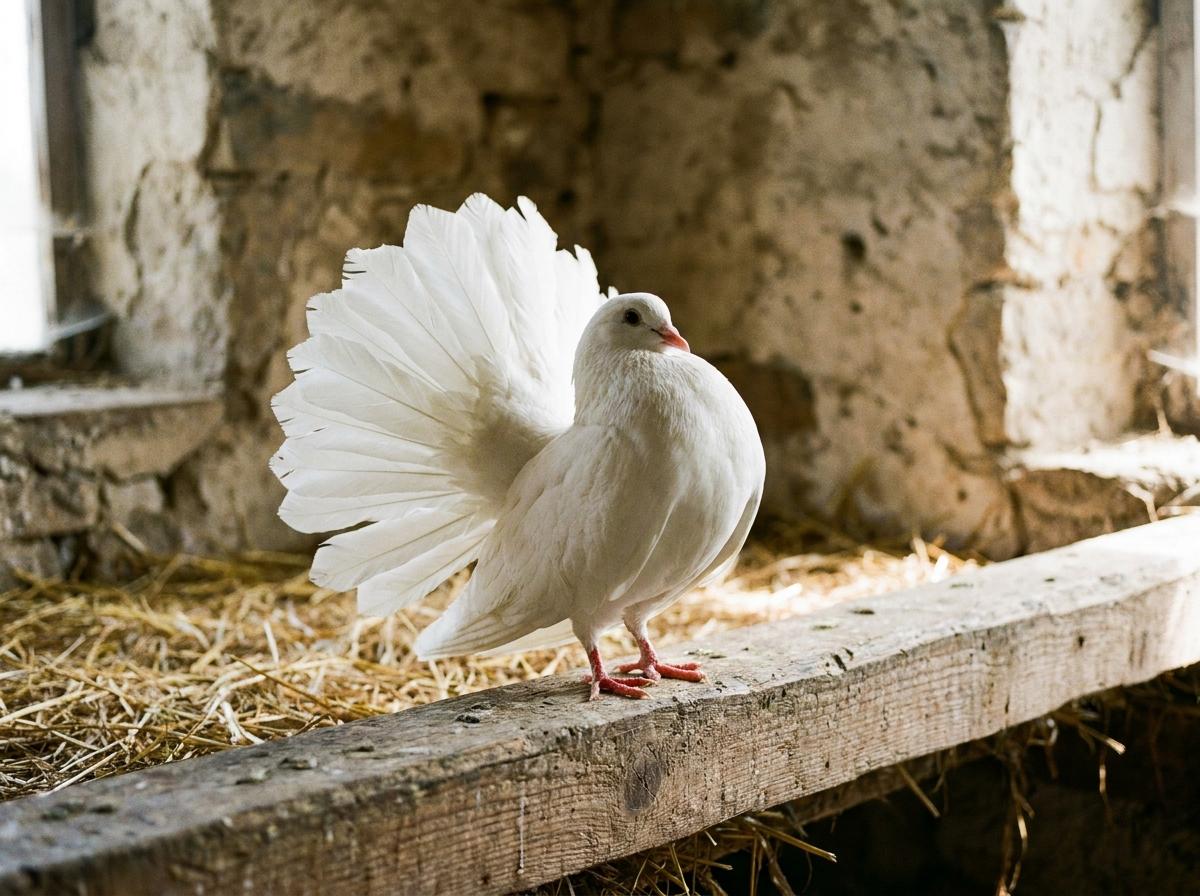
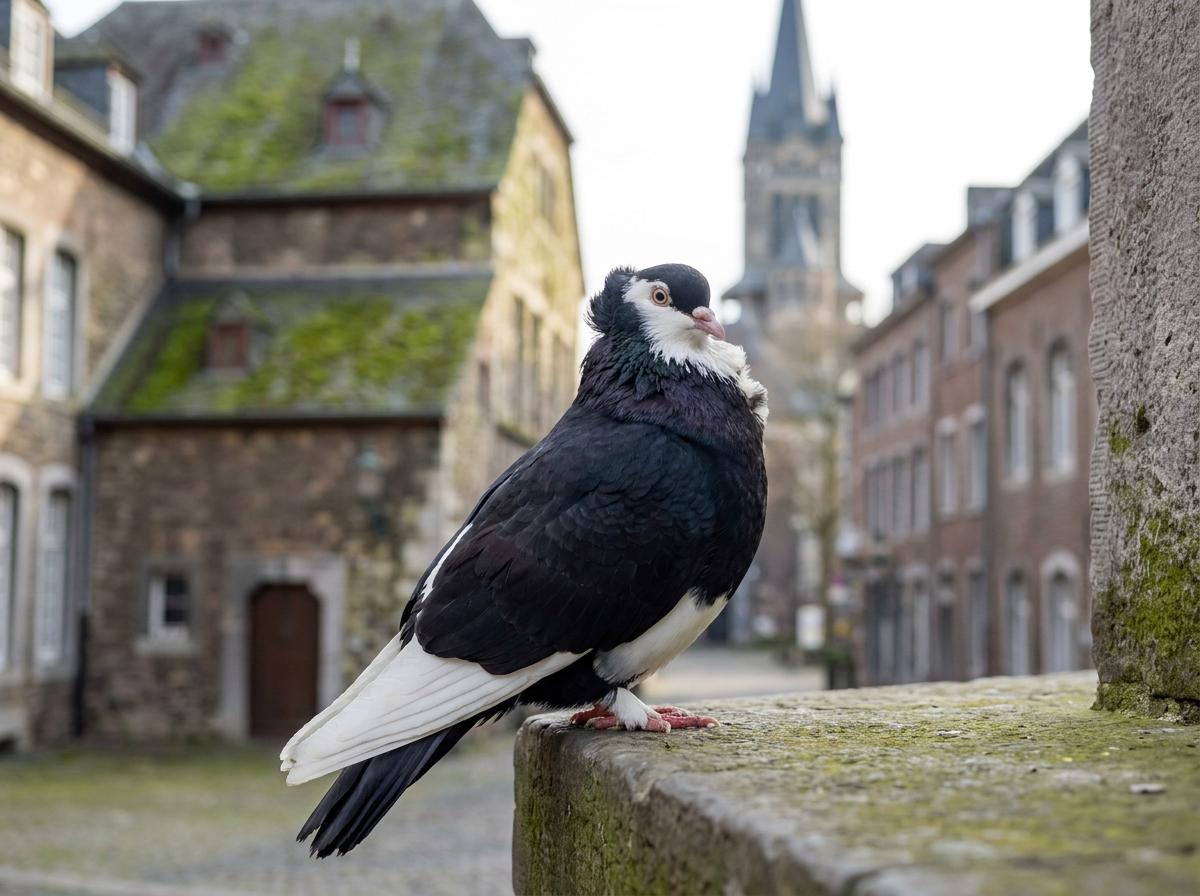
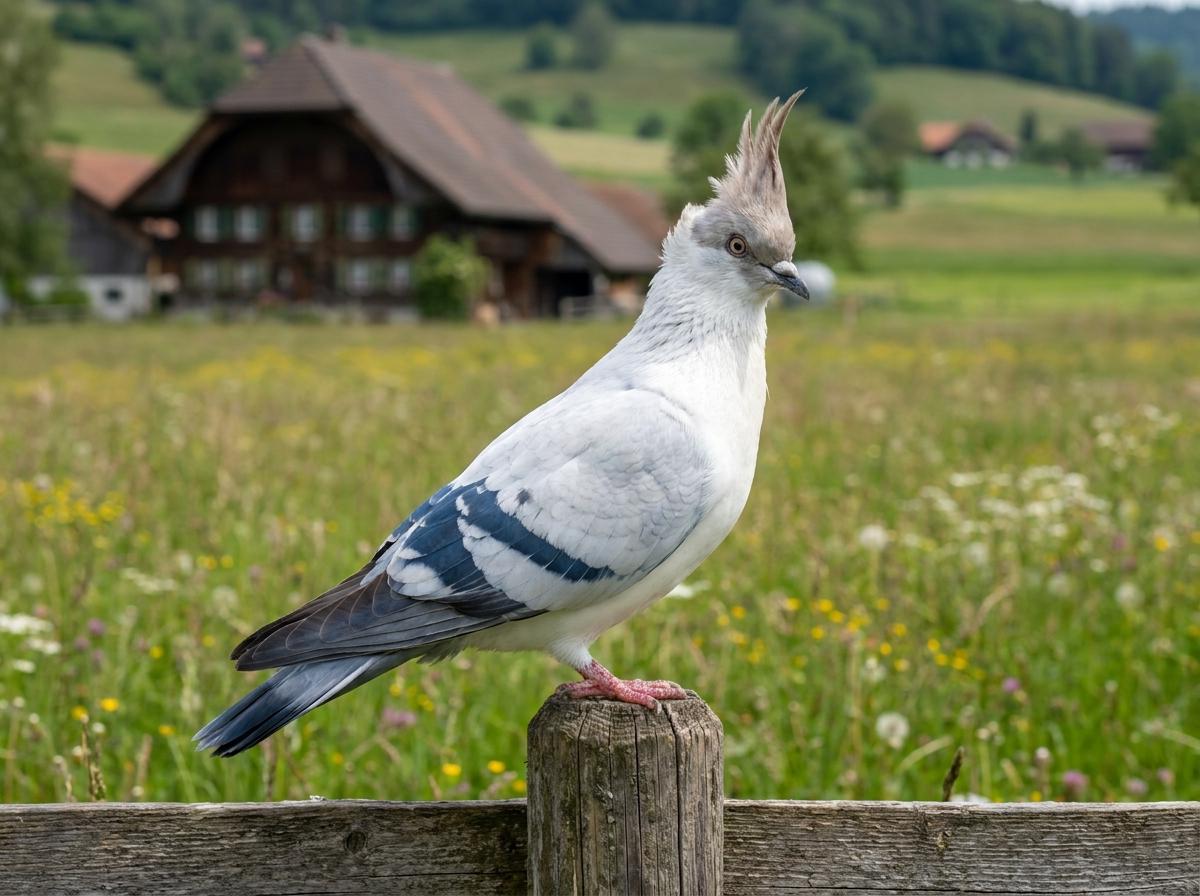
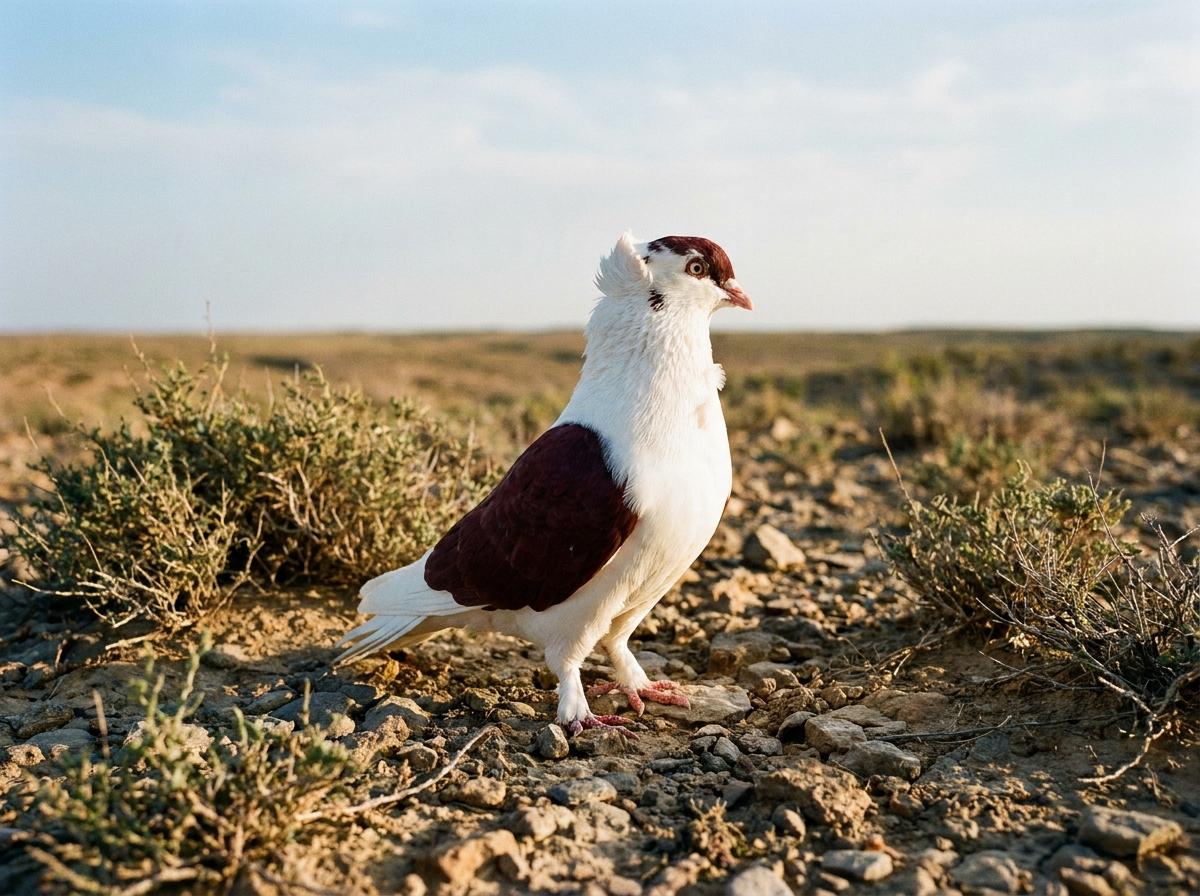
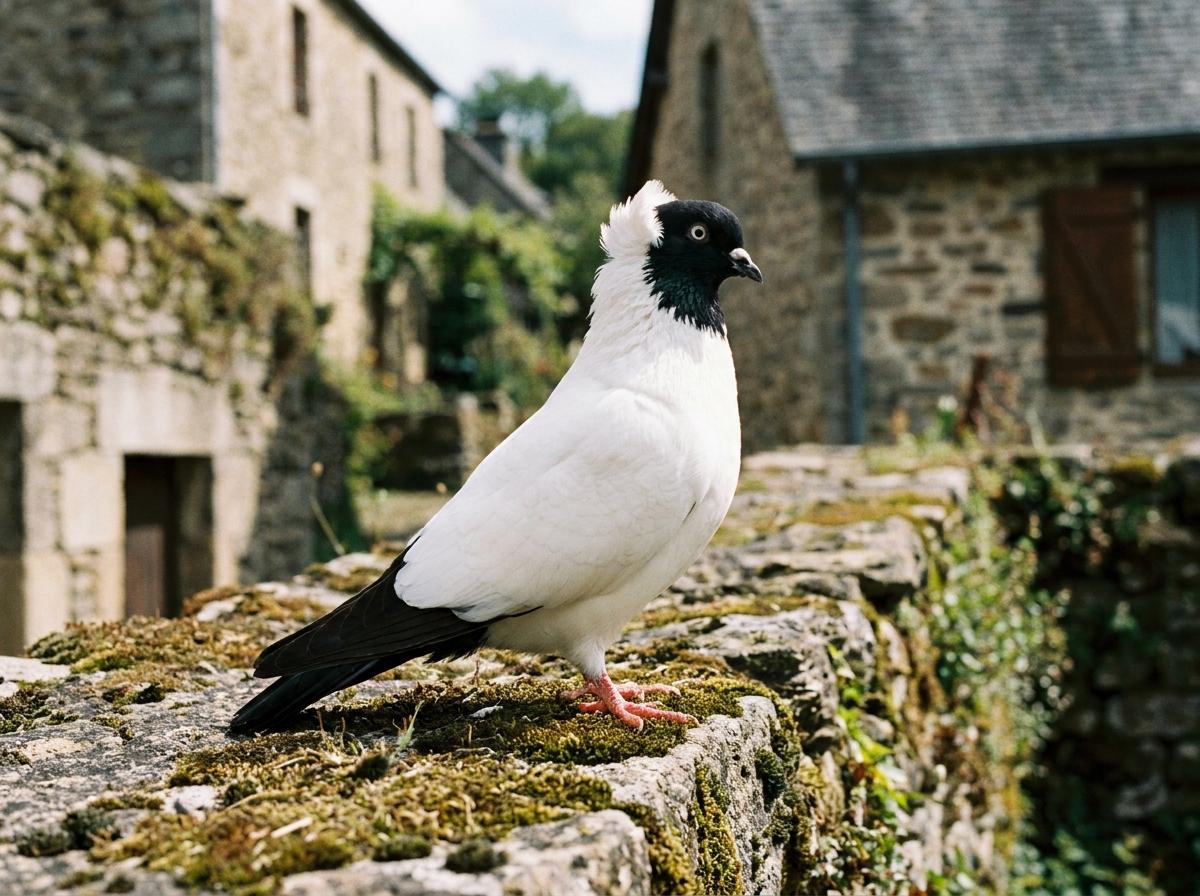
The Nun is a small domestic pigeon bred for one marking, and the marking is the whole point. A correct Nun is a pure white bird carrying color in exactly four places: a solid colored head, a matching bib running down the throat onto the chest, a colored tail, and ten colored primary flight feathers on each wing. Everything else stays white, including the crest. That crest is the second signature, a high fan of pure white feathers standing up across the back of the head like a hood, which is where the breed got its name. If you have seen this bird called the Dutch Shell pigeon, that is an older continental name for the same breed.
Two things trip people up. The first is the name: in English-speaking fancier circles “Nun” on its own almost always means the English Nun, while the German Nun (Deutsches Nonnchen) is a separate breed with its own standard. The second is the direction of the marking. The body is white and the head is colored, never the other way around, and a bird with a colored body and a white head is some other breed. Once those two are straight the rest of the Nun reads easily, and the Creatures pigeon species page shows how it sits beside other crested and color-marked breeds.

| Also called | English Nun; Dutch Shell pigeon, an older continental name |
|---|---|
| What it is | A breed of domestic pigeon (Columba livia domestica) kept for exhibition and as a pet |
| Marking | White body and wings; color on the head, bib, tail, and ten primary flights per wing |
| Crest | White shell crest, high and erect, curving across the back of the head |
| Show group | Tumblers, Rollers and High Flyers (US NPA); Tumblers and Highflyers (British Nun Club) |
| Size | Cock about 9.5 inches (242 mm) to the top of the head, measured without the crest |
| Colors | Black, brown, khaki, blue, silver, red, yellow, ash red and ash yellow, plus dun, barred, grizzle, indigo, andalusian and lavender in the British standard |
| Standards | US National Pigeon Association (1993); British Nun Club (1989, re-formatted to the EE model in 2012) |
Browse listings, public profiles, breeders, or add your animal.
What is a Nun pigeon?
The Nun is a breed of domestic pigeon, the same species as the feral pigeons on a city ledge and as every racing homer and fantail. It is not a wild bird, not a dove of a separate species, and not a hybrid. Centuries of selective breeding shaped it for a precise color pattern and a specific crest rather than for flying performance, meat, or message carrying.
Fanciers call the colored head the veil, and a bird is named for the color it wears: a black-headed bird is a black Nun, a yellow-headed bird a yellow Nun. There is no such thing as a “white Nun,” because a bird with no color has no marking to judge.
The breed name comes from the raised feathers behind the head. They stand up and curve around the back of the skull the way a hood sits on a habit, and the resemblance stuck. The same crest shape is called a shell crest, which is why continental fanciers of the last century knew the bird as the Dutch Shell pigeon, and why Darwin recorded the French name as pigeons coquilles, shell pigeons.
Is it a toy pigeon or a tumbler?
Honestly, both, depending which century you ask.
Darwin, writing in 1868 in The Variation of Animals and Plants Under Domestication, grouped the Nun with what fanciers of his day called the toy pigeons, birds that differ from the rock pigeon in little except color, listing it alongside Spots, Helmets, Swallows and Archangels. That still describes what the bird is for.
Modern show classification files it somewhere else. The US National Pigeon Association lists the Nun in its Tumblers, Rollers and High Flyers group, next to the German Nun and the Helmet, and the British Nun Club standard puts it in the same group, recording that Nuns were flying tumblers before they were developed for exhibition. So the Nun is ornamental by appearance and a tumbler by descent, and at a US show you will find its class among the tumblers rather than among the color pigeons. Modern show birds are not flown for performance, so do not buy one expecting aerial tumbling.
The marking, feather by feather
This is where a Nun is won or lost. The US National Pigeon Association standard and the British Nun Club standard describe the same pattern, and color appears in four places and nowhere else:
- The head. Solid color from the beak back over the forehead, crown and cheeks. The boundary where it meets the white must be clean and regular, not ragged or broken.
- The bib. The head color carries down the throat and finishes on the chest, level with the top of the wing butts. It joins the base of the crest but must not run up behind it, and must not wrap further around the neck than the front half. A bib visible from directly behind the bird is a fault, which the US NPA standard calls wrap around, or flagging, and the British standard lists as a bib extending round the back of the neck.
- The tail. Colored, narrow and short, held just clear of the ground and extending barely past the flights.
- The primary flights. Ten colored primaries on each wing, counted from the outermost feather inwards, lying tight against the body and resting on top of the tail.
Everything else is pure white: the neck below the bib, the breast, belly, back, both wing shields, and the shell crest itself. A stray colored feather in the white, or a white feather in the color, is what fanciers call a foul feather, and it is what a judge looks for first.
The flight count is scored on a sliding scale rather than pass or fail. In the NPA standard, ten colored primaries on each wing takes the full ten points for flights, nine on each wing takes eight, and the score steps down to a single point at seven and seven. Carrying fewer than seven and seven, or more than ten and ten, sits on the NPA’s list of faults rather than on its separate list of disqualifications, so it costs a bird points and placings rather than putting it out of the class. The British standard draws its hard lines further out, disqualifying only below seven and seven or above thirteen and thirteen and scoring everything in between on a table that falls away evenly on either side of ten and ten, so eleven and eleven is worth the same eight points as nine and nine. Colored secondary flights cost points too. That scale is why breeders talk about birds in numbers like “nine by ten,” and why a beautifully headed bird can lose to a plainer one that flights correctly.

The shell crest
Behind the head sits the breed’s other defining feature. The standards ask for a shell-shaped crest that is high, erect, and as wide and thick as the bird can carry, rising vertically at the front, curving evenly around the back of the head until it meets the head level with the beak and just below the eye ceres, then falling away into a small mane down the neck.
It matters more than anything else on the bird. In the NPA scale of 100 points, the shell alone is worth 26, broken down into height, breadth, thickness and shape. The head is worth 23, the bib 17, body and type 16, and color only 8. A judge working the standard spends more than a quarter of the bird’s score on the crest.
The faults follow from that. A crest set too low, a small or thin shell, weak sides, or a split at the back are all serious faults. A shell that caps the head, flopping forward over the skull instead of standing behind it, is a disqualification in both standards, as is starching or ironing a crest to fake its shape. The British standard also disqualifies rosettes and treats a white lining at the front of the shell as a serious fault.
If you are buying, be fussiest here. Markings can be bred toward in a generation or two. A genuinely wide, thick, well-curved shell is slow work.
Size, build, and eye
The Nun is a small, short, cobby bird with an upright, alert carriage and a full rounded chest carried high and forward. The wings sit tight, the tail is narrow, ideally one feather wide, and the legs are clean, meaning free of feathers below the hock, so there is no muff or boot to groom.
The two standards differ slightly on measurements. The British Nun Club puts an adult cock at 242 mm, or 9.5 inches, from the base of the foot to the top of the head, excluding the shell crest, and 250 mm, or 10 inches, from the front of the chest to the tip of the tail. The NPA also puts cocks at 9.5 inches to the top of the head rather than the shell, and gives 11 inches in length standing erect. The two standards part company on hens: the NPA puts them slightly smaller and cobbier, while the British standard prefers hens and young birds the same size as cocks and allows no more than 6 mm under. A breed height of 9 inches circulates widely online and matches neither standard as written.
The eye is a breed point, not a detail. It should be full pearl, a silvery white, with a small dark pupil, centrally set and not obscured by feathering. Bull, broken or odd eyes are disqualifications in both standards.
Recognized colors
Because a Nun is named for its veil color, color choice is part of choosing the bird. The NPA standard recognizes black, brown, red, yellow, blue, silver, khaki, ash red and ash yellow. The British Nun Club standard runs longer and is organized around genetics, which makes it easier to understand:
- Black and its dilute, dun, a soft even shade distinct from brown.
- Brown and its dilute, khaki, a tan with a yellowish cast.
- Blue and its dilute, silver, both with a tail bar.
- Brown bar and khaki bar, the barred versions.
- Red (recessive red, a deep blood red) and its dilute, yellow, a rich golden shade.
- Ash red, sometimes called mealy, and its dilute, ash yellow or cream.
- Grizzle in blue, silver, brown bar, khaki bar, ash red and ash yellow, where each colored feather is a peppery mix of ground color and white.
- Andalusian and indigo, along with their dilutes, and lavender, a pale lilac grey.
Whatever the color, the requirement is the same: deep, even and lustrous, carried right down to the root of the feather, against a spotless white body. Black should show a green sheen on the bib feathers, and red and yellow a pink one. Sootiness, uneven shade, or a blue tail on a bird that is not blue are all serious faults in the British standard.
Black is the color most people picture and the one most often shown, with red and yellow next. The barred, grizzle and indigo families are far less common and hard to source well.

English Nun, German Nun, and the other marked breeds
The names in this corner of the fancy overlap badly, so it helps to place the Nun among its neighbors.
The German Nun is a separate breed judged to its own standard. It follows the same idea, a white bird with a colored cap, colored tail and colored primary flights, and it has also been called the Monk (for the cap) and the Cross (because the colored tail and wingtips read as a cross in flight). Its colored areas come in black, red, yellow, coffee brown, ash grey, light blue and silver. The head furnishing is the clearest difference in practice: the German Nun carries a forward-curling forelock and ear rosettes, while on an English Nun rosettes are a fault under the US standard and an outright disqualification under the British one. Two cousins in concept, two different birds in the show pen.
The Helmet shares the English Nun’s show group and, per the British Nun Club standard, possibly its ancestry, but is marked more simply: a colored cap and tail on a white body, no bib. The Saxon Monk works the same theme again with a different arrangement of colored and white areas. Further out, the Damascus and the Modena show how differently other traditions solved the puzzle of putting color on a pigeon.
Where the Nun comes from
The Nun is one of the genuinely old breeds, and the evidence is better than the usual breed-page folklore.
Darwin devoted two chapters of The Variation of Animals and Plants Under Domestication to pigeons and described the Nun directly: a white bird with the head, primary wing feathers, tail and tail coverts sharing one color, black or red. He then made the point that matters here, that the breed had held that character since Aldrovandi wrote about it before the year 1600. He listed it among the breeds he could date precisely because they had barely changed, alongside Spots in 1676.
So the marking is roughly four centuries old and remarkably stable. Two details read differently now. Darwin named the tail coverts as part of the colored area, where both modern standards describe that marking simply as the tail, and the British standard draws the boundary at the rump rather than at the coverts. And he does not mention a bib at all, where the bib is now worth 17 of 100 points. Today’s pattern is a refinement of the old one, not a copy.
The British Nun Club standard fills in the rest. The breed is European rather than strictly English in origin, it appears in Aldrovandi around 1600 and again in Moore’s work of 1735, and the high-class modern Nun with its exacting crest was developed by British fanciers in the late 1800s. The present breed club was formed in 1906, and its standard was published in 1989 and re-formatted to the European Entente model in 2012. This is a long-established breed with written standards and a documented history, not a recent cross or a made-up variety.
Keeping a Nun
Nuns are kept the way other small fancy pigeons are kept, with one wrinkle: the breed’s entire value sits in white plumage, so anything that stains, breaks or soils a feather costs you twice.
Loft and housing
A pigeon loft needs to be dry, secure against predators and rodents, and ventilated without being drafty. Give each pair real space, wide flat perches, and open-fronted nest boxes if you intend to breed. A solid floor with dry litter, cleaned on a routine rather than when it looks bad, is the backbone of the operation. Damp is the enemy twice over: it drives respiratory disease and it wrecks white feather.
Nuns like to bathe, and the Association of Avian Veterinarians puts routine bathing at least once or twice weekly, offered as a shallow pan of lukewarm water or a fine mist. On a white bird, that regular access does more for the look of the feather than any fussing on show morning. Take the pan out afterwards so it does not become a drinking hazard.

Feeding
Pigeons are seed eaters, so a good pigeon grain mix plus constant clean water is the base. The Merck Veterinary Manual notes that seed-eating pigeons and doves can also be fed commercial pigeon pellets of about 2 mm, and that some pelleted diets need supplementing depending on their composition.
Grit deserves more care than old fancier advice gives it. Pigeons swallow seed whole and grind it with powerful gizzard contractions, but the Association of Avian Veterinarians calls it genuinely debated whether gizzard grit is needed at all, and warns that too much can cause impaction, so insoluble grit especially should be offered sparingly rather than left down permanently. Soluble grit is a different matter: the same brochure calls it a good calcium source, particularly for growing and laying birds, and puts oyster shell and vitamin or mineral supplements to work balancing the diet.
Change diets gradually, keep feed dry and vermin-proof, and scrub drinkers often.
Health and the moult
Work with an avian or pigeon-experienced veterinarian rather than guessing, and treat that as the rule for anything that needs medicating. The problems that show up most in lofts are respiratory disease, external parasites, coccidiosis, and canker, the keeper’s name for trichomonosis, a protozoal infection that produces yellow masses in the mouth, throat and crop and can block the esophagus completely. The Merck Veterinary Manual entry on trichomonosis describes plainly what it looks like and how it is confirmed.
The annual moult is when feather quality is rebuilt, and for a white bird that is the whole ballgame. Nutrition, clean housing and low stress through the moult decide how a Nun looks in the following show season.
Two honest cautions
First, your own lungs. Pigeon keeping carries a well-documented risk of hypersensitivity pneumonitis, known to keepers as bird fancier’s lung, from breathing dried droppings and feather dust. A Danish follow-up study of 6,920 pigeon breeders published in the European Respiratory Journal found a sharply increased risk of it compared with matched members of the general population, while noting that interstitial lung disease serious enough to reach hospital stayed rare among breeders. Their recommendation is the practical one: use protective measures. Ventilate well, damp down before sweeping, wear a proper respirator to clean, and tell your doctor you keep pigeons if you develop a cough or breathlessness.
Second, shows are not guaranteed. State agriculture departments can suspend bird gatherings during avian influenza outbreaks, and the rules change by season and state. Check your state department of agriculture and the USDA APHIS avian influenza pages before planning a trip. Whatever the show calendar is doing, quarantine every new bird before it joins the loft: the Association of Avian Veterinarians encourages at least 40 days in a separate enclosure, with an examination and a fecal evaluation on the new bird, and bloodwork in some cases.
Temperament and lifespan
Nuns are small, long-domesticated pigeons and most handle calmly with gentle, regular contact. Character varies with rearing far more than with breed, so treat this as keeper experience rather than a measured trait.
The same Association of Avian Veterinarians brochure puts the captive lifespan of commonly kept pigeon and dove species at 10 to 15 years, with the occasional bird reaching 20. Good feed, clean water, predator protection and veterinary care are what carry a bird toward the top of that range. There is no breed-specific lifespan study for the Nun, so treat it as a general expectation rather than a promise.
What a Nun costs and where to find one
The Nun moves inside the pigeon fancy: through breed clubs, club shows, and breeder to breeder, rather than through pet retail. There is no reliable public list price.
The range is wide and driven by quality. A young or pet-quality bird with slightly off markings is usually an affordable hobby purchase, while a proven show bird with a wide, thick, correctly curved shell, ten by ten flights and a clean, deep veil is a premium animal. The gap between the two is large, and shipping is a real cost on top. Three places to look:
- Breed clubs. In the United States, the National Pigeon Association lists affiliated Nun clubs, including National Nun Fanciers and the United Nun Club. In Britain, the British Nun Club publishes the standard and runs the breed’s shows.
- Shows. A local or championship show is the fastest way to see the breed in the feather and learn what a good shell looks like before you spend anything.
- Creatures. Browse Nun pigeon listings on the marketplace and search lofts in the Creatures breeder directory. Supply for a breed this specialized comes and goes, so a saved listing alert beats checking back.
Judging a bird before you buy
The British standard sets its own order of evaluation, which is a sensible order for a buyer too.
- Type first. Short, cobby, upright, with a full chest carried high. A long, flat or crouched bird will not improve.
- Then the shell. Height, breadth, thickness and shape, in that order. Look for a full even curve with no split at the back and no weak sides, set high on the head and standing behind the skull rather than capping it.
- Then the markings. Clean boundaries, a full deep bib that does not wrap around the neck, a narrow short tail, and count the colored primaries on both wings.
- Then the head and eye. Broad and round with a bold rise above the beak, a short stout beak, and a full pearl eye centrally set.
- Then the color. Deep, even and lustrous down to the feather root, with no foul feathers either way.
- And health. Bright eye, clean nostrils and vent, smooth quiet breathing, good weight in the hand, no lice or pinholes in the feather.
Ask for hatch date, parentage, color and any show results. A breeder who can produce those is telling you something about the whole loft, not just the bird in the box.
Frequently asked questions
What kind of animal is a Nun?
In animal terms, the Nun is a breed of domestic pigeon. It is not a separate species. The name refers to the hood of raised white feathers behind the head.
Formerly known as the Dutch Shell, the Nun is a breed of what type of bird?
A pigeon. The Nun is a fancy breed of domestic pigeon that continental European fanciers knew as the Dutch Shell pigeon, after the shell-shaped crest at the back of its head.
Why is it called a Nun pigeon?
For the crest. The raised white feathers curve around the back of the head like a hood, which fanciers thought resembled a nun’s habit. The colored head is called the veil.
What colors do Nun pigeons come in?
Black is the classic and most common. The US standard also recognizes brown, red, yellow, blue, silver, khaki, ash red and ash yellow, and the British standard adds dun, barred, grizzle, indigo, andalusian and lavender. The bird is named for its head color, so a red-headed bird is a red Nun.
How many colored flight feathers should a Nun have?
Ten colored primary flights on each wing, counted from the outermost feather inwards. Anything off ten and ten costs points feather by feather rather than putting the bird out of the class: the US standard lists a count below seven and seven, or above ten and ten, among its faults, and the British standard disqualifies only below seven and seven or above thirteen and thirteen.
Is the English Nun the same as the German Nun?
No. They share the idea of a white bird with a colored head, tail and flights, but they are separate breeds with separate standards. The clearest practical difference is the head furnishing: the German Nun carries a forelock and rosettes, which on an English Nun are a fault under the US standard and a disqualification under the British one.
Are Nun pigeons good pets?
For someone who can provide a clean, dry, predator-proof loft or aviary, yes. They are small, generally calm, and tame with gentle handling. Like all pigeons they do best with other pigeons.
Do this next on Creatures
Whether you are identifying a Nun, hunting for a well-marked bird, or already running a loft, Creatures is the records, marketplace and directory layer to do it in one place.
Find a bird. Browse Nun pigeons on the marketplace and search lofts and breeders in the Creatures breeder directory. New to the tools? Start with saving searches and using your watchlist.
Get told when one appears. Nuns sell inside the fancy and rarely sit in public listings, so set a free Nun pigeon listing alert and we will tell you when one is posted. No account needed to start.
Add your bird. Already keeping Nuns? Create a free animal profile in a few minutes, no account needed to start. The walkthrough is in adding an animal to Creatures, and your animal’s profile page explains the tabs.
Track pairings, color and health. Keep breeding, moult, show and health records on Creatures. The record sheet opens for any visitor to look around, and a free account saves what you enter. See adding a record for the full how-to.
List your loft. Breeding Nuns to standard? Add your loft or breeder profile so buyers looking for well-marked birds can find you, and read getting listed in the breeder directory.