UKC Registration: Litters, Single Registration, Transfers and Current Fees
Author: Elliott Garber, DVM · Published
UKC registration puts a dog into the United Kennel Club stud book, and there are two main ways in: register a litter from two UKC permanently registered parents, or single register a purebred dog that already has papers from a registry UKC acknowledges. Mixed-breed and shelter dogs can get a Performance Listing instead, which covers UKC performance events only.
Which route you use depends on what paperwork the dog already has. For single registration, UKC asks for the dog’s complete three-generation pedigree, and the free dog pedigree chart maker is a quick way to lay out the sire, dam, four grandparents and eight great-grandparents before you copy them onto UKC’s form.
This guide follows the paperwork in the order a breeder meets it: the litter, the puppy buyer’s application, transfers of adult dogs, single registration from another registry, naming rules, current fees and submission. It finishes with how to keep the certificate, number and pedigree attached to the dog afterwards.
Rules checked November 14, 2026 and fees rechecked November 17, 2026 on ukcdogs.com: the registration pages, the Registration Services Pricing Worksheet (effective November 16, 2026), and the litter and single registration application forms (both marked updated 11-26).
| Litter route | Both parents UKC permanently registered, same breed |
|---|---|
| Litter fee | $41 up to 6 months of age, $82 from 6 months to 1 year |
| Single registration | Papers from a UKC acknowledged registry plus a three-generation pedigree |
| Single registration fee | $49 for the standard package |
| Mixed or shelter dogs | Performance Listing, $25, performance events only |
| Name length | 30 characters and spaces |
| Turnaround | Forms say allow 4 to 6 weeks; UKC’s site reports processing within 10 days of receipt |
| Fees checked | November 17, 2026 |
Which UKC route fits your dog
UKC’s registration hub separates registration from listing. Permanent registration, in UKC’s own words, is acceptance “into the UKC and/or FDSB stud book,” and it carries conformation and breeding rights. A dog that is not eligible may be given performance event rights only.
| Litter Registration | Breeder with a litter from two UKC permanently registered parents of the same breed |
|---|---|
| Dual-Sired Litter | One UKC registered dam, two or more UKC registered sires, same breed |
| Non-UKC Sired Litter | UKC registered dam, sire permanently registered with a UKC acknowledged registry |
| Puppy application | Buyer completing a puppy’s permanent registration from the breeder’s kit |
| Single Registration | Owner of a purebred dog already registered elsewhere |
| Performance Listing | Mixed-breed, shelter or otherwise ineligible dogs, performance events only |
The litter registration types page defines the three litter routes. If you are deciding between registries for the same litter, the AKC litter registration guide covers AKC’s separate process; a dog can hold papers from both registries.
Registering a litter with UKC
The breeder does the litter step. UKC’s litter registration application opens with the rule that both the sire and dam must be permanently registered with UKC; for a Non-UKC Sired litter, the sire section asks for a copy of proof of registration from an acknowledged registry instead.
What the form asks for:
- Litter information: breed, number of males and females, date of breeding and date of birth.
- Sire: UKC number, registered name, the sire registrant’s printed name and signature, and whether frozen semen was used (with the collection date).
- Dam: UKC number, registered name, and the dam registrant’s printed name and signature.
- Litter owner (optional): only one individual may be listed.
- Permanent registration of pups (optional): each pup’s name, color, sex, variety, tattoo or chip number, and the new registrant’s details and date of sale.
The form states it is invalid without proper signatures, so get the stud owner’s signature at the time of breeding rather than chasing it after the puppies are born. Agree in writing who supplies the signed sire section; the dog stud fees guide covers the rest of a stud arrangement.
Puppy kits or straight to permanent registration
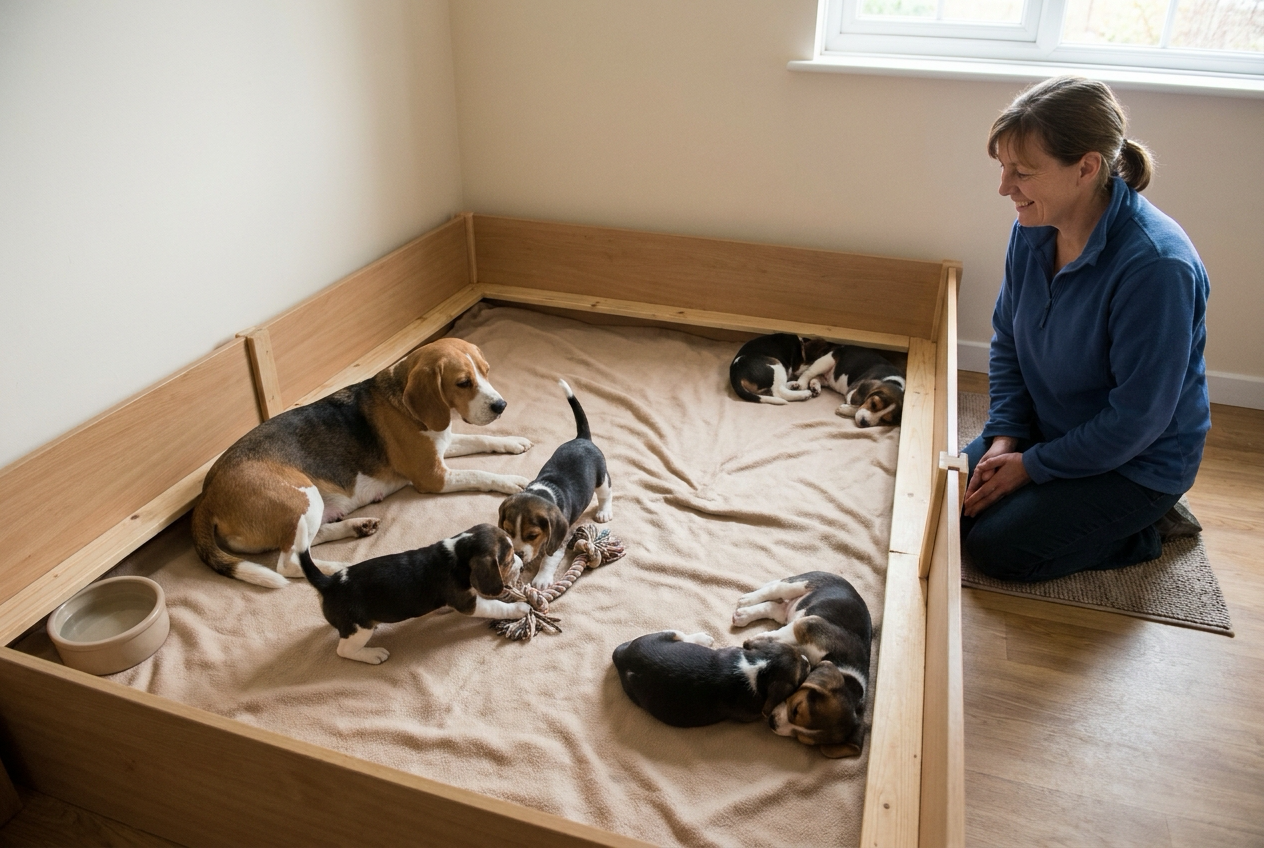
The breeder has two options. Register the litter and receive individualized puppy booklets and applications, one for each pup, which go home with buyers. Or permanently register as many puppies as you choose on the litter application itself, naming each one and entering its new registrant.
Litter fees on the current form are $41 when the pups are up to 6 months old and $82 from 6 months to 1 year. A flat fee option permanently registers five pups with three-generation papers for $185 (up to 6 months) or $226 (6 months to 1 year). The form does not give a litter rate past one year, so ask UKC before letting a litter age out.
Write the breeding and whelping dates down when they happen. The dog gestation calculator gives a due date from the breeding date, and how long dogs are pregnant explains the window around it.
When UKC requires DNA
UKC’s registration FAQs say that, generally, DNA is not required to breed a sire or dam. The exceptions it lists:
- The sire must be DNA profiled if frozen semen was used.
- Some breeds require DNA before breeding; UKC names Silken Windhounds, Llewellin Setters and Olde English Bulldogge.
- Sires or dams under or over typical breeding ages.
- Litters where the sire is in question.
The registry adds that it can request DNA on any dog at any time. Its DNA Services line on the pricing worksheet is $65. DNA profiling for parentage is a different job from health screening; for that, see OFA health testing for dogs.
Completing a puppy’s registration and transferring ownership
UKC’s permanent registration and transfers page is clear that a pup “is not fully registered until the application has been submitted, processed, and approved by UKC.” Handing over a puppy booklet is not the same as handing over a registered dog.
For a puppy from a registered litter:
- The breeder signs the Puppy Application on page 1 of the Puppy Booklet.
- The new owner completes the application and sends it to UKC for processing and approval, by mail or through UKC’s online transfer form.
For an adult dog that already has UKC papers:
- The owner needs the valid UKC Registration Certificate and fills in the transfer area on it.
- The seller signs exactly as their name appears on the certificate. If the dog is co-registered, both co-registrants sign.
- The seller writes the date of sale. If it is left blank, UKC uses the date it receives the transfer as the purchase date.
- The new registrant completes their own section.
UKC’s FAQ says applications for permanent registration, or for a permanent certificate on a transfer, must have the original certificate mailed to its office. A photocopy is not enough, so scan or photograph both sides before the original goes in the envelope. If the original certificate is lost, UKC’s forms and fees page lists a Duplicate Application under Duplicate Registration; ask UKC which applies before a sale. Your puppy sales contract is the right place to say when the signed application changes hands.
Sole Signatory and Successors
Each dog is registered to one Sole Signatory. Its Sole Signatory Designation Form is required when a dog or litter is registered to more than one individual, and up to three additional Successors can be listed on the dog’s record. Co-owned breeding dogs are common, so decide who signs before the first litter, not when the stud owner is unreachable.
Single registration for a dog with papers from another registry
Single registration is how a purebred dog that is not yet UKC registered gets in. UKC’s single registration page notes requirements may vary by breed, so pick your breed from the page’s breed menu. For most breeds, the single registration requirements page asks for:
- A completed Application for Single Registration.
- A copy of the dog’s registration certificate from a UKC acknowledged registry. For these breeds UKC acknowledges the American Kennel Club, the Canadian Kennel Club, the Kennel Club (of Great Britain), the Independent Kennel Club and any FCI affiliated registry.
- The dog’s complete three-generation pedigree. A photocopy or a handwritten pedigree is accepted.
A dog whose parents are already UKC registered does not need proof of registration, but you supply the sire’s and dam’s UKC names and numbers. Some breeds have their own requirement page, and the single registration page lists separate forms for dogs registered with certain field and hunting organizations.
The application’s pedigree section has a slot for each of the 14 ancestors with a UKC number field beside each. For a dog without UKC registered ancestors, the form says the pedigree “will appear exactly as it is provided,” and anything you leave blank prints as “Not Provided.” Copy registered names letter for letter from the original papers. The guide to checking dog pedigree papers walks through matching names, numbers and DNA claims before you do.
The standard single registration package on the current form is $49 and includes a Certificate of Ownership with a three-generation pedigree and an Easy Entry card. The application also asks for tattoo, microchip and spay or neuter details, and the owners of the sire and dam at the time of breeding where known.
If the dog is not eligible for the route you chose, UKC’s forms say it may fulfill the request another way, including issuing UKC Bloodlines Listing Service credentials instead, and that those papers do not carry the same rights and privileges as full registration. Any refund is for the difference, less a $5 processing fee.
Registered names, name changes and Purple Ribbon
UKC’s FAQ refers to a 30 characters and spaces limit on a dog’s registered name. The limit applies to the whole registered name, so plan the full name, including any kennel prefix, within 30 characters and spaces before you write it on a puppy application.
Name changes have firm limits. UKC does not allow any part of a name to change once the dog has earned a UKC title, or once the dog is the sire or dam of a UKC registered litter, because the puppies’ pedigrees already carry the parent’s name. Before that, the registrant can write the new name on the back of the original certificate and send it with the fee. The registry also reserves the right to deny a name for any reason and denies discriminatory or derogatory names.
Purple Ribbon (PR) is a UKC distinction for a dog whose 14 ancestors in its three-generation pedigree are all UKC registered and of the same breed. UKC adds “PR” to the front of the name (it does not count toward the 30 characters) and shows a comma instead of a dash inside the UKC number. Getting a full seven-generation UKC pedigree requires both parents to be Purple Ribbon. Breeders who want PR puppies need every ancestor in those three generations UKC registered. Line breeding inside a closed UKC pedigree has its own trade-offs, covered in the coefficient of inbreeding guide.
UKC registration fees checked November 17, 2026
These prices come from the Registration Services Pricing Worksheet, effective November 16, 2026, and the single registration and litter application forms updated 11-26, all fetched November 17, 2026. UKC states it can change rules and fees without notice, so check the forms and fees page before you pay.
| Litter or Non-UKC Sired Litter | $41 per litter (pups up to 6 months) |
|---|---|
| Dual-Sired Litter | $51 per litter |
| Pups 6 months to 1 year | Add $41 per litter |
| Five-pup flat fee | $185 up to 6 months, $226 from 6 months to 1 year |
| Transfer, standard package | $37, plus $40 for a dog over 1 year |
| Four-generation pedigree upgrade | Add $4 |
| Single registration, standard package | $49 (single registration form) |
| Performance Listing | $25 with Easy Entry card |
| DNA Services | $65 |
| Processing and delivery options | From $25 for Silver (tracking included) to $75 for Platinum Domestic (same-day processing, next-day delivery) |
Display pedigrees, metallic upgrades and binders are optional extras with their own lines on the worksheet. A breeder’s real total for a litter is the litter fee plus whatever each pup’s permanent registration package costs if you register them yourself.
Submitting the paperwork and checking on it
UKC takes registration paperwork online, by mail to its Kalamazoo, Michigan address, or by email, and its forms list the phone number and registration email. Two timing statements appear on UKC’s own materials: the application forms say to allow 4 to 6 weeks for processing, and the registration pages currently say UKC is processing applications it has received within 10 days. Mail time is extra, and errors stop the clock. UKC’s registration status check is where to look once the envelope has gone.
Before anything leaves your hands:
- Photograph or scan every page you send, including the back of any certificate.
- Note the date, the route used and, for mail, the tracking number.
- When the certificate comes back, compare the name, number, color, sex, sire, dam and owner against what you submitted.
The forms and fees page lists correction forms for a wrong birth date, sire or dam (breeder’s signature and the original litter fee), color or sex changes (breeder’s signature), purchase dates (both owners’ signatures) and pedigree corrections. A clean submission is cheaper than any of them.
The FAQ also says UKC will not get involved in contract disputes between buyer and seller and will not act on alleged forgeries; those belong in court. Keep your own copies accordingly.

Keep UKC papers with the dog on Creatures
Once UKC has issued the papers, the job is keeping them findable and attached to the right dog, especially when you also hold AKC numbers, microchip details and litter records for the same animals. Creatures is a records and profile layer for that; it does not submit anything to UKC, and storing a registration number or certificate on Creatures never registers or certifies a dog.
What you can do today:
- Registration record. Add a registration record and pick United Kennel Club from the registry list, then enter the registered name and UKC number, with an optional link to the registry entry and notes. A dog with both AKC and UKC papers gets one registration record per registry. The care, growth and identity records guide covers registration and identity records.
- The certificate itself. Records take photo and PDF attachments, so a scan of the front and back of the certificate can sit on the same record as the number. Attached files follow that record’s public setting.
- Identifiers. Microchip, tattoo and DNA profile entries live on the dog’s identity page, so the numbers you wrote on the UKC application match what you can look up later. The dog microchip records guide covers keeping registry contact details current.
- Litters. Record the breeding, then record the birth to create the puppies’ profiles as a litter, each one ready for its own registration record once papers arrive. See recording births and creating a litter.
- Pedigree. Linking parents on each profile builds the dog’s online pedigree, which exports as a PDF or image and shows an estimated inbreeding coefficient from the ancestry you entered. The pedigree, family and lineage guide explains how parents and ancestors connect.
- Existing paperwork. If you have a stack of certificates already, Import reads PDFs and photos of papers as well as spreadsheets, and every import is reviewed before anything saves. The import guide lists file types and limits.
The pedigree chart maker and the gestation calculator work without an account. Saving profiles and records needs a free account.
Questions breeders ask about UKC registration
Can I register an AKC dog with UKC?
Usually, yes, through single registration. For most breeds UKC acknowledges AKC papers, and you send a copy of the certificate, the dog’s complete three-generation pedigree and the application with the $49 standard package fee. Check your breed in UKC’s single registration menu first, because some breeds have their own requirements.
Can I register a litter if only the dam is UKC registered?
Yes, if the sire is permanently registered with a UKC acknowledged registry of the same breed. That is the Non-UKC Sired Litter route, and the sire section of the form asks for a copy of his proof of registration. If neither parent is UKC registered, you would single register the parents first.
How long does UKC registration take?
UKC’s application forms say to allow 4 to 6 weeks. Its registration pages currently report processing within 10 days of receiving an application. Paid processing and delivery options shorten the wait, and any missing or incorrect information slows everything down.
Can my mixed-breed dog be UKC registered?
Not into the stud book. A mixed-breed or shelter dog can receive a Performance Listing for $25, which allows UKC performance events but not conformation or breeding rights.
Is UKC registration a health or quality guarantee?
No. Registration records identity and parentage. Health screening is a separate set of results: see OFA health testing. Cat breeders working through a different registry can compare CFA registration.
Does Creatures register my dog with UKC?
No. Creatures stores the UKC number, the certificate image and the dog’s pedigree alongside its other records. The application, fees and approval all go through UKC.
More breeding, papers and puppy guides are on the dog species page.
Do this next on Creatures
Start with the dog whose papers you just received, then the litter that will need its own.
- Add your dog’s profile with its registered name, sex and birth date. This has a guest signup path, and the adding an animal guide walks through the form.
- Add a UKC registration record with the number and a scan of the certificate. The form opens for visitors; a free account saves it. The record guide covers each field.
- Create your kennel profile so buyers can see your dogs and litters in one place. The breeder directory guide explains how listing works.
- Save a dog listing alert if you are looking for a registered dog to add to your program, and get an email when new ones are listed.
- Browse dogs on the marketplace and ask each seller which registry issued the papers and for a copy before you commit.
- Browse the breeder directory to find kennels and contact them about their dogs and litters.