

Romanian Raven Shepherd Dog
Author: Elliott Garber, DVM · Published
The Romanian Raven Shepherd Dog is a large black livestock guardian from the southern Carpathian Mountains of Romania, known at home as the Ciobanesc Romanesc Corb (corb is the Romanian word for raven, after the dog’s coat). It is a mountain molossoid bred to live with flocks and stand up to bears and wolves, calm and devoted with its own people and reserved with strangers. If you found this page while weighing whether one belongs on your property, the honest short answer is that this is a serious working guardian, not a starter dog, and a genuinely hard breed to find outside Romania. Below is what the breed actually is, where it comes from, how to read its size and coat correctly, what its care really demands, and how to go about finding one responsibly.
| Also called | Ciobanesc Romanesc Corb, Corb, Raven Sheepdog |
|---|---|
| Origin | Southern (Meridional) Carpathians and sub-Carpathian Romania (Dambovita, Arges, Prahova, Brasov) |
| Primary use | Livestock guardian for sheep and cattle, property watchdog |
| Height, males | 70 to 80 cm (about 27.5 to 31.5 in) at the withers |
| Height, females | 65 to 75 cm (about 25.5 to 29.5 in) at the withers |
| Weight | Not fixed by the standard, only “in proportion to height”; in practice a heavy mountain dog well over 45 kg (100 lb) |
| Coat | Long (7 to 10 cm), black or more than 80% black with white on chest and lower forelegs, dense undercoat, mane at the neck |
| Temperament | Calm and attached at home, courageous guardian, reserved toward strangers, loud far-carrying bark |
| Recognition | Romanian Kennel Club 2008; FCI standard No. 373, published 2024 (Group 2, Section 2.2) |
| Availability | Numerous in its home region, very rare outside Romania |
Browse listings, public profiles, breeders, or add your animal.
What is a Romanian Raven Shepherd Dog?
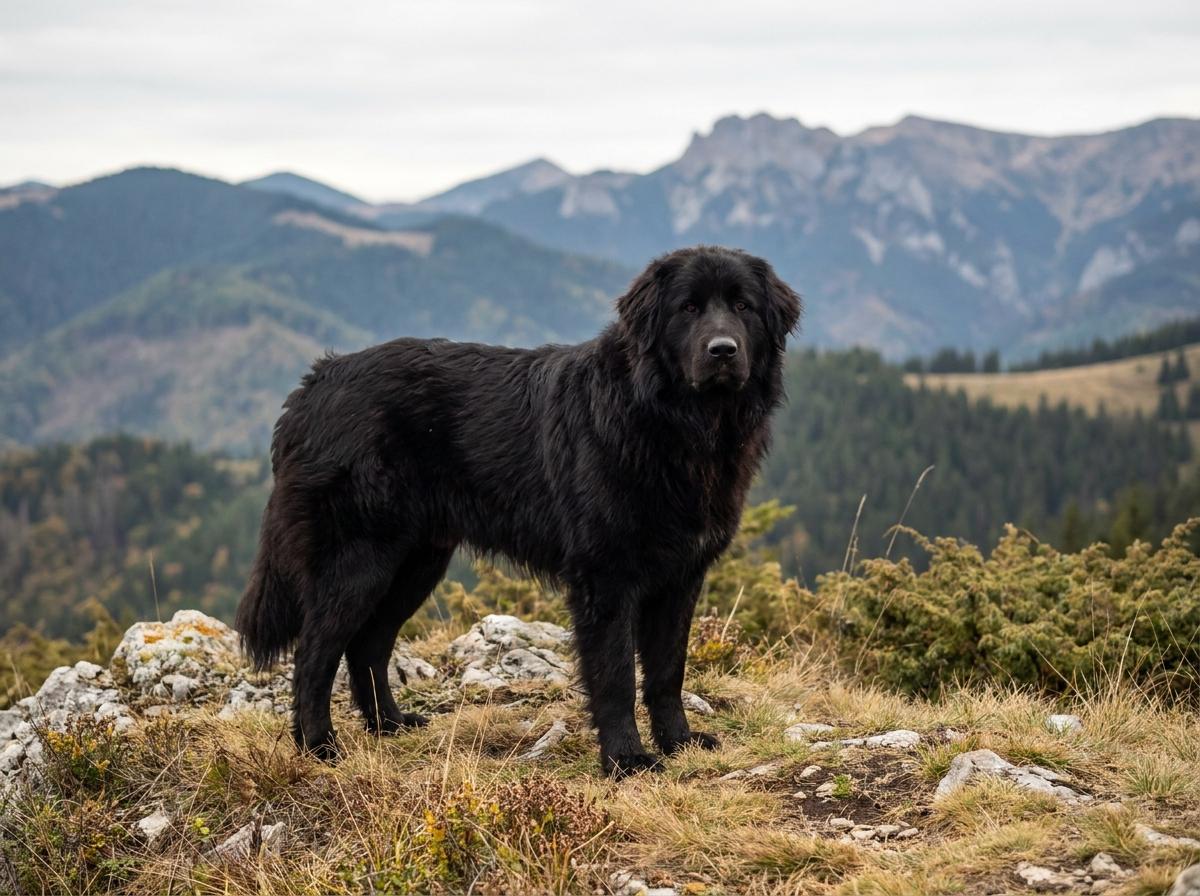
The Romanian Raven Shepherd Dog is one of Romania’s shepherd breeds, alongside the better-known Carpathian, Mioritic, and Bucovina Shepherd Dogs. What sets the Raven apart is simple and right there in the name: it is the black one. The Federation Cynologique Internationale (FCI), the international body that publishes the breed standard, describes it as a large mountain molossoid with a coat that is “always black (like a raven) or black on more than 80% of the body,” carried on a towering, powerful frame built to guard livestock in rough country.
This is a working livestock guardian, the kind that lives among the animals it protects rather than herding them at a distance. The FCI standard lists its job plainly as “shepherd dog for sheep and cattle” and “excellent guardian.” In its Carpathian home it is trusted to stay with a flock and deter or fight the predators that still range those mountains. That heritage shapes everything about the breed, from its size and coat to the way it reads strangers. If you are still comparing guardian and working breeds, the broader Creatures dog species page is a useful place to line them up against one another.
Origin and history
The breed formed naturally in the Meridional Carpathians (the southern range) and the sub-Carpathian hill country of Romania, concentrated in the counties of Dambovita, Arges, Prahova, and Brasov. According to the FCI’s historical summary, dogs of this type “have been known for generations” in these regions and were called the Raven because of the predominantly black coat. This is what breed people mean by a natural or landrace breed: a working population shaped over a long time by the job and the terrain rather than assembled recently from a written plan.
Its formal recognition, by contrast, is recent. The Romanian Kennel Club (Asociatia Chinologica Romana) recognized the breed on November 14, 2008. The FCI, which many national kennel clubs around the world defer to, published its official standard for the breed (No. 373) in 2024, placing it in Group 2 (Pinscher and Schnauzer, Molossoid and Swiss Mountain and Cattle Dogs), Section 2.2, mountain-type molossoids. That gap between a long unwritten working history and a very recent paper trail is worth holding onto. It explains why solid, breed-specific data on things like lifespan and health is thin, and why the dog is far more familiar to a Carpathian shepherd than to a kennel club registry outside Romania.
One useful nuance from the standard: the FCI notes that although the breed’s “habitat is relatively limited, due to his qualities the existing population is numerous.” The Raven, in other words, is not teetering on the edge of extinction. It is locally common where it works and simply uncommon everywhere else, which is a different thing from endangered.
What a Romanian Raven Shepherd Dog looks like
Get the picture right and this breed is hard to confuse with anything else. A few diagnostic features do most of the identifying work, and each of the figures below comes straight from the current FCI standard rather than from secondhand breed pages.
- A black, raven coat. The color is the whole point. The coat is black or at least 80 percent black, with white marks allowed only on the chest and the lower front legs. On the forelegs the white must not rise above the pastern (wrist) joint. Any color other than black is not permitted on the white, and white covering more than 30 percent of the body is a disqualifying fault. A reddish cast from a summer of sun does not count against the dog.
- A long, weatherproof double coat. The hair on the body is abundant and long, 7 to 10 cm, flat, straight and rough to the touch, over a shorter dense undercoat. It grows into a distinct mane around the neck, fringes down the back of the front legs, and full “culottes” on the thighs, with a bushy natural tail. This is a coat built for a mountain winter, not for looks.
- Large mountain-guardian size. Males stand 70 to 80 cm at the withers (about 27.5 to 31.5 in) and females 65 to 75 cm (about 25.5 to 29.5 in). The standard deliberately does not pin a weight, asking only that it be “in proportion to height,” but a dog of that stature is a heavy animal, comfortably over 45 kg (100 lb) in most adults. The body is slightly longer than tall, rectangular, and described as massive and vigorous.
- A powerful head with almond eyes and V-shaped ears. The head is broad and strongly built with a fairly marked stop. The eyes are relatively small for the head, almond-shaped, set obliquely, and brown in color from a light to a dark shade. The ears sit slightly above eye level, are V-shaped with a lightly rounded tip, and hang close to the cheeks. One point worth correcting if you have read otherwise: the standard allows only brown eyes, from a light to a dark shade, and treats yellow eyes as a fault, so the correct eye color is brown, not the amber or yellow you may see described on other breed pages.

Temperament and guardian instinct
The temperament reads exactly the way a livestock guardian’s should. The FCI standard describes the breed as “balanced, calm with a well developed guardian instinct, obedient and attached to his masters,” and “diffident towards strangers.” It is a dog that fights predators as large as bears and wolves when it has to, with a bark the standard calls “loud, profound and can be heard from a great distance.” That combination, steady at home and formidable at the boundary, is the breed working as designed.
For a family or a farm, the practical translation is a dog that is affectionate and settled with the people and animals it knows, and naturally suspicious of the ones it does not. That suspicion is a feature on a remote property and a liability in a busy suburban one. Guardian breeds make their own decisions about who and what belongs, which is exactly why early, ongoing socialization and a calm, confident handler matter so much. A Raven that meets a wide range of people, places, and situations as a young dog, under guidance, learns to tell a normal visitor from a real threat. One that is left to draw its own conclusions in isolation does not become friendlier, it becomes harder to manage.
Owners of guardian breeds also describe a playful, even goofy side at home, and the breed is generally reported as good with children it is raised alongside. Treat that as the observation of keepers rather than a formally studied trait, and keep the usual rules in place regardless of breed: supervise dogs and young children, and never rely on size or good nature as a substitute for management. A dog this powerful asks for adult judgment around it at all times.

Exercise, space, and climate
This is not an apartment breed and it is not a city breed. A dog bred to patrol mountain pasture needs room and a job, and the most contented Ravens are the ones with real territory to watch and real work to do. On a farm or a large rural property with secure fencing, much of that need is met simply by living the life the breed was made for. Without livestock, an owner has to supply the equivalent: space, long daily walks or free movement on secure ground, and the mental engagement of training, structure, and a clear routine. A bored, under-exercised guardian in a small yard is how nuisance barking, fence-testing, and general frustration start.
Fencing deserves its own line. A territorial dog of this size needs boundaries it will actually respect and that keep it and the neighborhood safely apart. Plan the fence before the dog, not after.
On climate, the breed comes with its own insulation. That long double coat and dense undercoat were built for Carpathian winters, so cold, snow, and wind are the conditions it handles best. The flip side is heat. A heavily coated black dog is at a real disadvantage in hot, humid weather, so shade, constant fresh water, and avoiding hard exercise in the heat of the day are not optional in a warm climate. Watch for the early signs of a dog struggling with heat and plan the day around the temperature.
Health considerations
There is no published, breed-specific health or longevity study for the Romanian Raven Shepherd Dog, which is unsurprising for a working landrace only recently entered into international registries. The honest approach is to reason from what is well established for large, heavy, deep-chested breeds and to keep records on your own dog, rather than quote breed statistics that do not exist. Everything here is general guidance, and every medical decision belongs with a veterinarian who can examine the animal.
Two orthopedic and one emergency concern lead the list for dogs of this build:
- Hip (and elbow) dysplasia. Canine hip dysplasia is a polygenic developmental disorder of the hip joint and is most prevalent in large and giant breeds, according to the veterinary literature. Responsible breeders of large guardian dogs screen breeding stock for hip and elbow conformation, so asking about that screening is a fair and important question when you buy.
- Bloat, or gastric dilatation and volvulus (GDV). GDV is a sudden, life-threatening emergency most common in large, deep-chested dogs, in which the stomach distends and can twist. The American College of Veterinary Surgeons describes it as a true emergency requiring immediate veterinary care. Know the signs (a distended abdomen, unproductive retching, restlessness, distress) and know your nearest emergency clinic before you ever need it. Ask your veterinarian whether a preventive gastropexy makes sense for a dog of this size.
- Ear care. Pendant ears that hang close to the head trap moisture and warmth, which can set up ear infections. Routine checks and keeping the ears clean and dry are simple, worthwhile habits for any drop-eared breed.
Because the breed-level data is thin, the single most useful thing an owner can do is keep good records: vaccinations, parasite prevention, weight, screening results, and anything abnormal, tracked over the dog’s life so patterns are visible and your veterinarian has real history to work from. You can keep all of that in one place with a free animal profile on Creatures, and the help articles on adding a record and health and medical records walk through how.
Grooming and coat care
A long, dense double coat is low-fuss most of the year and high-effort twice a year. Weekly brushing keeps the body coat, the neck mane, the leg fringes, and the culottes free of mats and moves loose hair and debris out before it builds up. Then come the seasonal blowouts, when the undercoat sheds heavily and daily brushing for a stretch is the realistic price of keeping the dog and the house under control. Pay particular attention to the areas that mat first, behind the ears, the mane, and the trousers on the hind legs.
Do not shave a working double coat to fight heat or shedding. That coat insulates against both cold and sun and regulates temperature in ways a clipped coat cannot, and shaving can interfere with how it grows back. Manage heat with shade, water, and timing instead. Otherwise, grooming is the ordinary large-dog routine: keep nails trimmed, check and clean the ears, and look after the teeth.
Finding a Romanian Raven Shepherd Dog responsibly
Here is the reality check. Inside its home region the Raven is a known, working dog, but outside Romania it is genuinely rare, and its international paperwork only arrived in 2024. If you are shopping from North America, western Europe, or almost anywhere outside the breed’s range, expect a very small pool of breeders, likely tied to recent imports, and expect to travel, wait, or import to get a genuine dog.
That scarcity is exactly the situation where careful buying matters most, because a thin market is where mislabeled or poorly bred dogs slip through. A few things to insist on:
- Verify the breed and the paperwork. Ask what registry the dog and its parents are recorded in and confirm the pedigree rather than taking a seller’s word that a large black shepherd dog is a Corb. Given how new the breed’s formal recognition is, be specific about what documentation exists for the animal in front of you.
- Ask about health screening. For a large guardian breed, hip and elbow screening of the parents is a reasonable expectation. A breeder who screens and shares results is telling you something good about how they work.
- Ask about temperament and how pups are raised. Guardian temperament is shaped early. Ask how the breeder socializes litters and what kind of homes and work they breed for. A serious breeder will have questions for you, too.
- Match the dog to your setup honestly. These dogs are bred to guard space and stock. Be candid with a breeder about your property, your fencing, your experience, and whether you have real work or real space for the dog, and listen if they steer you elsewhere.
Because so few are listed at any given time, the most practical way to catch one is to watch the market rather than refresh it by hand. You can search the Creatures directory of trusted breeders and farms, browse current dog listings on the marketplace, and set a free listing alert (in the hub below) so Creatures tells you when a matching dog is posted. On price, there is no reliable public figure for the breed outside Romania, and given the tiny international market any number would be guesswork, so plan on the cost of a well-bred large guardian dog plus, in many cases, the real expense of importing.
Is the Romanian Raven Shepherd Dog right for you?
Be honest with yourself before you fall for the coat. This is a large, powerful, independent-minded guardian with a serious bark and a real protective drive, bred to make its own decisions about threats. In the right home, a rural property with space, secure fencing, a job to do, and an experienced owner who will socialize and guide the dog, it can be a magnificent, devoted companion and protector. In the wrong home, a small yard, a busy street, a first-time dog owner, or a household with a steady stream of unfamiliar visitors, that same drive becomes a management problem that is not fair to the dog or the neighbors.
If you have kept guardian or working breeds before, have the space and the setup, and are drawn to the breed for what it is rather than how it looks, this is a rewarding dog. If this would be your first big dog, or your first guardian, it is worth being very clear-eyed, and a conversation with an experienced breeder about whether the breed fits your life is time well spent.
Frequently asked questions
Why is it called a Raven Shepherd Dog?
The name comes from the coat. Corb is the Romanian word for raven, and the breed is defined by a coat that is black or more than 80 percent black. It is one of Romania’s shepherd breeds, and the black one.
How big does a Romanian Raven Shepherd Dog get?
Per the FCI standard, males stand 70 to 80 cm at the withers (about 27.5 to 31.5 in) and females 65 to 75 cm (about 25.5 to 29.5 in). The standard does not fix a weight, only that it be in proportion to height, but a dog this tall is a heavy animal, generally well over 45 kg (100 lb).
Are they good family dogs?
With the right owner and setup, they can be. The breed is described as calm and attached to its people and is generally reported as good with children it is raised with, while being reserved toward strangers. That guardian nature needs a rural or large-property home, secure fencing, early socialization, and an experienced handler. It is not a low-maintenance companion breed.
Is the breed recognized by kennel clubs?
Yes. The Romanian Kennel Club recognized it in 2008, and the FCI published its official breed standard (No. 373) in 2024, classing it in Group 2, Section 2.2 (mountain-type molossoids). As of 2026 it is not a fully recognized American Kennel Club breed.
How long do they live?
There is no published breed-specific longevity data, so any exact figure would be a guess. As a rough guide, large guardian breeds of this size commonly live around a decade, and lifespan depends heavily on genetics, weight management, and veterinary care.
Are they rare?
Outside Romania, yes, they are genuinely hard to find, and international recognition only came in 2024. Within their Carpathian home region, however, the FCI notes the working population is numerous, so this is a locally common dog that is simply uncommon everywhere else.
Do this next on Creatures
Whether you are researching the breed, trying to track down a genuine dog, or already living with a Raven, Creatures is the records, marketplace, and directory layer to do it in one place.
Get alerted when one is posted. Genuine Ravens are scarce outside Romania, so set a free listing alert and Creatures will tell you when a matching dog appears. No account needed to start. You can also browse current dog listings and learn how alerts work in saving searches and using your watchlist.
Find responsible breeders. Search trusted breeders and farms in the Creatures directory to connect with people raising this rare Romanian guardian.
Add your dog. Already living with a Raven? Create a free animal profile in a few minutes. The walkthrough is in adding an animal to Creatures.
Track health and screening. Start health and care records for hip screening, vaccinations, weight, and vet visits. The record sheet opens for any visitor to look around, and a free account saves what you enter. See adding a record and health and medical records for the how-to.
Breed or list your dogs. Raising Ravens? Create a breeder or farm profile so buyers searching for this hard-to-find breed can reach you, and get listed in the breeder directory. If you run your operation with others, see creating an organization and adding your team.
Compare related animals. Explore the dog species page, and browse other rare-breed guides in this series such as the African Owl pigeon and the Santa Ines sheep.