

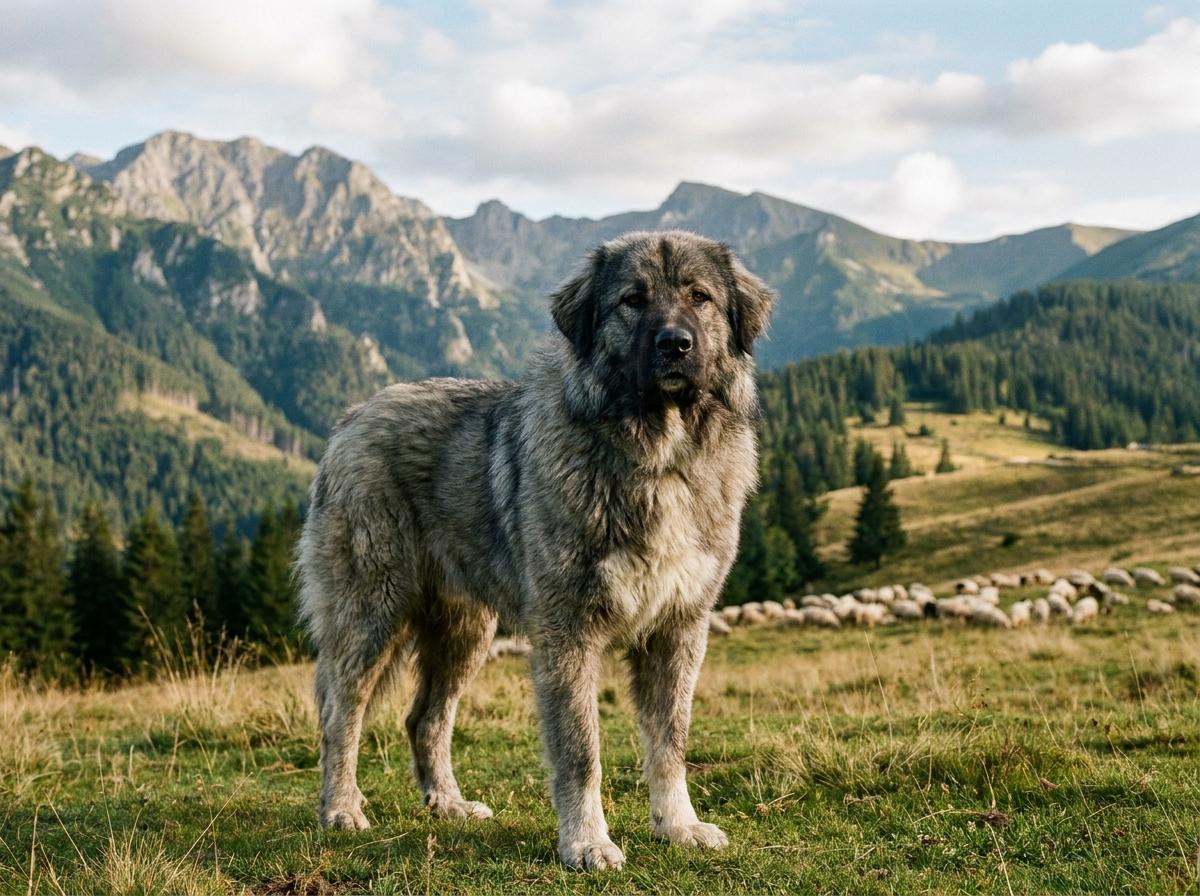
Ciobănesc Românesc Carpatin
The Ciobanesc Romanesc Carpatin, known in English as the Romanian Carpathian Shepherd Dog, is a large livestock guardian breed from the Carpathian Mountains of Romania. Shepherds there have used it for centuries to live out with the flock and turn back wolves and bears, and that job shaped everything about the dog: the wolf-grey coat, the calm and watchful head, the deep chest built for a full day on the move, and a temperament that is devoted to its own people and deeply suspicious of everything else. The name itself is plain Romanian, “ciobanesc” for shepherd dog, “romanesc” for Romanian, “carpatin” for Carpathian. This page covers what the breed is, where it comes from, how to recognize a correct one, how it behaves, what it needs from an owner, and the honest reality of finding a good one outside Romania.
| Also called | Romanian Carpathian Shepherd Dog, Carpathian Sheepdog, Carpatin |
|---|---|
| Origin | Carpathian Mountains, Romania |
| Original job | Livestock guardian, protecting flocks from wolves and bears |
| FCI standard | No. 350, Group 1 (sheepdogs), full recognition in 2015 |
| Height at withers | Males 65 to 73 cm (about 26 to 29 in); females 59 to 67 cm (about 23 to 26 in) |
| Weight | FCI Standard 350 specifies only that weight be in harmony with size; the 32 to 45 kg (70 to 100 lb) figure often quoted is a nonstandard secondary estimate |
| Coat | Harsh double coat, wolf-grey (pale fawn overlaid with black), longer on neck, legs, and tail |
| Temperament | Calm, dignified, intensely loyal, independent, and protective |
| Typical lifespan | No reliable breed-specific data. For general context only, the AKC puts large breeds around 8 to 12 years |
| Best suited to | Experienced owners with space, a real guardian job, or a rural property |
Browse listings, public profiles, breeders, or add your animal.
What is a Ciobanesc Romanesc Carpatin?
The Carpathian Shepherd is one of Romania’s native livestock guardian dogs, a working type that lived alongside transhumant shepherds moving flocks up into the Carpathian range for the summer and back down in autumn. It is not a herding dog in the border collie sense. Its job was never to gather or drive sheep. Its job was to be the muscle: to stay with the flock day and night, read the ground, and stand between the sheep and a predator when one showed up. That distinction explains the calm, the independence, and the size all at once.
The Federation Cynologique Internationale (FCI) recognizes the breed under Standard No. 350, placing it in Group 1 (sheepdogs and cattle dogs), Section 1 (sheepdogs). The standard describes the intended dog plainly: a natural guardian, courageous, with an instinctive and unconditional attachment to the herd and to its master, and a dignified, calm, and stable temperament. If you are deciding between large guardian breeds, the broader Creatures dog species page is a good place to compare the Carpatin against other working and guardian types before you commit.
The Carpatin also belongs to a family worth naming, because Romania has more than one native shepherd dog. Alongside the Carpatin sit the shaggier Romanian Mioritic Shepherd and the Bucovina Shepherd, both also FCI-recognized livestock guardians from the same mountains. People new to the breeds sometimes lump them together, but they look and feel different in the flesh. The Carpatin is the wolf-grey, athletic, medium-to-large one; the Mioritic is the big white or grey shaggy one; the Bucovina is the largest and heaviest of the three.
Where the breed comes from
The Carpathian Shepherd was not designed in a studbook. It was selected over a very long time by the work itself. The FCI records that the breed was drawn from an endemic type present in the Carpatho-Danubian area, and that for centuries the main criterion for keeping a dog was simple usefulness on the mountain. Dogs that guarded well, held up to the weather, and could be trusted around stock got bred. Dogs that could not, did not.
The written history is much shorter than the working history. According to the FCI, the first breed standard was drawn up in 1934 by Romania’s Zootechnical National Institute, then revised in 1982, 1999, and 2001 by the Romanian Kennel Club, which adapted it in 2002 to the FCI’s format. Formal international recognition came later still: the breed received provisional FCI homologation in 2005 and full recognition in 2015. In the United States, the American Kennel Club lists it in its Foundation Stock Service, the preliminary register for rare breeds that are still building up numbers and records, rather than in a fully recognized group.
For a prospective owner, the point is that this is a working landrace formalized recently, not a long-standing show breed. Type can still vary from line to line, and the dogs closest to the original mountain function are still out there doing that function in Romania today.
What a Carpathian Shepherd looks like
A correct Carpatin reads as a substantial but athletic dog, never a heavy mastiff. The FCI standard is explicit that it should be vigorous and agile, never heavy, with a slightly rectangular body that is a little longer than it is tall. A few features let you identify the breed with confidence.
- Wolf-grey coat. This is the single most reliable field mark. The standard calls the color pale fawn overlaid with black in varying tones, usually lighter on the sides and darker over the back, which reads to the eye as a sable, wolf-like grey. White markings on the muzzle, forehead, neck, chest, limbs, and tail are allowed. The coat itself is a harsh, dense, straight outer layer over a dense soft undercoat, shorter on the head and the front of the legs, and noticeably longer on the neck, the backs of the legs, and the tail.
- A wolf-like (lupoid) head. The standard describes the head as lupoid, meaning wolf-like, and of mesocephalic proportion, powerful but not heavy. The forehead is broad and slightly domed, narrowing toward a moderate stop.
- A powerful muzzle with a black nose. The muzzle is strong, roughly oval in section and shaped like a slightly truncated cone, a little shorter than or equal to the length of the skull. The nose is large, wide, and always black. A brown or liver nose is not correct for the breed.
- Brown almond eyes, never yellow. The eyes are almond-shaped, set slightly obliquely, and range through shades of brown. Yellow eyes are listed as a severe fault, so a pale, wolfish yellow stare is a red flag rather than a breed trait.
- Moderate, close-carried ears and a bushy tail. The ears are triangular, not oversized, set a little above eye level, with slightly rounded tips carried close to the cheek. The tail is set fairly high and well feathered; it hangs low at rest and lifts when the dog is alert, but should not curl over the back.
On size, males stand ideally 65 to 73 cm at the withers and females 59 to 67 cm, with a small tolerance either way. Weight is where you should be careful with numbers. The FCI standard deliberately does not fix a weight, saying only that it should be in harmony with the frame and give the impression of a powerful but not heavy dog. Breed references generally put adults somewhere around 32 to 45 kg (roughly 70 to 100 lb), but treat that as a practical range rather than a standard requirement, and judge the individual dog’s condition and structure over the number on a scale.

Temperament and working character
Everything good and everything difficult about this breed comes from the same place: it is a guardian that was bred to make its own decisions. On a mountain with no handler in sight, a good guardian dog has to assess a situation and act on its own judgment, which is a very different mind from a biddable herding or sporting dog waiting for a cue. That independence is the point of the breed, not a defect in it, but it shapes what living with one is like.
The FCI standard leans on words like dignified, calm, and balanced, and that is a fair description of a well-raised Carpatin at rest. These are not frantic or fussy dogs. Within their own family they are typically affectionate, steady, and deeply attached, and they often bond hardest to one household and watch over children and stock with obvious seriousness. The flip side is an inbuilt wariness of strangers and of anything out of place. A dog bred to treat an approaching wolf as a problem to be solved does not switch that instinct off for the mail carrier or an unfamiliar dog at the fence.
Two practical points follow. First, this is a barker and a patroller by design; guardian dogs work the boundary and announce themselves, which is part of the deterrent. Second, same-sex aggression and a strong territorial streak are common in the guardian breeds, so multi-dog households and off-leash encounters need real management rather than optimism. None of this makes the Carpatin a “bad” dog. It makes it a specialist, and it belongs with people who want exactly what it was bred to do.
Living with a Carpathian Shepherd
Training a guardian breed is less about obedience drills and more about early, consistent socialization and clear, fair leadership. Because the dog is independent and physically powerful, the groundwork you lay as it grows up matters enormously, and it is not the kind of dog you can leave to sort itself out.
Start socialization early and keep it up. A guardian’s default is suspicion, so a puppy needs broad, positive, structured exposure to people, places, sounds, other animals, and normal household comings and goings while it is young, and continued into adulthood. The goal is a dog that can tell a genuine threat from ordinary life, not one that is either indiscriminately friendly or reflexively reactive. Reward-based methods work; heavy-handed corrections tend to backfire badly with a proud, sensitive guardian and can damage the trust the whole relationship runs on.
Set the rules and hold them. These dogs respect calm consistency and read a wishy-washy household quickly. Fencing has to be real. A bored or under-stimulated Carpatin with a flimsy fence is a dog that will patrol the whole neighborhood on its own authority, and its size and protectiveness make that a serious liability. Secure containment protects the dog, the public, and you.
Give the guarding instinct a legitimate outlet. A Carpatin with a flock, a smallholding, or at minimum a real property to watch and a job to feel responsible for is a settled dog. The same dog with nothing to guard and too little exercise can become anxious, over-reactive, or destructive. This is a breed that does far better with a purpose than as a pure companion in a small space.
Care, exercise, and health
For all its intensity of character, the Carpatin is a relatively low-maintenance dog in day-to-day physical care. It is a hardy mountain breed, not a high-strung one.
Exercise and space. This is a working dog that spent generations covering ground, and it needs substantial daily activity and, ideally, room to move. Long walks, a large securely fenced area, and a job to do suit it far better than a city apartment and a couple of laps around the block. It is not a jogging-partner sporting breed so much as a tireless patroller, but the underlying need for space and stimulation is high, and an under-exercised guardian tends to invent its own, less convenient, occupations.
Coat and grooming. The dense double coat is built for weather, not for salons. Regular brushing, roughly weekly, keeps it in order, with heavier shedding during the seasonal coat changes when more frequent grooming pays off. Bathe only as needed. The coat’s job is insulation and protection, so resist the urge to clip it down.
Health. There is no large, breed-specific health study to lean on the way there is for popular registry breeds, and the Carpatin is generally regarded as a robust, naturally healthy working dog. It is still a big, deep-chested dog, though, and the sensible thing is to watch for the health issues that affect large breeds broadly. Hip and elbow dysplasia are worth screening breeding stock for, and deep-chested dogs are at risk of bloat, or gastric dilatation and volvulus, a genuine emergency in which the stomach fills with gas and can twist. Learn the signs of bloat (a distended abdomen, unproductive retching, restlessness and distress) and treat it as an immediate veterinary emergency rather than something to wait out. As with any breed, keep to a routine of veterinary checkups, parasite prevention, and core vaccinations, and defer all medical decisions and any medication to your veterinarian, who can actually examine the dog. On lifespan, be wary of the confident figures you will find elsewhere: there is no reliable breed-specific longevity data for the Carpatin, and the commonly quoted 12 to 14 years is not supported by breed evidence and actually sits above the general large-breed picture. For context only, the AKC puts large breeds at roughly 8 to 12 years. Use that as background rather than a promise about this breed.
Keeping clear records helps here more than people expect. Logging vaccinations, weight, screening results, and any health events gives your veterinarian a real history to work from and makes breeding and care decisions evidence-based rather than a matter of memory. You can keep all of that in one place with a free animal profile on Creatures, and the health and medical records guide walks through how the records tab works.

Is this the right breed for you?
Be honest with yourself before you fall for the wolf-grey good looks. The Carpathian Shepherd is a wonderful dog in the right home and a difficult one in the wrong home, and the difference is almost entirely about matching the dog to a life that fits its nature.
It suits you if you have space and ideally a rural or semi-rural property, you want a serious guardian rather than a soft family pet, you have handled large, strong-willed dogs before, and you are ready to commit to early socialization, secure fencing, and lifelong consistent handling. Owners who keep livestock, or who simply want a devoted protector for a country home, tend to be the best fit, and the breed rewards them with steadiness and loyalty.
It is a poor fit if you live in a small apartment, are a first-time dog owner, travel constantly, want an easygoing dog that greets every visitor warmly, or expect off-leash reliability in busy public places. A powerful, independent guardian with strong territorial instincts is a lot of dog to manage, and there is no shame in deciding it is more breed than your circumstances can do justice to. Choosing well is part of responsible ownership. If a large guardian appeals but the Carpatin’s intensity gives you pause, comparing it against a more widely available working breed such as the German Shepherd, or against other rare shepherd types like the Jeju dog and the Podenco Valenciano, can help you calibrate what you actually want.
Finding a Carpathian Shepherd
Outside Romania and its neighbors, the plain truth is that the Carpatin is rare. It is a national breed still concentrated in its homeland, only recently recognized internationally, and listed in the AKC’s preliminary Foundation Stock Service rather than as a common registry breed in North America. That scarcity shapes how you should shop.
Expect a small pool of breeders, waiting lists, and the need to do your homework on any given litter. Because the breed was formalized recently and type still varies, ask to see health screening on the parents (hips and elbows in particular), meet the dam and ideally the sire, and look for temperament that matches the standard’s calm, stable guardian rather than either nervousness or indiscriminate aggression. Ask what the line was bred for and whether the dogs are actually working stock. A breeder who understands guardian temperament and places dogs into appropriate homes is worth waiting for.
You can search for the breed and browse dogs on the Creatures marketplace, and look for trusted breeders and rescues in the Creatures directory. Because genuine Carpatin stock is uncommon, a saved listing alert (below) is often the most practical way to hear about one when it appears rather than checking back by hand.
Frequently asked questions
Is the Carpathian Shepherd a good family dog?
It can be, in the right family. Within its own household a well-raised Carpatin is typically calm, affectionate, and deeply loyal, and it often watches over children and stock with real seriousness. It is not, however, a soft, sociable-with-everyone pet. It is a protective guardian that is naturally wary of strangers, so it needs owners committed to early socialization, secure fencing, and consistent handling.
Are Carpathian Shepherds aggressive?
They are protective and territorial rather than gratuitously aggressive. The breed was developed to confront predators and to defend flock and family, so a strong guarding drive and suspicion of strangers are normal. Good socialization and management channel that into a stable, discerning guardian; neglecting it can produce a reactive dog. This is a breed for experienced owners.
How big does a Carpathian Shepherd get?
Males stand ideally 65 to 73 cm at the withers (about 26 to 29 in) and females 59 to 67 cm (about 23 to 26 in) under FCI Standard 350. On weight the standard gives no number at all, specifying only that it be in harmony with the dog’s size; the 32 to 45 kg (roughly 70 to 100 lb) range you will see quoted is a secondary estimate rather than part of the standard. It is a large, athletic dog, powerful without being a heavy mastiff.
What is the difference between the Carpathian, Mioritic, and Bucovina Shepherds?
All three are FCI-recognized Romanian livestock guardian breeds from the Carpathian region. The Carpatin is the wolf-grey, athletic one covered on this page. The Mioritic is a larger, shaggy dog usually white or grey. The Bucovina is the biggest and heaviest of the three. They share a guardian heritage but differ in size, coat, and appearance.
Do Carpathian Shepherds need a lot of exercise?
Yes. This is a working guardian bred to cover ground and stay active with a flock, so it needs substantial daily activity and room to move. A large securely fenced space and a sense of purpose suit it far better than apartment life. An under-exercised, under-occupied guardian tends to become restless and hard to manage.
Are Carpathian Shepherds rare?
Outside Romania, yes. The breed is still concentrated in its homeland, was only fully recognized by the FCI in 2015, and sits in the AKC’s preliminary Foundation Stock Service rather than a fully recognized group in the United States. Expect a small number of breeders, waiting lists, and the need to verify health and temperament carefully.
Do this next on Creatures
Whether you are researching the breed, hunting for a genuine dog, or already living with a Carpathian Shepherd, Creatures is the records, marketplace, and directory layer to do it in one place.
Compare the breed. Use the Creatures dog species page to weigh the Carpatin against other guardian and working breeds before you commit.
Find a dog. Browse Carpathian Shepherds on the marketplace and search trusted breeders and rescues in the Creatures directory.
Get alerted. Genuine Carpatin stock is rare, so set a free Carpathian Shepherd listing alert and we will tell you when one is posted. No account needed to start.
Add your dog. Already living with one? Create a free animal profile in a few minutes. The walkthrough is in adding an animal to Creatures.
Track health and care. Log vaccinations, screening results, and health events. The record sheet opens for any visitor to look around, and you will need a free account to save what you enter. See adding a record for the full how-to, and set up reminders and upcoming care so nothing slips.
Breed or rescue. Run a breeding program or a rescue for this rare breed? Create an organization profile and get listed in the breeder directory so the right homes can find you.