

Samurai
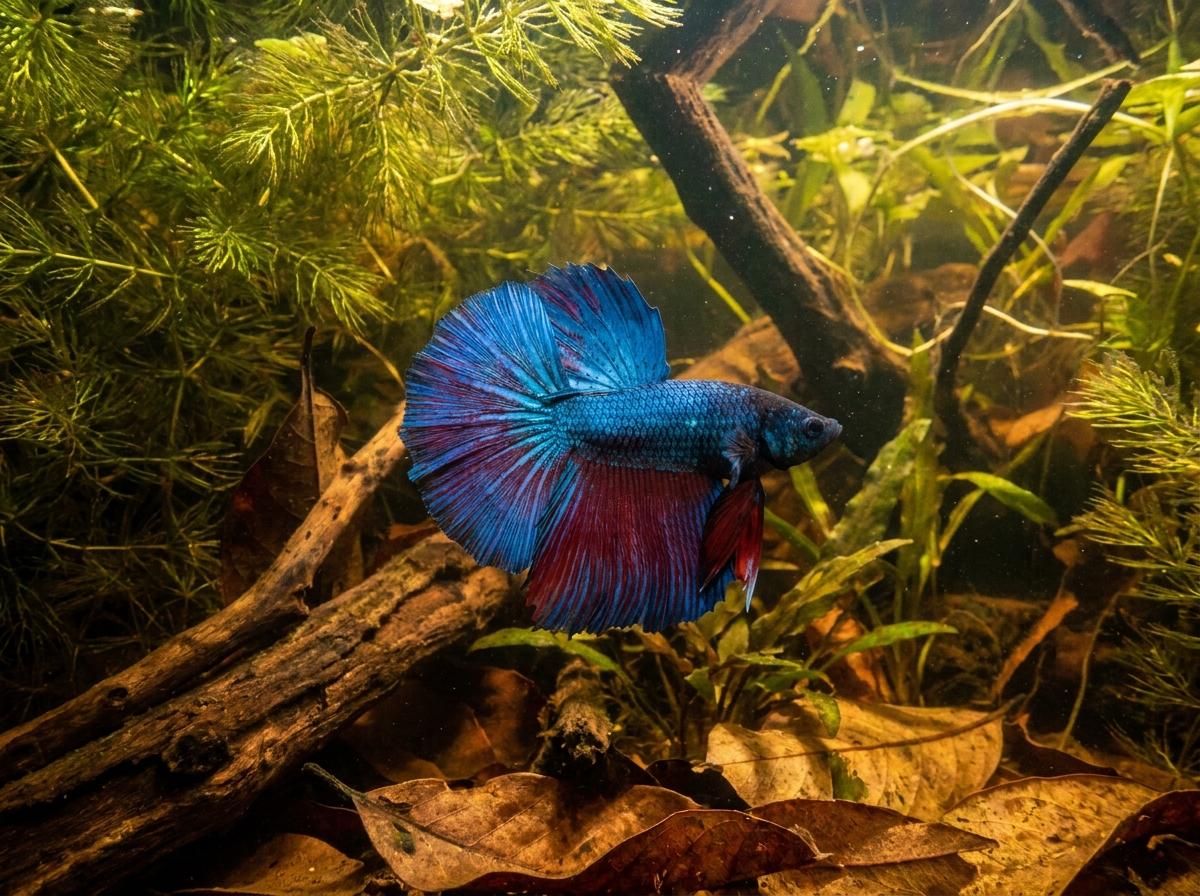
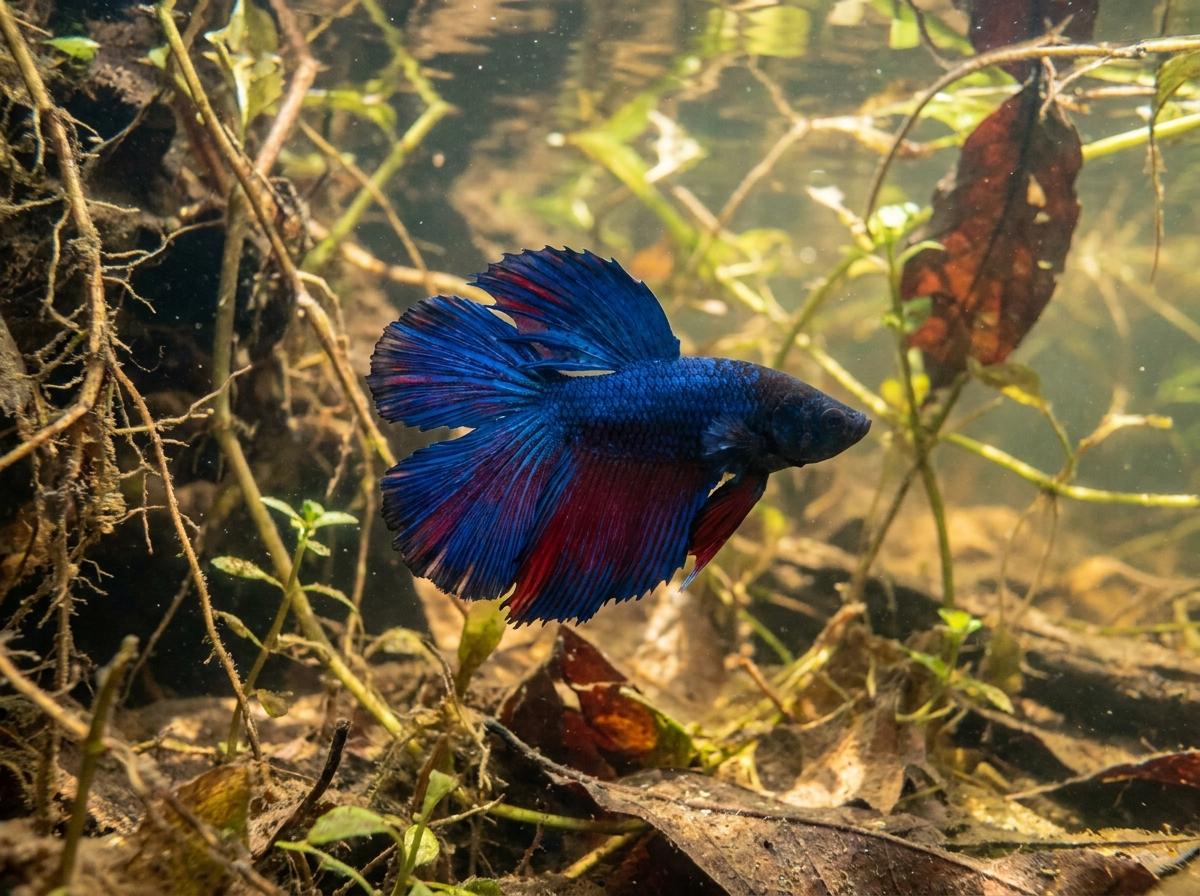
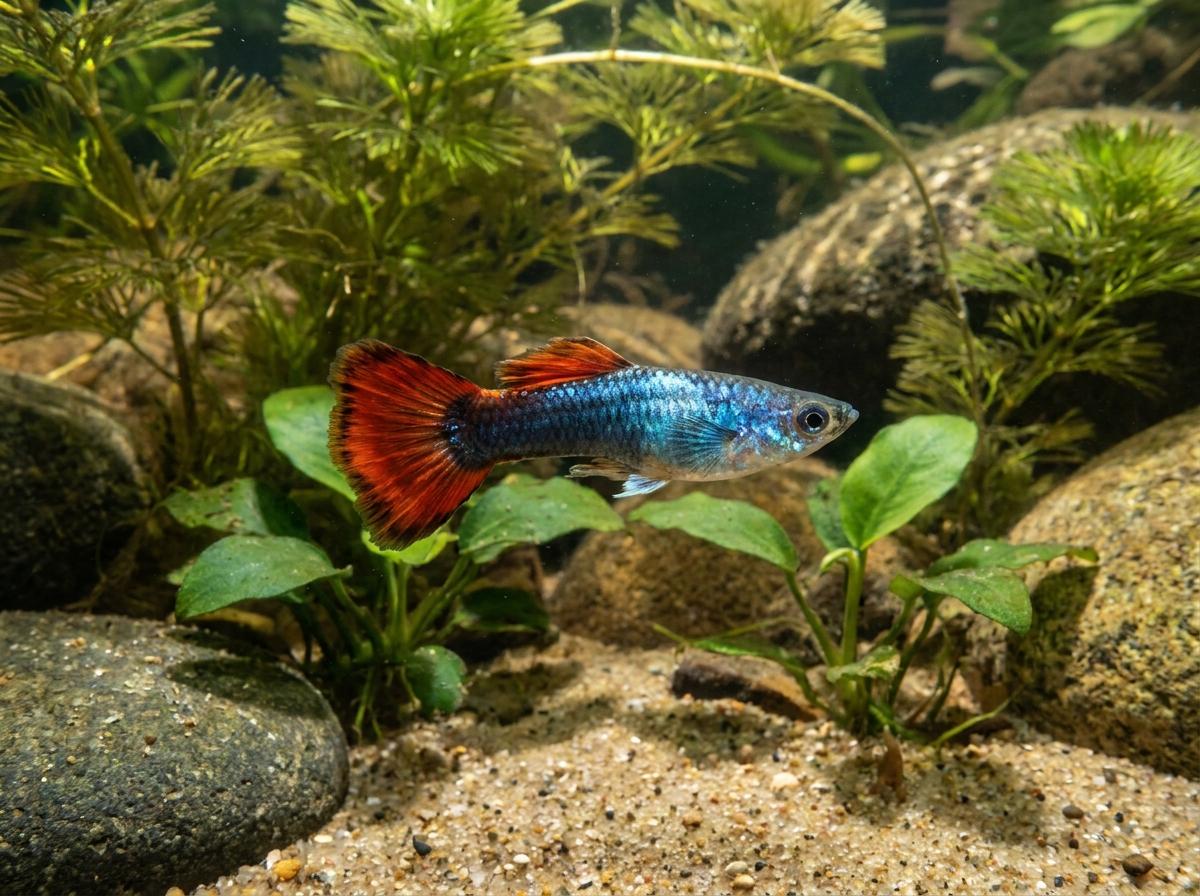
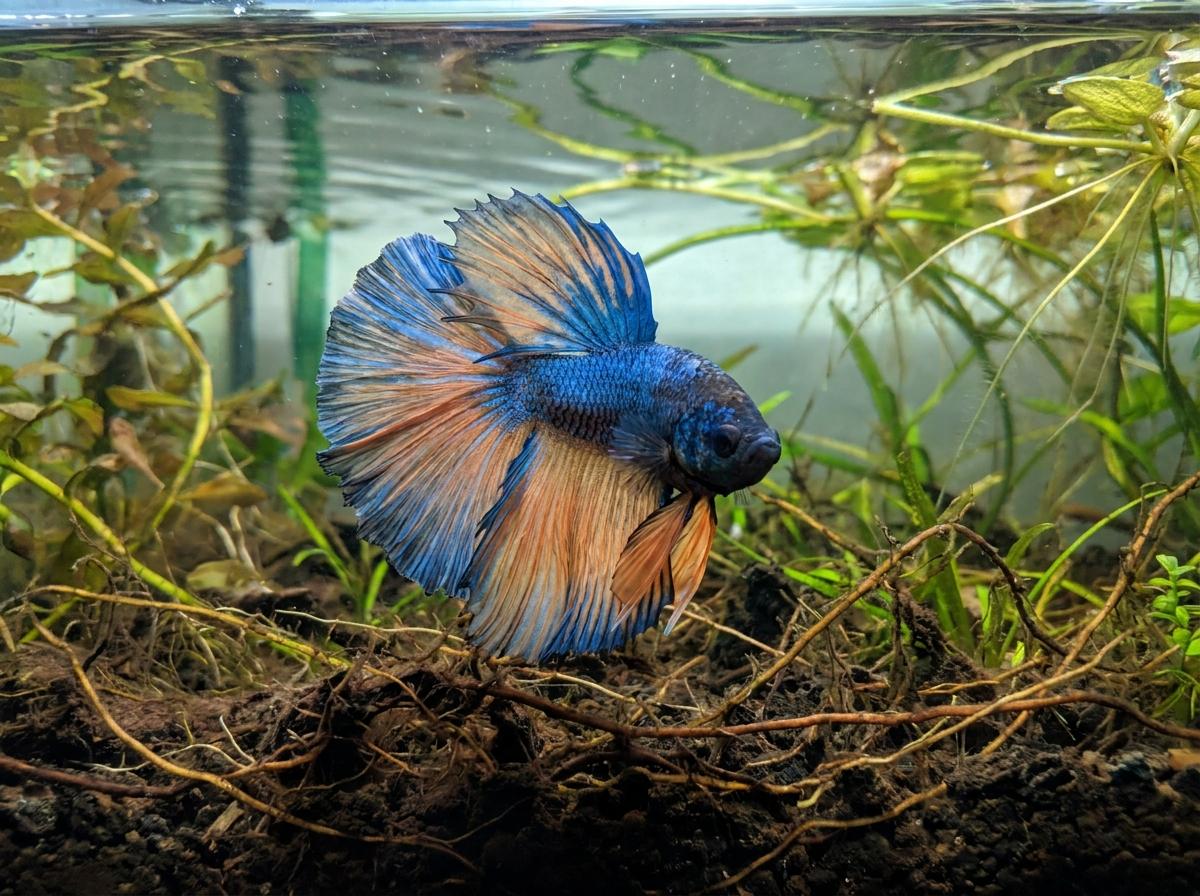
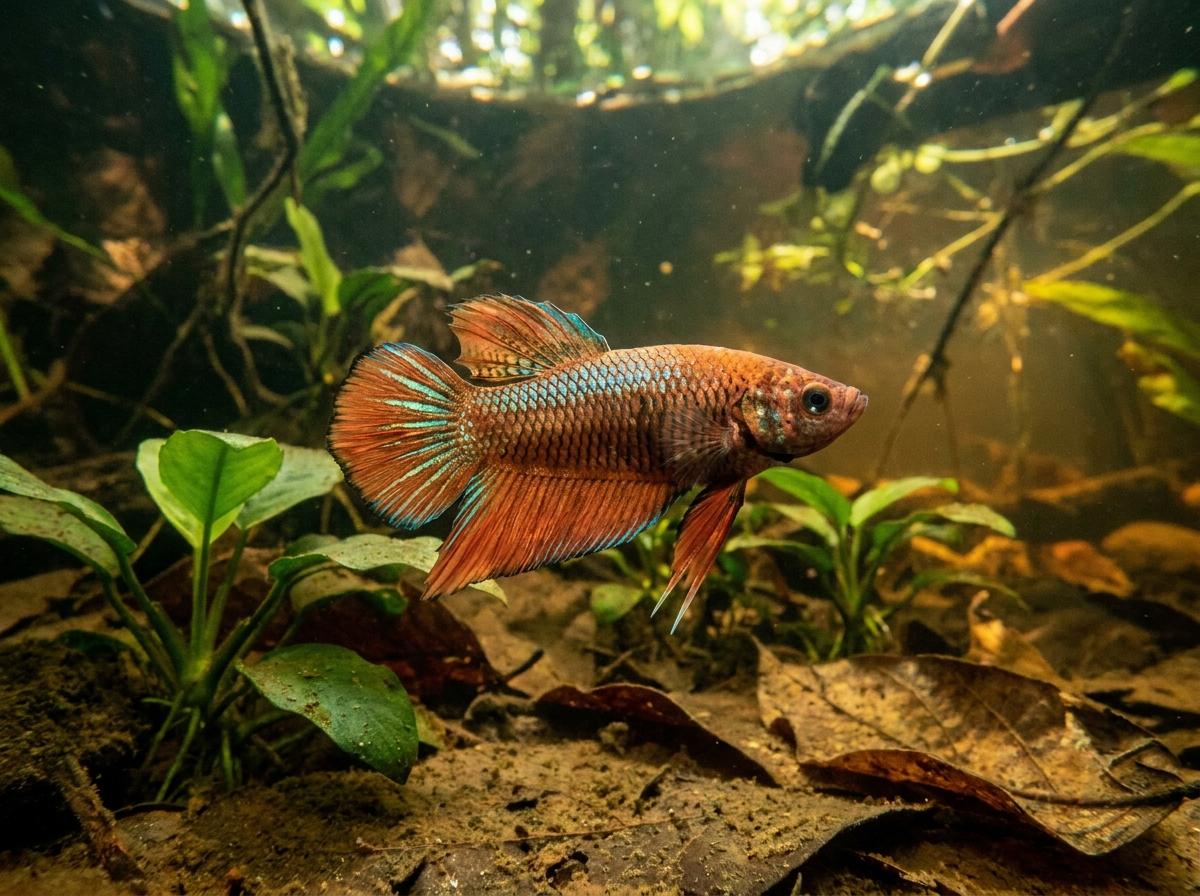
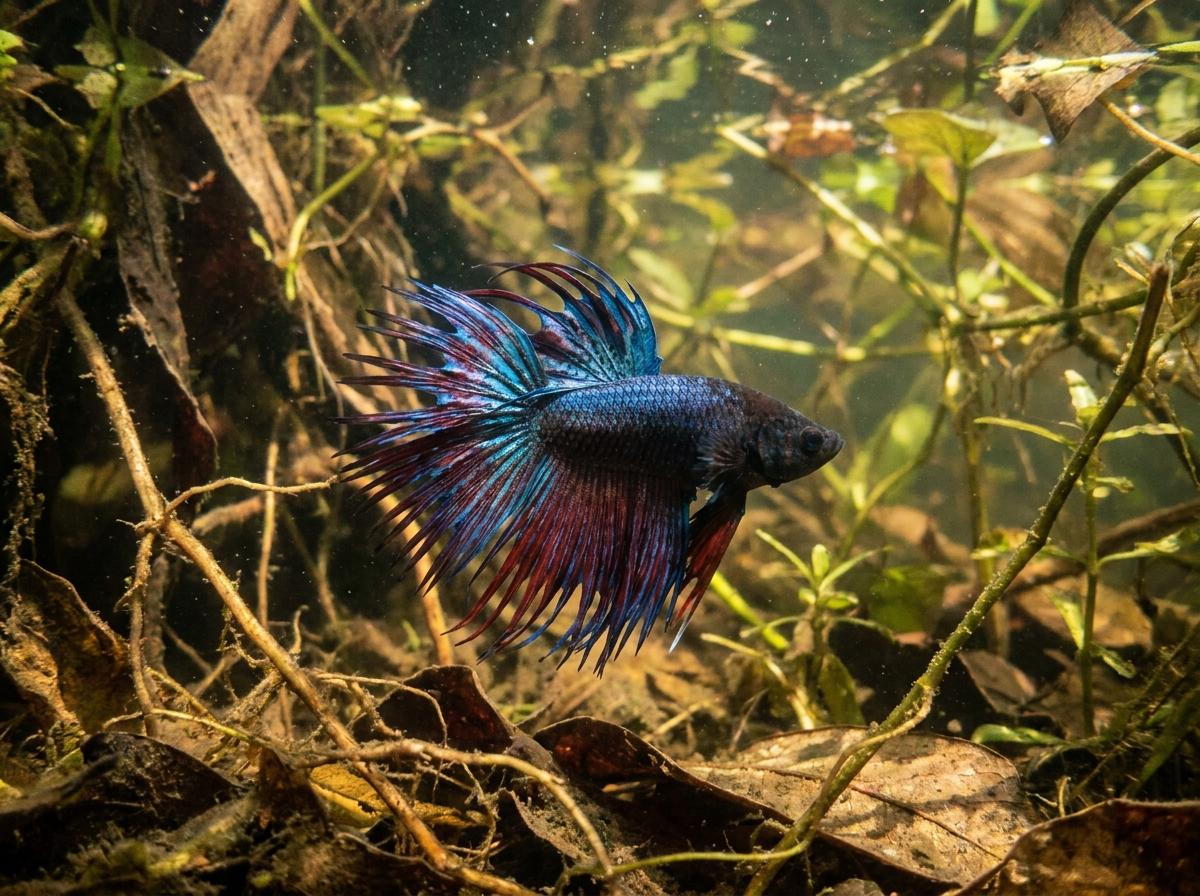
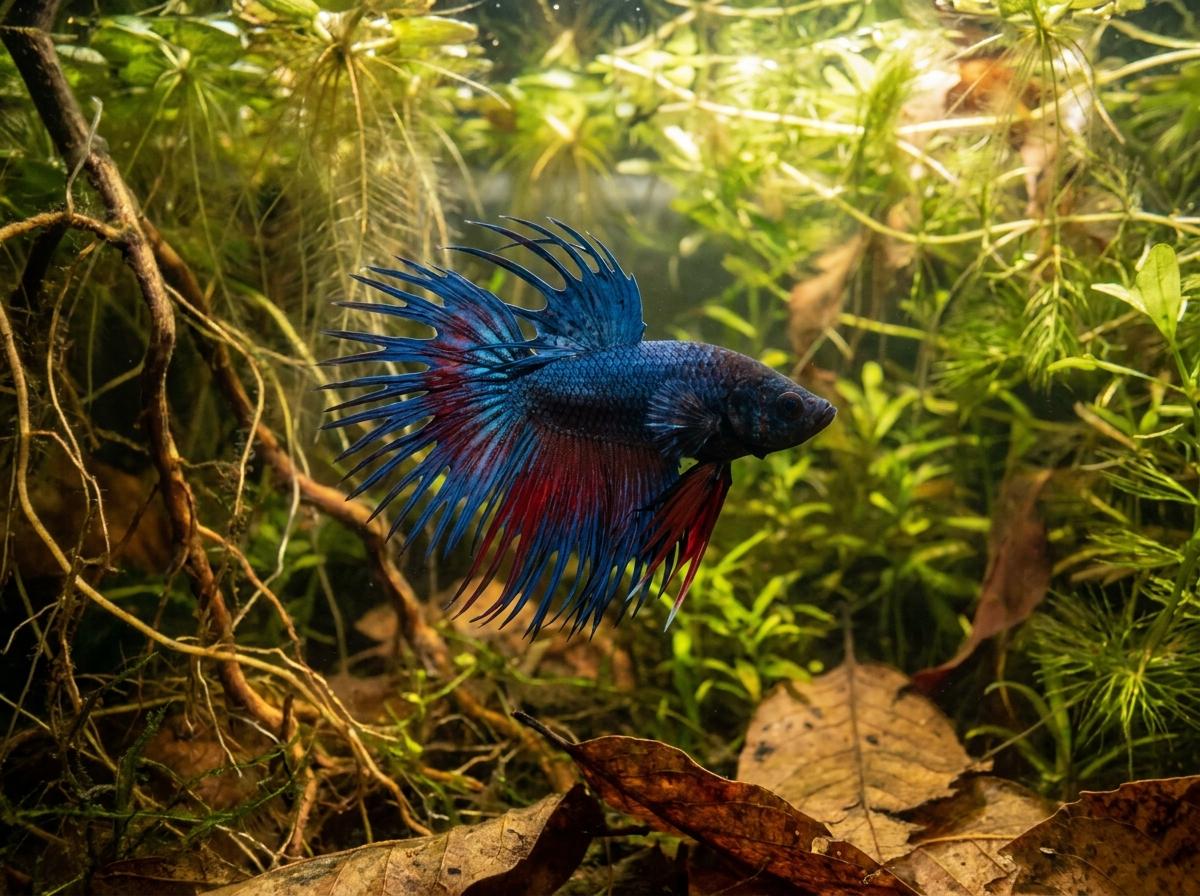
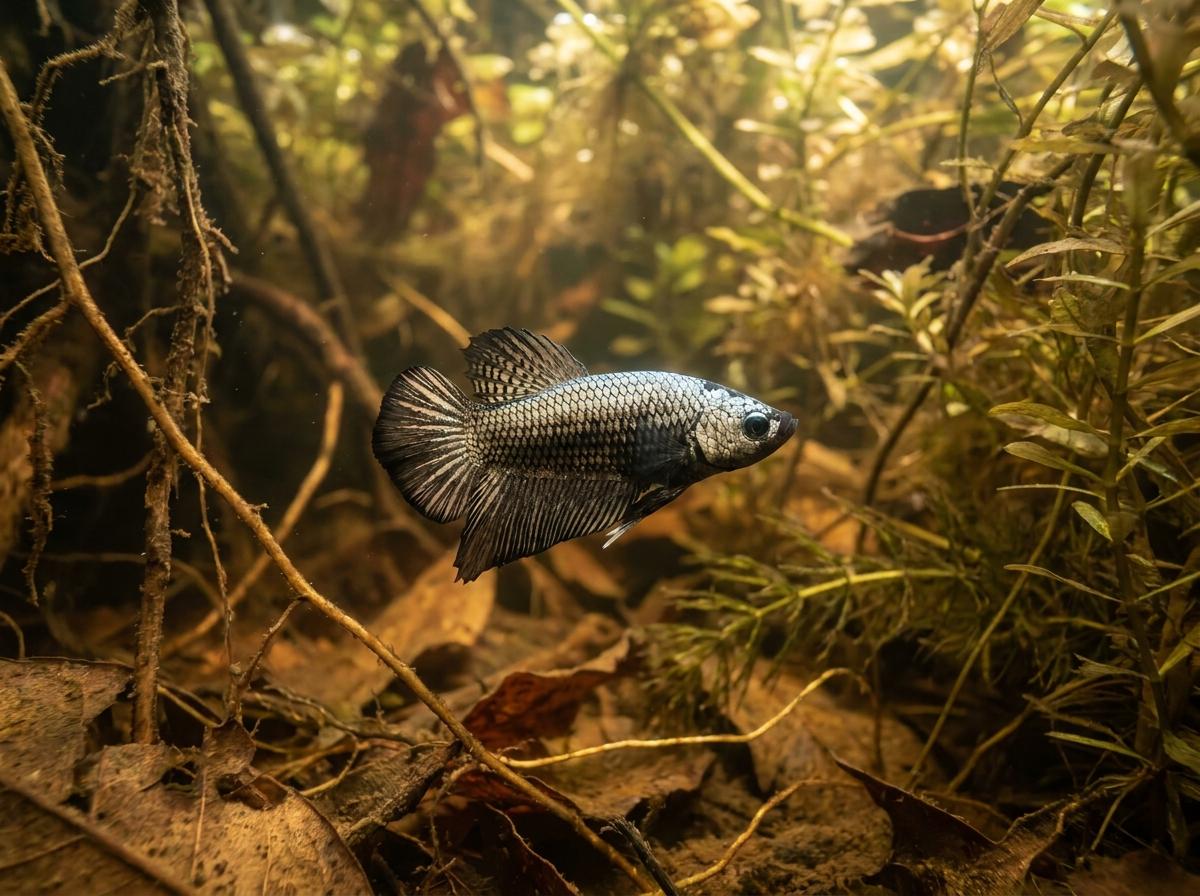
A samurai betta is not a species and not a breed. It is a trade name for a Betta splendens carrying very heavy metallic scale plating, thick and opaque enough that the body reads as armor and the head as a mask, usually paired with fins in a clearly contrasting color. The word is seller shorthand. Read the International Betta Congress exhibition standards, the rulebook the hobby is actually judged against, and “samurai” does not appear anywhere in it.
What does appear is Dragon Scale, which the standards define as a color pattern “with the scales thickened by a heavy layer of metallic color over the body with a full mask over the head, giving the appearance of armor plating, like the mythological dragon.” That is the phenotype a samurai fish is being sold on. The honest translation is that samurai means a dragon scale presentation, most often on a short finned plakat, priced and marketed under a name that no governing body defines. Two fish sold as samurai do not have to match, and often will not.
That matters more than it sounds, because the same scale plating that earns the premium is the trait with a health question attached to it. This page separates the naming from the fish: what the label means, how it stacks with the other two labels you will see on the same animal, what the published evidence says about heavy metallic selection and the eye, and how to house one properly. Care comes first here, because the tank decides how the fish lives and the label does not. If you are still working out the wider picture, the Creatures betta fish species page is the place to compare presentations side by side.

Browse listings, public profiles, breeders, or add your animal.
What a samurai betta actually is
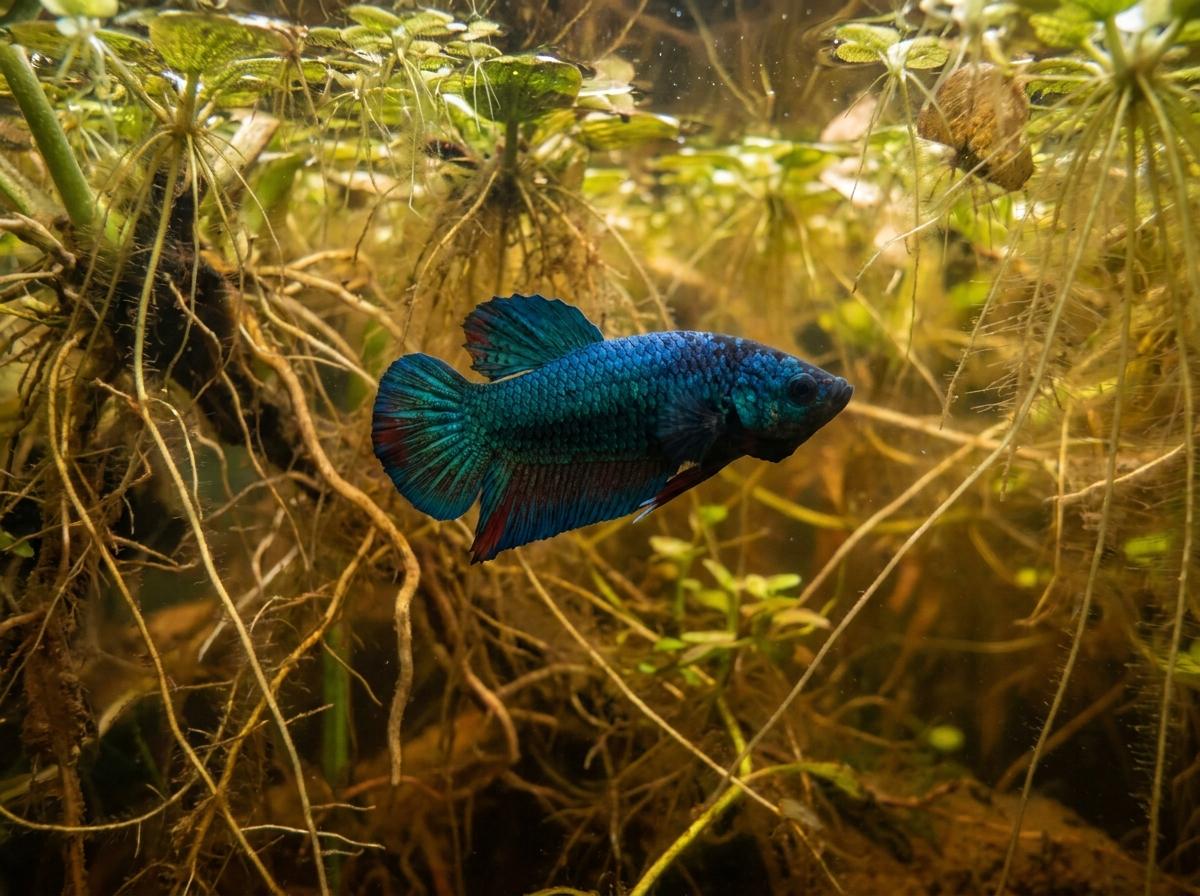
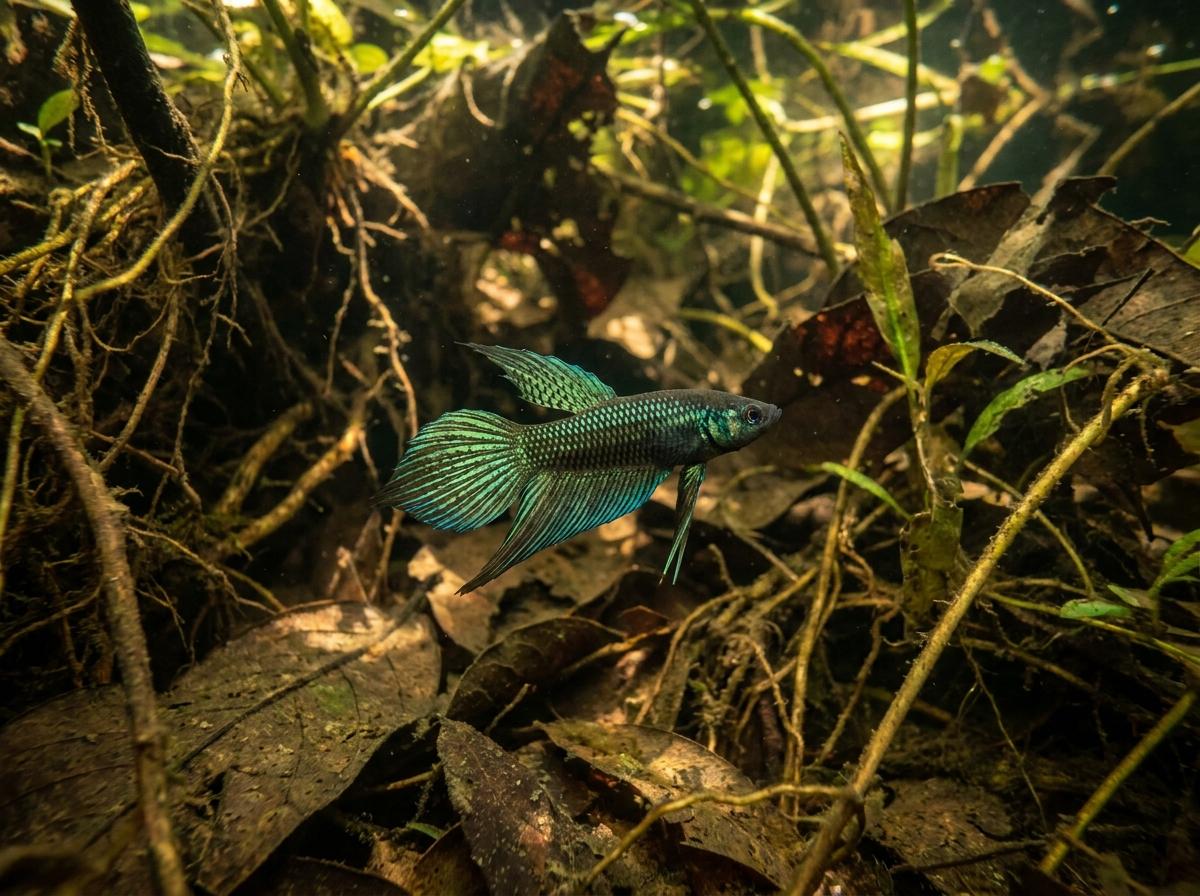
Every betta sold in a shop is one species, Betta splendens. The US Fish and Wildlife Service screening summary for the species records it as native to Southeast Asia, living in shallow ponds and rice paddy fields with heavy vegetation, and reaching about 6.5 cm total length (Ecological Risk Screening Summary, USFWS). Everything the trade calls a variety sits on top of that one species.
The plating itself is a pigment cell effect. The metallic look comes from light reflecting cells called iridophores, and the betta standards describe the metallic group as the spread of yellow reflecting chromatophores that interact with the fish’s normal green and blue iridescence, producing the shiny dark bodied fish sold under names like copper. Dragon scale takes that further: the layer becomes thick and opaque enough to hide the scale margins and cover the head as a solid mask. When a seller writes samurai, that thick plated look is what is being described.
Where did the metallic lines come from? Genomic work on the species points at wild relatives. A 2022 study of 727 betta genomes found that current breeds “have a complex domestication history with extensive introgression with wild species” (Science Advances), and a companion study the same year found “bidirectional hybridization between domesticated ornamental betta and other wild Betta species” (Science Advances). The International Betta Congress makes the same point in plainer language, quoted in the federal screening summary above: today’s show bettas were bred out of Betta imbellis, Betta mahachaiensis, Betta smaragdina and the original Betta splendens.
So the fish is real and the trait is real. The name is the soft part. Samurai sits alongside dragon, armor, copper samurai and black samurai as words breeders and sellers apply to overlapping looks, and those words move with fashion rather than with any registry. Treat a variety name as a description of what the seller believes the fish looks like, never as a specification you can hold them to.
What the name does not tell you
- Not a size. Samurai fish are ordinary bettas. Giant lines exist and are judged separately by the standards, but samurai says nothing about them.
- Not a fin type. Plating and finnage are independent, which is the whole subject of the next section.
- Not a temperament. No published work links scale plating to behavior in this species.
- Not a health grade. If anything the evidence runs the other way, which is covered below.
Samurai, Cambodian and super delta describe three different things
Betta listings usually stack three or four words together, and buyers read them as one label. They are not one label. They come from three separate axes, and running them together is how a buyer ends up paying twice for the same trait, or paying for a trait the fish does not have.

Axis one, the scale and pattern morph. This is samurai. It describes how the scales themselves are built: thick, opaque, metallic, plated, masking the head. The formal relative in the standards is Dragon Scale, which is judged on how uniform the plating is and how completely it covers the fish, with an incomplete head mask counting as a major fault and a missing one as a severe fault.
Axis two, the body color pattern. This is where a word like Cambodian sits. The standards define Cambodian as a flesh colored body with fins of another color, and Traditional Cambodian as a flesh colored body with red fins. That page is worth reading beside this one for a reason the standards spell out themselves: the judging term and the genetic term are not the same thing. The show definition is about what the fish looks like, while the genetic Cambodian trait means absence of black pigment. A fish can satisfy one and not the other, and the standards say the show definition wins in the show hall.
Axis three, the fin type. This is where super delta sits, and it is another hobby word rather than a class. The standards judge Halfmoon, defined as a caudal spread of 180 degrees “making a crisp letter D with its tail”, alongside Crowntail, Plakat in traditional, show and giant forms, Doubletail, Large Pectoral and Veiltail. There is no delta or super delta class in the book at all. Super delta is the trade’s term for a caudal that opens wider than a delta but stops short of a full 180, which is a real and visible difference, just not a judged one.
Why the three combine freely
They combine because the underlying genetics are largely independent. The 2022 domestication study found genes under recent strong selection “that have large effects on color in specific parts of the body or on the shape of individual fins and that most are unlinked” (Science Advances). Unlinked means they are inherited separately, which is exactly why breeders can move plating onto any fin type and any color base, and why a listing can honestly read samurai Cambodian super delta and describe one fish.
The practical version, when a seller hands you three words: ask which axis each word is on. If two of them are on the same axis, one of them is decoration. If a word is on no axis you recognize, ask what it means, and expect an answer about appearance rather than about a standard.
Housing a betta well, before anything else
Bettas are among the pet fish most commonly housed badly, and one myth does most of the damage: the labyrinth organ. Bettas do breathe air at the surface, which is true and is why they survive in shallow, warm, low oxygen water in the wild. It does not follow that they can live in a cup. Breathing air does nothing about ammonia, and ammonia is what accumulates fastest in a small volume of water.
The Merck Veterinary Manual puts a number on that. A calculated un-ionized ammonia concentration of 0.05 mg/L “is high enough to cause histologic changes to gill tissue and is considered harmful to fish”, and new tank syndrome is ammonia rising in the first two to three weeks after a new system is set up, because the biofilter has not developed yet (Merck Veterinary Manual). The same manual notes that a biofilter in a tropical tank can take up to eight weeks to establish (Management of Aquarium Fish). A cup has no biofilter and no margin.

Tank size, and what the research actually measured
Two peer reviewed studies published in Animal Welfare in 2024 tested this directly, and they are the most directly relevant evidence a betta keeper can point at.
The first compared five conditions: a 1.5 L jar, a 3.3 L small tank, a 5.6 L medium tank, a 19.3 L large tank, and the same 19.3 L tank stripped of furnishings. Fish in the larger tanks swam and foraged more and spent less time hovering, swimming stereotypically and interacting with the walls. The authors conclude that “small, barren jars and tanks… are detrimental to their welfare, and larger, furnished tanks are more optimal”, and recommend 5.6 L as a minimum for shop display, described as a realistic compromise given retail space, with larger tanks for keeping at home (Clark-Shen et al. 2024).
The second compared a 0.5 L bowl against 10 L, 38 L and 208 L aquaria. Fish in the bowls swam significantly less than fish in any of the three larger tanks, and the authors conclude that “male Bettas require physically enriched aquaria of at least 10 L in volume to ensure full expression of swimming behaviour” (Oldfield and Murphy 2024).
Read together: 5.6 L is a floor for a shop holding a fish for days, 10 L is a floor for behavior at home, and the furnished 19.3 L condition performed best within the Clark-Shen study. A tank of around 19 L, close to 5 US gallons, is the sensible practical minimum for one betta, and more is better as long as the flow stays gentle.
Furnish it, because space alone is not enough
In the first study, the large barren tank produced more abnormal behavior than the large furnished one. Same volume, worse outcome. The authors are explicit: tanks “should not be barren, but should contain gravel/pebbles, as well as plants and other furnishings (e.g. refuges).” The fish used them, resting on furnishings for 47 percent of their resting time on average, and in the large tank spending 29 percent of resting time in or on a hideout and 21 percent on plants.
Practically that means live or soft silk plants, broad leaves near the surface a fish can rest on, at least one shaded refuge, and a substrate. Hard plastic plants with sharp edges are a genuine risk to long fins, which matters more on a long finned fish than on a plakat.
Heat, and stable heat
Bettas are tropical. The recommended aquarium range quoted for the species is 24 to 30 degrees C, roughly 75 to 86 F, and the wild breeding season habitat measured by Jaroensutasinee and Jaroensutasinee averaged 29.9 degrees C, both recorded in the USFWS screening summary. A room temperature tank in most homes sits below that and swings daily, and swings are their own problem: sudden changes of even a few degrees can compromise immunity and increase the pathogenicity of some infectious agents, per the Merck Veterinary Manual. An adjustable heater sized to the tank, plus a thermometer you actually read, is not optional equipment.
Filtration, cycling and gentle flow
Cycle the tank before the fish goes in, and give it time. Two to three weeks is when ammonia spikes in an uncycled system and up to eight weeks is what a tropical biofilter can take to mature, so a fish added on day one is living through the spike.
Keep the flow soft. In the tank size study, fish rested on the filter in only one of the 45 trials where a filter was inside the aquarium, which the authors summarize as the fish avoiding the filter. A sponge filter, or an outflow baffled against the glass or a plant, gives you biological filtration without pushing a long finned fish around.
A lid, and an air gap
Keep the tank covered, and leave an air gap between the cover and the water so the fish can still reach the surface to breathe. The betta hobby’s own show rules require an individual lid on every show container, and specifically warn that wild type and giant bettas “are prone to jump when disturbed”. Treat a cover as standard on any betta tank rather than a precaution for exotic types only.
One male to a tank
This is the rule that never bends. The 2024 bowl study tested paired fish in tanks up to 378 L and still concluded that “large, enriched spaces… are insufficient to ensure that multiple males will cohabitate peacefully”. More space reduces displays. It does not make two males safe together. Keep one male per tank, and treat any community plan as a question for someone who knows both species involved, because a betta with long fins is also a target for fin nippers.
Feeding, briefly
Wild bettas are carnivores eating mosquito larvae and other water insects, per the sources compiled in the USFWS summary. A quality betta or small carnivore diet suits them, fed in small amounts. Overfeeding is a water quality problem before it is a nutrition problem, because uneaten food and extra waste degrade the water the fish has to breathe in.
And the veterinary line
Anything that looks like disease, injury, an eye change or a growth is a veterinary question. Aquatic veterinarians exist and treat ornamental fish. Nothing on this page is a diagnosis or a treatment plan, and a fish that is unwell needs someone who can examine it.
Heavy metallic scales and the eye: what the evidence says
Here is the part that a listing will not tell you. In the hobby, thick metallic scale tissue growing across the eye of a dragon scale betta is called diamond eye, and keepers report that it can reduce or destroy vision in the affected eye. The honest question is what evidence stands behind that, so here is exactly what exists and what it shows.

The show standards already treat pigment over the eye as a real failure. The International Betta Congress list of disqualifying faults includes blindness, with a parenthetical noting it especially in opaques and albinos, and in the opaque color class the standards list “opaque covering eyes” as disqualifying when the fish cannot see, tested by whether it will flare at a fish it should be able to see. That is a standards body acknowledging that heavy pigment layers reach the eye in some selected lines. The standards do not attach an equivalent eye fault to the Dragon Scale subgroup, which is a limit worth stating rather than glossing.
One peer reviewed case report documents it in a dragon scale fish. In 2022, veterinarians described an eight month old male giant koi dragonscale plakat betta presented for ocular abnormalities and a tail mass. Pigmentary keratitis, anterior uveitis and a mixed chromatophoroma were found on histology, and the fish was euthanized ten weeks after presentation for declining quality of life. The authors reviewed both the hobbyist and scientific literature and concluded that “both the neoplastic disease and ocular disease may have had a genetic cause in this particular colour morph”, closing with the line breeders should sit with: “ethical fish breeders should select away from characteristics that decrease lifespan and affect quality of life” (McLaughlin et al. 2022, Aquaculture, Fish and Fisheries).
A separate line of evidence concerns the pigment cells themselves. A 2025 veterinary pathology study described 71 iridophoromas, tumors of the light reflecting cells that produce metallic color, in farmed Siamese fighting fish. Forty five of them, 63 percent, were malignant. The authors report a higher occurrence in royal blue and fancy copper color patterns and in young males, and conclude this “suggests a potential genetic/hereditary factor in the tumorigenesis of these neoplasms” (Diniz et al. 2025, Veterinary Pathology). A 2025 case report in the Journal of Fish Diseases describing a malignant mixed irido-melanophoroma makes the same general point, that “a genetic predisposition has become a significant concern regarding the increasing incidence of chromatophoromas and other inherited diseases in these pet betta fish” (Yu et al. 2025).
What that adds up to, stated carefully
It is a case report, a tumor series from one breeding facility, and a show standard, not a prevalence study. Nobody has published a figure for how often diamond eye occurs in dragon scale fish, and this page is not going to invent one. Read against a listing, the evidence supports three specific statements and no more:
- Pigment and scale tissue covering the eye in heavily pigmented betta lines is documented well enough that the hobby’s own standards body disqualifies the result.
- In at least one veterinary case, ocular disease and a pigment cell tumor in a dragonscale fish were judged likely to have a genetic component tied to the color morph.
- Selection on iridophores, the cells that make metallic scales metallic, is associated in a published tumor series with a higher occurrence in two heavily metallic color patterns.
None of that means a samurai betta will go blind. It does mean that heavy metallic plating is a selected extreme with a plausible cost, not a free decoration, and that a seller who tells you the look carries no trade off is either uninformed or is not being straight with you.
What to do about it
Look at the eyes before you buy, both of them, from the side and from the front. You want a clean circular rim with the plating stopping at the edge of the socket, not creeping across it. Watch the fish track food or your finger. Ask the breeder directly whether they see diamond eye in their line and what they do about it, and take a straight answer as a good sign rather than a red flag. If a fish you already own develops a film, a crust or tissue moving over the eye, that is a veterinary visit, not a home procedure. Keepers do manage partially sighted fish by feeding in a consistent spot and keeping the layout stable, but the diagnosis and the plan belong to a vet who can see the animal.
What to ask before you buy
- Which axis is each word on? Scale morph, body color pattern, fin type. Three words should not all be describing the same thing.
- How old is the fish, and are the parents still alive? Age at sale and parent longevity say more about a line than any label.
- Do you see diamond eye or lumps in this line? Ask it plainly.
- What is it living in right now? A seller keeping stock in heated, cycled, planted tanks is telling you something a photo cannot.
- Photographs of the actual fish, from both sides. Plating is often uneven, and a single flattering angle hides it.
- What are you feeding it? Switching diet and water chemistry on the same day is avoidable stress.
Betta prices vary too widely to quote honestly, and they move with fashion, import route and how a fish photographs. Anyone quoting a fixed market price for a name that no body defines is guessing. Browse betta listings on Creatures to see what is actually being asked, and set an alert if nothing matching is up today.
What to record once the fish is home
A betta is a short lived animal in a small closed system, so the useful records are the boring ones: water parameters, temperature, the date the tank finished cycling, what the fish eats, and anything that changes about the eyes, fins or scales. Dated photographs are worth more than memory here, because plating and eye changes are gradual and you will not notice a slow change without a baseline.
Keep it in one place rather than in a notebook that goes missing. On Creatures you can create a free profile for the fish, log records against it, and set reminders for water changes and filter maintenance, which is the part most keepers drop first.
Frequently asked questions
Is samurai a real betta variety?
It is a real look and a widely used trade name, but it is not a recognized class. The word does not appear in the International Betta Congress exhibition standards, which define Dragon Scale for the plated metallic phenotype that samurai fish are sold on.
What is the difference between a samurai betta and a dragon scale betta?
In practice, very little. Dragon Scale is the defined pattern, thick metallic plating over the body with a full mask over the head. Samurai is a seller’s name for the same kind of fish, often applied to short finned plakats and to high contrast combinations such as a dark plated body with pale fins.
Is diamond eye guaranteed in samurai bettas?
No, and nobody has published how common it is. What exists is a veterinary case report of ocular disease in a dragonscale plakat where a genetic cause tied to the color morph was judged plausible, a show standard that disqualifies blindness and pigment covering the eyes, and a tumor series linking iridophore tumors to heavily metallic color patterns. Treat it as a real risk to check for, not a certainty.
How big a tank does a betta need?
Bigger than the container it was sold in. Published welfare work recommends at least 5.6 L for shop display and at least 10 L of enriched aquarium for a male to express normal swimming, with the furnished 19.3 L condition producing the best behavior in the 2024 study that tested it. Around 19 L, near 5 US gallons, heated, filtered, cycled and planted, is the sensible practical minimum at home.
Can I keep two samurai bettas together?
Not two males. A 2024 study that paired males in tanks up to 378 L still concluded that large enriched spaces are insufficient to ensure males will live together peacefully. One male per tank.
How long do bettas live?
There is no dependable published figure for well kept aquarium fish. The species database figure quoted in the USFWS screening summary is a maximum reported age of about two years, which reflects records for the species rather than a target for a home aquarium, and keepers commonly report longer in stable heated tanks. Buy on the condition of the fish rather than on a promised lifespan.
Does the plating affect how the fish behaves?
No published work links scale plating to behavior in this species. The 2022 genome-wide study mapped aggression to a polygenic signal involving multiple neural system genes, separately from color, so a plated fish is neither calmer nor more aggressive because of its scales.
Do this next on Creatures
Whether you are trying to decode a listing, hunting for a specific fish, or already keeping one, Creatures is the records, marketplace and directory layer to do it in one place.
Compare the axes. Read this page beside Cambodian betta for body color pattern and super delta betta for fin type, or start from the betta fish species page.
Find a fish. Browse samurai betta listings on the marketplace and search trusted breeders and shops in the Creatures directory. New to it? See saving searches and using your watchlist.
Get alerted. Named morphs come and go with the shipment, so set a free samurai betta listing alert and we will tell you when one is posted. No account needed to start.
Add your fish. Already keeping one? Create a free animal profile in a few minutes, no account needed to start. The walkthrough is in adding an animal to Creatures.
Track water, feeding and health. Log a record on Creatures. The record sheet opens for any visitor to look around, and a free account is what saves what you enter. See adding a record and health and medical records for the how to.
Do not forget the water changes. Set reminders and upcoming care for water changes, filter maintenance and test days, and see what each profile tab does.
Breeding or selling bettas? List your operation on Creatures so buyers can find you, and read getting listed in the breeder directory.