

Super Delta
Variety
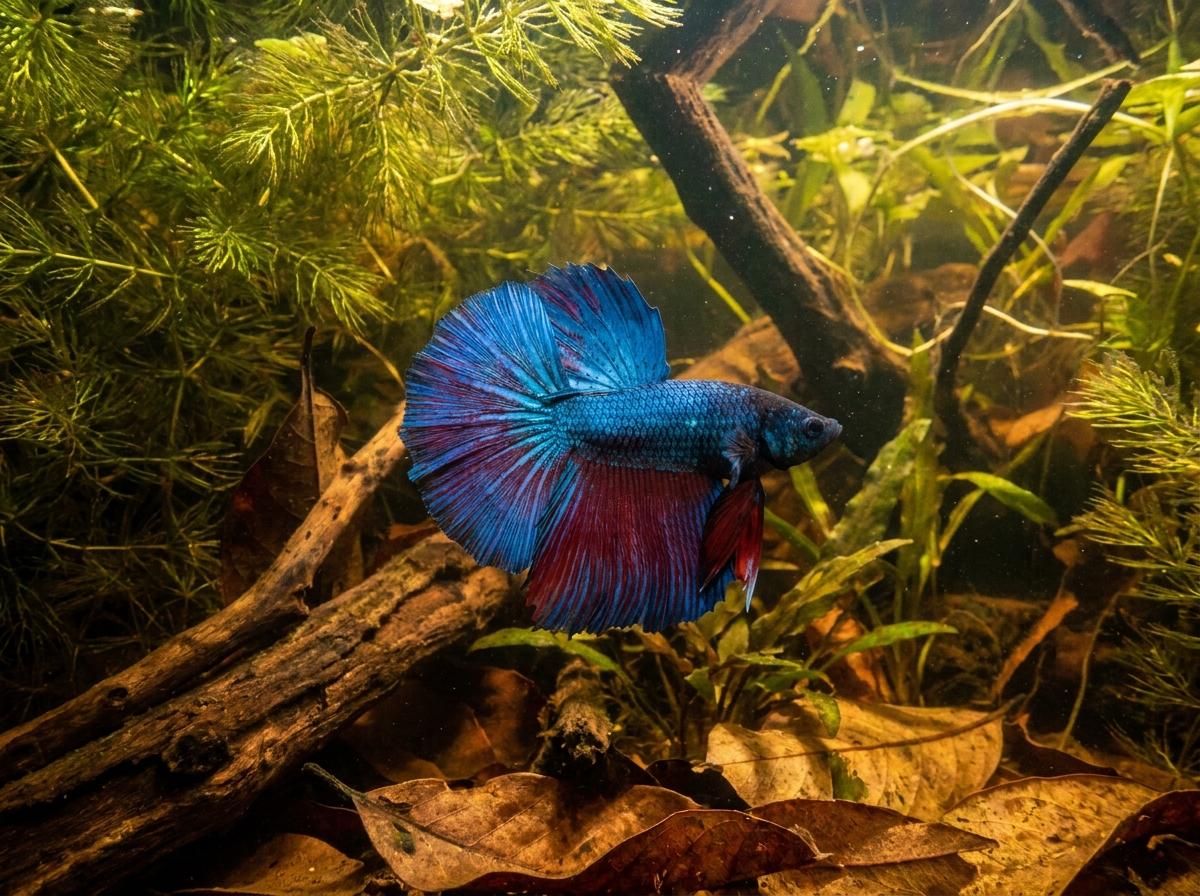
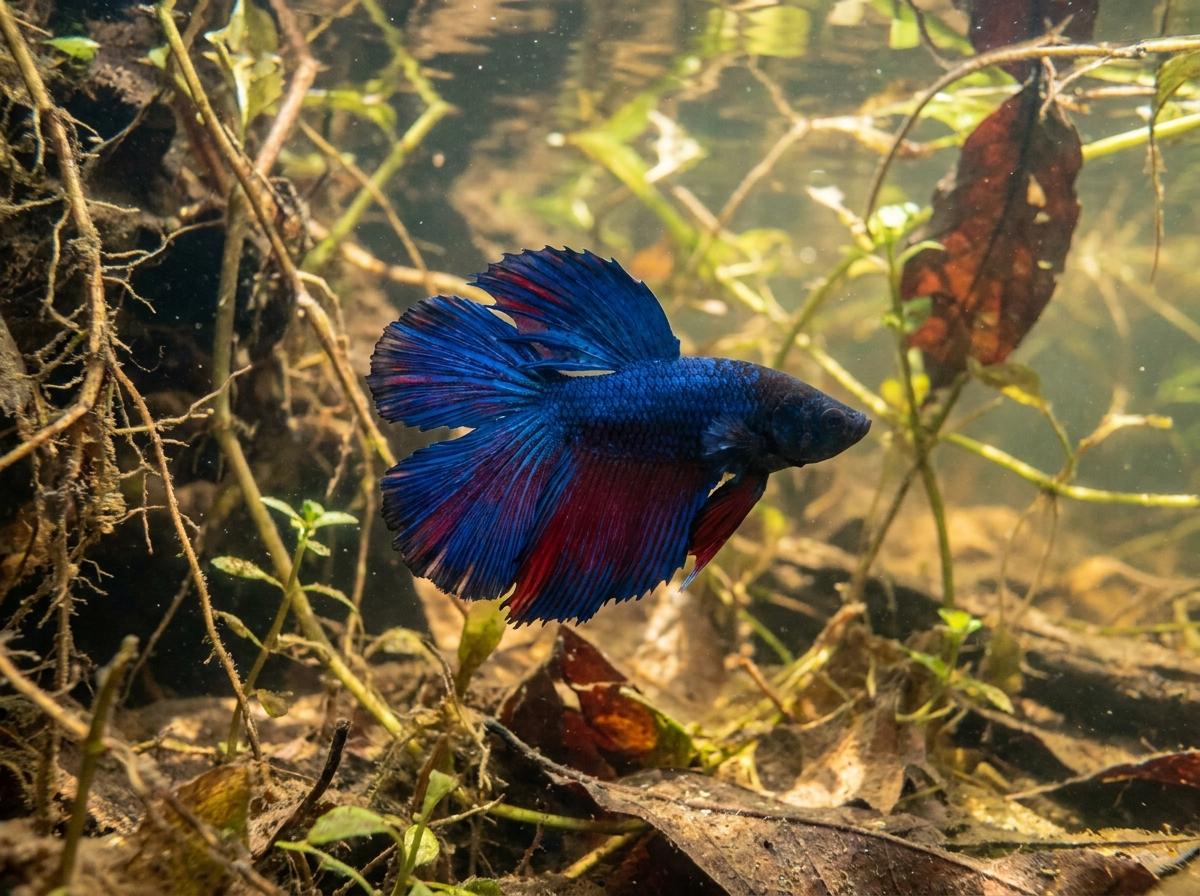
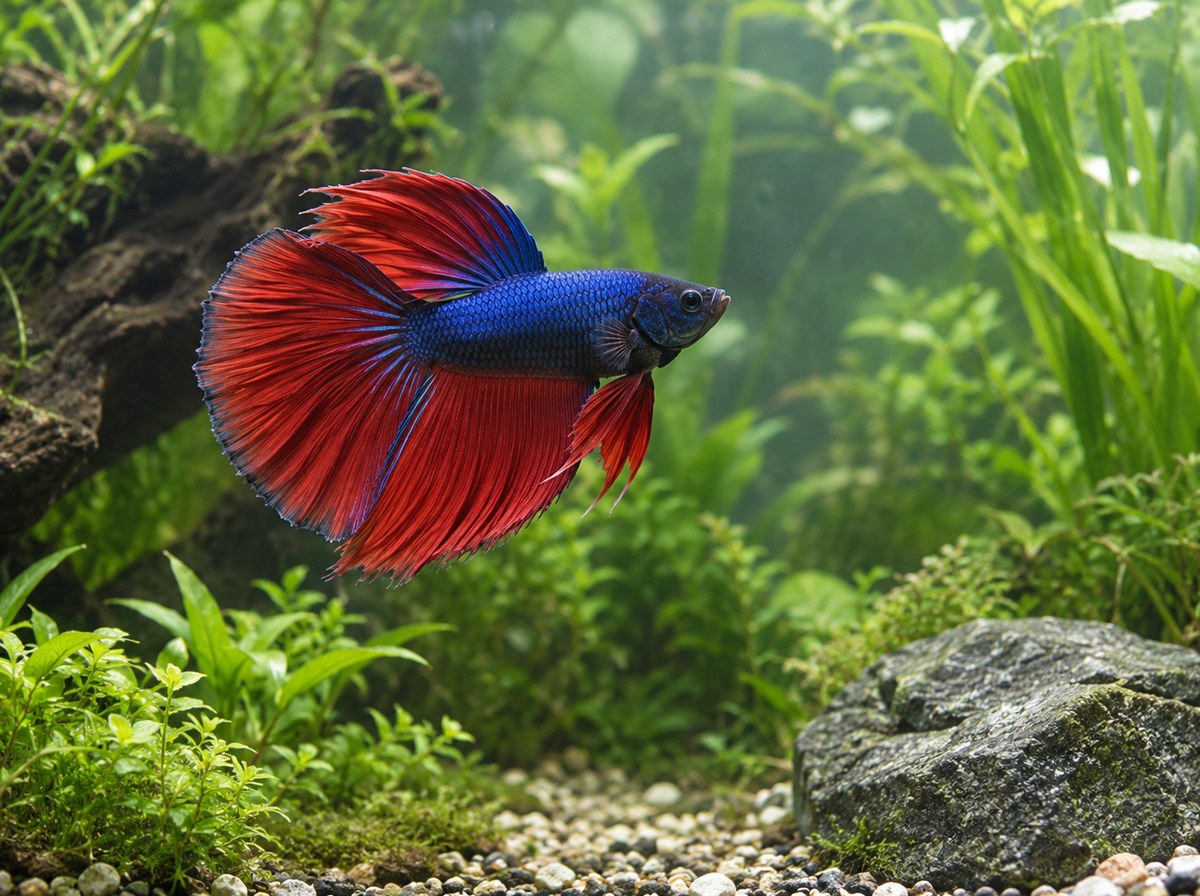
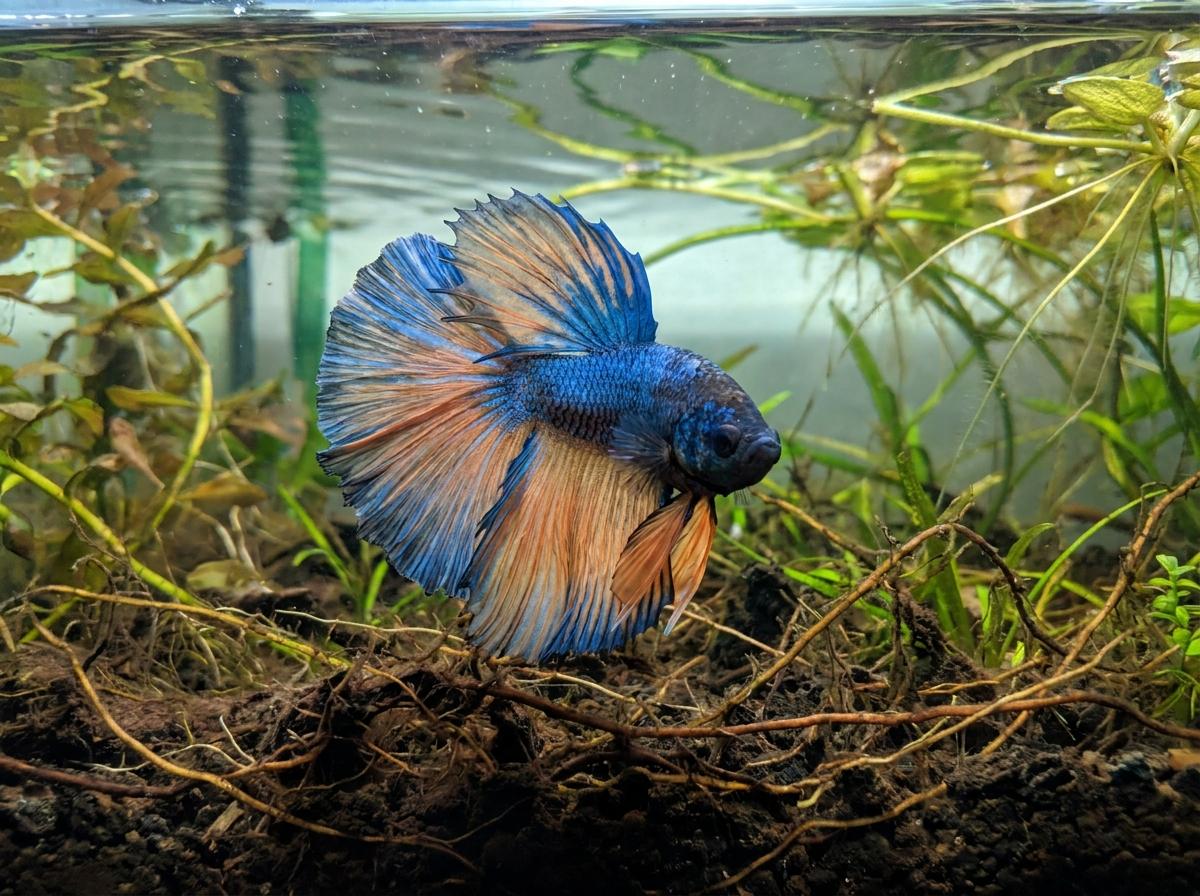
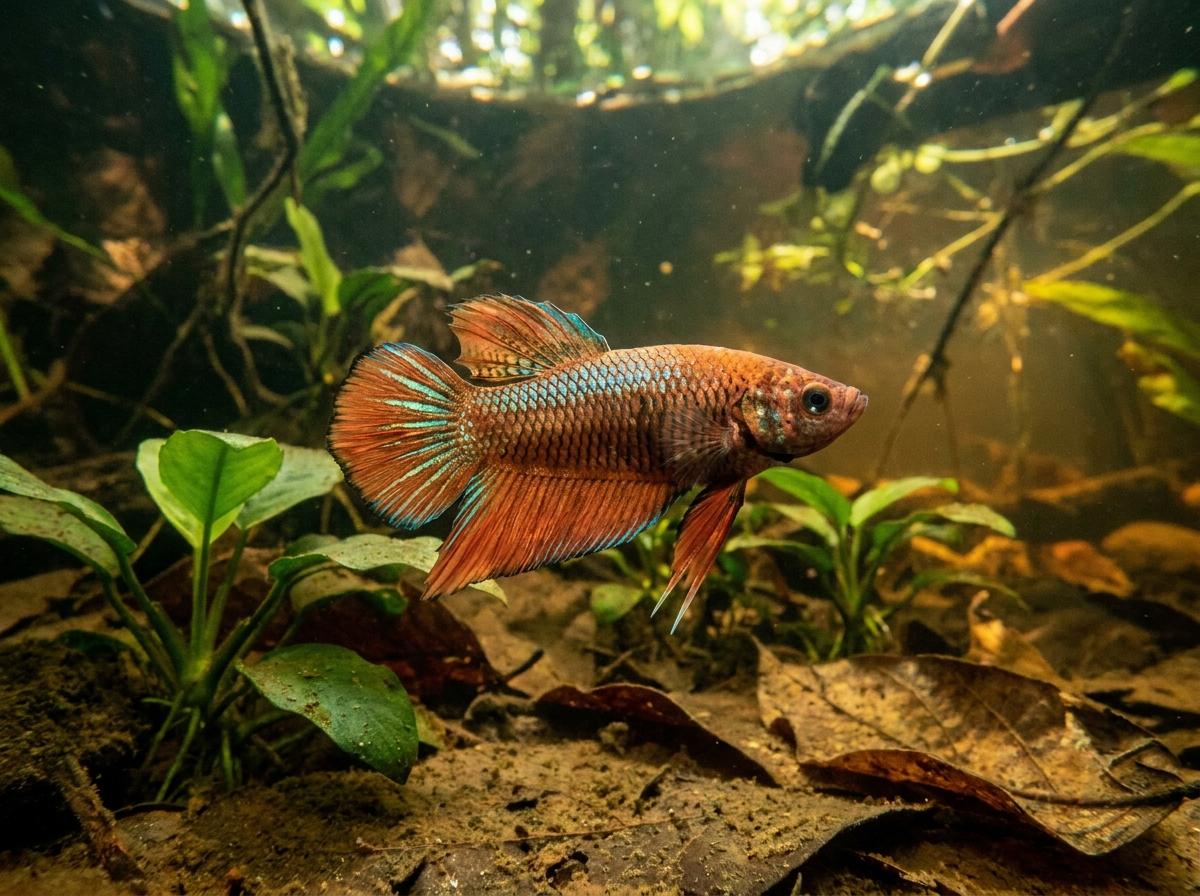
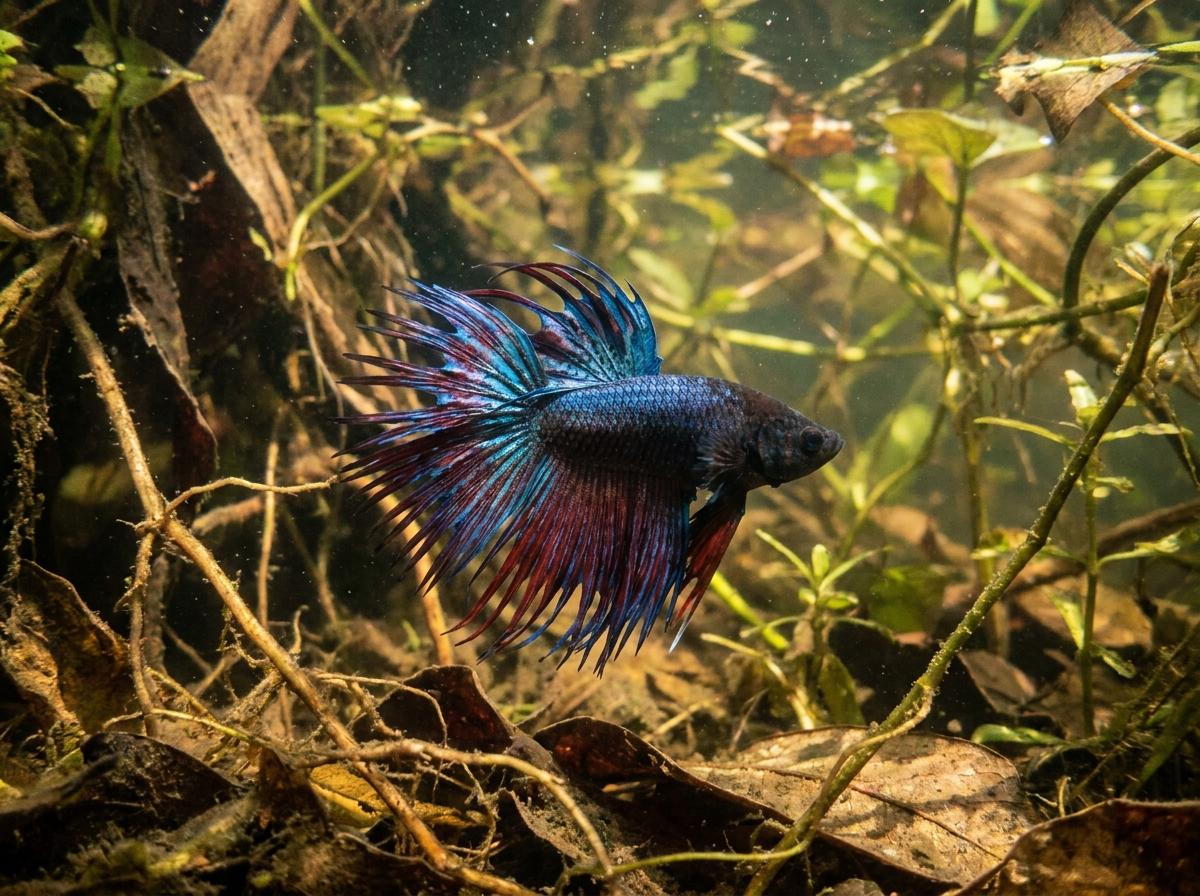
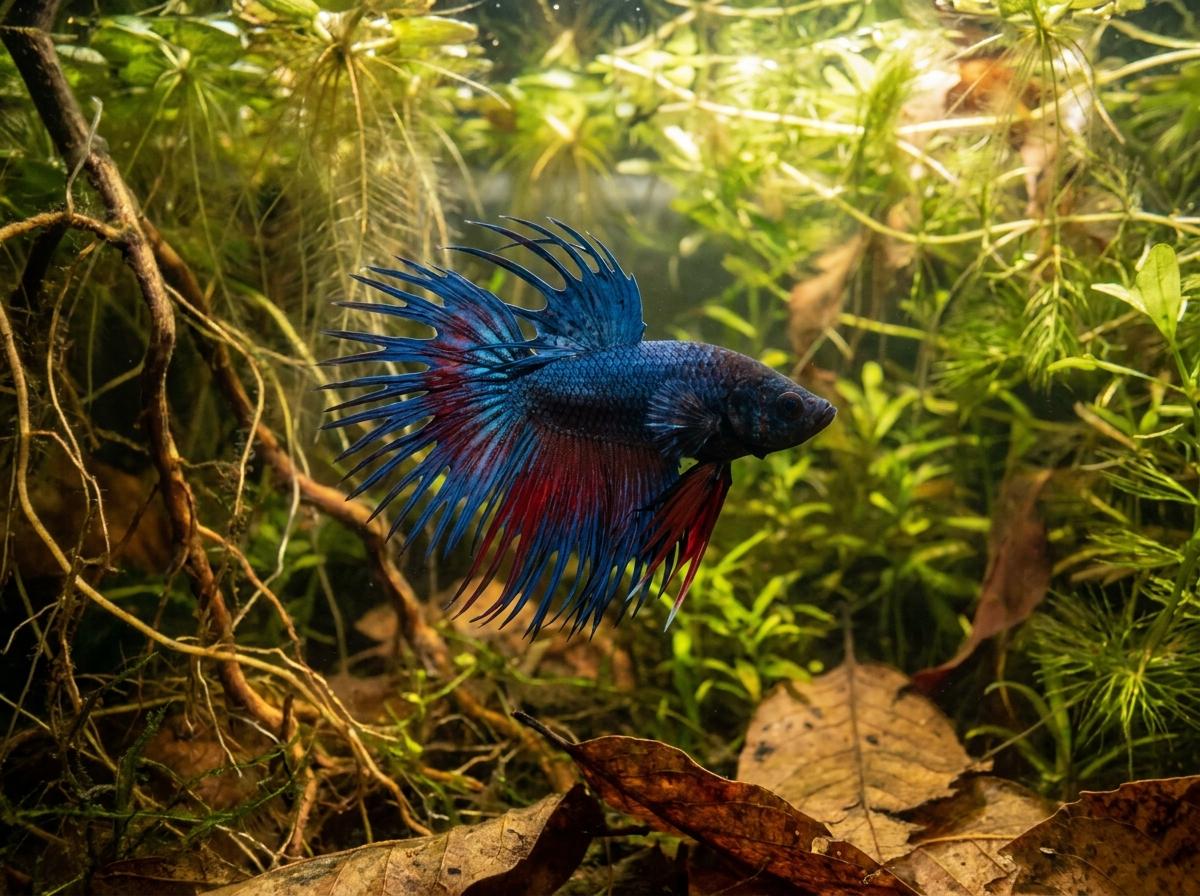
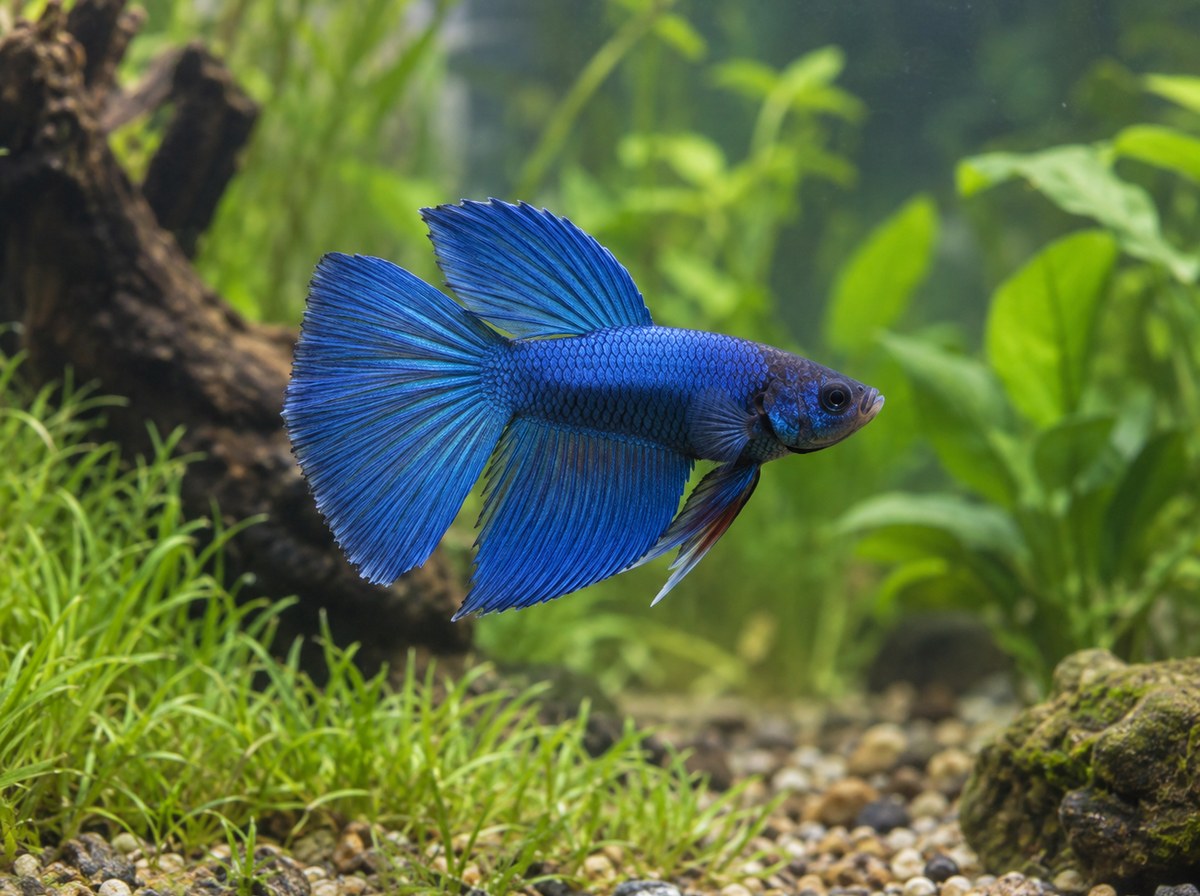
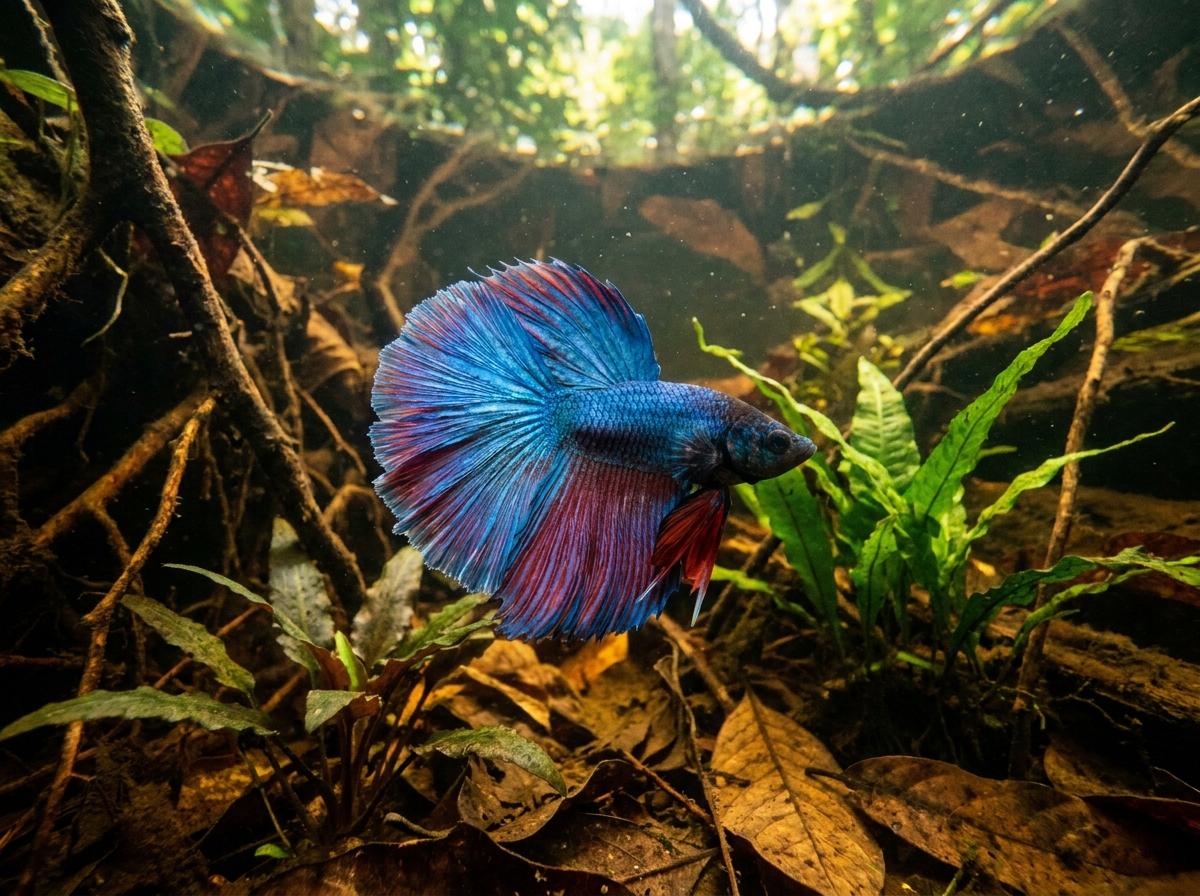
A super delta is not a breed. It is a tail shape: one position on the fin-type continuum that runs through Betta splendens, the domesticated Siamese fighting fish. A super delta’s caudal fin opens wider than a delta’s triangle but stops short of the straight-edged half circle that defines a halfmoon, and hobbyists generally put that somewhere near 120 to 160 degrees of spread. The same fish also carries a color pattern and a scale type, which are separate labels entirely, so a fish can be a Cambodian super delta or a samurai super delta. If you want the wider view first, the betta fish species page collects every variety we track.
The label is worth less than most listings imply. No governing body certifies a super delta. The International Betta Congress, whose exhibition standards are the closest thing the hobby has to a rulebook, runs no delta or super delta class at all, and its general fault guide treats any caudal spread under 180 degrees as a fault to be marked down. Super delta is an accurate and useful description of what a great many long-finned pet-shop bettas actually are. It is a hobby description, not a standard.
What does decide how this fish lives is the tank. Bettas are routinely sold and kept in unheated bowls, jars and desk cubes, and the published welfare work on the species is blunt about what that costs them. So this page puts the care section early, ahead of the show-ring detail, and it is honest about the fact that the long fins people buy a super delta for carry a cost of their own. You can also skip straight to current betta listings if you are shopping now.

| What it is | A tail (caudal fin) type in Betta splendens, not a breed and not a color |
|---|---|
| Tail spread | Wider than a delta, short of a halfmoon’s straight 180 degrees; hobbyists commonly cite 120 to 160 degrees |
| Show status | Not an International Betta Congress class. IBC judges Halfmoon, Crowntail, Plakat, Doubletail, Veiltail and Large Pectoral |
| Origin | A domesticated ornamental form. The wild species is native to Southeast Asia and is listed as Vulnerable |
| Size and lifespan | Wild fish reach about 6.5 cm total length; roughly 2 years is the lifespan figure in the primary literature |
| Tank | Heated, filtered, cycled, planted and covered, with genuine swimming volume. Never a bowl |
| Temperature | Commonly cited aquarium range of 24 to 30 C (75 to 86 F), held steady |
| Social | One male per tank, with no exceptions |
Browse listings, public profiles, breeders, or add your animal.
What a super delta betta actually is
Every domesticated betta you can buy is the same species, Betta splendens. The names in a listing describe traits stacked on that one animal, and tail type is the trait people notice first because it is the most visually dramatic.
Tail types sit on a rough continuum of caudal spread, measured as the angle between the topmost and bottommost rays of the tail when the fish flares:
- Veiltail. The old, long, drooping tail that falls to one side rather than opening into a fan. The long-established pet-shop tail.
- Delta. A tail that opens into a triangle, with a narrower spread than the types below it.
- Super delta. A broader fan than a delta, but the leading edges do not open out into a single straight vertical line.
- Halfmoon. A full 180 degrees, so the tail’s outer edge forms a straight line and the fin makes a crisp letter D.
- Over-halfmoon. More than 180 degrees, sometimes with the fin curling back on itself.
Two more types sit off that spread axis rather than on it. A plakat is short-finned, closer to the fighting fish the species was originally selected for. A crowntail carries extended rays that project past the fin webbing, giving a spiky edge. Both come in their own spread ranges.

What the show standards actually say
Here is the honest version, because it is not what most betta content tells you.
The International Betta Congress exhibition standards are the document breeders and show judges work from, and they are published openly. Read the 2025 to 2026 standards for domesticated Betta splendens and you will find no class called delta and no class called super delta. The single-tail long-finned form classes are Halfmoon and Veiltail, alongside Crowntail, Plakat, Doubletail and Large Pectoral, each with color groups judged separately on top.
The standards go further than simply omitting the term. The general standard for the caudal fin states that in single-tail bettas “the ideal shape is a semi-circle that spreads to a perfect 180 degrees,” and the general fault guide scores anything less against that ideal: under 180 but over 165 degrees is a minor fault, under 165 but over 150 is a major fault, and under 150 degrees is a severe fault. In the Halfmoon class specifically, a caudal more than 15 degrees under 180 is a disqualification, not a deduction.
Put those two things together and the picture is clear. Judged by the IBC, a super delta is a faulted halfmoon. Used by a keeper, breeder or seller, “super delta” is a genuinely useful shorthand for a fish that has real fan-shaped spread without pretending to be something it is not. Both statements are true at once, and a seller who tells you the second without the first is selling you a word.
There is a practical consequence for buyers. Because the term has no certifying body, nobody is checking it. Spread is a continuum, and where one person’s delta ends and their super delta begins is a judgment call. Ask what a seller means, and look at photographs of the fish flaring rather than resting.
Fin type, color and scale are three separate labels
If you take one thing from this page, take this, because it clears up most betta listings in one move. A betta carries a value on each of three independent axes, and shops routinely present all three in one flat list as though they were alternatives.
Fin type is the shape of the fins. Super delta, halfmoon, delta, veiltail, crowntail, plakat, doubletail. This is the axis this page is about.
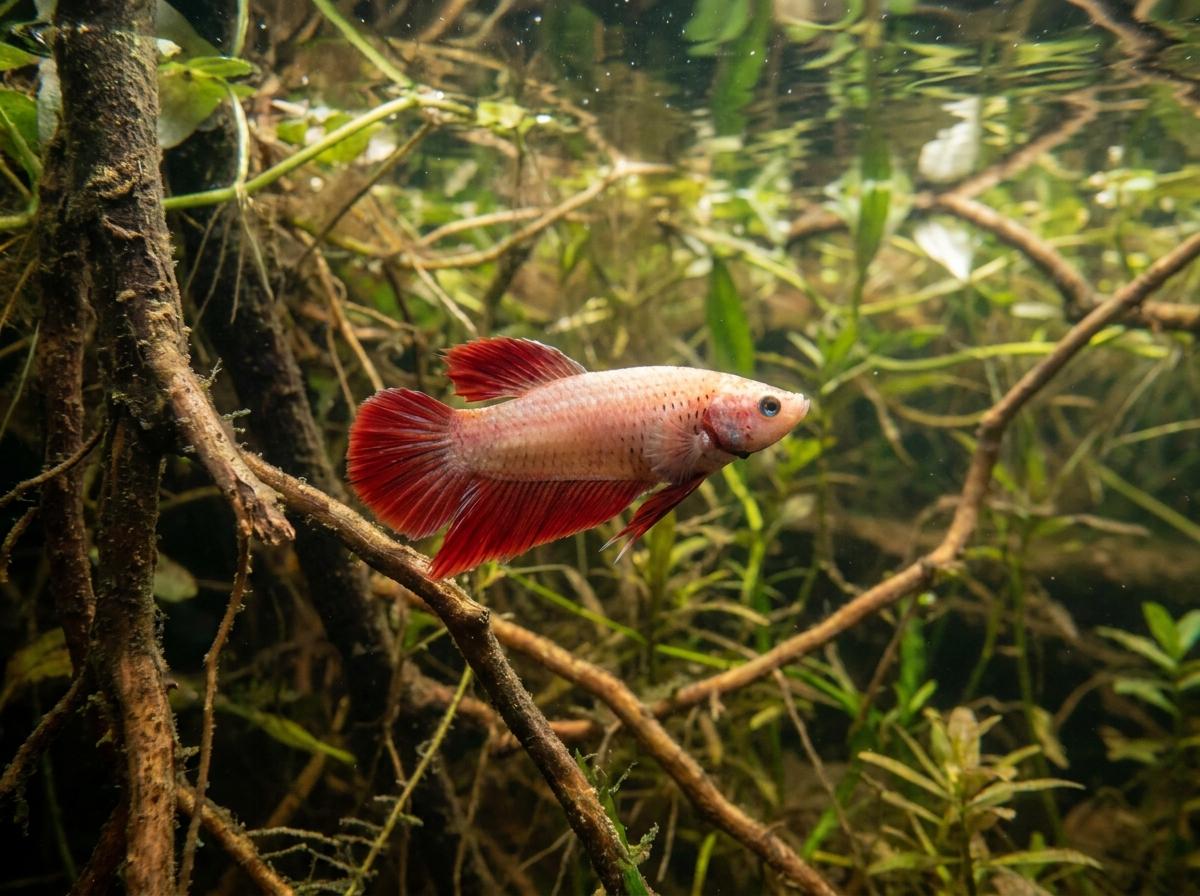
Color pattern is the arrangement of pigment. This is where Cambodian lives. In IBC judging, Cambodian is defined as a flesh-colored body with fins of another color, and the traditional Cambodian is specifically a flesh body with red fins. The standards also carry a warning that is easy to miss and matters to breeders: the judging definition of Cambodian is not the same as the genetic one, which refers to the absence of black pigment. So a fish can be genetically Cambodian and still not be shown in a Cambodian class.
Scale and pattern morph is the third axis, covering how the scales themselves are built and layered. The IBC recognizes a Dragon Scale subgroup, defined by scales “thickened by a heavy layer of metallic color over the body with a full mask over the head, giving the appearance of armor plating.” Samurai is a breeder name that sits in that family: heavy plated metallic scaling concentrated over the head and forward body, usually against a darker base. Unlike Cambodian, samurai is not an IBC term at all, so like super delta it is hobby vocabulary rather than standard vocabulary. We keep a separate page for dragon scale for that reason.
The three axes multiply rather than compete. A Cambodian super delta and a samurai super delta are both perfectly ordinary descriptions, and neither one contradicts the other. When a listing gives you a string of words, sort them into these three buckets and see which buckets are still empty. The empty bucket is the question to ask the seller.
One caution that follows from the scale axis: heavy scale coverage is not free either. The IBC’s own opaque standard disqualifies a fish whose covering has grown over the eyes to the point that it cannot see, which tells you that judges have had to write a rule about ornamental coverage going too far. Fin type is the same story in a different tissue.
The tank a super delta needs
Nothing above changes how this fish should live. Everything below does.
Bettas have a cultural image problem: a small bowl on a desk, no heater, no filter, a plant stem stuck in the top. That picture is a welfare failure, and it is the reason the care section is here rather than at the bottom of the page.

Volume, and why a bowl fails
The clearest evidence comes from a 2024 study in Animal Welfare by Clark-Shen and colleagues, which rotated male bettas through five housing conditions and measured what they did. The containers were a 1.5 L jar, a 3.3 L small tank, a 5.6 L medium tank, a 19.3 L furnished tank and the same 19.3 L tank stripped bare. Fish were significantly more active in the larger tanks: across a 600 second trial they swam 92 seconds more in the large tank than in the jar, and 76 seconds more than in the small tank. Their recommendation is explicit: “a minimum tank size of 5.6 L for the display and sale of Siamese fighting fish, and tanks larger than this for keeping Siamese fighting fish at home.” You can read the full study on PubMed Central.
Read that recommendation carefully, because retailers quote the number and stop there. 5.6 L is the floor the authors set for a display and sale container, and their sentence continues past it: tanks larger than this for keeping at home. The two conditions that produced the most swimming in their trials were the 19.3 L tanks.
So the practical answer for a home aquarium is well above 5.6 L, not at it, and a long tank beats a tall one because a betta swims horizontally. A super delta’s finnage makes this more pressing rather than less: a fish dragging a large fan needs room to use it.
Furnishing, not just filling
The same 2024 study found something that a volume number alone would hide. Fish in the large but barren tank performed more abnormal behaviors, described as hovering, stereotypic swimming and interaction with the walls, than fish in the same size tank with furnishings in it. Space without structure is not enrichment. The authors recommend gravel or pebbles plus plants and other furnishings such as refuges, and note that the fish spent a good deal of their resting time on those furnishings.
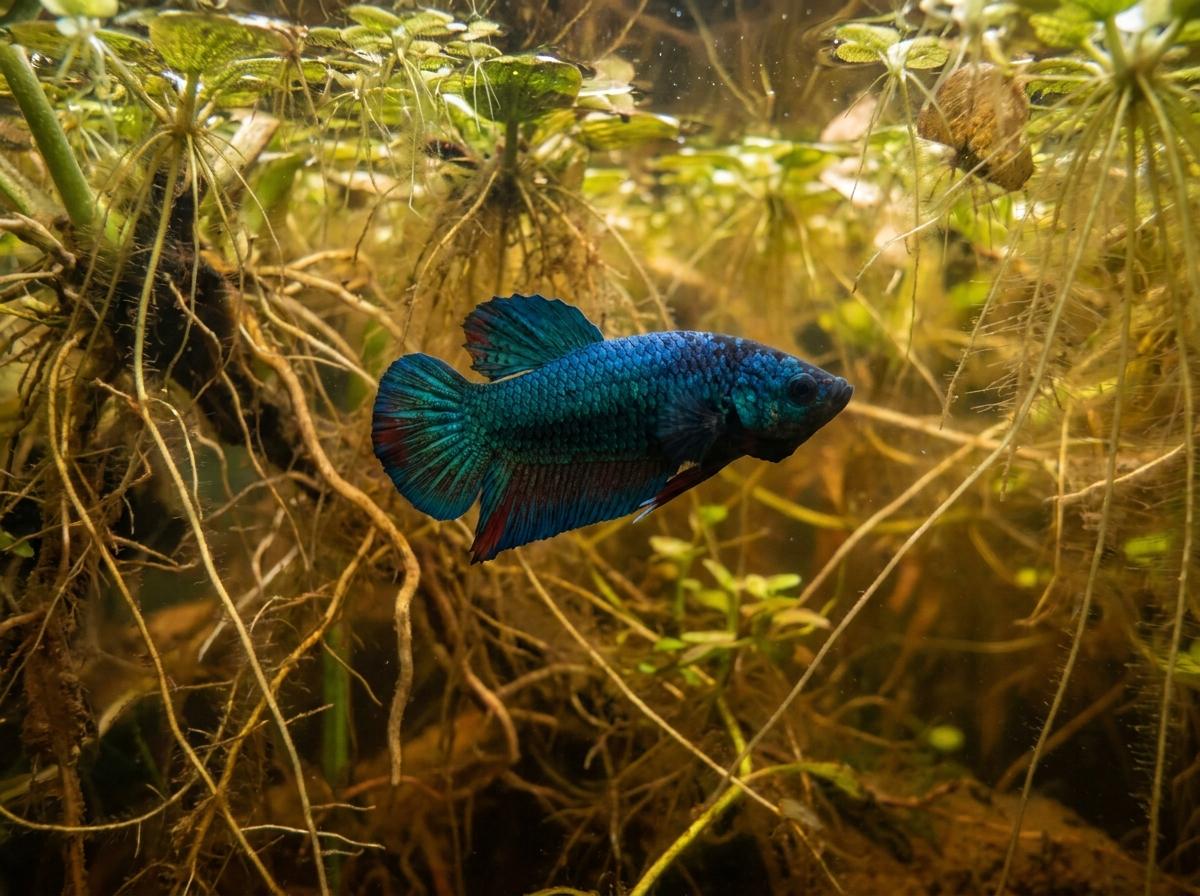
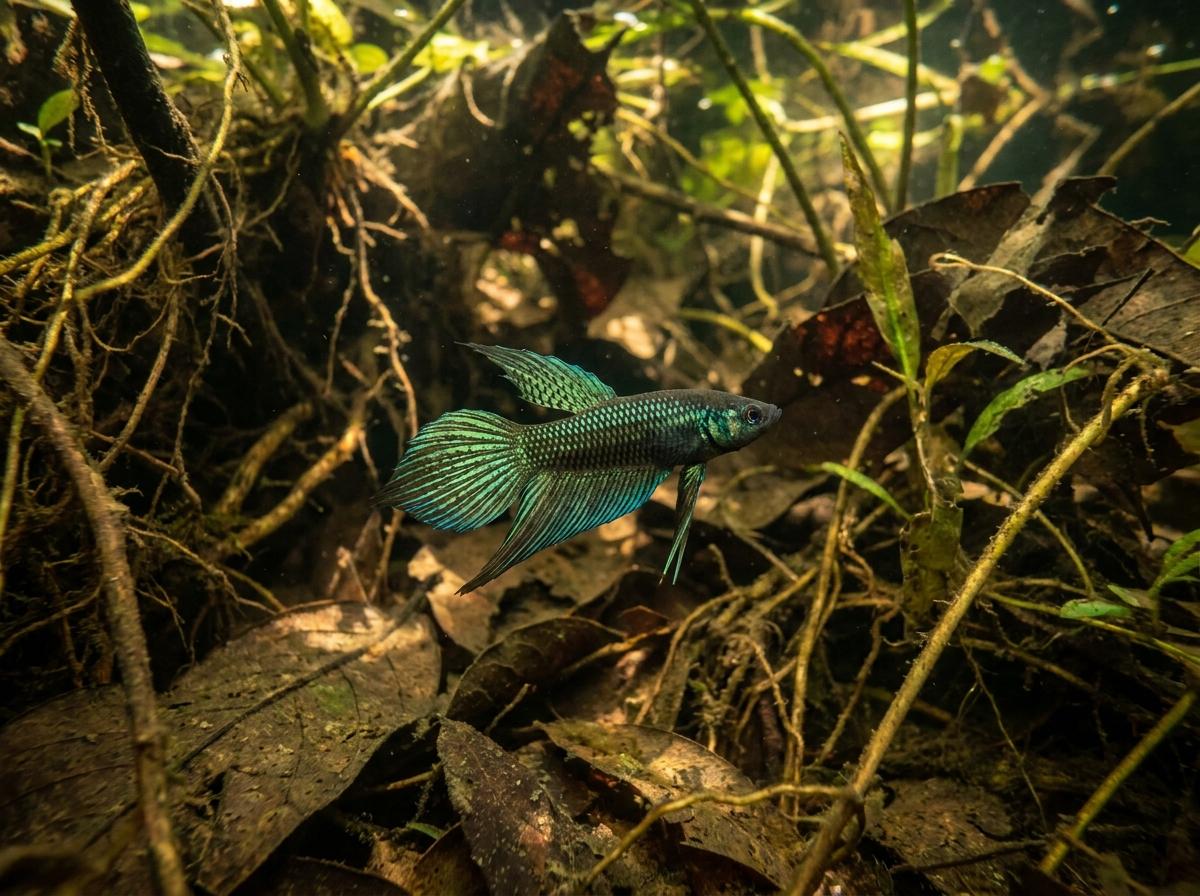
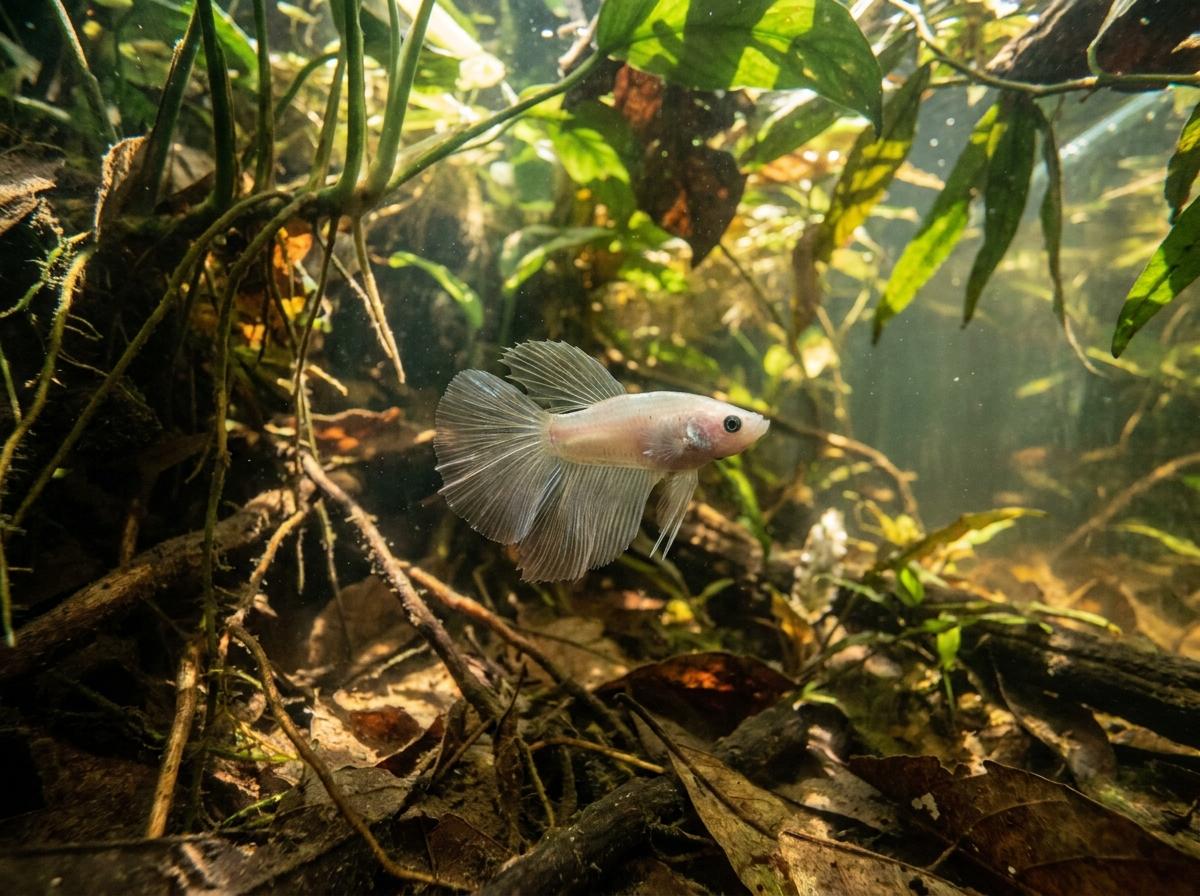
That fits the wild animal. The US Fish and Wildlife Service ecological risk screening summary for the species, quoting a veterinary welfare review by Pleeging and Moons (2017), describes its natural habitat as shallow ponds and rice paddy fields with plenty of vegetation, and notes that the vegetation provides cover against fish-eating birds such as egrets, herons and kingfishers. A tank a betta feels safe in is one where it can break the line of sight and get out of the open.
In practice: live or silk plants (nothing sharp or stiff enough to catch finnage), broad leaves at mid and upper height for resting on, a shaded refuge, and a dark substrate. Keep an open swimming lane through the middle rather than packing the tank solid.
Heat, and why room temperature is not enough
This is a tropical fish, and a very common failure in betta keeping is treating it as though it is not. The FWS summary gives 24 to 30 C (about 75 to 86 F) as the reference aquarium range, and cites field measurements putting the average water temperature in natural betta habitat during the breeding season near 29.9 C. A research colony described by Lichak and colleagues (2022) runs its system at 28 C.
Most homes sit several degrees below that, and a room that is warm in the afternoon is cold at 4am. A thermostatically controlled aquarium heater sized to the tank, plus a thermometer you actually read, is the answer. Stability matters as much as the number: a fish swinging several degrees a day is a fish under load. Small tanks are harder to hold steady than larger ones, which is a second argument for volume.
Air, and a lid
Bettas are anabantoids. They carry a labyrinth organ, described by Lichak and colleagues as a structure “that allows them to breathe air from the surface of the water,” and the same organ produces the bubbles a male uses to build his nest. The FWS summary notes the species can survive oxygen levels that would kill most fish, which is exactly why it got put in bowls in the first place. Tolerating something is not the same as needing it.
Two consequences follow. The fish must always be able to reach the surface easily, so no floating decor sealing off the top and no current pinning it down. And the tank must be covered. Lichak and colleagues are direct about this in a lab context: “Lids must always be properly secured, and feeding holes in the tank lids can be covered using mesh tape,” because “wild betta and other strains tend to jump through the holes on the lid.” A home tank needs the same discipline. Leave a few centimeters of air between the water and the cover so the air the fish gulps is warm and humid rather than a cold draft.

Filtration, cycling and water quality
Filtered and cycled, gently. A betta tank needs biological filtration established before the fish arrives, because ammonia is the thing that quietly kills. Lichak and colleagues note that ammonia has detrimental effects on betta health above 0.25 ppm, which is a low number and one that a small unfiltered container reaches quickly.
Flow is the part people get wrong in the other direction. This animal evolved in still, shallow, vegetated water, and a long-finned fish carries drag that a wild-type plakat does not. Aim for turnover with almost no visible current: a sponge filter, or an outflow baffled against the glass or broken by planting. A betta that spends its day parked behind an ornament is often telling you the flow is too strong.
One male per tank
There is no version of this rule with an exception. The species was selectively bred for fighting, and the aggression came with the ornamental fish. In the research colony described by Lichak and colleagues, “adult males are individually housed,” and the team goes further, placing opaque, white, non-reflective dividers between adjacent male tanks purely to stop them displaying at each other through the glass. That is a laboratory being careful about a real effect, not a myth.
Females are not automatically compatible either, with each other or with males outside a managed spawning. Group housing of females is an advanced project with a backup plan, not a default. If you want a community tank, choose the tankmates around the betta’s temperament, the flow it needs and the temperature it needs, and be ready to separate.
Health decisions belong to a veterinarian. Aquatic veterinarians exist, and a fish that is sick, injured or off its food deserves one rather than a shelf treatment guessed at from a photograph.
What heavy finnage costs the fish
The long fins are the product. It would be dishonest to write about a fin type without saying what the fins do to the animal carrying them.
Start with the show standards, because they make the point better than any advocacy would. In the IBC’s disqualifying faults that apply to every class, the second entry is “Swimming difficulty (due to excess finnage or swim bladder disorder).” The body fault list separately marks down a “Body moderately too small for finnage.” The organization that exists to reward ornamental finnage has written into its own rulebook that finnage can go far enough to impair the fish, and that when it does, the fish leaves the show.
Long fins are a domestication trait, not a wild one. The genome study by Zhang and colleagues (2022) in Science Advances sequenced 727 bettas across the ornamental morphotypes and mapped the long-fin phenotype to a locus containing the gene kcnj15, alongside separate loci for the enlarged “dumbo” pectoral fins and for giant body size. These are single, strongly selected changes on a fish whose wild form is a compact 6.5 cm animal in a rice paddy.
Then there is fin biting, and here the honest answer is that the evidence is thinner than the confidence around it. Keepers commonly report long-finned bettas taking clean, scissor-cut bites out of their own caudal and anal fins, and the explanation usually offered is some combination of the weight and drag of the fins, boredom, stress, reflection, too-strong flow and inherited tendency. Those are plausible and widely reported observations from practitioners. What does not exist, as far as we can find, is a controlled study establishing the cause, so we will not dress up a hobby consensus as a finding. Treat fin biting as a signal to audit the environment, and treat the difference between the two damage patterns as worth learning:
- Biting leaves clean, sharp-edged notches, often symmetrical, appearing suddenly and usually in the largest fins.
- Fin rot leaves a ragged, receding, often discolored margin that advances over days.
The second one is an infection and a veterinary matter. The first one is a husbandry question, though a bitten fin can then become infected, which is why the IBC condition faults treat frayed tips, multiple defects and broken rays as serious in a show fish and why you should treat them as serious in a pet.
None of this is an argument against keeping a super delta. It is an argument for choosing the moderate end of the finnage range, which is precisely what a super delta is, and for giving that fish a tank with the room, the warmth and the calm water to carry what it has.
Size, lifespan and the wild fish behind the hobby
Wild Betta splendens is small. The FWS summary cites a maximum size of 6.5 cm total length and a maximum reported age of 2 years. Domesticated ornamental fish are larger in body and vastly larger in fin, and the IBC sets a floor for its show fish, disqualifying a male whose body length is under 3.5 cm.
Lifespan deserves a careful answer rather than a confident one. The figure in the primary literature is short: Lichak and colleagues report that “the life span of betta is around 2 y under laboratory conditions,” and the FWS summary’s maximum reported age is the same. Keepers routinely report longer lives in well-managed home aquaria, and that is credible given how different a heated, cycled, planted tank is from either a research rack or a rice paddy. We are not going to attach a number to it that no source supports. Plan for a few years, keep the water right, and understand that a fish bought as an adult has already spent part of its life somewhere else.
The wild population is a separate story from the pet trade, and worth knowing. The species was assessed for the IUCN Red List in 2011 and listed as Vulnerable. The ornamental fish in your tank is a domesticated animal many generations removed from that population, so buying one neither helps nor harms it directly. It is context: the fish on the shelf is common, and the animal it descends from is not.
Buying a super delta
Because the term is unregulated and the fish are mass-produced, the questions you ask matter more than the label on the cup.
- Ask what the seller means by super delta. A photo of the fish flaring settles it in a second. Resting photos hide tail spread almost completely.
- Read the fin margins. Look for clean, continuous edges. Sharp notches suggest biting; a ragged receding edge suggests rot; a fish sold with either should come with an explanation.
- Watch it swim before you commit. A healthy betta holds position without effort, moves off decisively and comes to the front of the glass. A fish resting on the bottom constantly, struggling to stay off it, listing, or repeatedly rushing to the surface is telling you something.
- Ask what water it has been living in. Temperature and tank size at the seller predicts how hard the move will be. A fish coming out of an unheated cup needs a slow, warm acclimation.
- Ask for a spawn date and a line. Serious breeders keep both. It also tells you how much fin growth is still ahead of the fish, since young long-finned bettas are still developing.
- Be skeptical of a young fish sold as a guaranteed halfmoon. Spread varies within a spawn, and a fish advertised on its future is being sold on a forecast.
Browse super delta bettas on the Creatures marketplace, or find trusted breeders in the Creatures directory. If nothing matches today, a saved listing alert is the low-effort way to catch the right fish when it appears rather than settling for the one in front of you. And if you are naming a new arrival, the betta fish name generator is a pleasant way to lose ten minutes.
Frequently asked questions
Is a super delta betta a breed?
No. Every domesticated betta is one species, Betta splendens. Super delta describes the spread of the tail fin, in the same way that Cambodian describes a color pattern and samurai describes a scale morph. A single fish carries one value on each of those three axes.
What is the difference between a super delta and a halfmoon?
The angle. A halfmoon’s caudal opens to a full 180 degrees, so its outer edge forms a straight line and the fin reads as a crisp letter D. A super delta is a broad fan that falls short of that. The IBC treats the gap as a fault: in the Halfmoon class, more than 15 degrees under 180 is a disqualification.
Will a super delta’s tail widen into a halfmoon as it grows?
Fins keep developing in a young fish, so a juvenile’s spread is not final. But the spread a fish ends up with is set by its genetics and its rearing, not by waiting, and plenty of fish sold as future halfmoons finish as super deltas. Buy the fish in front of you rather than the one in the description.
Does a super delta betta need a heater?
Yes. This is a tropical fish with a reference aquarium range of roughly 24 to 30 C (75 to 86 F), and its natural water is warmer still. A room that feels comfortable to you is usually several degrees too cold, and it drops overnight. A thermostatically controlled heater and a thermometer are basic equipment, not upgrades.
How big a tank does one super delta need?
Bigger than the containers they are sold in. The peer-reviewed recommendation is a minimum of 5.6 L for retail display and larger than that for keeping at home, and the tanks that produced the most swimming in that study were 19.3 L. Treat the 5.6 L as a floor rather than a target, favor a long tank over a tall one, and remember that a bigger volume is also easier to hold at a stable temperature.
Can two male super deltas share a tank?
No, and there is no tank size that makes it work. Adult males are housed individually even in research settings, where opaque dividers are also used between neighboring tanks to stop the fish displaying at each other through the glass.
Do bettas really need a filter if they can breathe air?
Yes. The labyrinth organ lets a betta take oxygen from the surface, which is why the species survives conditions that kill other fish. It does nothing about ammonia, which harms them at low concentrations. Cycle the tank, filter it gently, and keep the flow soft enough that a long-finned fish is not fighting it.
Why does my super delta’s tail look chewed?
Two very different causes look similar at a glance. Clean, sharply cut notches that appear suddenly point toward the fish biting its own fins, which is a widely reported behavior in long-finned bettas and a prompt to review flow, space, cover, reflections and boredom. A ragged, receding, discolored edge that advances over days points toward infection and needs a veterinarian.
Do this next on Creatures
Whether you are trying to identify the fish you already own, hunting for a better one, or keeping records on a tank you have had for years, Creatures is the profile, records, marketplace and directory layer to do it in one place.
Compare the other labels. Fin type is only one axis. Read up on the Cambodian color pattern, the samurai scale morph and dragon scale, or browse every variety on the betta fish species page.
Add your betta. Already keeping one? Create a free profile for your fish in a couple of minutes, no account needed to start. The walkthrough is in adding an animal to Creatures, and your animal’s profile page explains what each tab is for.
Track the tank, not just the fish. Water changes, temperature checks, fin condition and any treatment are exactly the things nobody remembers accurately three months later. Start a record on Creatures. The record sheet opens for any visitor to look around, and a free account is what saves what you enter. See adding a record and health and medical records for the detail, and reminders and upcoming care if you want the water change to nag you instead of the other way around.
Find a fish. Browse super delta bettas on the marketplace and search trusted breeders in the Creatures directory.
Get alerted instead of settling. Good long-finned stock moves quickly and tail type is hard to filter for in a hurry, so set a free super delta listing alert and let the right fish come to you. No account needed to start. Saving searches and using your watchlist covers how it works.
Breeding or selling bettas? Set up a breeder profile so buyers looking for a specific tail type can find you, no account needed to start.