






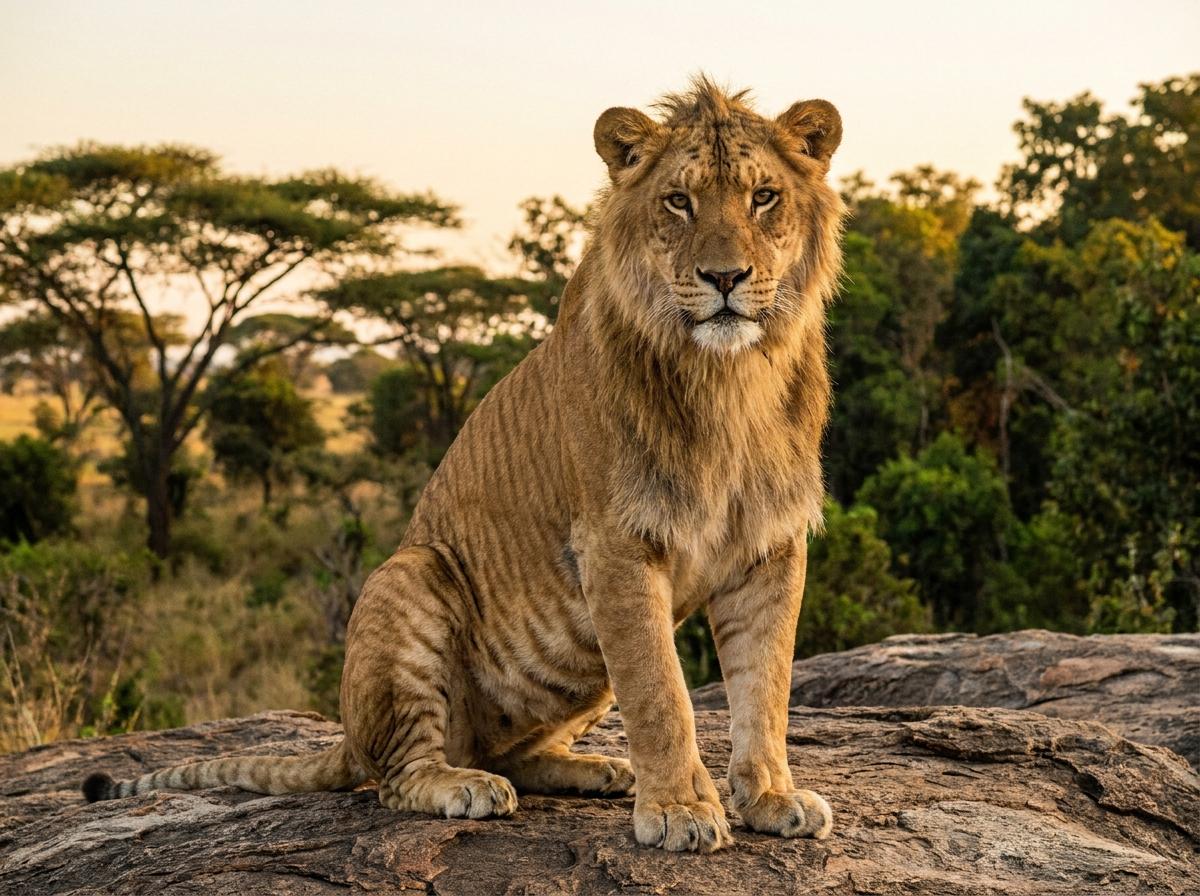
Tigon
Panthera tigris x Panthera leo
Author: Elliott Garber, DVM · Published
A tigon is the hybrid offspring of a male tiger and a female lion. It exists only in captivity, it is rarer than its better known mirror image, the liger (a male lion crossed with a female tiger), and it does not grow into a giant. Most tigons end up roughly the size of their parents or a little smaller, with a tawny lion-like coat washed with faint tiger stripes. In the United States an ordinary private owner cannot legally buy, breed, or newly acquire one as a pet: the federal Big Cat Public Safety Act of 2022 covers lions, tigers, and their hybrids, with narrow exemptions only for licensed and qualifying facilities.
This page explains what a tigon is, why it looks and grows the way it does, what the documented history actually shows, and why the honest answer to “how much does a tigon cost” is that there is no lawful way to buy one as a pet.

| Parents | Male tiger (Panthera tigris) crossed with a female lion (Panthera leo) |
|---|---|
| Reverse cross | The liger: male lion crossed with a female tiger |
| Size | Usually no larger than its parents and often smaller; no giant growth like the liger |
| Look | Tawny lion-like coat with faint tiger stripes; males grow at most a short ruff, not a full mane |
| Fertility | Males are considered sterile; some females have produced cubs |
| In the wild | Never recorded; lions and tigers do not share a range today |
| US legal status | Covered by the Big Cat Public Safety Act (2022): no private pet breeding, buying or selling; narrow exemptions for licensed facilities |
| Conservation value | None; hybrids cannot be released and do nothing for wild lions or tigers |
Browse listings, public profiles, breeders, or add your animal.
What a tigon is
A tigon (sometimes spelled tiglon) is a first-generation cross between two different big cat species. The father is a tiger and the mother is a lion. Lions and tigers are both members of the genus Panthera, close enough relatives that a pairing can produce live cubs, but they are separate species that have been evolving apart for a long time. A tigon is not a breed, not a subspecies, and not a stable population. Every tigon that has ever lived was produced by people putting a tiger and a lioness together in captivity.
The name order tells you the parentage. The first half of the word comes from the father: ti-gon (tiger father, lion mother) versus li-ger (lion father, tiger mother). The two are easy to mix up, and plenty of photos online labelled “tigon” are actually ligers, or simply unusually coloured lions or tigers.
Tigon vs liger: why the same two species make such different cats
Swap which parent is the lion and which is the tiger, and the results are strikingly different. Ligers are famous for outgrowing both parents. A review of mammal hybrid growth in the Journal of Mammalogy (Vrana, 2007) describes ligers as larger than either parent species, often exceeding 3 m in length and 350 kg in mass, while the reciprocal cross, the tigon, is typically smaller than either parent. Other accounts put tigons closer to parent size rather than clearly smaller, so the fair summary is that a tigon does not show the liger’s runaway growth.

The leading explanation is genomic imprinting. For a small set of genes, a mammal uses only the copy inherited from one particular parent; the other copy is chemically switched off. Some of these genes control growth before birth, and the parents are thought to pull in opposite directions: genes switched on from the father tend to push growth up, while genes switched on from the mother tend to rein it in. When the two parents come from the same species, those pushes and pulls balance out.
In a hybrid, they may not. The idea researchers have explored is that each species has tuned its own balance differently, so a cross can end up with the growth “accelerator” from one species and a weaker “brake” from the other (the liger), or the reverse, with a strong brake and a weaker accelerator (the tigon). The Vrana review uses the lion and tiger crosses as a textbook illustration of parent-of-origin effects, and the best experimental evidence for imprinting-driven hybrid growth comes from crosses between species of deer mice rather than from big cats themselves. So the imprinting explanation is well supported in principle, but the exact genes involved in lion and tiger hybrids have not been pinned down. Treat any article that names “the” liger gene with caution.
What a tigon looks like
Because it carries genes from both parents, a tigon’s appearance is a blend, and individuals vary. The general pattern described in reference sources such as the Wikipedia summary of recorded tigons:
- Coat: a tawny, lion-like base colour, often a little warmer or more orange than a typical lioness, with a pale cream belly and inner legs.
- Stripes: faint tiger stripes, usually most visible on the back, flanks, and legs. They are generally softer and less contrasting than a tiger’s.
- Spots: some tigons also show faint spotting, a trait that comes from the lion side (lion cubs are born spotted, and some adults keep faint marks).
- Mane: male tigons may grow a modest ruff of longer fur around the cheeks and neck, more like a tiger’s ruff than a lion’s mane. They do not grow the full, heavy mane of a male lion.
- Face: often a broad lion-like head with tiger-like facial markings, pale fur around the muzzle and eyes, and the white spots on the backs of the ears that tigers carry.
- Size: as covered above, roughly lion-sized or a little smaller. Exact weights for tigons are thinly documented, so be wary of confident figures.
If you see a huge, heavily built hybrid described as a “tigon”, check the parentage. Great size is the calling card of a liger, not a tigon.
Why tigons only exist in captivity
A tigon has never been recorded in the wild, and the reason is geography. Lions today live mostly in sub-Saharan Africa, with one small wild population in India. Tigers live in South and Southeast Asia, parts of China, and the Russian Far East. The only country with both species is India, and even there they do not meet.
Historically the Asiatic lion ranged across a huge area, from the Middle East through northern and central India, which overlapped with tiger country. That range collapsed. A review of Asiatic lion ecology in Frontiers in Ecology and Evolution describes the surviving wild lions as restricted to a single population in the Gir and Saurashtra region of Gujarat, western India. Tigers, for their part, disappeared from Gujarat for decades. A tiger reported to have settled in the Ratanmahal sanctuary in eastern Gujarat led to Gujarat being put back on India’s tiger map in late 2025, far from the lions of the Saurashtra peninsula. Even where the two species did share ground in the past, there is no documented case of them interbreeding naturally. They differ in social life (lions live in prides, tigers are solitary) and in behaviour, and a wild tiger and a lioness are far more likely to avoid or fight each other than to mate.
A short documented history of tigons
Lion and tiger crosses have been produced in captivity for about two centuries. One of the earliest well documented litters was actually of ligers, not tigons: three cubs born to a lion and a tigress in Thomas Atkins’s travelling menagerie at Windsor, England, in October 1824, which King George IV asked to see.

The best documented tigons are from the Zoological Garden, Alipore, in Kolkata (then Calcutta), India. As retold by Down To Earth magazine in a 2021 history of the Alipore hybrids, the zoo ran hybridisation experiments starting in the 1960s. A female tigon named Rudrani, born in the early 1970s to an African lioness and a male tiger, was later paired with an Asiatic lion and produced several litigons (lion and tigon crosses). The first of them, a male named Cubanacan, was widely described as the first litigon and grew very large. That same account reports that India banned the cross-breeding of big cats in 1985, which ended the experiments. Sources disagree on some details, such as Rudrani’s exact birth year, so treat individual dates from this era as approximate.
Rudrani’s litters also answer the fertility question, at least for females. Female lion and tiger hybrids have produced cubs on several recorded occasions. Male hybrids are a different story: male ligers and tigons are generally considered sterile, which fits Haldane’s rule, the long observed pattern that when a hybrid cross produces one sterile sex, it is usually the male in mammals. Because so few tigons have ever been examined, “generally sterile” is the honest wording rather than “always”.
Health and welfare: why experts oppose breeding them
Nobody breeds tigons for conservation, because they have no conservation value. They are not a wild form that needs saving, they cannot be released, and they do nothing to protect wild lions or tigers. How many exist is not known: National Geographic’s report notes that nobody has a reliable count of big cat hybrids.
National Geographic reports that accredited zoos discourage crossbreeding big cats, and it quotes the Association of Zoos and Aquariums’ policy against breeding animals for unusual traits: “propagating animals that specifically do not represent the normal characteristics and variation of the species creates a confused educational message.” Luke Dollar, then program director of the National Geographic Society’s Big Cats Initiative, told the magazine he could think of no legitimate reason for a liger or tigon to exist. Big cat biologist Luke Hunter of Panthera told the magazine that hybrids run a much greater chance of genetic problems, though how common those problems are has never been studied, because the animals do not exist in the wild. The best known problems are the growth disorders in ligers; for tigons, the health record is simply too thin to give reliable figures, which is itself a reason for caution.
The other welfare issue is the business model. For years, some roadside attractions bred big cat cubs, pure and hybrid, for photo sessions and cub petting. US federal law now bans public contact with big cats, cubs included.
Can you buy or own a tigon?
In the United States, not as a pet. The Big Cat Public Safety Act, signed on 20 December 2022, makes it unlawful to breed or possess lions, tigers, and several other big cats unless one of the Act’s exceptions applies, and it explicitly covers hybrids of those species, which includes tigons and ligers. According to the US Fish and Wildlife Service’s guidance on the Act, it also bans importing, exporting, transporting, selling, or buying these animals in interstate or foreign commerce, and it prohibits allowing direct contact between the public and any big cat, cubs included.
The exceptions are narrow. People who already owned a big cat before the law passed could keep it only if they registered it with the Fish and Wildlife Service by 18 June 2023, and that registration window is permanently closed; the Act does not let those owners acquire more big cats. Separately, certain USDA-licensed (Class C) exhibitors that meet the Act’s conditions are exempt from its breeding and commerce prohibitions, and qualifying wildlife sanctuaries, state colleges, universities and agencies, and state-licensed veterinarians have their own exemptions. These are regulated facilities, not a route for pet keepers: none of them creates a way for an ordinary private buyer to acquire a tigon today, and penalties for violations can include fines, imprisonment, and seizure of the animal.
Outside the US, rules vary a great deal by country and region, and we are not going to list other countries’ laws here without an official source for each. If you are anywhere else, assume that keeping a big cat or a big cat hybrid is tightly regulated, and check with your national wildlife authority.
So what does a tigon cost? For an ordinary pet buyer in the US there is no lawful purchase and so no price to quote. Treat any tigon or tigon cub offered to private buyers as a red flag: a private buyer cannot lawfully acquire one, and animals sold under the name are often misdescribed (a liger or an ordinary lion or tiger). If you want to see a tigon, the ethical route is a sanctuary that houses hybrids already alive, where the animals are not bred, sold, or handled by visitors.

Where tigons fit among other “not quite a breed” animals
A tigon is one of a handful of animals people search for as if they were a breed you could pick out, when they are really something else: a one-off hybrid, a historical type, or a category rather than a studbook. The medieval destrier is a good comparison from the horse world. It was a type of warhorse, not a breed, and there is no destrier you can simply buy today, only modern horses that fill a similar role. The tigon is the big cat version of that story, with the added twist that breeding them in the US is now prohibited outside a few narrowly exempt, licensed facilities.
Frequently asked questions
What is the difference between a tigon and a liger?
Parentage. A tigon has a tiger father and a lion mother; a liger has a lion father and a tiger mother. That swap changes growth: ligers often grow larger than either parent, while tigons stay around parent size or smaller.
Are tigons real?
Yes. Tigons have been bred in captivity, and the Alipore Zoo in Kolkata produced well documented tigons in the 1970s. They are far rarer than ligers, and none has been recorded in the wild.
Can tigons reproduce?
Some female tigons have. Rudrani at Alipore Zoo produced litigon cubs with an Asiatic lion. Male tigons, like male ligers, are generally considered sterile.
Do tigons exist in the wild?
No. Wild lions and tigers do not share a range today. India is the only country with both, and its wild lions live only in Gujarat’s Gir and Saurashtra region, away from its tigers.
How big does a tigon get?
Roughly the size of a lion or tiger, often a little smaller. They do not show the oversized growth that makes ligers famous. Reliable measured weights for tigons are scarce.
Is it legal to own a tigon in the US?
Not as a new pet. The Big Cat Public Safety Act bars ordinary private owners from breeding, acquiring, buying, and selling lions, tigers, and their hybrids. The exceptions are animals registered with the US Fish and Wildlife Service by 18 June 2023, which their owners may keep but not add to, and certain licensed exhibitors, qualifying sanctuaries and state institutions that meet the Act’s conditions.
How much does a tigon cost?
There is no lawful pet price in the US, because an ordinary private buyer cannot acquire one. Treat any tigon offered to a private buyer as a warning sign.
Do this next on Creatures
Tigons are not something to buy, and Creatures does not offer them for sale. The honest next steps are about the living big cats and the people who care for them properly.
- Learn the related species. Compare the tigon with the liger, and read about its parent species on the tiger and lion pages.
- Find trusted organizations, not sellers. The Creatures directory lists trusted breeders, farms, and animal organizations for animals people can legally and responsibly keep. It is a better place to spend your interest than any tigon advert.
- Run a sanctuary or zoo that already cares for a hybrid? Lawfully exempt facilities can set up an organization profile on Creatures to present their work and their team, with no account needed to start. This is for care and education, not for breeding or selling. Here is how creating an organization and adding your team works.
- Keep a lifelong record for a resident animal. A sanctuary or exempt facility caring for a tigon can add the animal to Creatures (no account needed to start) and keep its history in one place. See adding an animal to Creatures.
- Log veterinary care and observations. Add a record for exams, weights, and treatments. The form opens for visitors, and a free account saves it. The help guides on adding a record and health and medical records cover the details.





