Pigeon Breeding: Pairing, Eggs, Squabs, Banding and Breeding Records
Author: Elliott Garber, DVM · Published
Pigeon breeding works in pairs: a cock and hen bond, build a nest, and the hen lays two eggs about two days apart, which both parents incubate for about 17 days and then feed on crop milk until the squabs leave the nest at around four weeks. The breeder’s job is to choose the pairs, give each pair two nest boxes, band every squab in its first week or so, and write down who came from whom. Start the paper trail as you go: record each pairing as a breeding on its hen’s profile, then the clutch and the squabs, so the pigeon family tree builds itself instead of living in a notebook.
Sources checked November 14, 2026. Timings below come from Oregon State and Wisconsin 4-H extension manuals, a 2025 peer-reviewed study of pigeon breeding behavior and the Merck Veterinary Manual. Pigeon health problems, medicines and vaccines are decisions for an avian veterinarian; this guide gives no doses or treatment steps.
That rhythm is the whole season in miniature. A good pair can be sitting on a fresh clutch while it still feeds the last one, so a loft in full swing runs two families per pair at once. Everything that follows, from loft layout to banding day to the record you keep, exists to keep those overlapping families straight.
| Breeding age | About 5 to 7 months in a 2025 study (Tarim pigeons) |
|---|---|
| Clutch | Two eggs, the second about two days after the first |
| Incubation | About 17 days (17 to 18 in recent research), shared by both parents |
| Hatch | First egg first; the second usually about 24 hours later |
| First food | Crop milk from both parents, later mixed with softened grain |
| Banding | Seamless band at about 5 to 10 days old, sized for the breed |
| Leaving the nest | About four weeks old |
| Nest boxes | At least two per pair, because the next clutch overlaps the last |
The pigeon breeding cycle, day by day
Pigeons are among the easier birds to breed, and the hard part is rarely getting eggs. It is getting the right eggs from the right pair and keeping the results identifiable. Know the normal cycle first so you can tell when a pair is off schedule.
Pairing and nest building
A cock that has chosen a hen struts around her and coos, and if she accepts him the pair “bill” each other before choosing a nest site. Oregon State’s 4-H pigeon manual describes the pair then building a nest, with the hen settling into it after several days. Oregon State lists hay, straw, pine needles, wood chips or twigs as nesting material; keep a clean, dry supply near the boxes.
A 2025 study of Tarim pigeons in Archives Animal Breeding puts mating age at 5 to 7 months; other breeds and individual birds can differ.
Laying: two eggs, about two days apart
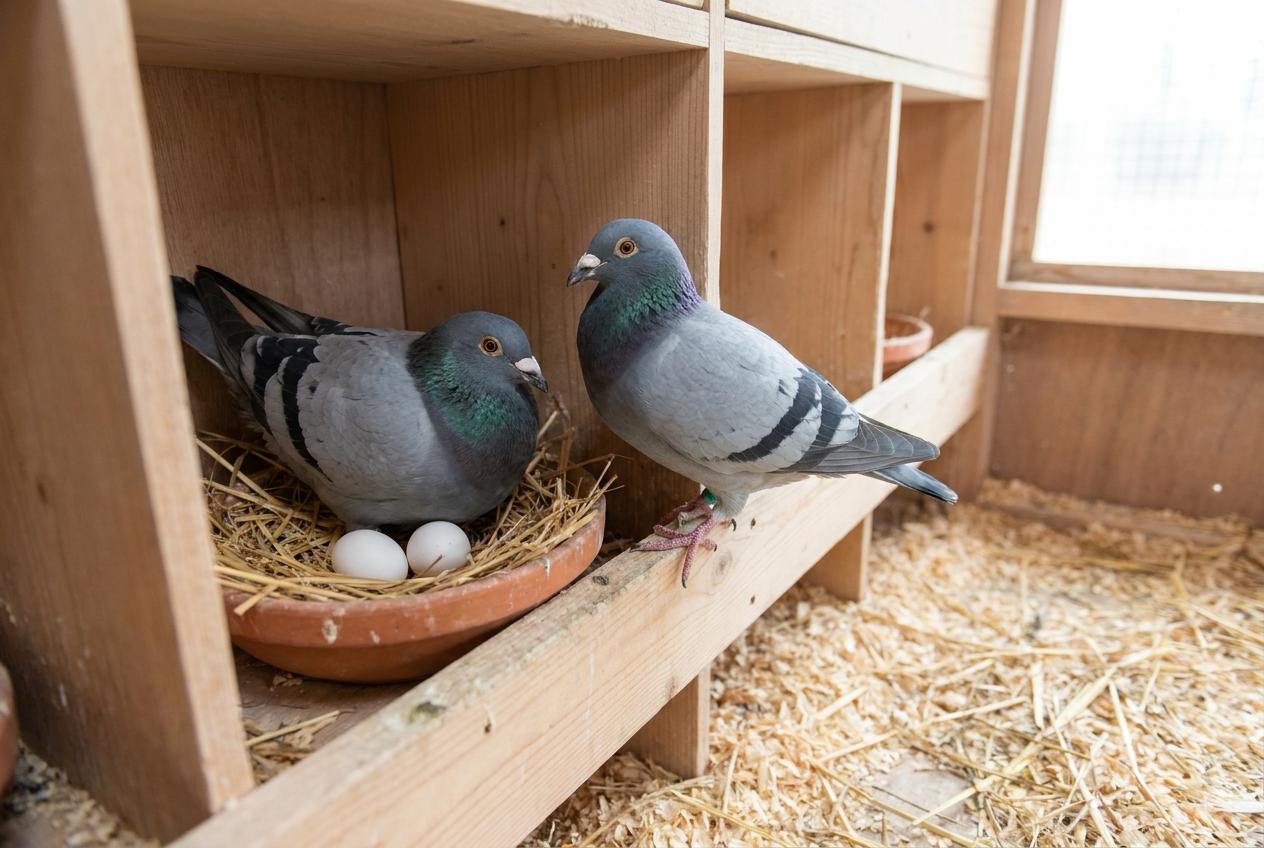
The hen lays one egg, skips a day, and lays the second. Oregon State says the hen lays only two eggs per nesting. Four eggs in one nest is a warning sign rather than a bonus: the same manual notes that with no cock available, two hens may pair up and both lay infertile eggs in the same nest.
Write down the date of the first egg. It is the anchor for every date that follows.
Incubation: about 17 days, shared
Incubation starts with the first egg. Both 4-H manuals describe the same shift pattern: the hen sits from late afternoon through the night and into the morning, and the cock takes the day shift while she eats and rests. The first egg hatches after about 17 days and the second usually about 24 hours later. The 2025 study gives 17 to 18 days.
Because the first squab is a day older, it can outcompete its nest mate for food. Wisconsin 4-H’s pigeon member guide warns that the older squab sometimes dominates to the point that the younger one is underfed. Check both squabs daily, not just the nest.
If you candle pigeon eggs to pull clear ones and confirm development, the technique is the same light against the shell used for poultry. Our egg candling guide walks through what you see at each stage.
Hatching and crop milk
Both parents feed the squabs a thick, creamy secretion from the crop, usually called pigeon milk. The 2025 study says the newly hatched squabs’ diet consists entirely of crop milk at first; Wisconsin 4-H describes it being augmented later by partly digested feed. Squabs grow fast on it, which is why a healthy pair can raise two squabs to near adult size in a month.
The same study notes a pair can rear at most two squabs in one cycle.
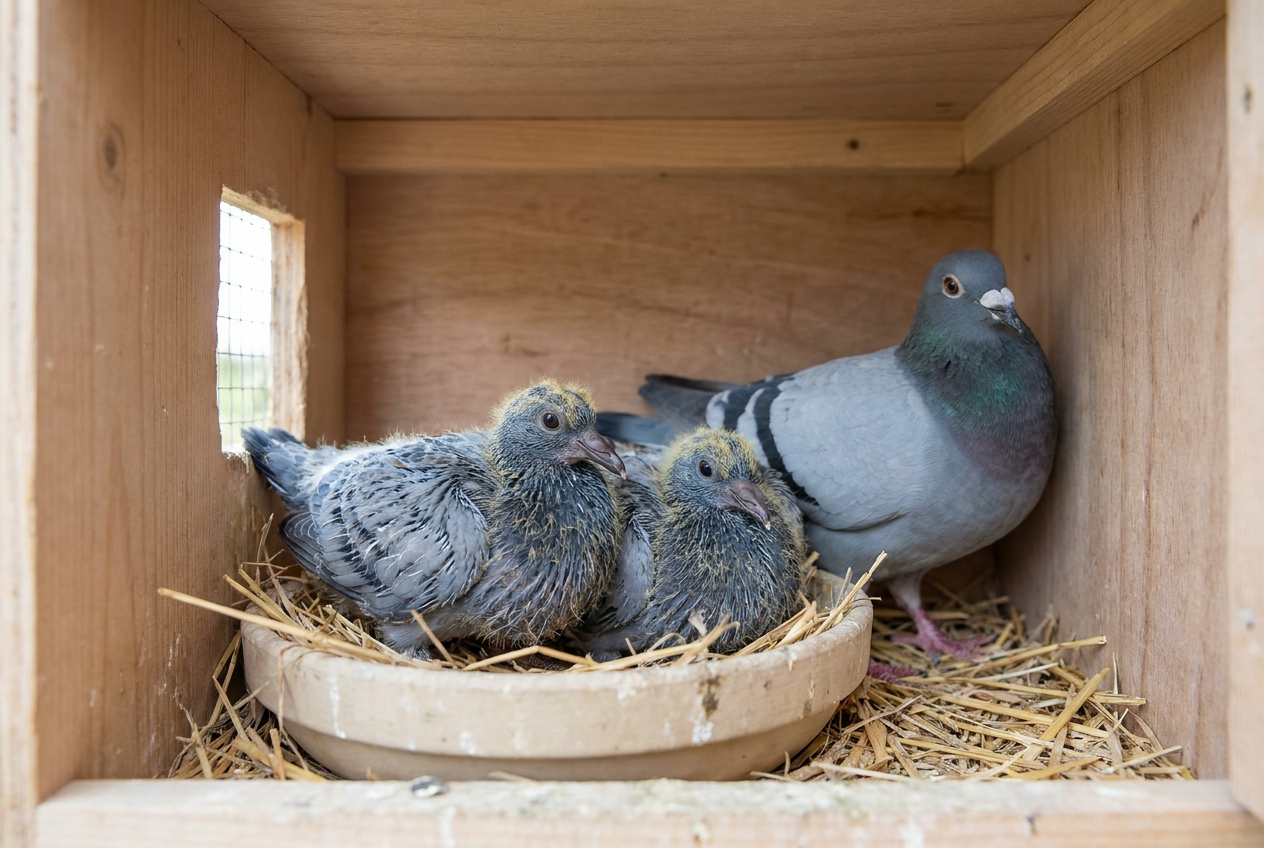
The next clutch overlaps the last
Here is the part that catches new breeders out. The hen starts the next clutch while the current squabs are still in the nest. Oregon State says she is ready to nest again approximately a week after the squabs hatch; the 2025 study says she may start laying when the squabs are about 15 days old. Pairs vary, and both sources describe the same thing: a pair sitting on eggs in one box while feeding squabs in another.
That overlap is why both manuals call for at least two nest boxes per pair. Without a second box, the pair either lays in the nest with the growing squabs or fights a neighbor for a box.
Leaving the nest at about four weeks
Squabs reach full size at about four weeks. Wisconsin 4-H notes that utility squabs are taken from the nest at 28 to 30 days, and that parents wanting to start the next clutch may push older squabs out of the nest. Move weaned youngsters to their own section once they are eating on their own; Wisconsin recommends separate pens for young birds after they leave the nest, unmated birds and mated pairs.
Setting up the loft for breeding pairs
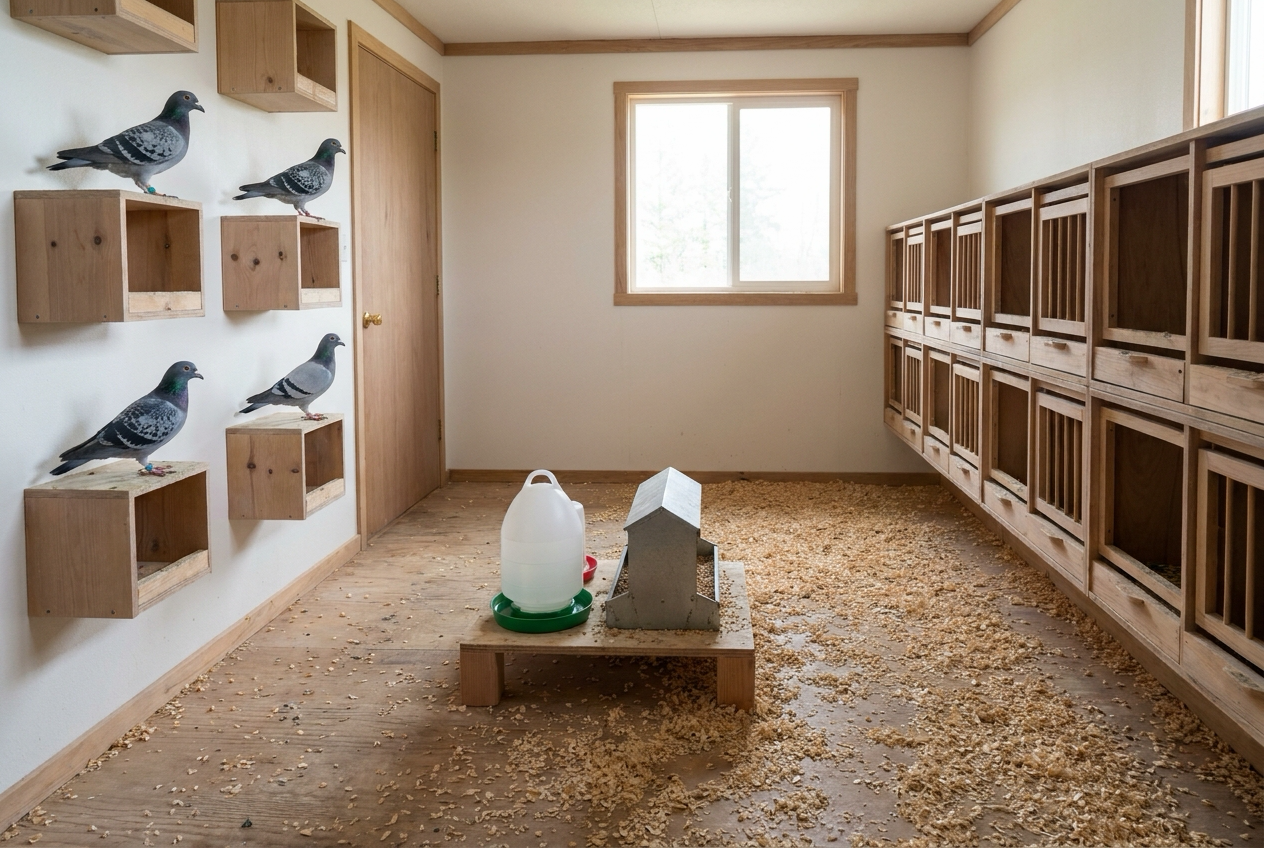
A breeding loft does not need to be elaborate, but it needs to be clean, dry, secure and laid out for pairs.
- Two nest boxes per pair, more if you can. Oregon State describes a box of about 12 by 12 by 18 inches with a front board to keep nest material, eggs and squabs from falling out. Extra boxes reduce quarreling between pairs.
- Nest bowls and dry material. A shallow bowl inside each box keeps eggs together. Replace soiled material between rounds.
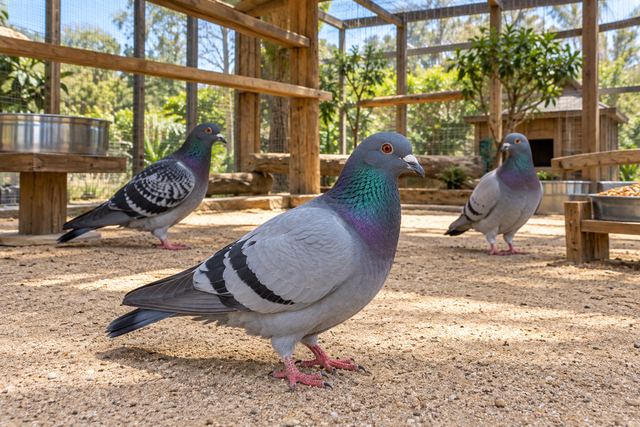
- Space per pair. Wisconsin 4-H gives a working rule of four square feet of pen and four square feet of coop area per breeding pair, and adds that more space does no harm.
- Perches for every bird. Pigeons are territorial; separate box perches let each bird hold its own spot.
- Clean feed, water and grit. Containers should keep droppings and dirt out, and birds should not roost on them.
- Security. Predators and rodents rob nests and kill squabs. Locks, solid construction and rodent-proof feed storage matter as much as the nest boxes.
Clean the loft and nest boxes at least once a week, as Oregon State advises, and take extra care with boxes holding young.
Choosing and mating pairs
Buy mated pairs, or make your own
Cocks and hens of most breeds look alike to a beginner. Oregon State’s advice is to buy mated pairs from the breeder and to avoid pairs too old to produce fertile eggs. Our guide to where to buy pigeons covers what to ask about bands, clubs and the loft before you buy.
To make a planned pairing, both manuals describe confining the two birds together, Wisconsin with a wire partition until they are acquainted, Oregon for one to two weeks until they are firmly mated, before returning them to the breeding pen. Not every forced pairing takes.
Keep only mated birds in the breeding section
Pigeons generally stay paired for life once mated. Both manuals warn that an odd cock or hen loose among breeding pairs causes fights, broken eggs and killed squabs. Keep spare and young birds elsewhere until you pair them.
If a pair produces no young, Wisconsin 4-H suggests one bird may be barren; split them and give each a new mate. Note the change, so a later look at either bird’s history shows who it was paired with and when.
Breed for the job the bird does
Pairing decisions depend on what you breed for. Racing lofts select on performance and homing, show breeders on the breed standard, and utility breeders on squab size and production. Breed pages such as the racing homer, King for squab production, and show breeds like the Modena and Fantail describe what each type is bred to do. If color is part of your plan, the pigeon colors guide explains base colors and wing patterns and what to write down about each bird.
Rest the pairs over winter
Pigeons will nest year round, but cold weather can freeze eggs and squabs. Oregon State notes that many breeders separate cocks and hens in October and re-mate them in April. Wisconsin 4-H describes removing nests in the fall molt, when few young are produced, and letting the birds rest through winter to build them up for the next season.
Banding squabs: the window is short
A seamless band is the permanent identity of a bird you breed, and you get one chance to put it on.
- Timing. Band at 5 to 10 days old, Oregon State says, depending on the size and breed; Wisconsin 4-H gives about 10 days. After that the foot is too large for the closed ring.
- Size. Band sizes are specific to the size of the bird, so order the size your breed uses.
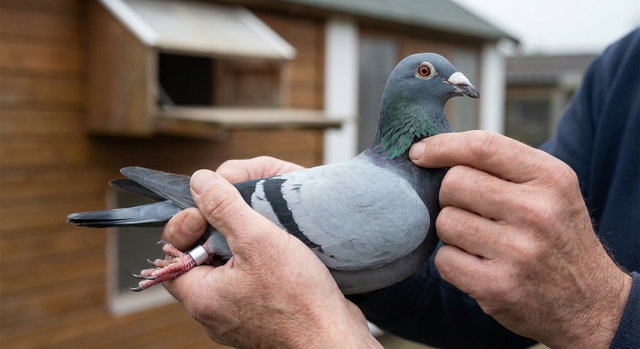
- Method. Oregon State describes gathering the three front toes, sliding the band over them and the ball of the foot, then easing the hind toe through. If you have not done it before, have an experienced fancier show you on your first squab.
- Show birds. Birds raised for show must carry a seamless band, per the Oregon manual.
In the United States, the National Pigeon Association, founded in 1920, provides seamless bands for all breeds of domesticated pigeons. Its found pigeon page explains the code: in its example NPA 7 07 AT 1089, NPA is the issuing organization, 7 the band size, 07 the year the bird was born, AT the letter sequence and 1089 the bird’s own serial number. The same page lists AU (American Racing Pigeon Union) and IF (International Federation) as other band issuers.
Wisconsin 4-H also describes colored rings as a second marker that is easier to read at a distance, for example one color for cocks and another for hens, or a color per pair.
Write the band number down the day you band. Wisconsin’s guide puts it plainly: record each squab’s band number at the time it is banded, along with the pair it came from. A band links a bird to a number; only your records link that number to its parents.
Health in a breeding loft
Breeding concentrates birds, eggs and squabs, so disease moves fast. Prevention is mostly management, and diagnosis and treatment belong to an avian veterinarian.
Canker (trichomonosis). The Merck Veterinary Manual says pigeons and doves pass the infection to their young in contaminated crop milk, and that chronically infected birds should be separated from breeding birds. It centers control on sanitation and biosecurity, including frequent cleaning of feeders and waterers. Yellowish lesions in a squab’s mouth or throat, weight loss or a squab that stops thriving warrant a call to your veterinarian.
Pigeon paramyxovirus (PMV-1). This viral disease of pigeons can cause nervous signs such as a twisted neck, and vaccination is widely discussed in pigeon circles. Whether to vaccinate, which product and when, and what your country’s rules allow are your veterinarian’s call.
New and returning birds. Isolate newly purchased birds, and birds coming back from a show, for several weeks before they join the flock, Oregon State advises, and get a laboratory diagnosis when disease strikes rather than guessing.
Call a veterinarian now if several birds sicken or die suddenly, if birds show twisting of the neck, circling or paralysis, or if squabs in more than one nest are failing.
What to record for every pair and clutch
The records are what turn a loft of birds into a breeding program. Oregon State tells 4-H members to record the date eggs are laid and how many young hatch; Wisconsin 4-H suggests a page per mated pair with pedigrees and every squab’s band number. A useful record for each round holds:
| Pair | Cock and hen by band number, and the date they were paired |
|---|---|
| Clutch | Date of the first and second egg, and which nest box |
| Candling | Clear or developing, and the date checked |
| Hatch | Hatch date for each egg, or what happened to it |
| Banding | Each squab’s band number and the date banded |
| Weaning | Date each youngster moved out of the nest section |
| Notes | Color, faults, health events and any change of mate |
Kept for a few seasons, that record tells you which pairs hatch and rear reliably, which pairings produce the colors or type you want, and which birds to keep as future breeders.
How to keep pigeon breeding records on Creatures
Creatures is where you keep the records; it does not issue bands or register birds. Storing a band number on a profile never registers a bird with the NPA, the AU or any club. Here is the workflow for a loft.
1. Give each breeder a profile with its band. Add each bird and put its band on the profile’s identity records as a Leg band (the default identifier for birds), along with color, sex and breed. The identity records guide covers identifiers. If a bird needs a name as well as a number, the free pigeon name generator works without an account.
2. Record the pairing as a breeding. On the hen’s profile, add a Breeding and Reproduction record, choose natural mating, and pick the cock as sire if he is on Creatures, or type his name or band if he is not. Later records on the same hen, such as egg laying, hatching and the clutch size, keep the round together. The breeding form opens for visitors; a free account saves it.
3. Track the clutch. Signed in, set the eggs from the hen and select the cock’s profile under Father, if known, so the clutch carries both parents. That field takes a bird with a profile on Creatures, so if you only typed his name or band in step 2, add his profile first. A clutch on Creatures follows the eggs from set through candling to hatch, and lets you record what happened to each egg (hatched, clear and pulled, stopped developing, and so on); see setting a clutch of eggs and following incubation. Open clutches show on the Breeding dashboard, which keeps every pair’s progress in one place.
4. Record the hatch, then give squabs profiles. Record the hatch on the clutch, and the squabs stay together as a brood until you create their individual profiles from it. When you create the profiles, Creatures can carry over the parent links you selected on the clutch; a parent owned by someone else may need their approval first. Record a hatch and add your chicks walks through both steps. Add the band number to each squab on banding day.
5. Let the pedigree build. When every squab is linked to its parents, each bird’s profile pedigree fills in as generations accumulate, with a PDF or image export for buyers and show entries. The viewer shows an estimated inbreeding coefficient calculated from the ancestry you have recorded, which is a planning aid, not a genetic test; unknown ancestors count as unrelated. The pedigree and lineage guide explains how it works. (The free printable pedigree chart maker on Creatures does not offer pigeons yet, so pigeon pedigrees live on the profiles.)
6. Put the loft’s routine on reminders. Care plans include curated pigeon starters, such as PMV and parasite checks and standard adult maintenance, that you adjust with your veterinarian and turn into reminders. See breeding and reproductive care protocols.
There is no pigeon egg or hatch calculator on Creatures today; with a steady 17 to 18 day incubation, the date of the first egg is the number to write down.
When you have youngsters to sell or a loft others should find, a free breeder profile puts your program in the breeder directory, and the Creatures for breeders page covers listings, websites and the rest of the toolkit.
Frequently asked questions
How long do pigeon eggs take to hatch?
About 17 days from the start of incubation, which begins when the first egg is laid. Recent research gives 17 to 18 days. The second egg usually hatches about a day after the first.
How many eggs does a pigeon lay?
Two per clutch, the second about two days after the first. Four eggs in one nest often means two hens have paired up, and with no cock those eggs are infertile.
At what age can pigeons breed?
A 2025 study of Tarim pigeons gives mating at about 5 to 7 months. Pair birds you have chosen as breeders rather than letting young birds pair up on their own in the breeding section.
When should I band baby pigeons?
At about 5 to 10 days old, depending on breed and size, while the foot still slips through a seamless band. Record the band number and the parents the same day.
How often do pigeons breed?
A healthy pair can start a new clutch while still feeding the last one, from about a week to about two weeks after a hatch depending on the source and the pair. Many breeders rest pairs over winter, separating cocks and hens in the fall and re-mating in spring.
Do pigeons mate for life?
Generally, yes. Mated pairs usually stay together until separated or until one dies, and a bird whose mate is gone will pair again. Breeders can break pairs and re-mate birds by confining a new pair together for a week or two.
How long do squabs stay in the nest?
About four weeks. Utility squabs are taken at 28 to 30 days; birds kept for flying or showing leave the nest around the same age and are moved to a young bird section once they eat on their own.
Do this next on Creatures
Ordered for a breeder setting up the season: profiles and pairings first, then your loft’s public page, then sourcing new blood.
- Add a breeding pigeon with its band, color and sex. Guest signup starts inside the form. How to add an animal shows the fields.
- Record a pairing or clutch on the hen’s profile. The form opens for visitors; a free account saves it. How to add a record explains each step.
- Create your loft’s profile so buyers and club members can find your program. Getting listed in the breeder directory explains the public profile.
- Browse the breeder directory to find other lofts when you want to bring in a new line.
- Set a pigeon listing alert and get an email when birds matching your search are listed. Saved searches and your watchlist explains the alert.
- Browse pigeon listings to see what is available now; listings change, so the alert is the surer way to catch a particular breed.