
Holle Cropper
Author: Elliott Garber, DVM · Published
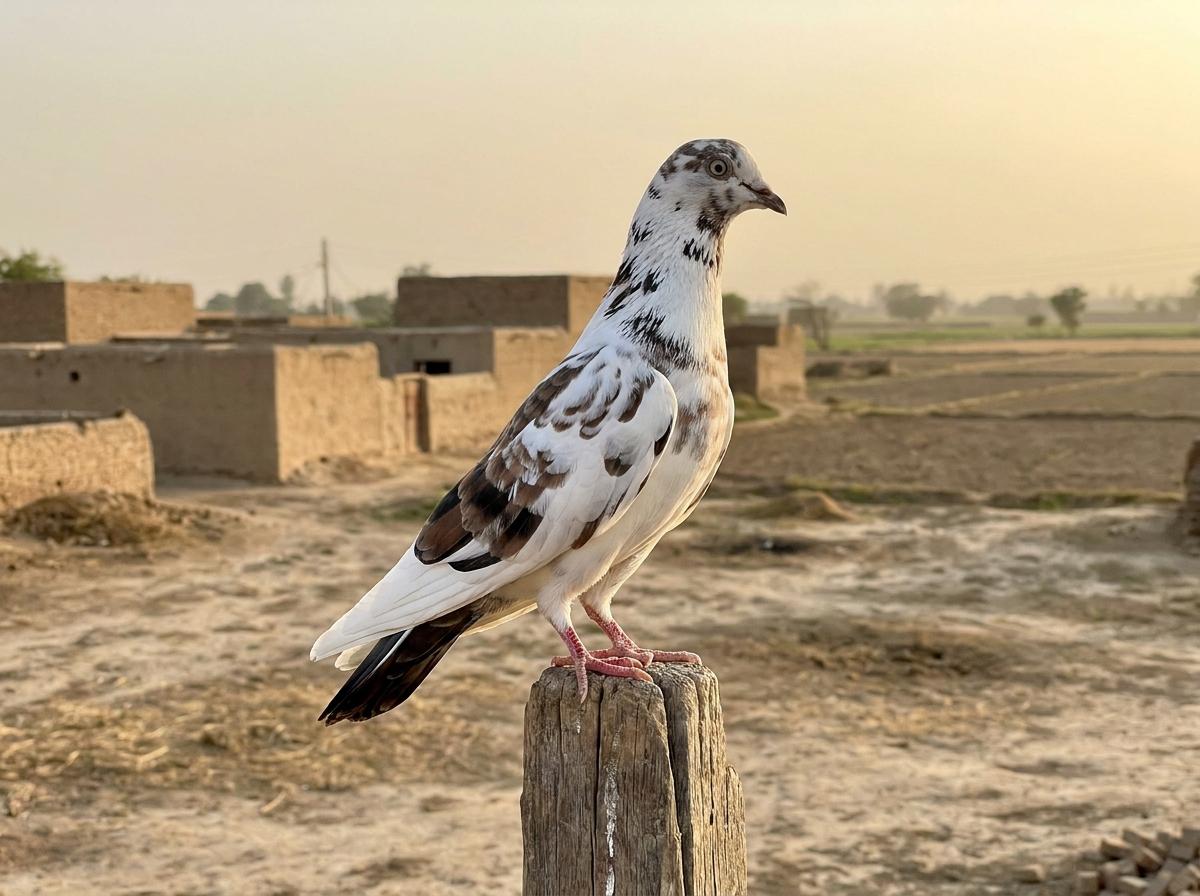
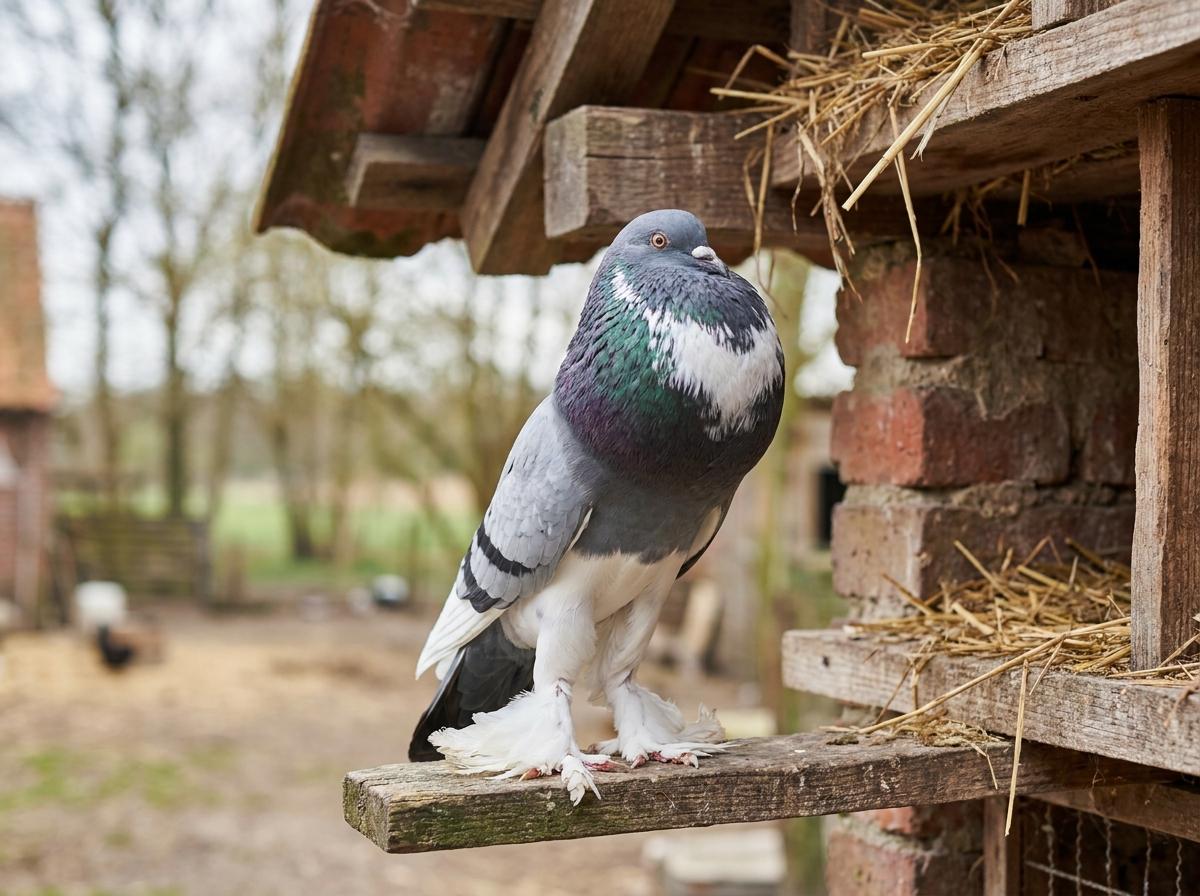
The Holle Cropper is a Dutch exhibition pigeon from the cropper and pouter group: a small, round, short bodied bird that blows its crop up into a wide ball and courts with a tripping, dancing walk. In its own country it is the Holle Kropper, and the German and French standards for the same breed call it the Amsterdam Cropper, which is where the occasional English rendering “Amsterdam Balloon Cropper” comes from. Two things confuse people, and this page settles both. The first is which breed the name actually refers to, because it is not the Dutch Cropper and the cropper group is full of near neighbours that look nothing alike. The second is the inflated crop, which is a genuine welfare subject in this group of breeds and deserves a straight answer rather than a compliment.
If you are working out where this bird sits among the other croppers, the Creatures pigeon species page is a useful place to compare it against the pouters, the owls and the utility breeds. Below you will find what the Holle Cropper is, how to tell it from the breeds it gets mixed up with, what its written standard actually asks for, what the crop means for the bird, how to house, feed and breed it, how rare it is, and what to check before you buy one.

| Also called | Holle Kropper (Dutch), Amsterdamer Kröpfer (German), Boulant d’Amsterdam (French) |
|---|---|
| Origin | The Netherlands. The German standard records the origin simply as “Holland” |
| Breed group | Croppers and pouters. EE number 0331; NPA Croppers and Pouters class in the United States |
| Size | A dwarf cropper. Ring size 8 mm in the German register, against 12 mm for the Dutch Cropper and 13 mm for the Pomeranian |
| Build | Small, round, short and broad, carried horizontally, with the crop blown broader than it is tall |
| Head and beak | Smooth and uncrested, with a medium length beak. The German register prints it as “Schnabel: mittellang”, so it is not a short beaked breed |
| Colours | Selfs, heart marked (geherzt) and tigered (getigert) patterns across a long colour list |
| Status | The Dutch rare breeds foundation classes it as endangered, with roughly 250 breeding hens and a population trend it calls stable |
Browse listings, public profiles, breeders, or add your animal.
Which breed the name actually means
Start with the paperwork, because for this breed the paperwork is the whole answer.
The Entente Européenne, the European federation whose list of fancy pigeon breeds the national standards bodies work from, carries the Holle Cropper as EE 0331, country of origin the Netherlands, German name Amsterdamer Kröpfer, French name Boulant d’Amsterdam (EE list of fancy pigeon breeds). The German special breed club that maintains the standard text opens its description with one word for the origin: “Holland” (SV Amsterdamer Kröpfer von 1926, Musterbeschreibung). In the United States the National Pigeon Association lists Holle Cropper in its Croppers and Pouters class (NPA breed groups).
So the breed is Dutch, it is old, it is recognised in three national systems, and the English name simply keeps the Dutch adjective “Holle” untranslated. That untranslated word is a large part of why the breed is hard to research in English: search for it and you get a scatter of pages that disagree with each other. Worth saying plainly, because we would rather tell you what we could not confirm than invent it: none of the standards we read explains what “Holle” refers to. The word is ordinary Dutch for “hollow”, and the breed’s own standard does call for a back that is short, broad and slightly hollow, but no source we found ties the name to that trait, so treat the connection as unproven rather than established.
One correction while we are here. Some English write-ups describe the Holle Cropper as a German breed connected to the town of Holle in Lower Saxony. That is wrong on the record above: the EE list, the German club’s own standard text and the Dutch national body all place the breed in the Netherlands.
Telling it apart from the other croppers
The cropper and pouter group is large and the names overlap badly, so here is the practical sorting.

- Dutch Cropper (Hollandse Kropper, EE 0302). The one people actually mean when they mix names up. It is a big, tall, imposing bird with heavily feathered legs standing like a pedestal, ring size 12 mm, and the Dutch rare breeds foundation records about 295 breeding hens on a declining trend. Almost the opposite silhouette to the Holle Cropper.
- Voorburg Shield Cropper (EE 0327) and the Dutch Curled Cropper (EE 0352). The other two Dutch entries in the group. Different breeds again, with their own numbers and standards.
- English Pouter. The tall, narrow, long legged bird most people picture from the word “pouter”. Darwin’s description in 1868 still fits it: “Pouters stand remarkably upright, and their bodies are thin and elongated” (The Variation of Animals and Plants under Domestication). The Holle Cropper is the round, low, short legged end of the same family.
- Brunner Pouter, Pigmy Pouter and Norwich Cropper. The other small croppers a beginner is likely to meet. Ring sizes put them in the same size bracket: 7 mm for the Brunner, 8 mm for the Pigmy and the Norwich, 8 mm for the Holle Cropper (BDRG ring size register).
The single quickest field test is the outline. Stand back from the pen. If the bird is tall, upright and narrow, it is not a Holle Cropper. If it is a low, round, short backed bird whose inflated crop is wider than it is tall, and it has clean or nearly clean legs, you are probably looking at one. The Dutch national fancy pigeon body, the NBS, lists Holle Kropper and Hollandse Kropper as two separate breeds in its own cropper index, so the distinction is not a fine point of opinion (NBS cropper breeds).
What the standard actually asks for
The German club standard is the most detailed text available for this breed in a language other than Dutch, and it is specific. The general impression it asks for is “a small, round, short, broad, well proportioned dwarf body of trusting temperament, with a crop blown more broad than high and a completely rounded body seen both from the front and from the side, graceful in its movements, with the tail and wings carried horizontally or, better still, a little raised.”
Point by point, and this is the part worth memorising before you judge or buy:
- Head. Smooth, medium sized, oval, well rounded, with a slightly domed forehead. Smooth means no crest, no peak and no hood.
- Beak. Medium length. Colour follows the plumage: flesh coloured in whites, reds and yellows, horn coloured in the blue and red mealy patterns, dark in blues, black in blacks.
- Eye. Small, yellow to orange, dark in whites, with a narrow eye ring of fine tissue.
- Neck and crop. The neck is long, “the longer the better”, elegant, S curved, very loose and mobile. When the bird courts it snaps its neck back so far that a vertical line dropped through the eye falls behind the feet, and the head still must not rest on the back. The crop should be in harmony with the body and, when inflated, cover the wing butts and complete the ball shape.
- Body. Small, round, short and broad with good fill, carried horizontally. Breast broad and round. Breast, belly and tail wedge together form a half circle. The back is short, broad and slightly hollow.
- Wings and tail. Wings short and broad, resting on the tail, reaching to just short of the tail end. Tail short, carried a little above horizontal.
- Legs. Medium length, not standing too wide apart, smooth or lightly feathered.
The gross faults tell you as much as the ideals do, because they show which way the breed is being steered. The standard lists a narrow body, a strongly upright or flat breast, a falling back, a crop blown crooked, a stiff or short neck, a split breast, a round back, wings carried under the tail, a stand that is too low, too high or stilty, bandy or knock kneed legs, an over long rear, and coarse colour faults. Note two of those in particular: a stilty stand and a strongly upright carriage are faults here. This breed is not being pushed toward the long legged, bolt upright look at all.
Colours run to a long list in three pattern groups. The German register prints selfs (white, black, andalusian, blue with bars, blue chequer, several grizzles and mealies, red, yellow), the heart marked pattern the Dutch and Germans call geherzt, and getigert, a tigered or mottled pattern of evenly mixed white and coloured feathers (BDRG breed and colour register). The heart marked birds are the ones most people remember: white lower breast, belly and thighs, at least seven white flight feathers on each wing, a few white feathers at the wing butt, and a white crescent band curving across the front of the crop, which is the “heart” the name refers to. The Dutch rare breeds foundation summarises the Dutch side more briefly, describing the breed as recognised in ten colour varieties spanning selfs, pieds and tigered birds (Stichting Zeldzame Huisdierrassen). National lists differ in how finely they split colours, which is normal and not a contradiction.

The inflated crop, told straight
This is the trait the breed is named for and the reason people click on it, so it should be described honestly rather than sold.
The crop is an organ, not an ornament. In a pigeon it sits between the lower oesophagus and the top of the proventriculus, and its ordinary jobs are storing food and holding a low pH environment created by microbial fermentation, which acts as a barrier against pathogens. It is also the organ of pigeon parenting: both the cock and the hen produce crop milk, driven by prolactin rising in the second half of incubation, and a newly hatched squab lives on crop milk alone for its first few days before grain starts to be mixed in (Wang and colleagues, Life, 2023). Every cropper breed is therefore a breed selected on the appearance of a working digestive and feeding organ.
What the display is. Inflating the crop with air is normal pigeon courtship behaviour that has been selected upward. The German expert group on animal welfare and pet breeding, in its assessment of section 11b of the German Animal Welfare Act, files the cropper group under “hypertrophied display behaviour” and defines it as a behavioural hypertrophy promoted by breeding, expressed as an exaggerated inflation of the crop with air. It names the trait as the one that gives the whole group its name (Gutachten zur Auslegung von § 11b des Tierschutzgesetzes, hosted by the German Federal Chamber of Veterinary Surgeons).
What the assessment says the risk is. The same document is specific, and it is worth reading the whole finding rather than a summary of it. Over-typed crop forms impair normal crop physiology; enlarged crop sacs, what German fanciers call a Hängekropf or pendulous crop, predispose the bird to inflammation of the crop wall through faulty fermentation, acidification and putrefaction of the crop contents, which then needs veterinary treatment. Its recommendation is not to stop keeping croppers. It is to avoid over-typing, specifically to avoid crop forms that predispose to crop wall inflammation, and it calls for a breeding ban on birds with dilated crop sacs, with priority given to keeping body parts and organs fully functional.
Read that against the physiology above and the mechanism is easy to follow: the crop works partly because it is an acidic, fermenting holding tank that empties. Breed a sack that does not empty properly and you have changed the conditions inside it.
A second finding applies to the group but not to this breed’s ideal. The same assessment flags an unphysiological position of the intertarsal joints in various pigeon breeds, with early findings pointing to a predisposition to degenerative joint disease, and recommends against breeding for traits that increase susceptibility. That is a live question for the tall, long legged pouters. It is much less of one here, because, as above, the Holle Cropper standard treats a stilty stand and a strongly upright carriage as gross faults.
And the short beak question, which is the one people expect, does not apply. Its sister page on this site, the Turbit, covers the pigeon short beak problem properly: the German assessment lists the short beaked breeds by name, records hatching failures in their chicks, and states that beak shortening pursued as a breeding goal has produced parent birds that can no longer rear their own young. The Holle Cropper is not on that list. Its group is not on that list at all: the short beaked breeds named are owls and tumblers. The German register prints this breed with the note “Schnabel: mittellang”, medium length beak, exactly as it prints “Schnabel: kurz” against the Turbit. So the rearing risk that dominates the short faced part of the fancy is not the risk in front of a Holle Cropper keeper. The crop is.
What that means in a real loft. Less dramatic than either the horror version or the sales version, and more specific. A bird with a well shaped, well carried, functional crop is what the standard describes and what a good breeder is selecting for. The thing to watch is the bird whose crop hangs, stays full, feels doughy or sour, or empties slowly, because that is the shape the welfare assessment is pointing at. Handle your birds, feel the crop, and know what an empty crop feels like on your own stock so you can tell when one is not clearing. Croppers also share the whole species’ commonest crop disease: trichomonosis, called canker in pigeons and doves, which covers the crop with a yellowish membrane and yellow, raised lesions, and which parent birds pass to their squabs in contaminated crop milk (Merck Veterinary Manual). A crop that is not right is a veterinary question, not a forum question.
For the wider pattern here, the Dong Tao chicken in the same batch of guides is the same story in another species: a selected exaggeration that carries a documented, specific cost that most write-ups leave out. Naming the cost is what makes a breed page trustworthy.
History
The Dutch record for this bird goes back a long way. The Dutch rare breeds foundation traces it to a painting by M. d’Hondecoeter dated 1665, and identifies its forerunner as the “oploper”, a Dutch flying type. John Moore, writing an English pigeon book in 1735, gave what the foundation calls a very good description of the oploper: a good inflater and a very typical flyer, found in all parts of the Netherlands.
By the end of the nineteenth century three regional types had formed, the Hague type, the Amsterdam type and the Groningen type. The Holle Kropper Club was founded in 1904, and from that point birds were bred and judged to the standard it drew up, which is what dissolved the three regional types into one uniform breed. The standard was refined substantially through the early twentieth century, which is what the German text means by “essentially refined since the beginning of the twentieth century”. Today the Dutch club is Vrienden Holle Kropper Fokkers Nederland.
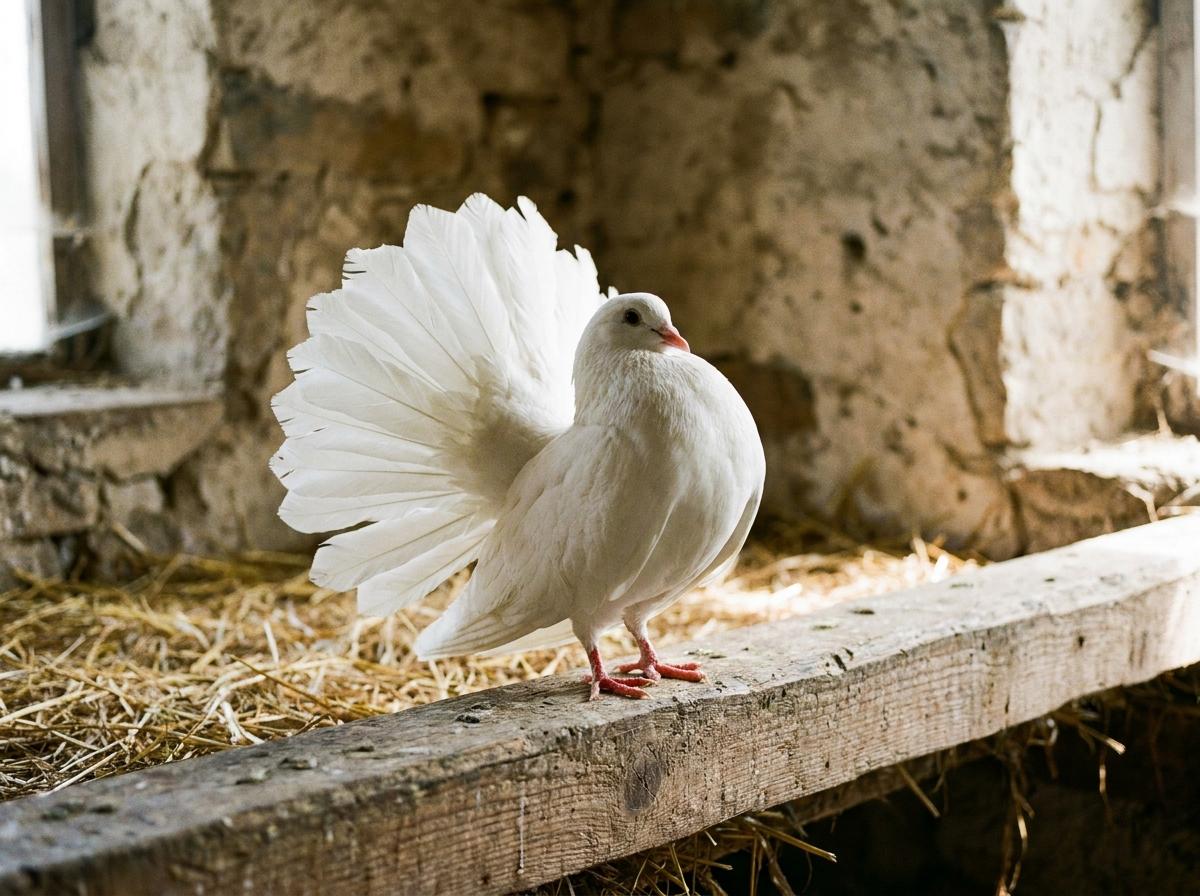
The behaviour survived all of it. The foundation still describes the breed as an oploper, and describes the cock’s courtship exactly: he makes tripping steps, and dances and jumps with his tail spread. If you keep this breed you are keeping a display, not just a shape.
Housing and daily care
Nothing about a Holle Cropper’s housing is exotic. It wants what any fancy pigeon wants, done properly.

The National Pigeon Association puts the housing principles plainly: a loft should be free from draughts in winter, able to be kept clean and dry in wet climates, and give adequate room for the number of birds, with good ventilation and access to sunshine along with clean water and food (NPA housing guidance). In practice that means a dry solid floor you can actually clean, roomy nest boxes, broad perches at more than one height, and enough space that birds are not forced past each other.
Two points are worth adding for a cropper specifically. Give the birds room to display, because a cock that cannot walk, dance and turn is being kept as an ornament rather than as the breed it is. And keep the fittings smooth: an inflated crop is a large, forward, exposed surface, and rough or sharp edges on nest fronts, feeders and door frames are worth removing.
On feed, the NPA’s care guidance is concrete. A whole grain or pellet mix of at least 13 percent protein for maintenance, rising to 18 to 20 percent through breeding and the moult; pigeon grit containing oyster shell, salt and minerals; and a drinker holding at least 1.5 inches (about 3.5 cm) of free standing water, scrubbed out at least once a week (NPA care guidance). Clean water matters more than usual in a bird whose showpiece is a fermenting holding tank, and the weekly scrub is not a nicety.
The same guidance names the three health problems to know first: canker (trichomonosis), paramyxovirus, and coccidiosis, which it notes is normally found only in damp conditions. Treat that last clause as a housing instruction. Damp is the enemy in a pigeon loft, and a dry floor prevents more disease than any bottle will cure. All medical decisions belong with a veterinarian who can see the bird.
Breeding
The mechanics are the ordinary pigeon timetable, and knowing it before you pair anything up saves a season. Pigeons reach sexual maturity at five to seven months, though plenty of keepers wait longer. The hen lays two eggs, the second about 44 hours after the first, and hatching follows about 18 days after the second egg. Both parents produce crop milk for the first days, start adding grain at about five to ten days, and youngsters are rung between five and twelve days and wean at about 35 days.
What changes with a cropper is what you should be writing down. The selection question for this breed is functional crop shape, and it only becomes visible over seasons: which birds carry a crop that empties cleanly, which line throws a bird that hangs, which pair reared without trouble, which bird needed treating for canker and when. That record is the tool that lets a breeder move a line in the direction the welfare assessment recommends instead of drifting the other way. Add a record is the quickest way to log a hatch, a treatment or a weight as it happens; the record sheet opens for any visitor to look around, and a free account saves what you enter.
Rarity, cost, and finding birds
The Holle Cropper is a rare breed in its own country. The Dutch rare breeds foundation classes it as endangered, counts roughly 250 breeding hens, and calls the fifteen year trend stable, which is a better position than the Dutch Cropper’s declining 295. Stable and small is still small: this is a breed sustained by a specialist club and a modest number of serious lofts.
Outside the Netherlands and Germany it is scarcer still. The NPA recognises it in the United States, but that listing does not establish the size, or even the current continuity, of a US population. It is not a breed you will find advertised week to week, and it does not appear at every show.
On price, we will not invent a figure. There is no published market rate for this breed from any authority we could check, and any number quoted in a search result is somebody’s single sale, not a market. What we can say usefully is how the money behaves in a breed like this one: birds move through club contacts and shows more than through open advertising, good stock from a known loft costs more than a bird of unknown breeding, and the scarcity premium is real. If you want one, the practical route is to make yourself findable to the small number of people who have them, then wait. You can browse Holle Cropper listings on the Creatures marketplace and look for lofts in the Creatures directory, and because the breed is rare, a saved listing alert is usually the thing that actually catches one.
What to check before you buy
- Check the outline against the standard, not against a photo. Low, round, short backed, carried horizontally, crop broader than tall, clean or lightly feathered legs. A tall, narrow, stilty bird is either a different breed or a bad one.
- Handle the crop. Feel it on several birds so you learn the range. A crop that hangs, stays full, or feels doughy or sour is the specific thing the welfare assessment is warning about, and it is the one health question that is genuinely breed shaped here.
- Check the head is smooth. No crest, no peak, no hood. A crest means you are looking at another breed.
- Watch the bird court. This is a display breed, and the display is half the point. Ask to see a cock work, and look for a neck that snaps back freely and a crop blown evenly rather than crooked.
- Ask about the loft’s rearing history. How many rounds did the pairs rear themselves last season, and what did they treat for. A breeder who keeps the answer is the breeder you want.
- Check the ring. German rung birds carry an 8 mm ring. A ring is not proof of quality, but it is a record, and a seller who can tell you the year and the breeder is a better bet than one who cannot.
Frequently asked questions
Is the Holle Cropper the same as the Dutch Cropper?
No. They are two separate breeds with separate EE numbers, 0331 and 0302, and separate entries in both the Dutch and the American breed lists. The Dutch Cropper is much bigger, taller and heavily feather legged, at a 12 mm ring against the Holle Cropper’s 8 mm.
Why is it called the Amsterdam Cropper in German and French?
Because that is the name those standards use for the same breed, EE 0331. The Dutch name is Holle Kropper and the English name keeps the Dutch word. Some English lists render the continental name as “Amsterdam Balloon Cropper”, which is the same bird.
Is the inflated crop harmful?
Not in itself, and the German expert assessment does not ask anyone to stop keeping croppers. What it identifies as harmful is over-typing: enlarged, dilated crop sacs that predispose the bird to crop wall inflammation from faulty fermentation of the crop contents. Its recommendation is to avoid crop forms that cause that, and it calls for a breeding ban on birds with dilated crop sacs.
Can Holle Croppers rear their own young?
There is no finding in the German welfare assessment that puts this breed in the group that cannot. That finding attaches to beak shortening, and it names short beaked owls and tumblers. The Holle Cropper is printed in the German register with a medium length beak, so the rearing problem that shapes the short faced fancy is not this breed’s problem.
Does it fly?
Its forerunner, the Dutch oploper, was described in 1735 as a good inflater and a very typical flyer. The modern breed is an exhibition bird, and its written standard is about shape, carriage and the display rather than flying performance. Give it room to fly anyway.
Are they good for a beginner?
As birds to keep, they ask for nothing unusual: a dry loft, clean water, good grain, grit. As birds to breed and show, they are a step up, because the whole judgment sits on crop shape and carriage, and that takes an eye you can only build by handling birds and going to shows. A sensible first season is to keep a pair or two, and go and look at a class being judged before you buy anything expensive.
How rare are they?
Rare. Roughly 250 breeding hens in the Netherlands on the rare breeds foundation’s count, held stable by a specialist club, and thinner on the ground elsewhere.
Do this next on Creatures
Whether you are pinning down which cropper you are actually looking at, hunting for stock, or already keeping a loft of them, Creatures is the records, marketplace and directory layer to do it in one place.
Get alerted. Holle Croppers are scarce, so set a free Holle Cropper listing alert and we will tell you when one is posted. No account needed to start, and saving searches and using your watchlist explains how the alerts and watchlist work.
Look at what is listed now. Browse Holle Croppers on the marketplace and search trusted breeders and lofts in the Creatures directory.
Add your birds. Already keeping them? Create a free profile for a bird in a couple of minutes, ring number and all. The walkthrough is in adding an animal to Creatures.
Log crops, hatches and treatments. Add a record for a hatch, a canker treatment, a weight, or a note that a bird’s crop was slow to clear. The record sheet opens for any visitor to look around, and a free account saves what you enter. See adding a record and health and medical records for the full how to.
List your loft. Breeding them? Add your loft as an organisation so the people hunting this breed can actually find you, and read getting listed in the breeder directory and creating an organization and adding your team.
Compare it with its neighbours. The pigeon species page lists the other croppers and pouters, and the Turbit page covers the short beak question in the breeds that do carry it.