Celestial Eye
Variety
Author: Elliott Garber, DVM · Published
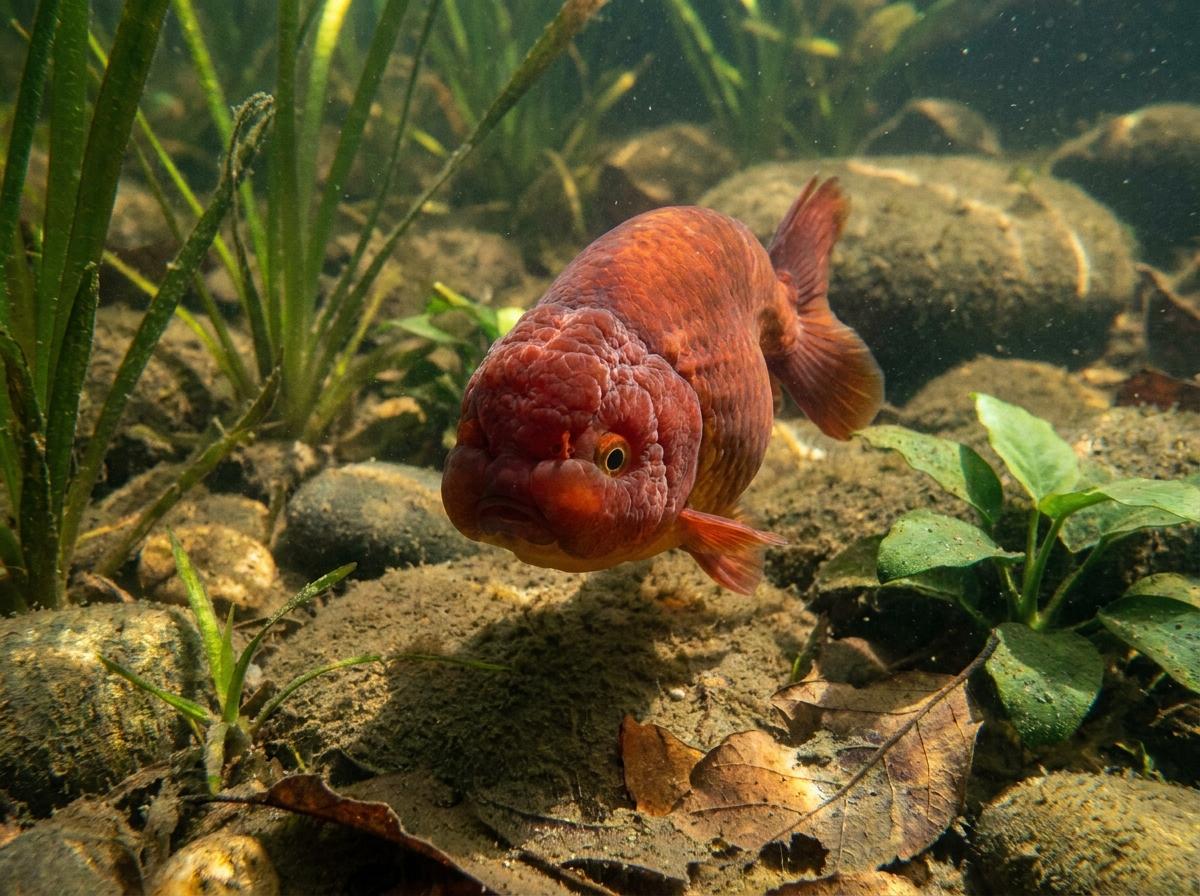
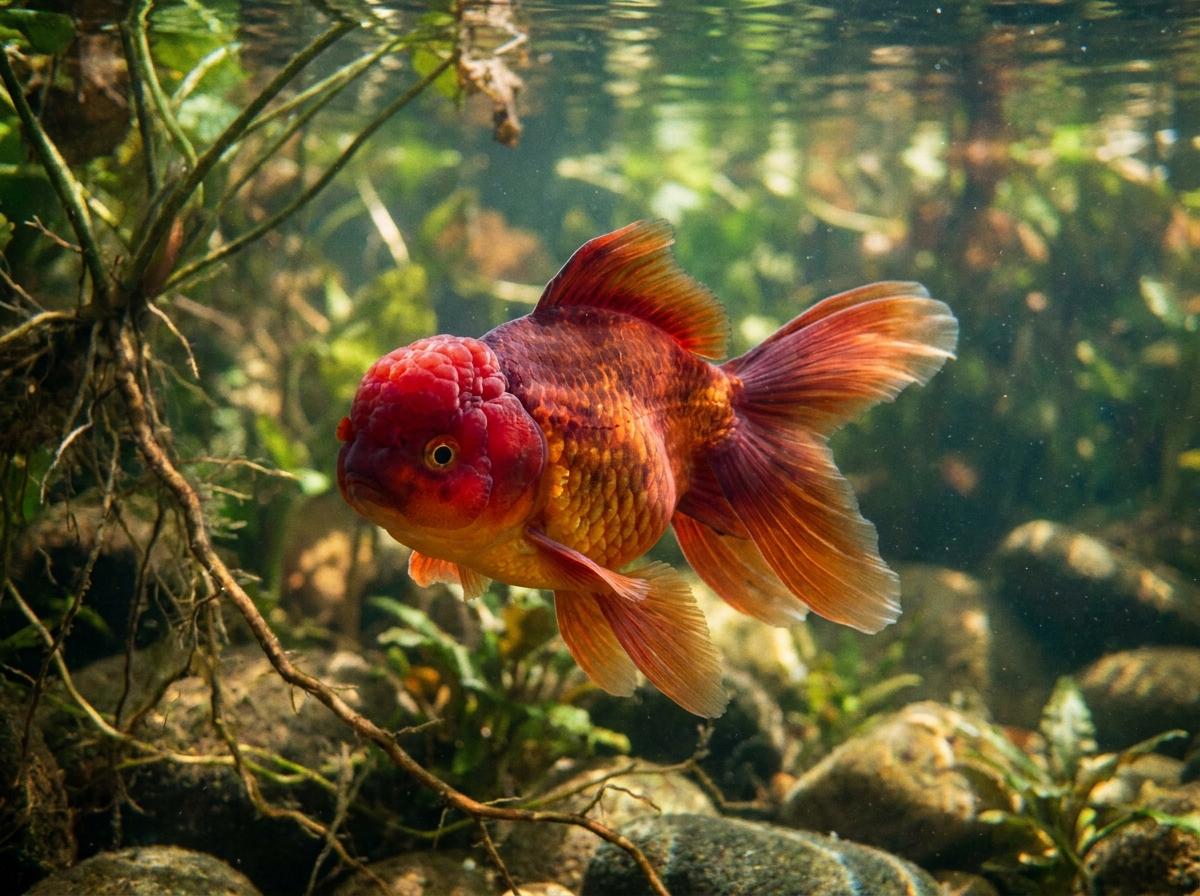
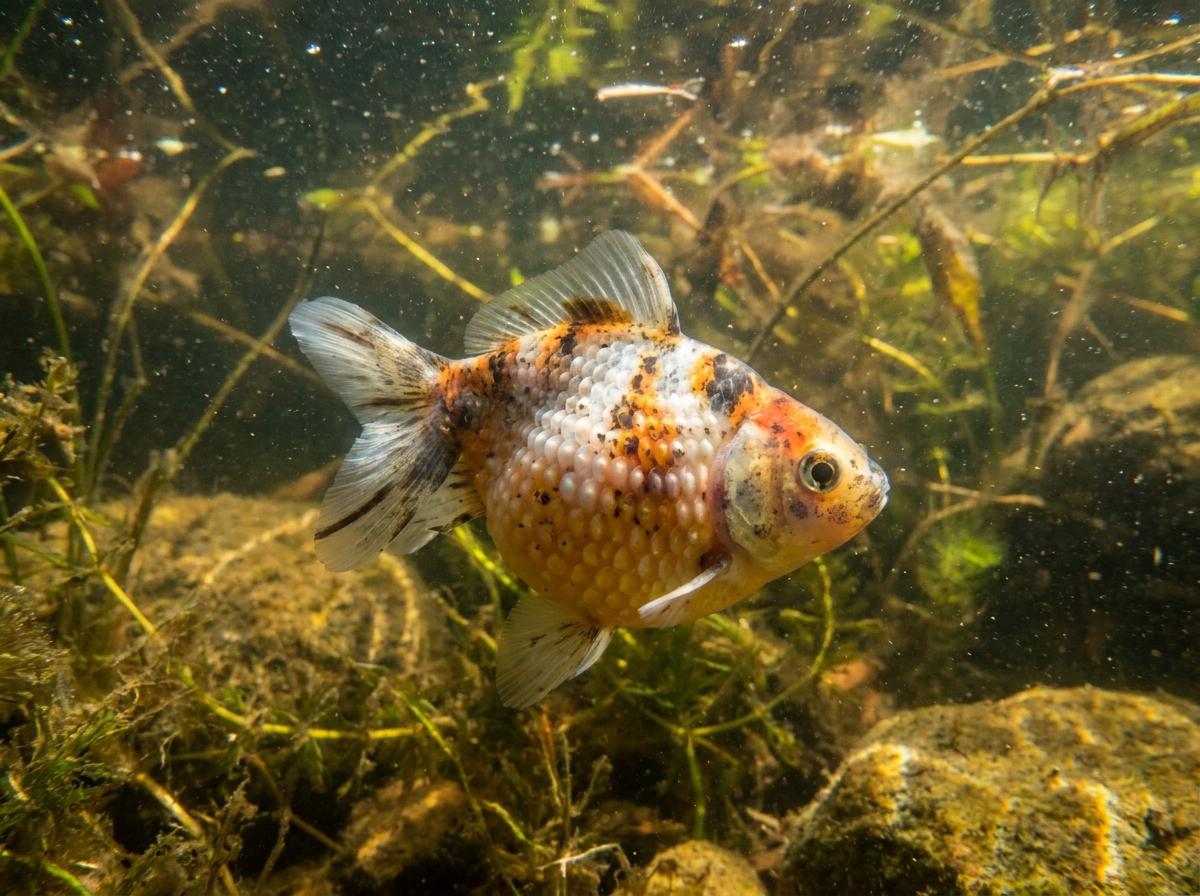
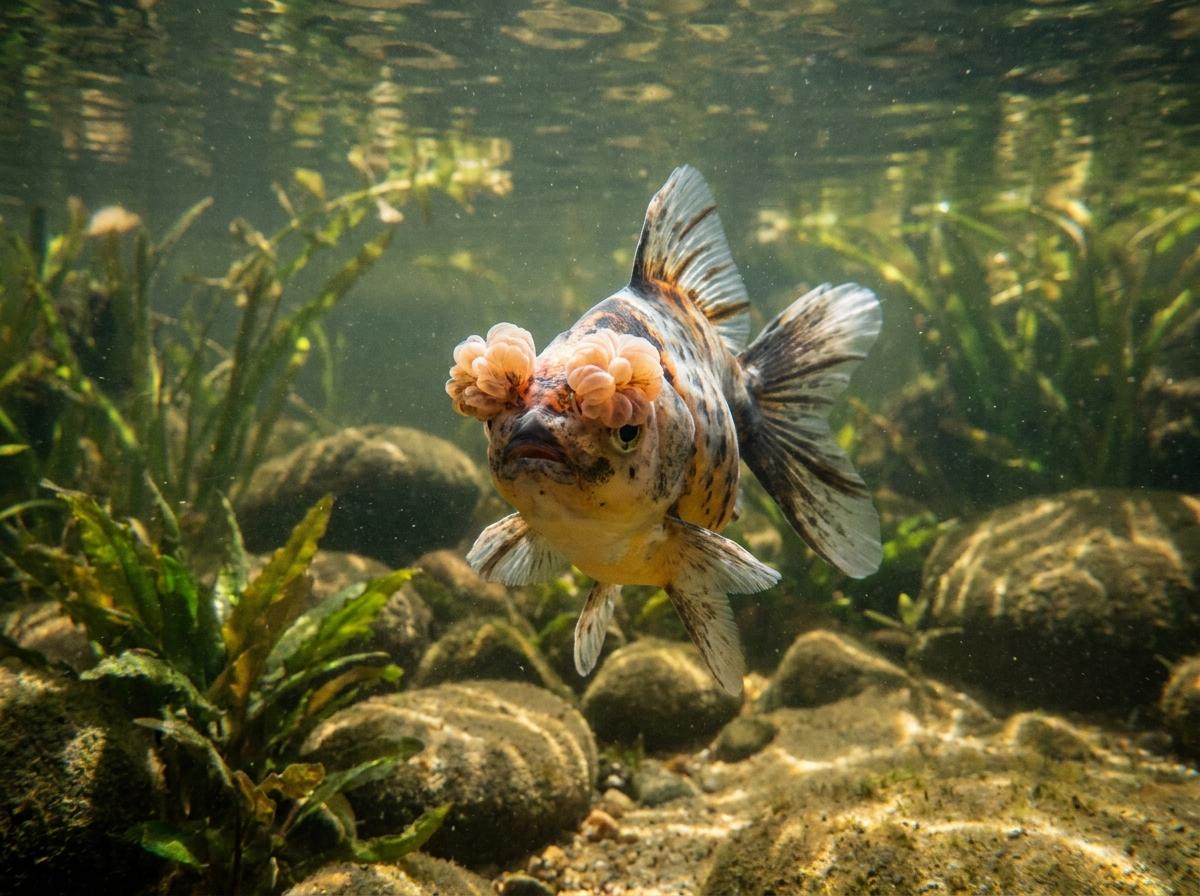
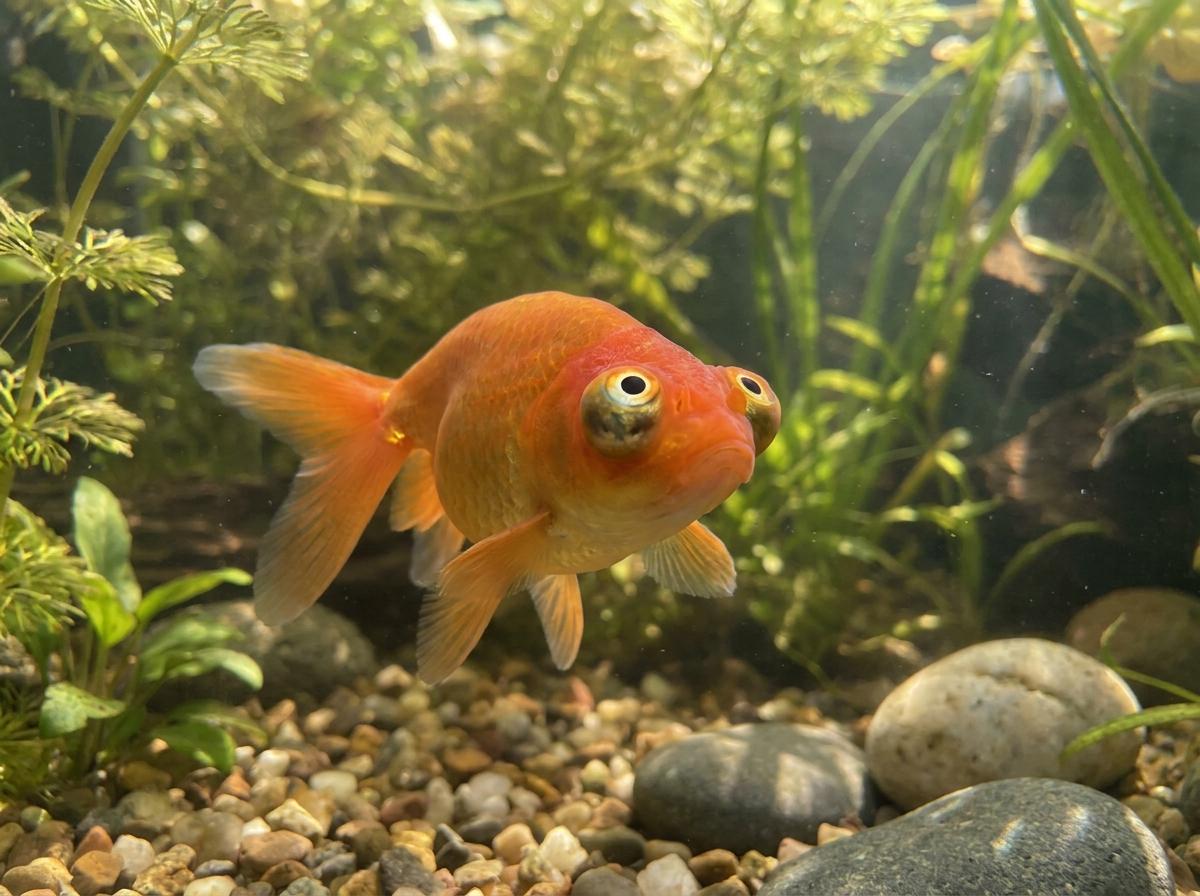
A celestial eye goldfish is a fancy goldfish with no dorsal fin, a divided twin tail and large telescope eyes that turn until the pupils face straight up at the surface. The fish hatch with ordinary-looking eyes. Over the first two or three months the eyes bulge out to the sides, and then they rotate forward and up, so a young celestial can pass for a telescope goldfish for a while. Breeding studies show the upturned eye is inherited as a recessive trait, and eye research going back to 1982 shows the retina starts to degenerate as the eyes protrude. This is a slow fish with poor sight, and it does best in a gentle, smooth-sided tank with its own kind for company and food it can find.
Celestials are uncommon in North America, and none are listed on the Creatures marketplace right now, so the easiest way to hear about one is to set a free celestial eye listing alert (no account needed to start). For the species as a whole and its other varieties, start at the Creatures goldfish page.

| Other names | Celestial, sky gazer, stargazer; chotengan in Japan; wang tian yan in China |
|---|---|
| Defining look | Protruding telescope eyes with the pupils facing up, no dorsal fin, a divided twin tail |
| Origin | China; the variety appears to date from the 18th century |
| Eye development | Normal at hatching; the eyes bulge in the first 2 to 3 months, then turn up, usually finishing between about 4 and 10 months |
| Inheritance | Recessive; a 2025 study points to a candidate mutation in LRP2, the telescope eye’s gene, but a different mutation |
| Vision | The retina degenerates as the eyes protrude, so sight is poor |
| Tank | At least 120 litres (about 32 US gallons) for a pair, from RSPCA UK’s 60 litres per goldfish; at least 4 times adult body length long and 3 times as tall; never a bowl |
| Company | At least two goldfish, and celestials only with their own variety |
Browse listings, public profiles, breeders, or add your animal.
What is a celestial eye goldfish?
The goldfish, Carassius auratus, is a domesticated crucian carp that Chinese keepers have selected for color and shape since the Song dynasty (960 to 1279). The celestial is one of its most extreme varieties. A review of goldfish morphology by Ota and Abe classes its eyes as “upwardly directed protuberant eyes” and names it, with the ranchu, as a representative dorsal-finless strain. The same review notes that these dorsal-finless strains also have markedly fewer vertebrae than ordinary goldfish.

The names vary by country. A 2025 genetics paper lists sky gazer, heavenward star gazer, chotengan and deme ranchu as other names for the fish, and in Chinese it is known as wang tian yan. In English it is usually sold as the celestial or celestial eye goldfish, and sometimes as the stargazer.
A celestial shows three things at once, and all three have to be there:
- Eyes. Large, protruding telescope eyes, rotated so the pupils point up. Seen from the side, each eye is a round globe sitting on the top of the head, and the dark pupil looks at the sky rather than at you. Both eyes should be the same size and turned the same amount.
- Back. No dorsal fin. The back is a smooth, gently curved line with no fin, no spike and no hump.
- Tail. A divided twin tail, with the other fins matched in pairs. In UK shows, the Nationwide goldfish standards place the celestial in a group defined by a round body, no dorsal fin and a short double tail, alongside the lionhead, bubble eye and pompom, as Practical Fishkeeping reported when the first Nationwide open show was held in 2014.
Color is not what makes a celestial. A 2022 study of celestials raised in Beijing describes them as mainly white, yellow or brown, and the standard published by the Goldfish Council, a non-profit goldfish club founded in 2016, says celestials are metallic and come in a variety of colors. Judge the eyes, back and tail first.
How the eyes turn upward
There is no such thing as a baby celestial with upturned eyes. The eyes move in stages over months, and researchers have timed it.
In a 2025 study, Li and Sun followed 84 full siblings from one celestial pair at a Beijing research institute and published the milestones:
- About 20 days after hatching: the eyes of every fish bulged slightly to the sides.
- 60 days: every fish had the look of a telescope goldfish, eyes pushed well out.
- 70 days: about 12 percent had started to rotate their eyes forward.
- 100 days: about 40 percent had fully rotated their eyes up.
- 110 days: about half had upward-facing eyes, 49 percent had eyes still turned forward, and 1 percent had not rotated at all.
- 280 days: every fish had finished, with the eyes in the celestial position.
So the path runs sideways, then forward, then up. An earlier Japanese study by Matsumura and colleagues (Ophthalmic Research, 1982) saw a slower schedule, with the eyes starting to protrude at about 90 days and rotating at about 120. A second 2025 paper, by Li and colleagues, cites a turning window of 3 to 4 months with a maximum at 6 months, and adds that some of its own fish did not finish until 10 months of age, while others never reached a full 90 degree turn by 24 months.
What that means for you. A celestial under about six months old may still be a telescope-eyed juvenile, and its final eye angle is a guess. If matched, fully upturned eyes matter to you, buy a fish that has finished turning, or expect some young fish to end up with eyes that stop short or turn unevenly.
You may also read that the eyes turn up because the fish were raised in jars or dark pots and spent their lives looking toward the light. The breeding work below says otherwise: the trait passes from parents to young by simple recessive inheritance.
Celestial eye genetics: one recessive gene, and not the telescope’s mutation
For a long time keepers argued about whether the celestial was simply a telescope goldfish whose eyes went one step further. Two lines of evidence now say no.
The trait is recessive. In Li and colleagues’ 2025 study, a spawn from celestial parents gave 1,277 young, and only 3 had normal eyes. Crossing those three normal-eyed fish (the one male with each of the two females) produced celestials in about one in four of their young: 77 of 309 in one cross, and 109 of 508 in the other (after setting aside 126 fish whose eyes only bulged slightly). That 1 to 3 ratio is the signature of a single autosomal recessive gene carried by normal-eyed parents.
LRP2 is the leading candidate, and the candidate mutation is not the telescope’s. Sequencing pointed to a top candidate: a premature stop codon in exon 38 of the LRP2 gene, which cuts the protein roughly in half. Every fish in the tested sample with clearly protruding eyes carried two copies of it, whether its eyes had turned 15 degrees or the full 90, so the authors propose that the mutation drives the bulging and turning while other factors set the final angle. Telescope goldfish carry different mutations in the same gene: Kon and colleagues reported three of them in 2020, and a 2022 study that edited the gene in two goldfish strains reproduced telescope eyes. No mutation is shared between the two varieties. A 2009 study of mitochondrial DNA by Komiyama and colleagues had already suggested that telescopes and celestials were developed independently, from goldfish lines with and without dorsal fins.
Not every celestial line carries the same mutation. Of 50 celestials sampled from five farms in different regions of China, not all carried two copies of this one, so at least one other celestial mutation is still waiting to be found.
Simple Punnett math for breeders. If both parents carry the same celestial mutation (call it c, with C for the normal allele):
- Celestial (cc) x celestial (cc): every youngster is cc and should develop celestial eyes.
- Celestial (cc) x normal-eyed carrier (Cc): about half the young are cc celestials and half are Cc carriers with normal eyes.
- Carrier (Cc) x carrier (Cc): about one in four cc celestials, half Cc carriers and one in four CC non-carriers, all normal-eyed except the cc fish.
- Celestial (cc) x non-carrier (CC): no celestials at all; every youngster is a normal-eyed carrier.
Two cautions. Fish from unrelated lines may carry different celestial mutations, so these ratios can fail when you mix lines; the study’s own starting spawn, with 3 normal-eyed carriers among 1,277 young from celestial parents, shows that celestial parents are not always genetically identical. And the dorsal fin does not behave as neatly: Ota and Abe note that the expression of dorsal-fin loss is fairly unstable and that its inheritance has not been properly tested, so a celestial pairing is no guarantee of a clean back in every youngster.
Where the celestial came from
Goldfish keeping began in earnest in Song dynasty China, and twin tails and other fin and eye mutants were documented during the Ming (1368 to 1644) and Qing (1644 to 1912) dynasties. The telescope eye has a possible written reference as early as 1590. The celestial appears to be younger: Li and colleagues, citing Joseph Smartt’s breeders’ handbook, place its origin in the 18th century.
The traditional story is that celestials were favorites in the Chinese palaces because their eyes seemed to look up to the emperor, and Chinese researchers describe the variety as particularly prized at the Qing imperial court. Take the symbolism as tradition rather than documented history; the eyes themselves are what the record supports.
In Japan the fish is known as chotengan. In North America, the Goldfish Council’s 2016 standard calls the celestial fairly rare, while the bubble eye is fairly common, and says both are bred there as well as imported.
Celestial eye vs bubble eye, telescope and other look-alikes
Several fancy goldfish share one or two of the celestial’s features. Here is how to tell them apart:
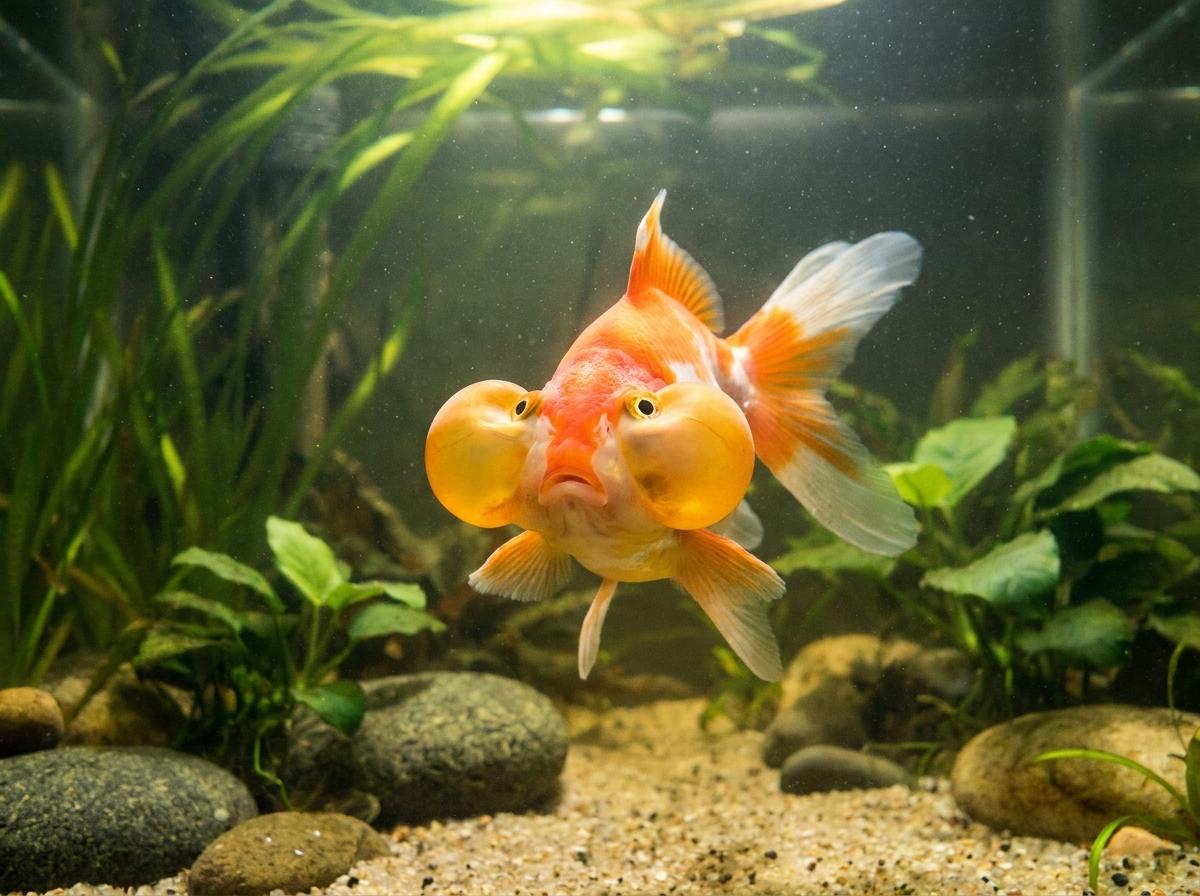
- Bubble eye. Also dorsal-less, with upturned eyes; the Goldfish Council says the two share a similar mutation that forces the eyes upward. The bubble eye adds large, fluid-filled sacs under the eyes, which Ota and Abe describe as a developed infraorbital vesicle. No sacs, no bubble eye. The council also notes that bubble eye tails can be quite long, while celestial tails are typically shorter.
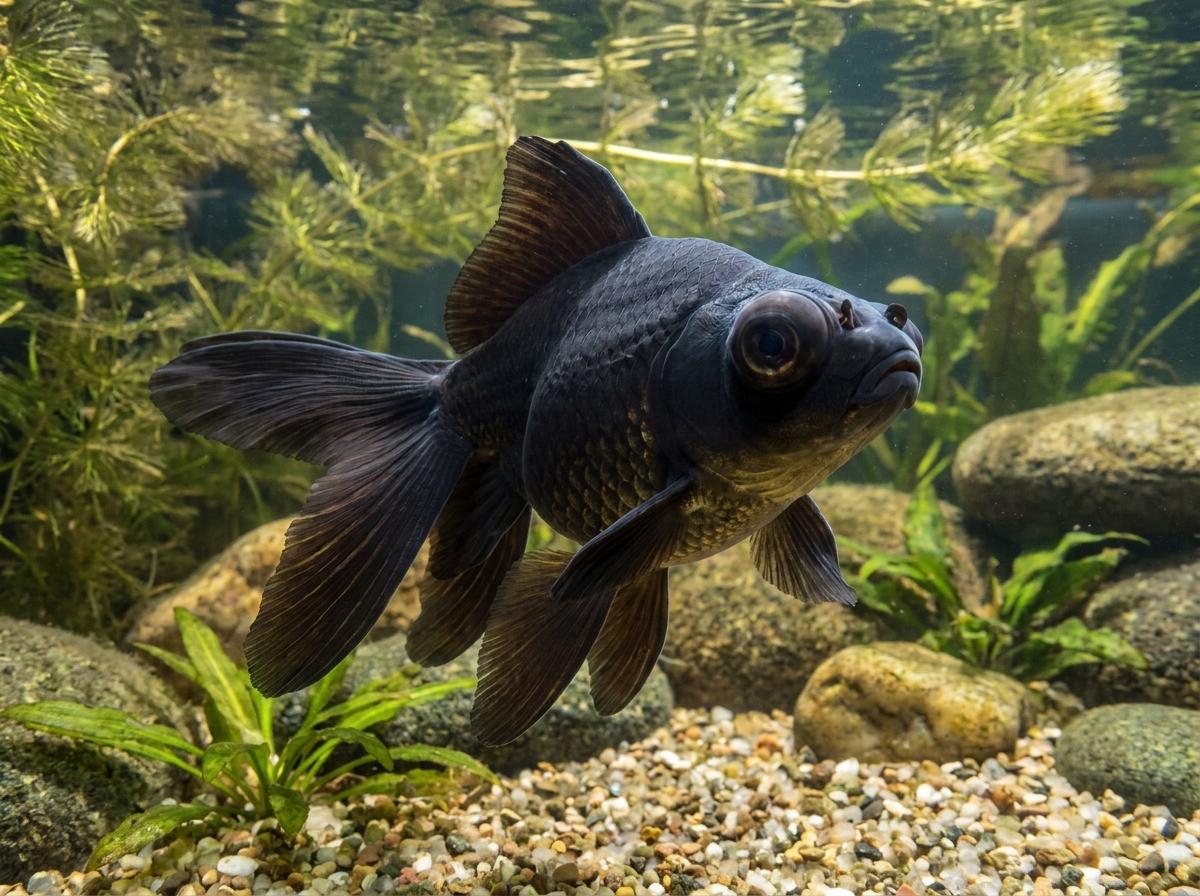
- Telescope goldfish and the black moor. Protruding eyes that point to the side and front, not up, and a dorsal fin. A fish with telescope eyes and a dorsal fin is a telescope type, not a celestial, and a juvenile celestial can look like a dorsal-less telescope until its eyes turn.
- Ranchu and lionhead. Also no dorsal fin, but normal eyes and a fleshy head growth (the hood or wen). A celestial has a smooth head.
- Pompom. Defined by the growths of tissue around the nostrils, not by the eyes.
- Anything with a dorsal fin and normal eyes, such as a fantail or an oranda, is not a celestial, whatever the label says.
What the upturned eyes cost the fish
The celestial’s defining traits come with real costs, and they shape everything about how to keep one.
Sight. Matsumura and colleagues found that the celestial’s retina reaches a normal mature structure by about 50 days and shows no damage until the eyes start to protrude, at about 90 days, when degeneration begins. By about 120 days, patches of the pigment layer had lost their melanin and been taken over by scavenging cells, and photoreceptor cells were being destroyed. Telescope goldfish with eyes just as large showed no such degeneration. Li and Sun summarize the result as restricted vision and reduced light sensitivity, and the 2025 gene study adds gene-expression evidence that the cornea is affected too. A celestial is not necessarily blind, but it sees poorly, and mostly upward.
Fragile eyes. The eye is enlarged by an increase in the volume of the vitreous, the gel inside the eyeball, and earlier work cited by Li and Sun describes a thin, fragile sclera, the eye’s white outer wall. A sharp rock, a rough ornament or a stiff plastic plant is a real hazard to an eye that sticks out and cannot see the obstacle coming.
Swimming. A 2024 study of goldfish anatomy by Le Verger and colleagues summarizes earlier swimming trials: dorsal-finless goldfish breeds show greatly impaired locomotion, with reduced directional stability, balance, swimming speed and acceleration. The same paper notes that ornamental head features in fancy goldfish are sensitive to mechanical damage and vision impairment.
Food. Put those together and a celestial is often the last fish to reach food. That is why RSPCA Australia says to keep celestials only with their own variety: they may find locating and competing for food difficult next to better swimmers.
None of this means a celestial cannot live a long, comfortable life. It means the tank has to be built around a slow fish that cannot see well.
Setting up a celestial eye tank
Most of the setup is ordinary good goldfish keeping. The figures below come from RSPCA Australia’s goldfish care guide (updated May 2024) and, where noted, RSPCA UK’s aquarium guidance, with the celestial-specific changes added.

Never a bowl. RSPCA Australia says traditional fish bowls are too small for goldfish and should be avoided, and RSPCA UK lists goldfish bowls, jars and children’s tanks as unsuitable. Use a filtered aquarium.
Size. Plan on at least 120 litres (about 32 US gallons) for a pair. RSPCA UK’s aquarium guidance says goldfish need at least 60 litres of water each, and its length rule lands in the same place: allow 2 litres of water for every 0.5 cm of goldfish, which is 4 litres per centimetre, or 120 litres for two fish 15 cm (6 inches) long. Shape matters too. RSPCA Australia sets 50 litres (about 13 US gallons) as the floor for any goldfish tank and wants the tank at least 4 times the adult body length long, 2 times as wide and 3 times as tall, which for a 15 cm fish means at least 60 by 30 by 45 cm (about 24 by 12 by 18 inches). A tank of about 90 by 35 by 45 cm (about 36 by 14 by 18 inches, roughly 140 litres) meets both rules for two 15 cm fish. RSPCA UK adds that wide tanks are better than tall ones, because the surface is where oxygen enters the water, and both RSPCA branches say bigger is better. You need at least two fish (see tank mates below), and every extra fish needs more water.
Filter and flow. Goldfish are heavy feeders and produce a lot of waste, so the filter has to be sized for the tank. Choose one with adjustable flow and keep the current gentle, because RSPCA Australia warns that fast currents make swimming difficult for fancy goldfish. If the filter does not stir the surface, add an air stone.
Water quality. Cycle the tank before the fish arrive, and while the nitrogen cycle establishes, test ammonia and nitrite every two to three days for the first six weeks, then every one to two weeks. The targets in RSPCA Australia’s guide: ammonia under 0.1 ppm, nitrite under 0.2 ppm, nitrate under 50 ppm, pH 6.5 to 7.5, and 20 to 24 C (68 to 75 F). For temperature, RSPCA UK gives goldfish a wider, cooler 10 to 21 C (50 to 70 F) and says a heater is not normally necessary; if temperature swings worry you, it suggests one set at the low end of the range.
Water changes. Change 10 to 25 percent of the water weekly with a gravel clean, treat new water with a conditioner for chlorine and chloramine, and rinse filter media only in old tank water so the beneficial bacteria survive. A repeating reminder on Creatures can carry the weekly change for you; see reminders and upcoming care.
Plants and decor. Aim for about half the tank planted, with dense patches and open swimming space. Live plants absorb waste, and RSPCA Australia notes that artificial plants reduce stress as well as real ones do, but for celestials choose soft-leaved plants. All decor must be free of sharp or rough edges and small holes, which RSPCA Australia flags as especially important for fancy goldfish with impaired vision. Give the tank one covered or backed side so the fish are not surrounded by bare glass.
Light. Keep the tank out of direct sun, run the light no more than 10 hours a day, and give at least 8 hours of darkness.
Indoors, not the pond. Fancy goldfish are kept in ornamental ponds, but a celestial belongs where you can watch every fish eat, and a pond shared with faster goldfish breaks the own-variety rule.
Feeding a fish that looks up
Short-bodied fancy goldfish like the celestial should get sinking pellets rather than flakes or floating pellets, according to RSPCA Australia, because gulping food at the surface means swallowing air, which leads to buoyancy problems.
The rest of RSPCA Australia’s feeding advice applies as written:
- Feed once a day, only what the fish eat in under two minutes. Overfeeding is the most common goldfish problem.
- With more than one fish, feed in two or more separate spots so every fish gets a share.
- Vary the diet with frozen brine shrimp, daphnia, a vegetable mix or scalded peas, and soak freeze-dried food first.
- Never feed mammalian fats such as beef heart or offal.
- Feed less when the water drops below 8 C (46 F), because a goldfish digests slowly in cold water.
Watch each celestial eat. A fish that hangs back, stays thin or keeps missing the food is telling you something about its tank mates or its eyes.
Tank mates for celestial eye goldfish
Keep at least two goldfish. In RSPCA Australia’s words, goldfish are social animals that interact with each other, and having at least two provides companionship and promotes activity.
Keep celestials with celestials. RSPCA Australia says the more unusual varieties such as the celestial should be kept with their own variety only, because they may struggle to find and compete for food against better swimmers. That rules out fast single-tailed goldfish such as the comet and the shubunkin, and it argues against mixing in even normal-eyed fancy goldfish.
Tropical community fish are a separate tank altogether. Our guide to the best freshwater aquarium fish explains why goldfish do not belong in a heated tropical community.
Health, quarantine and finding a fish vet
RSPCA Australia’s signs of a healthy goldfish are clear, bright color, fins held erect, alertness and swimming without undue effort. Warning signs are a fish that sinks or bobs at the surface, lumps, bumps or wounds, clamped fins, a trail of feces, or a fish that stays in one corner for a long time.
For a celestial, add the eyes to that list. A cloudy, swollen, bloody or injured eye, a fish that floats or rolls onto its side, or one that stops eating needs a veterinarian who treats fish rather than guesswork. The American Association of Fish Veterinarians keeps a map to find a fish vet in North America; if none is near you, it suggests asking your regular vet to consult with one. The Merck Veterinary Manual’s overview of aquarium fish notes that koi and fancy goldfish typically respond well to veterinary care, and that many of the best fancy goldfish are imported from China.
Quarantine every new fish. The Merck Veterinary Manual’s guide to routine health care of fish recommends quarantining valuable pet fish in a separate aquarium for at least 30 to 60 days before they join the others, and restarting the clock if you add another fish to quarantine. Merck’s overview adds that some freshwater fish are particularly prone to parasitic and bacterial infection in the first 30 days after arrival. Set up the quarantine tank before you buy.
Keep a record. A health record with photos, a length measurement every month or two, and notes on what the vet found make it far easier to see a slow decline, or a juvenile’s eyes turning. On Creatures, health and medical records explains what to log, and a medication record with a follow-up date creates its own reminder.
Showing celestials
Celestials are judged mostly on their eyes. The Goldfish Council’s 2016 judging schedule for the bubble eye and celestial gives 50 points to the eyes, more than the body (20), fins (10) and deportment and condition (10) put together. For a celestial, full marks for eyes means eyes that are matched and point upward in the same direction.
The same schedule spells out the faults a buyer should also look for:
- Body: slightly curved and elongated; a flat back, a divot or a spike loses points, and a humped body is disqualified.
- Tail: split at least 35 percent; a fused tail is disqualified.
- Fins: matched; fins longer than the body lose points, and missing anal fins or threadlike pectoral fins disqualify.
- Deportment: the fish must swim normally without flipping over and stay balanced at rest.
A footnote says dorsal fins are acceptable and leaves fish with them to the judge, a sign that club standards move. The classic celestial, the one described in the scientific literature, has no dorsal fin.
Fancy-fish shows all work this way: a written standard, and points for the features that define the variety. A show guppy is judged by tail shape and color class; a celestial, mostly by where its eyes point.
Buying a celestial eye goldfish
Expect to search. The Goldfish Council calls celestials fairly rare in North America, and Merck notes that many of the best fancy goldfish are imported from China. Specialist fancy goldfish breeders and importers, and goldfish clubs and their shows, are the likeliest sources; a general pet store may rarely see one.

Age. Buy a fish whose eyes have finished turning if eye quality matters to you. Given the timelines above, a fish under six months often has not finished, and some take until ten months.
What to check in the tank:
- Eyes: both protruding to a similar size, both pupils facing up at the same angle, both clear. Uneven or stalled eyes are faults, and a cloudy or damaged eye is a health problem.
- Back: no dorsal fin, no spike, no hump.
- Tail and fins: a divided twin tail rather than a fused one, with anal fins present.
- Swimming: upright and balanced at rest; no sinking, bobbing, rolling or flipping.
- General health: bright color, erect fins, alert behavior, and no lumps, wounds, clamped fins or trailing feces. Check, too, that the seller’s tanks are not overcrowded, as RSPCA Australia advises.
Have the quarantine tank running before the fish comes home, and keep the newcomer in it for the 30 to 60 days Merck recommends.
Price. We could not find a reliable, dated price source for celestials, so this page does not quote one. The judging schedule above is a fair guide to what quality means: matched, fully turned eyes count for the most.
Never release a goldfish
Released pets are one of the ways goldfish spread. Pennsylvania Sea Grant’s goldfish fact sheet says owners often release goldfish without realizing the consequences, that goldfish have been reported as invasive in every US state except Alaska, and that they are established in all the Great Lakes. Its advice for a fish you can no longer keep: never release it, and instead ask the retailer about returns, give or trade it to another aquarist, or donate it to a local aquarium society, school or aquatic business.
Release is also against the law in some places. In Minnesota, for example, the Department of Natural Resources’ goldfish fact sheet states that it is illegal to place unwanted fish in bodies of water. Check with your own state or local wildlife agency.
Frequently asked questions
Can celestial eye goldfish see?
Poorly. Research on celestials found that the retina starts to degenerate as the eyes begin to protrude, at about three months, and later studies describe restricted vision and reduced light sensitivity. With the pupils facing up, what sight they have is directed at the surface.
Why do celestial eye goldfish look up?
Genetics. The trait behaves as a single recessive gene in breeding crosses, and a 2025 study pointed to a candidate mutation in the LRP2 gene, the same gene behind the telescope eye but a different mutation. It is not caused by raising fish in jars or dark pots.
Are celestials born with upturned eyes?
No. They hatch with ordinary-looking eyes, which bulge out over the first two or three months and then rotate forward and up. In one study all fish had finished by about 280 days; in another, some took ten months and others never turned fully within two years.
What is the difference between a celestial eye and a bubble eye goldfish?
Both are dorsal-less with upturned eyes. The bubble eye also grows large fluid-filled sacs under the eyes; the celestial has none.
Can a celestial eye goldfish live with other goldfish?
It should live with other goldfish, but only its own kind. The RSPCA Australia guide advises keeping celestials with their own variety only, because they struggle to find and compete for food against better swimmers.
What size tank does a celestial eye goldfish need?
Plan on at least 120 litres (about 32 US gallons) for the pair this page recommends: RSPCA UK says goldfish need at least 60 litres of water each. RSPCA Australia’s absolute floor for any goldfish tank is 50 litres, with the tank at least 4 times the fish’s adult body length long, 2 times wide and 3 times tall. Never a bowl.
How long do celestial eye goldfish live?
We found no celestial-specific lifespan study. For goldfish in general, RSPCA Australia gives an average of about 10 to 15 years with proper care, with some varieties living longer, so plan for a fish that may be with you for a decade or more.
Do this next on Creatures
Whether you are still looking for your first celestials or already keep a tank of them, Creatures keeps the search, each fish’s records and your fishroom profile in one place.
Get alerted. Celestials are rarely listed, so set a free celestial eye listing alert and we will email you when one is posted. No account needed to start. See saving searches and using your watchlist for how alerts work.
Add your fish. Already keep celestials? Create a free celestial eye profile with photos of the eyes as they turn, its color and where it came from, no account needed to start. The walkthrough is in adding an animal to Creatures.
Keep its records. Add a length measurement, health check or water-change reminder. The record sheet opens for any visitor to look around, and a free account saves what you enter. See adding a record.
Look for breeders and listings. No goldfish breeders are listed in the Creatures breeder directory yet, so check back there, and watch celestial eye goldfish on the Creatures marketplace for new listings.
List your fishroom. Breed celestials? Create a free breeder profile so buyers searching for matched, fully turned eyes can find you, no account needed to start. Read getting listed in the breeder directory and creating an organization and adding your team.
Name them. Find names for this year’s fish with the free fish name generator, which has a goldfish list.