Russian Tsvetnaya Bolonka
Author: Elliott Garber, DVM · Published
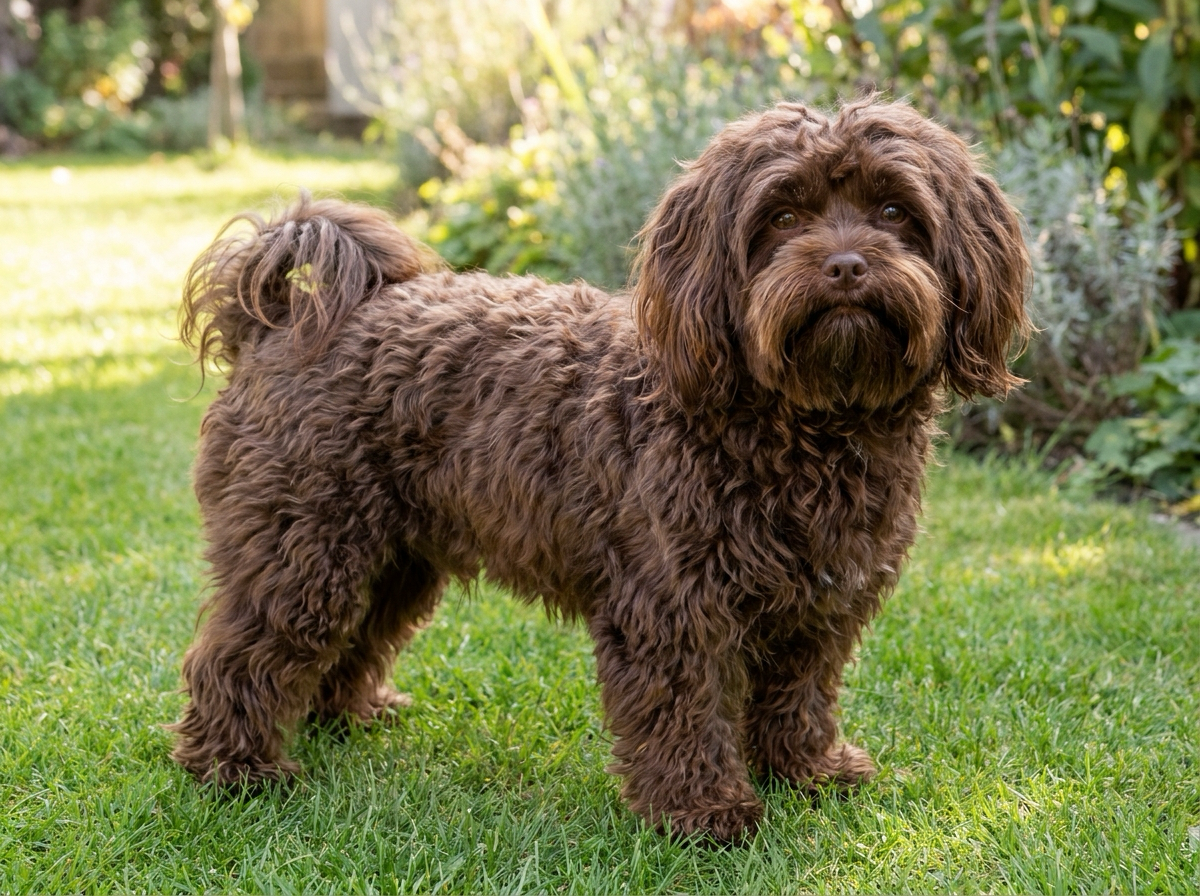
The Russian Tsvetnaya Bolonka is a small, curly-coated companion dog from Leningrad (now St. Petersburg), and its name means “Russian colored lapdog”. The American Kennel Club fully recognized it in the Toy Group on January 1, 2026, so it is now a regular AKC breed rather than a rare-breed curiosity. The AKC standard asks for a sturdy dog up to 10¼ inches tall, ideally 7 to 9 pounds, in any color except solid white, spotted, parti-color or merle.
That color rule is the breed’s whole reason for existing. Soviet breeders wanted a lapdog that was not white, and the Bolonka (plural Bolonki) is the result. If you are comparing it with a Maltese, Havanese or Bolognese, that is the first thing to check. If you already own one, you can start a free profile for your Bolonka and keep its registration papers, health screening results and weights in one place.
This guide covers where the breed came from, what the standard actually says, its registry status in the US, coat care, the health screening the parent club asks for, and what to check before you buy a puppy.
| Name | Russian colored lapdog; Bolonka for short, Bolonki for more than one |
|---|---|
| Origin | Leningrad (St. Petersburg), first litter in 1951 |
| AKC status | Fully recognized, Toy Group, since January 1, 2026 |
| Height | Up to 10¼ inches; over 11 inches is a disqualification (AKC standard) |
| Weight | Ideal 7 to 9 pounds for males and females (AKC standard) |
| Coat | Long, dense and soft with an undercoat; large curls preferred or very wavy; beard and moustache |
| Colors | Any except solid white, spotted, parti-color or merle; small white marks on toes and chest allowed |
| Parent club health tests | Patellas, eye exam by a board-certified ophthalmologist, cardiac exam, prcd-PRA DNA test; hips optional |
Browse listings, public profiles, breeders, or add your animal.
Where the Bolonka comes from
The breed is a Soviet-era project. The AKC’s Bolonka history, written with the Russian Tsvetnaya Bolonka Club of America, describes small companion dogs as scarce in postwar Leningrad. In 1951 breeders there paired Trifon, a white dog brought from Hungary, with Zhuzhu, a coffee-colored dog bought from a touring circus. The litter produced the first black and brown puppies. Between 1952 and 1961 the breeders added other small breeds, including the Maltese, Bolognese and Shih Tzu, and selected for a uniform type with a dark coat.
According to the same AKC account, the first Bolonka name appeared in a breeding book in 1958, fifteen Bolonki were shown in Leningrad in 1969, and the population had grown to about 100 dogs by the 1970s. The breeders “valued any color other than solid white”, in the words of Candace Mogavero, president of the US parent club, quoted by the AKC. She also describes the Bolonka as the national breed of Russia; treat that as the breed club’s description rather than an official title we have been able to check.
How it reached the United States
The first US imports came around 2000. The AKC credits Mogavero, then a Havanese breeder, as the first person in the US to import Bolonki from Russia. Fanciers formed the North American Russian Tsvetnaya Bolonka Club the same year and kept a registry of imported and US-bred dogs. The path through the AKC then followed the usual steps:
- 2015: accepted into the AKC Foundation Stock Service, the AKC’s record-keeping program for breeds working toward recognition. The club took its current name, the Russian Tsvetnaya Bolonka Club of America.
- January 1, 2023: moved into the AKC Miscellaneous Class, which made Bolonki eligible for AKC companion events such as agility, rally and obedience.
- January 1, 2026: full recognition in the Toy Group, announced in the AKC’s newly recognized breeds for 2026 alongside the Basset Fauve de Bretagne and the Teddy Roosevelt Terrier. That brought the AKC’s count to 205 breeds.
Some older articles and breeder pages still describe the Bolonka as a Foundation Stock Service breed. That was true until the end of 2022. It is out of date now, and it matters for buyers, because it changes what papers a puppy should come with (see the registration section below).
What the AKC standard asks for
The official AKC standard (approved June 17, 2021, effective January 1, 2023) is short and specific. The points that matter most to a buyer or a new owner:
Size and shape. A small, sturdy dog, slightly longer than tall, with the body no more than 15 percent longer than the height at the withers. Height is up to 10¼ inches, and a dog over 11 inches at the withers is disqualified. The ideal weight is 7 to 9 pounds. The AKC’s own breed page summarizes this as about 11 inches and 6 to 9 pounds, so expect small differences between the summary and the standard; the standard is the document a judge uses.
Head. A sweet, alert expression with dark brown eyes. Lighter brown eyes are allowed in brown, fawn and cream dogs, but a blue or partly blue eye is a disqualification. The nose is black or matches the coat, and a spotted or flesh-colored nose is a disqualification. The ears are moderate, V-shaped and hang close to the head.
Tail. Medium length, curling over the back so the tip lies close to it. The tail may not be docked, and a missing or docked tail is a disqualification.
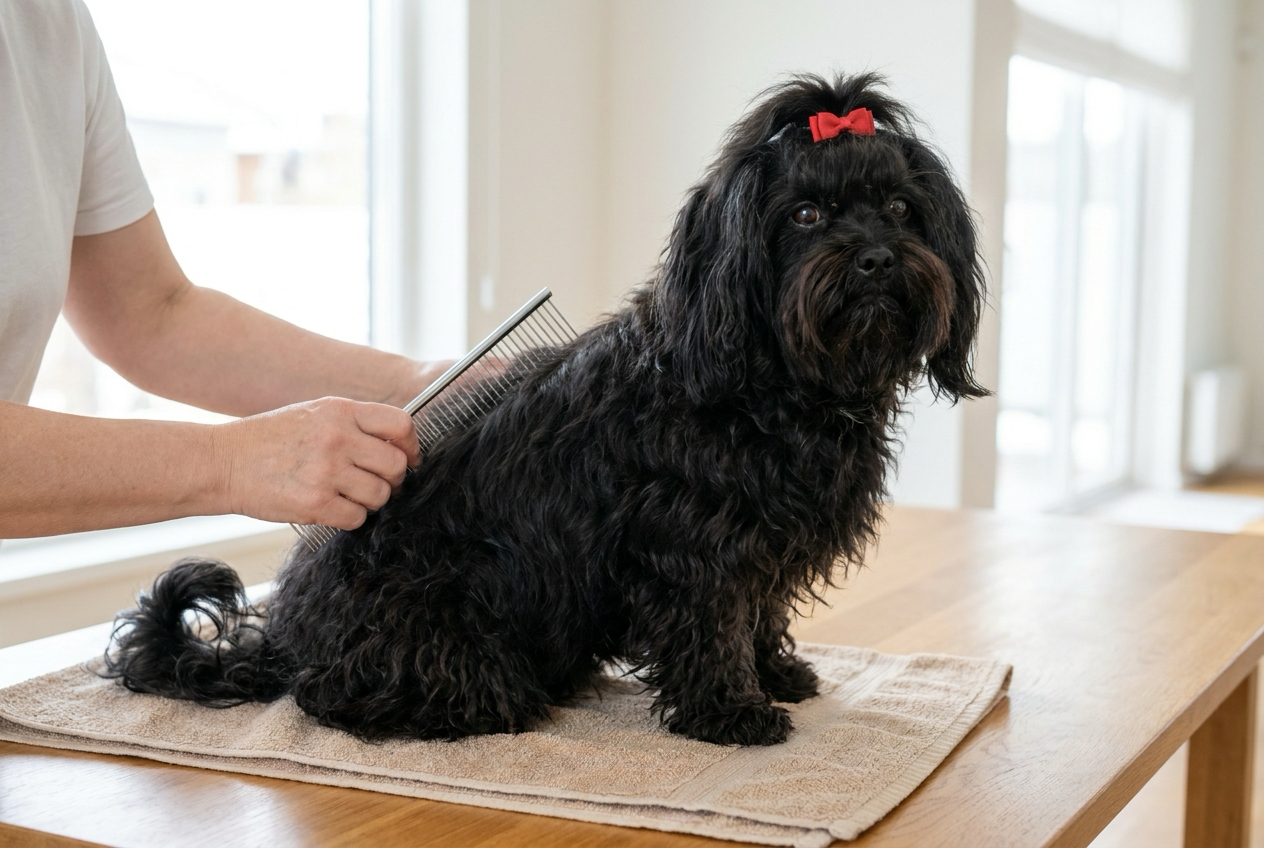
Coat. Long, dense, thick, soft and supple, with a well-developed undercoat. Large curls are preferred, and a very wavy coat is acceptable. The head carries a beard and moustache, and a dog with no beard and moustache at all is disqualified. The coat is never deliberately parted, the hair on top of the head may fall naturally or be tied up with a small bow, and the feet may be tidied. No other trimming is allowed in the show ring.
Temperament. Even-tempered, intelligent and friendly to everyone. The standard says a Bolonka should never be shy or show aggression of any kind.
Colors: what is allowed, and why merle is out
Every color is permitted except solid white, spotted, parti-color and merle. Small white marks on the toes and the front of the chest are fine. The founders favored brown, black, gray and dark red coats, according to the AKC history, and the standard itself refers to brown, fawn and cream dogs when it describes eye color. Ask the breeder what both parents look like as adults.
The merle disqualification is worth understanding, not just memorizing. Merle is a pattern gene, and two merle parents can produce double merle puppies with a higher risk of hearing and vision problems. Our guide to merle and double merle dogs explains the DNA test and the health concerns. A “merle Bolonka” advertised as rare is, under the AKC standard, a disqualified color, and it raises the question of what else is in the pedigree.
US registry status: AKC, UKC and FCI
Registration status changes over time, and this breed has moved quickly, so here is where things stood when we checked each registry’s own pages on October 31, 2026.
- American Kennel Club: Fully recognized, Toy Group, since January 1, 2026. AKC litters and puppies can be registered, and Bolonki compete in conformation and other AKC events.
- United Kennel Club: Listed in its Bloodlines Listing Service; UKC states no breed standard exists. The UKC breed page says the breed is not eligible for UKC conformation; its Bloodlines Listing Service page says listed dogs can enter UKC performance events.
- FCI (international): Not listed in the FCI’s Group 9 Bichons section. Outside Russia, recognition depends on the national kennel club; ask which registry issued an imported dog’s pedigree.
The practical point: in the US, a puppy sold as a purebred Bolonka from AKC-registered parents should now come with an AKC registration application, and you can check the parents’ registered names and numbers. Our step-by-step guide to AKC registration explains litter and individual registration and the difference between full and limited registration, which decides whether a puppy’s own puppies can be registered. To check a pedigree certificate itself, see how to check dog pedigree papers.
Creatures is not a registry and does not register dogs. What it does is keep the record: you can save the registry name, registered name and number on your dog’s profile, attach the certificate, and build the family tree. The free dog pedigree chart maker makes a printable chart from the names you already have, no account needed.
Living with a Bolonka
The AKC describes Bolonki as classic lapdogs that enjoy walks and play but do not need a great deal of exercise. It suggests at least a couple of good romps a week alongside daily walks, plus indoor games such as hide-and-seek, rolling a ball or learning tricks. The AKC adds that the breed does well in obedience, rally, tracking and agility when trained with a firm but gentle hand.
Three temperament notes from the AKC are useful before you commit:
- More independent than many toy breeds. Early socialization with people matters.
- Alert barking. A Bolonka may want to tell you about everything happening outside, so teach it when barking is and is not wanted, early.
- Good with children and other animals, with supervision. A 7 to 9 pound dog can be hurt by rough handling or a fall, so small children need supervising around it.
The AKC also advises against encouraging young dogs to jump before they are adults, to protect their kneecaps. That means ramps or a lift onto the sofa while the puppy is growing, rather than repeated leaps off furniture.

A growing toy puppy should gain steadily, and a scale is the easiest way to see that. Our puppy weight chart guide explains how small-breed puppies grow and how to judge body condition, and the puppy vaccination schedule covers the first-year visits.
Grooming the coat
This is the part of Bolonka ownership that takes real time. The AKC’s grooming advice is to comb the coat with a wide-tooth comb several times a week to stop mats forming. Dogs kept in full coat may need the face, beard and moustache washed daily. Check the eyes and ears often: hair in the eyes can scratch the cornea, and drop ears can trap moisture after a bath or a swim, so dry them well.
Many pet owners keep a shorter trim for easier care. That is a personal choice for a pet. Just know that a show dog is shown in a natural, untrimmed coat apart from tidied feet, so a breeder who also shows will keep their own dogs that way.
The topknot is practical as well as decorative. The AKC notes that keeping the topknot tied up helps prevent corneal abrasions, so a small bow or band is part of daily care, not just show styling.
We make no allergy claim for this breed. A coat that sheds little is not a promise that an allergic person will tolerate a particular dog, so spend time with adult Bolonki before you commit.
Health and the parent club’s screening tests
The AKC calls the Bolonka a generally healthy breed, and its breed page lists the routine checks: eyes, patellas (kneecaps) and heart. It adds that responsible breeders also screen for liver shunt, Legg-Calvé-Perthes disease and progressive retinal atrophy (PRA), even though they are not found often in the breed. Its life expectancy figure is 14 to 20 years, which is long even for a toy dog, so treat it as the breed page’s estimate rather than a promise.
The Russian Tsvetnaya Bolonka Club of America sets the tests it wants for an Orthopedic Foundation for Animals CHIC number, listed in its health statement of February 28, 2022:
- Patellar luxation: OFA evaluation.
- Eyes: examination by a board-certified (ACVO) veterinary ophthalmologist.
- Heart: one of the congenital, advanced or basic cardiac examinations.
- Progressive retinal atrophy: a DNA test for prcd-PRA from an approved laboratory.
- Hips: OFA evaluation, optional but recommended.
The club recommends buying a puppy from parents that meet those requirements and are AKC registered. In practice, ask to see each result for both parents, issued under the same registered names that appear on the puppy’s papers. A CHIC number shows the tests were done and submitted; it does not mean every result was normal, so read the results themselves. Any medical decision about your own dog belongs with your veterinarian.
Like most small dogs, Bolonki are easy to overfeed. The AKC’s nutrition note says some dogs tend to gain weight, so count treats and keep an eye on body condition. Weighing a small dog regularly makes slow weight gain visible long before it shows in the coat.
Buying a Bolonka puppy: what to check
The Bolonka is still uncommon in the US. When we checked the Russian Tsvetnaya Bolonka page on Creatures on October 31, 2026, it listed five breeders and no puppies for sale, so expect to wait and to talk to breeders before a litter is born. We have not found a trustworthy published price survey for the breed, so we do not quote a price range here; ask several breeders what their price includes (registration type, health testing, vaccinations, microchip) rather than comparing headline numbers.
A short checklist for any breeder conversation:
- Registration. Are both parents AKC registered, and will the puppy come with an AKC registration application? Will it be full or limited registration? A pet puppy is often sold on limited registration, which is normal but should be stated in writing.
- Health results for both parents. Patellas, ophthalmologist eye exam, cardiac exam and prcd-PRA DNA result, under the parents’ registered names.
- Color. Is the puppy a permitted color, and what did the parents look like as adults? Avoid any breeding that advertises merle, parti-color or “rare white”.
- Size. A dog much larger than about 11 inches, or sold as a “teacup” Bolonka, is outside the standard. Ask for the parents’ adult heights and weights.
- The contract. Our puppy sales contract guide covers deposits, return clauses and what a health guarantee does and does not mean, and the breeder buyer application guide explains why a careful breeder will ask you questions too.
If you are planning a litter yourself, the AKC rules apply to both parents’ registrations and the litter registration, and a female’s heat cycle sets the timing. Our guide to the dog heat cycle explains the stages and why progesterone testing is your veterinarian’s job, and the dog gestation calculator gives a due date from a breeding date. In a small breed with a narrow gene pool, the coefficient of inbreeding guide is worth reading before you choose a stud.

If you are still choosing between small companion breeds, the dog species page has every breed on Creatures, and the dog name generator helps once you have a puppy coming home.
Frequently asked questions
Is the Russian Tsvetnaya Bolonka AKC recognized?
Yes. It became a fully recognized AKC breed in the Toy Group on January 1, 2026, after entering the Foundation Stock Service in 2015 and the Miscellaneous Class on January 1, 2023.
How big does a Bolonka get?
The AKC standard calls for a height of up to 10¼ inches, disqualifies dogs over 11 inches, and gives an ideal weight of 7 to 9 pounds for both sexes.
What colors do Bolonki come in?
Any color except solid white, spotted, parti-color or merle. Small white marks on the toes and chest are allowed. The breed was founded on brown, black, gray and dark red dogs, and the standard also mentions fawn and cream.
Is a Bolonka the same as a Bolognese or a Havanese?
No. The FCI lists the Bolognese as an Italian breed and the Havanese as a Cuban one, both in its Bichon section. The Bolonka was developed in Russia from several small breeds, including the Maltese, Bolognese and Shih Tzu, specifically to produce colored dogs.
Do Bolonki need a lot of grooming?
Yes. The AKC recommends combing the coat several times a week with a wide-tooth comb, keeping the topknot tied up, and checking the eyes and ears often. A shorter pet trim reduces the work.
What health tests should a Bolonka breeder do?
The parent club asks for an OFA patella evaluation, an eye exam by a board-certified veterinary ophthalmologist, a cardiac exam and a prcd-PRA DNA test, with hips optional but recommended.
Do this next on Creatures
Whether you are waiting for a puppy, already have one on the sofa, or breed Bolonki yourself, these are the next steps.
Get told when a puppy is listed. Bolonki are listed only now and then, so set a free Bolonka listing alert and we will email you when one is posted. No account needed to start. See saving searches and using your watchlist.
Look for breeders. Browse the Creatures breeder directory for trusted breeders to contact, and check Bolonka listings on the marketplace. A directory entry is a place to start your questions, not a guarantee of a litter.
Add your Bolonka. Create a free profile for your dog, no account needed to start. The walkthrough is in adding an animal to Creatures.
Keep the papers and results. Add a registration, health or weight record for the AKC number, the eye and patella results, and regular weigh-ins. The record sheet opens for any visitor, and a free account saves what you enter. See identification and registration papers and health and medical records.
Breed Bolonki? Create your kennel’s profile, no account needed to start, then get listed in the breeder directory so people searching for this breed can find you.