Progesterone Test for Dogs: When to Breed by Ovulation Timing
Author: Elliott Garber, DVM · Published
A progesterone test for dog breeding is a blood test, repeated through her heat, that shows when her progesterone starts to climb at the LH surge and when she has ovulated. Your veterinarian reads that rise to pick the breeding days: the Merck Veterinary Manual’s breeding management chapter calls the day of the first rise “day zero” and advises breedings between days 3 and 6, with exact days depending on fresh, chilled or frozen semen.
Testing also gives you a better due date than the breeding date alone. Merck puts whelping 64 to 66 days after the LH peak, while a plain breeding date only supports a broad estimate. The free dog gestation calculator gives that breeding-date estimate before you sign up, and a test result record keeps each progesterone value with her profile so the next heat starts from her own history.
Sources checked November 14, 2026. This guide explains what the tests measure, how breeders use the numbers and what to record. Sampling, interpretation and every breeding decision belong with your veterinarian; nothing here is a hormone protocol or treatment plan. For the stages of the cycle and the signs you see at home, start with our dog heat cycle guide.
| What it finds | The LH surge (first progesterone rise) and confirmation of ovulation |
|---|---|
| When testing starts | Once vaginal cytology shows her well into heat, per Merck |
| How often | Every other day for routine breedings until the rise appears |
| Day zero | The day of the initial rise; ovulation follows about 2 to 3 days later |
| Breeding window | Merck advises days 3 to 6; frozen semen is usually day 5 or 6 |
| Due date | 64 to 66 days after the LH peak (Merck) |
| Key caution | Stay with one lab and one method; results do not compare across methods |
| Who reads it | Your veterinarian, from the pattern across tests, not one number |
Why breeders time ovulation instead of counting days
Counting from the first day of bleeding fails because heats vary so much. Proestrus averages 9 days in Merck’s chapter, ranging from 3 days to 3 weeks, and estrus shows the same spread. Two bitches that started bleeding on the same day can ovulate a week apart, and the same bitch can differ from one heat to the next.
The biology also leaves a narrow target. Eggs are released 2 to 3 days after the LH peak and need another 2 to 3 days to mature before they can be fertilized, and mature eggs then live about 2 to 3 days, according to the same chapter. Fresh semen is more forgiving, since Merck notes it can live in the vagina for 9 or more days. Chilled and frozen semen give much less room for error, which is why timing matters most when semen is shipped or stored.
Progesterone is the hormone that makes this visible. It stays low through most of proestrus and begins to rise at about the time of the LH surge, before ovulation. Tracking that rise turns a guess based on behaviour and discharge into a dated event your veterinarian can plan around.
When to start testing
Most programs start with vaginal cytology rather than a blood test. Merck describes cytology every 2 to 3 days to document early proestrus, with serial hormone testing starting once the smear shows more than 70% superficial (cornified) cells. Cytology tells your veterinarian roughly where she is in the heat; it cannot pinpoint ovulation by itself.
Your part is the dates. Note the first day you see swelling or bloody discharge, how long her previous heats ran and when she last ovulated if she was tested before. Call the clinic when the heat begins so the first cytology visit is not late. A bitch with short heats in her history may need sampling to start sooner than a bitch who runs long.
If she has never been tested, expect more visits the first time. A record of when her rise appeared, counted from the first day of bleeding, helps your veterinarian plan the next heat, although Merck’s ranges show it will not repeat exactly.
Reading the progesterone rise
Merck lists progesterone concentrations as ranges rather than cutoffs: about 0.8 to 3 ng/mL at the LH surge, 1 to 8 ng/mL at ovulation and 4 to 20 or more ng/mL during the fertile period. The ranges overlap on purpose. No single value tells you she has ovulated, and that is why one test is never enough.
For routine breedings, Merck describes testing every other day until progesterone rises above about 1.5 ng/mL. The day of that initial rise (to more than 1.5 to 2.5 ng/mL in the chapter’s wording) is day zero. A repeat test 2 to 3 days later should show more than 5 ng/mL, which confirms ovulation. When more precision is needed, for example with frozen semen, Merck describes daily LH testing on blood drawn at about the same time each day; serum saved from the day of the progesterone rise can also be tested for LH to confirm day zero.
Why the lab and the method matter
Merck is direct about this: results are not comparable across methodologies, so sampling and testing should stay consistent through the whole cycle. It calls chemiluminescent progesterone testing the gold standard. Several in-house semiquantitative kits exist, and they are cheaper and quicker, but Merck notes that interpretation can vary, so the same person should run them where possible.
Independent work supports the caution. A 2021 study in Frontiers in Veterinary Science compared a point-of-care analyzer with a chemiluminescent immunoassay and found good correlation but a significant positive proportional bias above 2 ng/mL, concluding that breeding interpretations from those results should be made with caution.
In practice that means three habits. Ask which method each result came from. Do not mix numbers from two labs, or from a clinic kit and a reference lab, on the same chart without your veterinarian’s say. Write the unit on every value, because a number copied without its unit or method is not usable at the next heat.
When to breed a dog: timing by semen type
Once day zero is set, the breeding days follow the type of semen. The timings below are Merck’s; your veterinarian and the stud owner confirm the actual plan, and the ovulation check at days 2 to 3 decides whether the plan holds.
| Natural breeding | Between days 3 and 6 |
|---|---|
| Fresh semen AI | Between days 3 and 6 |
| Chilled semen AI | Days 4 and 6, or days 3 and 5 |
| Frozen semen AI | Day 5 or 6 |
| Ovulation check | Progesterone above 5 ng/mL two to three days after day zero |
Chilled semen adds logistics. Chilled semen is meant for later or distant use within 48 hours in Merck’s description, so the stud owner needs your day zero as soon as you have it, and the collection and courier days have to fit the window. Agree in advance who pays for a missed shipment and what happens if the bitch is not confirmed in time. The dog stud fees guide covers how stud service is usually priced, and our dog stud contract guide covers the terms worth writing down, including repeat breedings and return service.
Frozen semen has the least room. Merck notes that dogs should be screened for Brucella canis when semen is collected for freezing, and frozen breedings are timed to a single day. Ask your veterinarian what screening both dogs need before any breeding, natural or AI, and how they will place the semen.
Health screening of the pair belongs before the heat, not during it. The OFA health testing guide explains the screenings breed clubs commonly ask for, and the free dog pedigree chart maker lays out both pedigrees side by side. Our coefficient of inbreeding guide explains what a COI estimate can and cannot tell you about the pairing.
A better due date from the LH surge
Merck states that breeding dates do not correlate with whelping as closely as actual ovulation does. With the LH peak known, it places whelping 64 to 66 days later. When cytology instead identifies the first day of diestrus, the shift back to non-heat cells on the smear, Merck gives 56 to 58 days from that day.
The dog gestation calculator works from the breeding date or exposure window: it adds 63 days and shows a broad 58 to 72 day range, because a breeding date alone carries the uncertainty of when she ovulated. Our guide to how long dogs are pregnant walks through the weeks. If your veterinarian gives you a due date from ovulation timing, keep that date as the one you plan around and note where it came from.
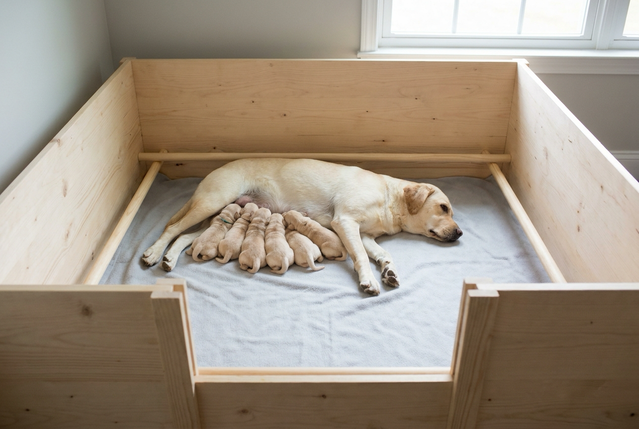
Progesterone also matters at the other end. Merck’s whelping chapter says dogs usually enter first-stage labor within 24 hours of progesterone falling below 2 ng/mL, that the fall can happen in hours, and that reference lab results often take 12 to 24 hours. Rectal temperature drops 8 to 24 hours before whelping in most dogs. Predicting gestation length without prior ovulation timing is difficult, Merck adds, which is one more reason to keep day zero on file. If she reaches the end of her window with no labor, or you see the danger signs in our dog pregnancy guide, call your veterinarian now. Set up the whelping box well before that window opens.
Keep the testing and breeding record on Creatures

A heat with progesterone timing produces a lot of dates: first day of bleeding, each cytology visit, each progesterone value, day zero, the ovulation check, each breeding and the due date. Kept in a notebook, they are hard to find at the next heat. On Creatures they sit on her profile in one timeline.
- Log the heat. Add a Breeding and Reproduction record with the Estrus / Heat Tracking category for the first day of bleeding and what you observed.
- Log each progesterone result. Add a Test Result record and choose the Estrus / Ovulation Timing subtype. Enter the date of sampling, the date of the report, the result, and in the notes the unit, the lab and the method. Our health and medical records walkthrough shows the fields.
- Record the breeding. Add a Breeding and Reproduction record, choose the Natural Mating or Artificial Insemination category, and enter the sire picked from Creatures or typed in by name, and the service start and end dates. Keep “Track due date and reminders” on and she gets a projected due date, window and reminders. If your veterinarian gave you a due date from ovulation timing, enter it as the projected date override. Recording a breeding explains each field. If better timing arrives after you saved the breeding, tracking pregnancy and progress covers correcting the projected dates.
- Watch the due list. The breeding dashboard shows who is due soon or overdue across your dogs.
Creatures has no progesterone or ovulation-timing calculator, and it does not interpret your results. The gestation calculator takes a breeding date or window only. The value of the record is the history: after two or three tested heats you can show your veterinarian when her rise has tended to appear.
When the puppies arrive, recording the birth closes the pregnancy and creates the litter, and the puppy weight chart helps you read their early gains. Storing a registration number later does not register a puppy; litter registration still goes through the registry, as our AKC litter registration guide explains.
What progesterone testing does not tell you
It does not confirm pregnancy. A rise and a confirmed ovulation tell you she ovulated and when; pregnancy diagnosis is a separate step later in gestation that your veterinarian schedules.
It does not judge the stud. Poor semen quality or a mistimed shipment can still end in a missed breeding with perfect timing on her side.
It does not replace your veterinarian’s reading. Consistent methods matter and the ranges overlap. A value that looks like ovulation in isolation may mean something else in context, so let the person who has seen her whole series make the call.
Frequently asked questions
When should I start progesterone testing my dog?
When your veterinarian says so, usually after vaginal cytology shows she is well into heat. Serial hormone testing typically starts once the smear shows more than 70% superficial cells, per Merck. Call the clinic on the first day of bleeding so cytology starts on time.
How many progesterone tests does a breeding take?
It varies with the length of her heat. For routine breedings, testing runs every other day until the rise appears, then a repeat 2 to 3 days later to confirm ovulation. A bitch with a long proestrus needs more tests than one who rises early. Daily LH tests are sometimes added for frozen semen.
What progesterone level means a dog is ready to breed?
There is no single number. Merck lists overlapping ranges: about 0.8 to 3 ng/mL at the LH surge, 1 to 8 at ovulation and 4 to 20 or more in the fertile period. The breeding days are counted from the day of the initial rise, between days 3 and 6 for natural or fresh breedings, and confirmed by a value above 5 ng/mL two to three days after that rise.
Can I use an in-clinic or quick progesterone test?
Your veterinarian decides. Merck notes that in-house semiquantitative kits are convenient and cheaper but can be read differently from person to person, and that results are not comparable across methods. A 2021 comparison found a point-of-care analyzer read higher than a chemiluminescent assay above 2 ng/mL. Whatever method you use, stay with it for the whole cycle.
How much does progesterone testing cost?
Prices vary by clinic, lab and method, and the total depends on how many tests her heat needs. Ask your clinic for the cost per test, whether cytology visits are charged separately and how many tests a typical cycle takes there.
How do I calculate the due date after progesterone testing?
Whelping falls 64 to 66 days after the LH peak, per Merck. Use your veterinarian’s date when you have one. The free gestation calculator gives a broader estimate from the breeding date, 63 days with a 58 to 72 day range.
Do this next on Creatures
You are planning or just finished a timed breeding. These steps keep the results, the breeding and the due date with her profile.
- Log a progesterone result as a Test Result with the Estrus / Ovulation Timing subtype. The form opens for visitors; a free account saves it. How to add a record walks through it.
- Add your dog so her heats, tests and breedings share one timeline. You can start without an account. Adding an animal to Creatures shows the fields.
- Create your kennel’s profile to group your dogs and litters under one program. Getting listed in the breeder directory explains the public listing.
- Browse the breeder directory to find trusted programs, for example when you are looking at stud dogs or comparing kennels.
- Save a dog listing alert and get an email when new dogs are listed. Saved searches and your watchlist explains the alert.
- Browse dog listings to see what is available now. Availability changes from day to day.
More dog guides are on the dog species page.