Whelping Box: Size, Pig Rail, Bedding, Temperature and Setup
Author: Elliott Garber, DVM · Published
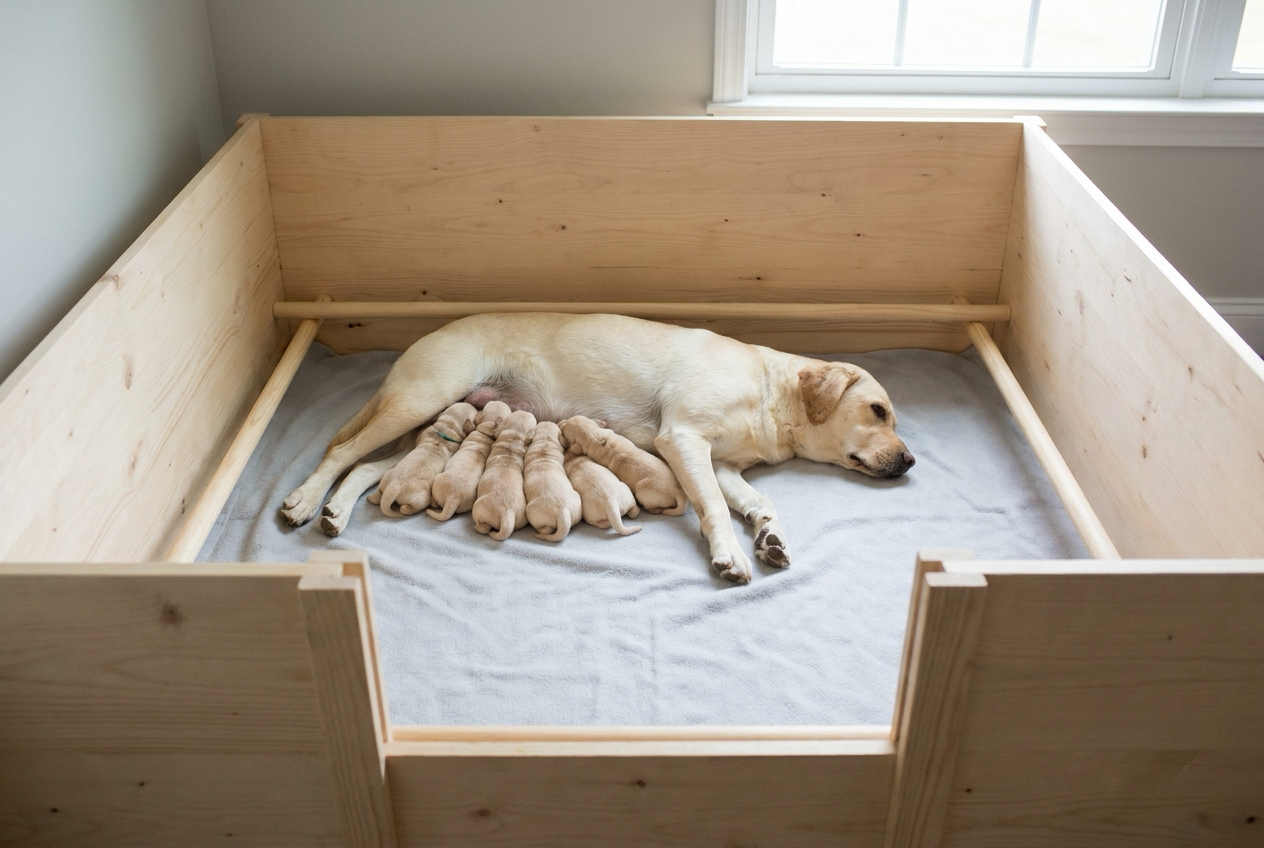
A whelping box is the enclosed bed where a dog gives birth and raises her puppies for their first weeks: big enough for her to stretch out, walled so newborns stay in, with one lower side she can step over and a rail around the inside so she is less likely to lie on a puppy against the wall. Purdue University’s canine welfare team sizes it at about one and a half times her body length and says to have it set up at least two weeks before the end of the pregnancy.
That second point is why the box starts with a date. Put her breeding date or mating window into the free dog gestation calculator and you get the due window to count back from, without an account. The box, the room and the kit should be ready before the earliest day in that window, not the middle of it.
Sources checked November 14, 2026. This guide covers the box, the room, warmth, bedding, the whelping kit and the records you keep through the first weeks. Labor, a difficult birth and any sick puppy belong with your veterinarian; there are no drug doses or treatment steps here. For the pregnancy itself, our dog pregnancy guide walks through the weeks and the signs of labor.
| Floor size | About 1.5 times her body length (Purdue); AKC says 1.5 to 2 times |
|---|---|
| Rail | A rail around the inside, about 3 to 4 inches off the floor (AKC) |
| Entry | One side she can step over easily that still keeps puppies in |
| Surface | Non porous, smooth, no rough edges, sanitized between litters (Purdue) |
| Bedding | Absorbent, non slip, washable; no straw, hay, shavings or loose fill |
| Warmth, week 1 | Box about 85 to 90°F with room for puppies to move away from heat |
| Set up by | At least two weeks before the end of pregnancy (Purdue) |
| Records | Due window, birth time, each puppy’s identity and regular weights |
What a whelping box has to do
A good box does four jobs at once. It keeps newborn puppies together and warm in one place, because they cannot hold their own body temperature yet. It lets the mother lie fully stretched out and feed them without crowding. It protects them from being pinned when she lies down or rolls. And it is easy to keep clean, because birth is messy and the bedding changes several times a day at first.
Everything else is detail on those four jobs. A cardboard box can hold a toy breed’s litter for a night in an emergency, but it soaks through, cannot be sanitized and gives a larger dog nothing to step over safely. Breeders who whelp regularly use a purpose-built box of wood, plastic or composite, and many build their own.
The box also does not have to be in a kennel building. Purdue’s Croney Research Group puts the whelping area in a low traffic spot away from barking dogs and noise, and in a kennel prefers a separate room for the mother and puppies. A quiet spare room at home meets that.
How big should a whelping box be?
Measure your dog, not a chart. The Purdue team wants a box large enough for the mother to relax and stretch out, and gives a target of one and a half times her body length. The AKC’s whelping guide gives one and a half to two times her length. Measure her lying on her side, from nose to the base of the tail, and use that for the shorter side of the box.
Go to the larger end of that range if the litter is likely to be large, if she is a breed that sprawls, or if you plan to keep the puppies in the box into their third week, when they start moving around. Go no smaller than the lower figure: a box she can only curl up in forces her to lie on puppies to fit.
One point is easy to forget, and Purdue makes it: she needs a large space outside the box too, where she can stretch out and take a break from the puppies, and she still needs access to where she eliminates and gets outdoor exercise. Plan the room around the box, not just the box.
Walls, the entry side and the pig rail
Wall height. The walls need to be high enough that puppies stay in once they start crawling and wobbling about, and smooth so a puppy cannot catch a paw. The sources here give no single height in inches, so scale it to your breed: a toy breed’s box and a giant breed’s box are very different builds.
The entry side. Purdue describes an opening that lets the mother in and out easily but keeps her puppies contained. On most boxes that is one lower panel she can step over without jumping, and some builds use a removable top board so the step height can rise as the puppies grow. She should never have to scramble or leap in, because she will be landing among newborns.
The pig rail. This is the feature that makes a box a whelping box. It is a smooth rail or ledge fixed around the inside walls, a few inches above the floor, so that when the mother lies down against the wall a puppy behind her lies under the rail instead of being pressed flat. Purdue describes the ideal box as having a railing, known as a pig rail, around the edge, which it says prevents the dam from accidentally lying on her puppies. AKC places the rail about 3 to 4 inches from the floor. Fit it so there are no gaps a puppy’s head can wedge into, and keep it smooth.
The surface. Purdue recommends a non porous surface such as plastic or plexiglass, kept clean and free of rough edges, and sanitized between dogs and litters. If you build in wood, seal it well so it can be scrubbed, and sand every edge.
Bedding that stays dry and gives grip
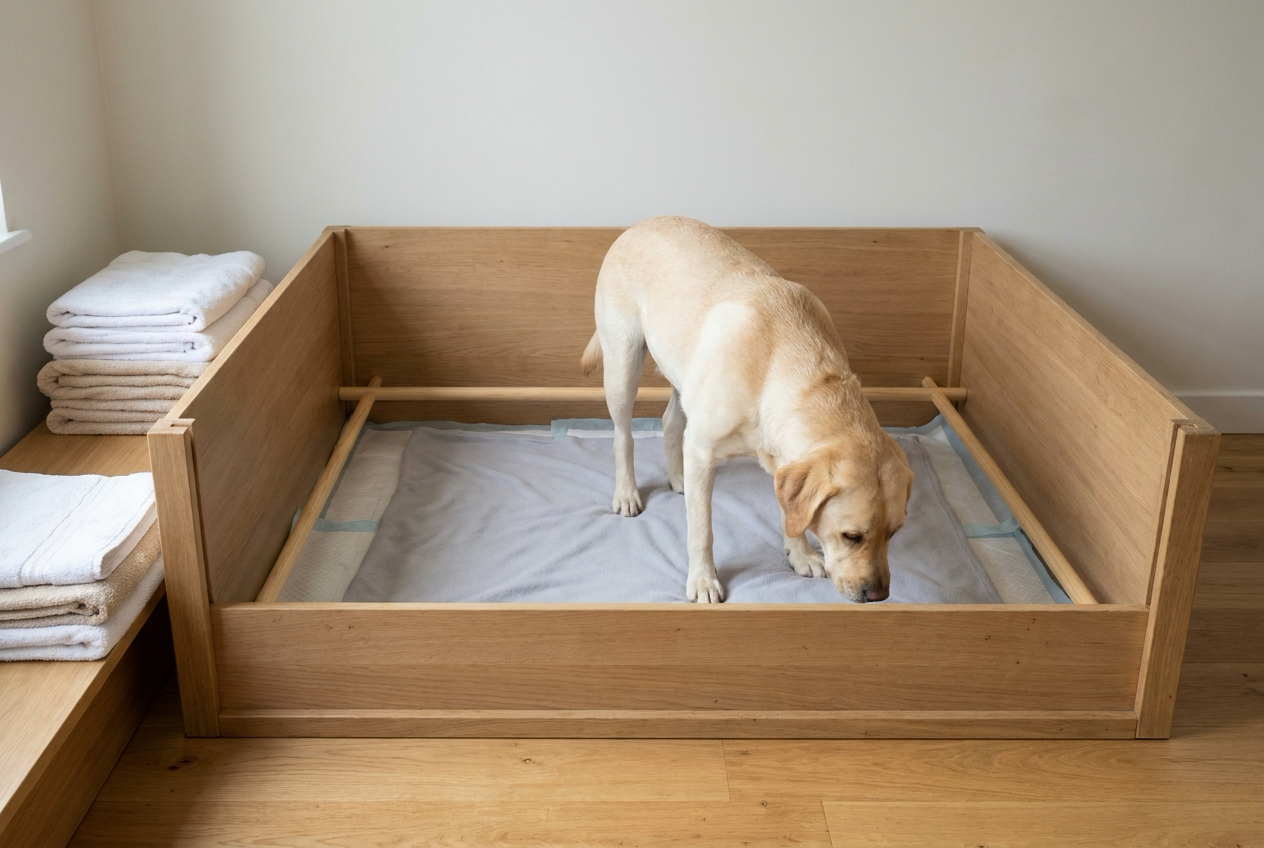
Newborn puppies push themselves to the teat with their back legs, so the bedding needs traction, and it needs to stay dry because wet puppies lose heat fast. Purdue recommends absorbent, non slip bedding with puppy pads or newspapers underneath to keep the area dry and clean. AKC says the best whelping box bedding is soft, warm, has good traction and is easily cleaned and disinfected, and advises avoiding hay, straw, shavings or stiff particles, which can irritate puppies’ eyes and skin.
A practical setup many breeders use:
- During the birth: layers of newspaper or disposable pads you can pull out and replace as each puppy arrives.
- After the birth: fitted fleece or vet bedding over absorbent pads, with at least one spare set washed and ready so the swap takes a minute.
- Not in the box: loose blankets that bunch into folds, towels with loose threads, straw and shavings.
Clean the whelping area daily, as Purdue advises. Move the puppies to a small box or carrier lined with a towel while you change the bedding, and keep that carrier warm too.
Temperature in the whelping box, week by week
Newborn puppies rely on the room and their mother for heat. The Merck Veterinary Manual’s chapter on neonatal management says puppies and kittens lack thermoregulatory mechanisms until 4 weeks of age, and that chilling harms immunity, nursing and digestion. The two sources below give slightly different figures because Purdue separates the box from the room, while Merck gives one environmental figure.
| Week 1 | Box 85 to 90°F, room 75 to 80°F (Purdue); environment 84 to 89°F (Merck) |
|---|---|
| Week 2 | Box 80 to 85°F, room 70 to 80°F (Purdue); environment about 80°F (Merck) |
| Week 3 | Box 75 to 80°F, room 70 to 75°F (Purdue); environment about 80°F (Merck) |
| Week 4 | Environment 69 to 75°F (Merck) |
| Humidity | 55 to 65 percent (Merck) |
AKC’s single figure, a consistent temperature around 85°F in the box, sits inside the first week ranges. Put a room thermometer at puppy level in the box, not on a wall at head height, because the floor is where they live.
Watch the puppies as well as the thermometer. Merck notes that healthy, well-fed newborns are quiet and sleep when they are not nursing. Puppies piled on top of each other and crying can be cold; puppies spread out to the far edges can be too hot. A puppy that is cold to the touch, will not suckle or keeps crying needs a call to your veterinarian, not a heat source turned up.
Heat sources and how to place them safely
Build around one rule from Purdue: the puppies and mother should have room to move away from the heat source if needed. That means warming one part of the box and leaving the rest cooler, never the whole floor.
- Heating pads under part of the bedding are common, but Merck warns they run the risk of burning newborns that cannot move away from excessively hot surfaces. Use one made for animals, under bedding, covering only part of the floor.
- Heat lamps carry a fire risk; Purdue’s table notes they are a potential fire hazard and can get too hot. Merck, by contrast, calls an overhead heat lamp the best form of added heat, provided it hangs at a distance that avoids overheating and burning. If you use one, fix it securely well out of the mother’s reach, keep cords out of the box, and check the temperature at puppy level.
- Warming the room and using microwavable heat discs are other options Purdue lists. Whatever you use, test it with your hand on the bedding where a puppy would lie.
Seal drafts around doors and windows, as Purdue suggests, and keep the light cycle normal with natural or dim light rather than lights left on all night.
Where and when to set up the box
Set it up early. Purdue’s advice is at least two weeks before the end of the pregnancy; AKC says to introduce the mother to the box at least five days before her delivery date so she is comfortable in it. Two weeks is the safer target, because due dates move.
That is where a better due date pays off. A due window from the breeding date is broad. If your veterinarian timed the breeding with progesterone tests, the date is tighter, and our sister guide to progesterone testing for breeding explains why. Work back from the earliest date you have, then add a margin.
A simple timeline:
- Four weeks before: measure her and build or buy the box. Order bedding and a scale.
- Two weeks before: set the box up in its room, bedding in, heating tested. Let her nap and eat near it.
- Final week: keep the kit next to the box. Start taking her temperature a few times a day; Merck’s whelping chapter describes a drop in rectal temperature to a mean of about 98.8°F (range about 98.1 to 100°F) roughly 8 to 24 hours before whelping.
If she picks a different spot, such as under a bed or in a closet, gently bring her back to the box and sit with her there. Most dogs settle once it smells of them and is somewhere quiet.
What goes in a whelping kit
There is no official whelping kit. The list below is what the sources above call for, plus the basics breeders keep within reach so nobody has to leave the room during labor:
- Clean, dry towels, more than you think, for drying puppies and changing bedding.
- Spare bedding and pads already cut to size.
- A digital thermometer for her temperature in the last week, and a room thermometer at puppy level.
- A gram scale with a small bowl or tray, for weighing puppies (see the weighing section below).
- A notebook or phone to log each puppy’s time of birth, sex, markings and weight as it happens.
- A way to tell puppies apart, such as soft identification collars, checked often for fit as they grow.
- A warm, towel-lined carrier for puppies while you change bedding.
- Your veterinarian’s number and the nearest after-hours emergency clinic’s address, written where everyone in the house can find them.
- Hand-washing supplies and disposable gloves.
Keep medicines, feeding tubes and any intervention equipment to what your veterinarian has shown you how to use. A kit is not training, and this guide gives no procedure for a stuck puppy or a puppy that is not breathing well.
When to call your veterinarian during whelping
A difficult birth can turn serious within hours. Do not try to pull a puppy yourself. Cornell’s normal whelping guide counts up to two hours between puppies as normal and says to contact your veterinarian once more than two hours have passed. It adds that green discharge should be followed immediately by a puppy. Call your veterinarian or an emergency clinic now if:
- More than two hours have passed since the last puppy was born.
- Green discharge appears and a puppy does not follow right away.
- There is foul-smelling discharge, heavy bleeding, or a fever over 103°F.
- The mother seems very ill, exhausted or in pain, or starts vomiting.
Cornell’s guide to dystocia in dogs lists more warning signs, each with a time limit. Treat each limit as the point by which you should already be on the phone, not as a time to wait through. Phone for guidance as soon as you see:
- Fetal membranes showing without a puppy being delivered (Cornell’s limit is 15 minutes).
- Strong contractions with no puppy (20 to 30 minutes).
- Weak contractions with no progress (1 to 2 hours).
- Active labor dragging on without the litter finished (12 to 24 hours in total).
One more reason to call, not on Cornell’s list: no labor once she is past the end of her expected due window, or past the 64 to 66 days after the LH peak that Merck’s breeding management chapter gives when your veterinarian timed ovulation. Merck also notes that breeding dates track whelping dates less closely than ovulation does, so ask your veterinarian whether she needs an exam.
Write the start of strong straining and each birth time in your notes as it happens. When you call, those times are what the veterinarian needs.
The first three weeks in the box
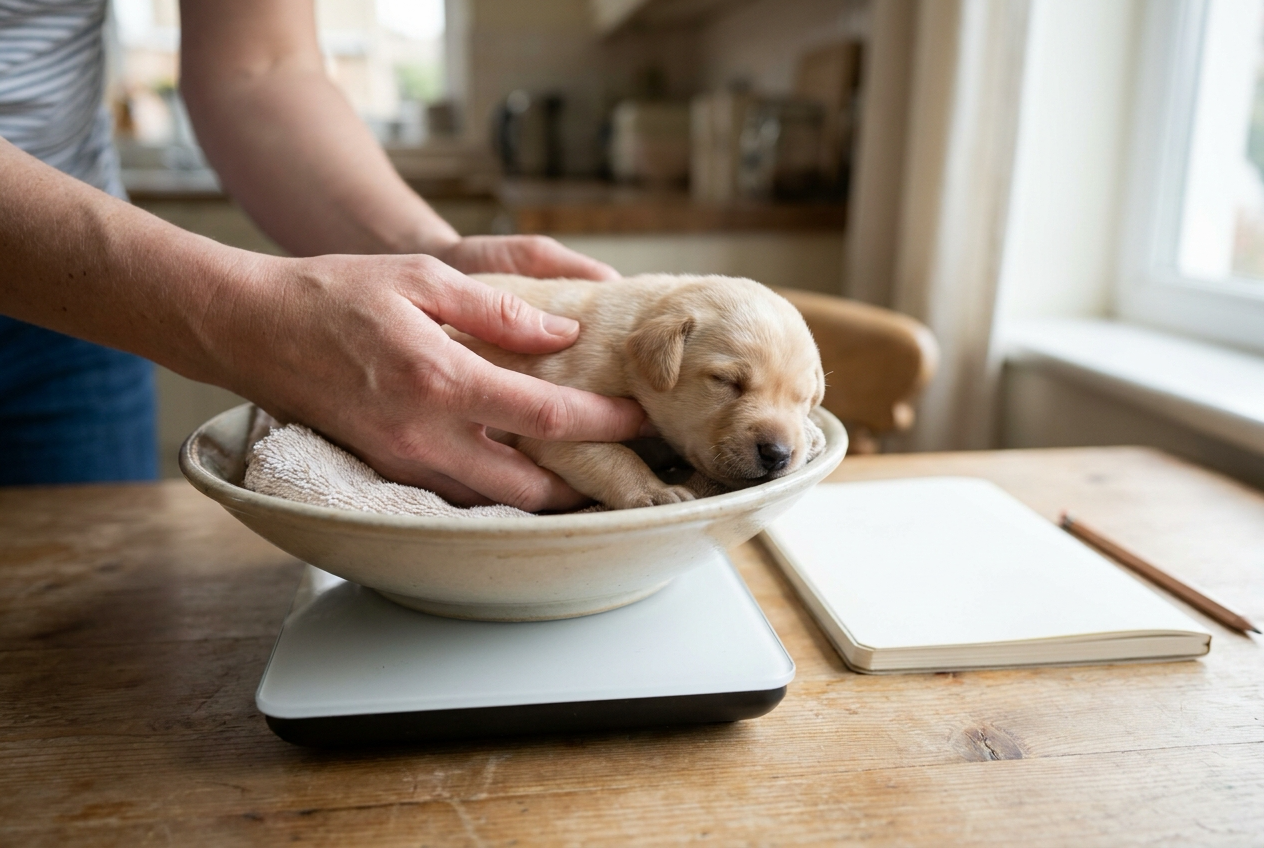
Weigh every puppy, on a schedule. Merck’s labor and postpartum chapter says a newborn should be weighed as soon as it is dry and then twice daily for the first week, and that any weight loss, or failure to gain beyond the first 24 hours, indicates a potential problem. Merck’s neonatal chapter then gives daily weights for the first two weeks and every three days until a month old. A kitchen scale that reads in grams is enough for most breeds. Weigh at the same times each day, in the same bowl, and write each value down against the right puppy. Our puppy weight chart explains what steady gain looks like after the newborn weeks.
Watch the mother. She should eat, drink, go outside and come back to the puppies on her own. Cornell’s normal whelping guide says foul-smelling or increasing discharge after birth needs veterinary care. A mother who stops eating, will not settle or stops caring for the puppies needs a call.
Clean daily, check daily. Fresh bedding every day at least, a look at every puppy’s belly and fullness, and a check that identification collars are not tight.
Week three onward. Purdue suggests gentle handling and socialization once puppies are three weeks old. As they start walking, raise the entry side if your box allows it, and plan the larger pen they will move into. The box’s job is mostly done once they are steady on their feet.
Keep the litter’s records on Creatures
The box gets you through the birth; the records are what you hand to buyers, your veterinarian and yourself next time. On Creatures, the whole litter can live on the mother’s profile.
Before the birth. Add the breeding as a breeding record on her profile with the date or window and the sire, on Creatures or typed in, and turn on due date tracking. Recording a breeding shows the fields. Creatures projects the due date and reminders, and the signed-in Breeding dashboard lists her under due soon or overdue as the date approaches; the breeding dashboard guide explains each list. That is your reminder to have the box up two weeks out. The gestation calculator guide covers the free calculator for anyone not ready to sign up.
On whelping day. Record the birth from her pregnancy with the date and time, how many were born alive and stillborn, and a row for each puppy with a name (a temporary one is fine), sex and status. Saving closes her pregnancy, adds the birth to her breeding history and creates the puppy profiles; you can also record the birth first and add the puppies later. Recording a birth and adding the babies walks through it.
Every weigh-in. Each puppy’s weight goes on its own profile as a physical measurement, with the unit and whether it was measured on a scale, so every puppy builds its own growth trend. For a whole litter, a group’s Add a record opens a batch panel with one row per puppy: enter each value, review, apply, and every puppy gets its own record. Weigh or measure a whole group at once shows the steps, and care, growth and identity records covers microchip numbers and other identifiers as the puppies get them.
Parentage and papers. The free dog pedigree chart maker lays out the litter’s known ancestry without an account. A chart or a number stored on a profile does not register a litter or certify parentage; registering is done with your registry, and our AKC litter registration guide covers that process. The agreement with the stud owner, including any pick-of-litter terms, belongs with the litter too; our sister guide to the dog stud contract covers what it usually includes.
Records are free and unlimited. Creatures runs in a browser on a phone or computer, which is handy when the scale is in one room and the laptop is in another.
Planning the next litter and the puppies’ homes
A whelping box is a recurring piece of equipment, so note what worked: the size against her length, whether the rail height suited the breed, what bedding stayed dry. That note is worth more than a new box next time.
When the puppies approach their new homes, the paperwork starts. Our puppy sales contract guide covers the terms buyers sign, and the dog heat cycle guide covers timing her next breeding. If you are building a breeding program around litters like this one, the dog breeding business plan puts welfare, costs and buyers in one plan. The dog species page links every dog guide.
Frequently asked questions
What size whelping box do I need?
Measure her stretched out on her side from nose to tail base. About one and a half times that length is the Purdue figure; AKC says one and a half to two times. Larger litters and puppies kept in the box into week three need the upper end.
What is a pig rail on a whelping box?
A smooth rail fixed around the inside walls a few inches above the floor, about 3 to 4 inches according to AKC. A puppy behind the mother lies under the rail rather than being pressed against the wall when she lies down.
How warm should a whelping box be?
In the box, Purdue gives 85 to 90°F during the first week, easing to 80 to 85°F in week two and 75 to 80°F in week three. Merck gives 84 to 89°F for the first week. Warm one area and leave room for puppies and mother to move away from the heat.
When should I put my dog in the whelping box?
Set the box up at least two weeks before the end of her pregnancy (Purdue) and let her get used to it; AKC says introduce her at least five days before the due date. Use the dog gestation calculator to count back from her earliest likely date.
What is the best bedding for a whelping box?
Absorbent, non slip and easy to wash, with pads or newspaper underneath. Newspaper or pads are easy to swap during the birth; fitted fleece or vet bedding works well afterward. Avoid straw, hay, shavings and other stiff loose material, which AKC says can irritate eyes and skin.
How long do puppies stay in the whelping box?
Usually until they are walking steadily, around three weeks, when Purdue suggests gentle handling and socialization can start. After that most breeders move the litter to a larger pen with room for play and a separate area for toileting.
Do I need a heat lamp?
Not necessarily, and the sources differ. Merck prefers an overhead lamp at a safe distance; Purdue flags lamps as a fire hazard that can get too hot and lists heating pads, radiant floors, heat discs and a warm room as alternatives. Whatever you use, it should warm only part of the box.
Do this next on Creatures
You are a breeder getting ready for a litter. These steps put the breeding, the birth and every puppy’s weights in one place.
- Add your dog’s profile so her breeding, whelping and the litter have a home. Guest signup can start right in this flow. Adding an animal to Creatures shows the fields.
- Add a breeding record to project her due date and reminders, then record the birth and each puppy’s weights. It opens for visitors; a free account is needed to save it. Adding a record explains the steps.
- Create your kennel’s profile so buyers can see your program and the litters you raise. Getting listed in the breeder directory explains how the public profile works.
- Browse the breeder directory to see how other trusted programs present their dogs and litters.
- Save a dog listing search if you are looking for future breeding stock, and get an email when matching dogs are listed. Saving searches and using your watchlist explains the alert.
- Browse dog listings on the marketplace. What is available changes from week to week.