

Gull Terrier
The Gull Terrier, usually written Gull Terr and often called the Pakistani Bull Terrier or Indian Bull Terrier, is a landrace working dog of the Punjab, the region divided between Pakistan and northern India. It descends from British Bull Terrier stock brought to the subcontinent during the colonial period and crossed with local dogs, and it has been kept ever since for guarding, hunting, and dog fighting. No major kennel club registers it, so there is no written standard, no herdbook, and no health screening programme attached to the name. What you get is a type, not a pedigree, and the type varies a great deal from line to line.
That fighting history is the first thing an honest page about this dog has to deal with, because it shapes everything else: how these dogs have been selected, what a buyer is likely to be told about them, and what is lawful where you live. Dog fighting is a federal felony in the United States, a criminal offence in the United Kingdom, and illegal in both Pakistan and India. Creatures does not support it, and nothing below is written to help anyone acquire a dog for it. If you already keep a dog of this type, you can start a free profile and record its health history in a few minutes, which matters more for an unregistered landrace than it does for a breed with a herdbook behind it.
The rest of this page covers where the Gull Terrier came from, what one actually looks like, how the fighting association changed the dogs and the law around them, what the honest picture on temperament is, and the specific health and legal questions that come with a large, white, short-coated working dog. If you are still working out which dog suits you, the broader Creatures dog species pages are a better starting point than this one.

| Also called | Gull Terr, Pakistani Bull Terrier, Indian Bull Terrier |
|---|---|
| Origin | The Punjab region of Pakistan and northern India |
| Ancestry | British Bull Terrier stock crossed with local subcontinental dogs from the colonial period onward |
| Registry status | Not registered by the AKC, the UKC, or the FCI. No written standard and no herdbook |
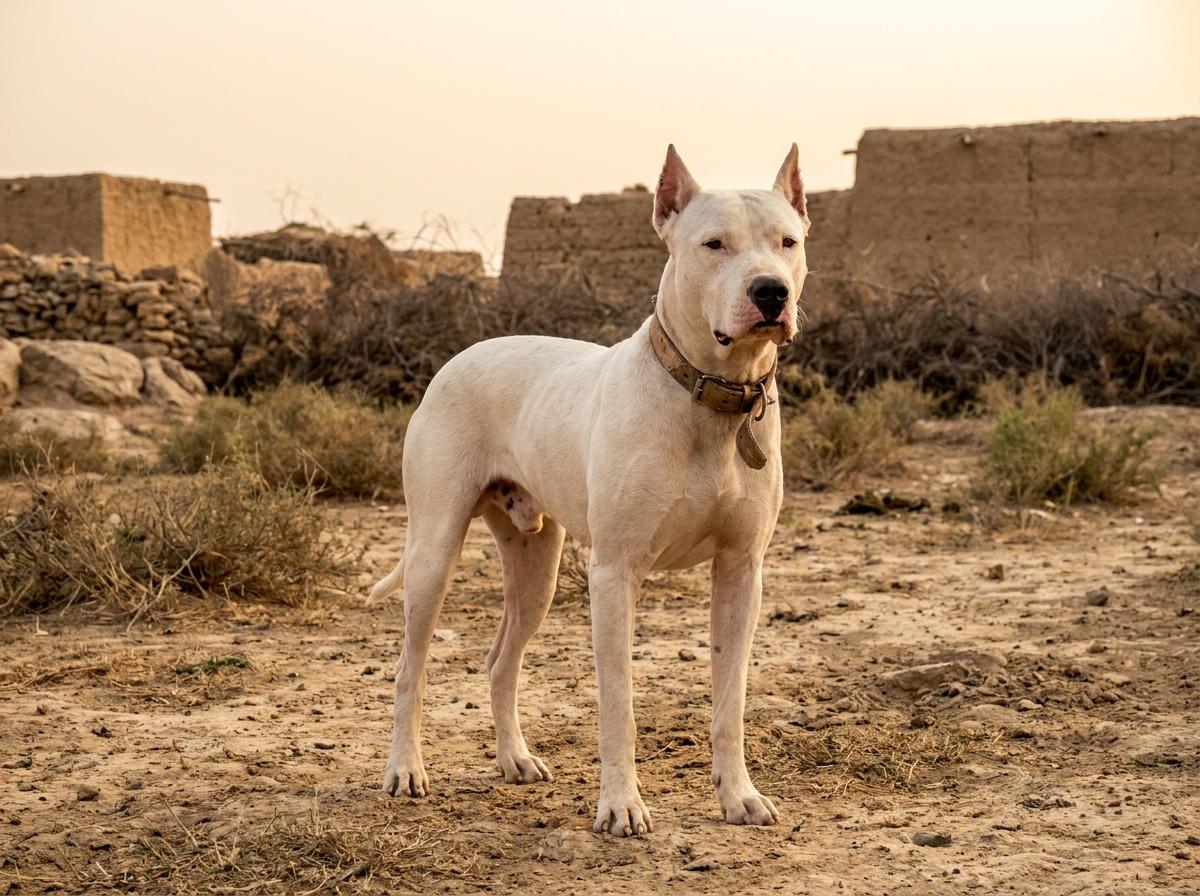
| Coat and build | Short and smooth, usually all white or white with dark patches. Deep chested and heavily muscled, with a long tapering muzzle and natural ears |
| Reported size | Commonly given as roughly 18 to 22 inches and 45 to 65 lb, but with no standard to measure against, treat any figure as approximate |
| Traditional roles | Property and livestock guarding, hunting, and dog fighting. Fighting is a crime in the United States, the United Kingdom, Pakistan, and India |
| Main health watchpoints | Congenital deafness in white dogs, sun damage to unpigmented skin, heat and exertion, joints and growth |
Browse listings, public profiles, breeders, or add your animal.
What is a Gull Terrier?
A Gull Terrier is a bull-and-terrier type: the same broad family as the English Bull Terrier, the Staffordshire Bull Terrier, and the American Pit Bull Terrier, all of which trace back to crosses between bulldogs and terriers. The South Asian branch of that family formed after British Bull Terriers arrived on the subcontinent under the Raj and were bred with local dogs. One marker of how established the British bull-and-terrier had become there: Thomas William Hogarth, the Scottish veterinary surgeon who wrote The Bull Terrier in 1931, spent 1929 judging dogs across India.
“Gull Terrier” is a regional working name rather than a registered breed name, and it is used loosely. Dogs sold under it in Punjab, in the Gulf, and online can differ substantially in size, head shape, and bone. Two related names come up constantly and are worth keeping straight:
- The Bully Kutta is the large mastiff type of the same region, a heavier and slower dog than the Gull Terrier.
- The Gull Dong is the cross between the two, bred to combine the Gull Terrier’s speed with the Bully Kutta’s mass.
If you want the registered breed at the root of all this, that is the Bull Terrier, which does have a standard, a herdbook, and published health data. The difference in documentation between the two is not a small one, and it changes what you can reasonably know about an individual dog before you take it on.
Where the breed came from
The Punjab has a long tradition of keeping large working dogs for guarding villages, livestock, and property, and for hunting. When British Bull Terriers arrived with colonial officers and soldiers, local breeders crossed them onto that existing stock. The results were selected for the jobs people wanted done, which in the region at that time included organised dog fighting alongside guarding and hunting.
Two things follow from this that are easy to get wrong. First, the Gull Terrier is not a British breed that happens to live abroad; it is a subcontinental landrace with British ancestry, shaped on the subcontinent for a century by the priorities of the people who kept it. Second, “several hundred years old” claims that circulate about the breed cannot be reconciled with an ancestry that depends on Bull Terriers, which were themselves only developed in England in the nineteenth century. The honest date range is the colonial period onward.
There is very little scholarly literature on the Gull Terrier specifically. It has no entry in the FCI nomenclature, no AKC or UKC breed page, and no peer-reviewed breed survey of the kind that exists for established registry breeds. Almost everything written about it in English traces back to hobbyist sources rather than to records anyone can audit. That absence is itself a fact about the breed, and it is why this page keeps saying “reported” rather than giving you confident numbers.
What a Gull Terrier looks like
The consistent features across descriptions are a short smooth coat, a predominantly white or white-and-patched colouring, a deep chest, a long muscular neck, a long straight tapering muzzle, and natural uncropped ears set high. That muzzle is the clearest way to tell the type from an English Bull Terrier, which has a distinctive downfaced, egg-shaped head that the Gull Terrier does not share.

Beyond that, size and build vary widely. Some dogs are tall, leggy, and lightly muscled, closer to a running dog; others are shorter in the leg and much heavier through the chest and shoulder. Both are sold under the same name. Figures of roughly 18 to 22 inches at the shoulder and 45 to 65 lb get repeated across breed listings, but there is no standard behind them and no registry measuring anything, so they describe a rough centre rather than a specification. If a seller quotes you an exact height and weight range as though it were official, that is a signal about the seller.
Colour matters more here than it usually does. A predominantly white coat in a bull-and-terrier type carries real health consequences, covered further down, and it is one of the few genuinely predictable things about the dog.
The fighting history, stated plainly
Every source that describes what Gull Terriers have historically been used for lists dog fighting alongside guarding and hunting. Sanitising that would make this page useless, and dramatising it would be just as bad, so here is the plain version.
Organised dog fighting is a crime across the jurisdictions most readers of this page live in.
United States. Animal fighting is a federal offence under section 26 of the Animal Welfare Act, with the penalties set out in 18 U.S.C. section 49. Anyone who sponsors or exhibits a dog in a fight, or who buys, sells, delivers, possesses, trains, or transports a dog for fighting, “shall be fined under this title, imprisoned for not more than 5 years, or both, for each violation.” Attending a fight is separately punishable by up to a year, and causing a child under sixteen to attend by up to three years. That is felony-level exposure, and it reaches the breeding and transport end of the business, not only the pit.
United Kingdom. Section 8 of the Animal Welfare Act 2006 makes it an offence to cause an animal fight, to publicise or take bets on one, to take part, to possess equipment for one, to keep premises for one, and, specifically, to keep or train an animal for use in connection with an animal fight. Being present at a fight without lawful authority is a separate offence, as is supplying or possessing a recording of one.
Pakistan and India. Both countries prohibit inciting animals to fight under their cruelty statutes, Pakistan under the Prevention of Cruelty to Animals Act 1890 and India under section 11 of the Prevention of Cruelty to Animals Act 1960. Enforcement in the breed’s home region has historically been weak, which is why the practice persists there despite being unlawful. That gap between the law and what happens on the ground is real, and it is not a defence anywhere.
Creatures does not support dog fighting, and this page carries no guidance on sourcing a dog for it. Two practical consequences flow from the history for anyone considering one of these dogs honestly:
- Selection pressure is not neutral. A line advertised on fighting performance has been bred for a willingness to keep going in a fight with another dog. That is a behavioural inheritance somebody has to live with for a decade, usually in a house, on a lead, past other people’s dogs.
- Fighting-line marketing is a warning sign, not a selling point. Sellers who lead with a dog’s fighting ancestry, “gameness,” or the record of its parents are advertising something illegal. Walk away, and if you have reason to believe animals are being fought, report it to the police or your national animal welfare enforcement body rather than handling it yourself.
Temperament, honestly framed
Descriptions of the Gull Terrier converge on the same handful of words: alert, wary of strangers, protective of its people and territory, and responsive to training. Those come from keeper and breeder accounts rather than from any published behavioural study of the breed, because no such study exists. Take them as the shared impression of people who have kept these dogs, not as measured findings.
What the evidence does support is more useful than a breed adjective list. A 2022 study in Science that surveyed the owners of 18,385 dogs and genotyped 2,155 of them found that breed explains only about 9 percent of behavioural variation between individual dogs, and that most behavioural traits, while heritable, are far less breed-predictable than owners assume. The American Veterinary Medical Association reaches the same conclusion in its literature review on breed and bite risk: the variation within a breed is large enough that predicting an individual dog’s behaviour from its breed label is not sound, and factors such as socialisation, training, sex and neuter status, the target of the behaviour, and the environment carry more weight.
That cuts in both directions here. It means no Gull Terrier is destined to be dangerous because of what its ancestors did. It also means no dog is safe because a seller says the line is calm. You judge the individual animal in front of you, over time, with help.
The practical points, for a powerful dog from an undocumented working background:
- Socialise early and keep going. Broad, calm, positive exposure to people, dogs, traffic, and handling through puppyhood and adolescence does more for outcomes than anything you can buy.
- Assume dog-directed reactivity is possible and manage for it. Secure fencing, reliable lead equipment, and a habit of creating distance rather than testing tolerance are ordinary competence with a strong dog, not pessimism.
- Get professional help early, not after an incident. The Merck Veterinary Manual notes that aggression is the most common behaviour problem seen in referral practice and that moderate or severe cases warrant referral to a board-certified veterinary behaviourist. It is also clear that punishment-based methods, including prong and shock collars and confrontational handling, tend to increase fear and aggression rather than reduce them.
- Behavioural and medical decisions belong with professionals. Your veterinarian and a qualified behaviourist should make the calls about medication, diagnosis, and risk. This page is background reading, not advice about your dog.
Health and care for a white, short-coated working dog
There is no breed health survey for the Gull Terrier, so the sensible approach is to work from what is documented for the population it belongs to: large, white, short-coated bull-and-terrier types. The four issues below all follow from what this dog physically is, a big heavily muscled animal with a mostly unpigmented coat, which makes them predictable enough to plan for rather than react to.

Congenital deafness
This is the single most important screening question for a predominantly white dog of this family. Congenital deafness in dogs is strongly linked to the pigment genes that produce white and piebald coats, because the same melanocytes are needed for normal development of the inner ear. The Merck Veterinary Manual describes congenital deafness as usually hereditary, associated with white pigmentation, and particularly common in piebald-gene breeds including Bull Terriers.
The numbers from the parent breed are worth knowing. A study of 1,060 English Bull Terrier puppies published in BMC Veterinary Research in 2016 found congenital sensorineural deafness in 10.19 percent overall, split into 8.21 percent unilateral and 1.98 percent bilateral, and reported that 19.29 percent of white-coated puppies were deaf against 0.77 percent of coloured ones. Those figures describe English Bull Terriers, not Gull Terriers, and nobody has measured the Gull Terrier population. They are the closest documented comparison available, and the mechanism is the same.
Unilateral deafness is the trap. A dog deaf in one ear behaves almost normally and is routinely missed at home. Confirming it takes brainstem auditory evoked response testing, which the Merck manual identifies as the most accurate method of identifying deafness. If you are taking on a white puppy of this type, ask whether it has been BAER tested and ask to see the result. If you already own one, a test result is exactly the kind of thing worth attaching to a permanent record rather than a piece of paper in a drawer.
Sun and skin
Unpigmented skin under a thin white coat burns, and repeated burning leads somewhere serious. The Merck Veterinary Manual notes that some canine squamous cell carcinomas are caused by prolonged sun exposure and typically develop on the lower abdomen of “white-skinned, shorthaired breeds such as Dalmatians, Pit Bull Terriers, Bull Terriers, and Beagles”, where thin hair cover offers little protection and dogs sunbathing on their backs take reflected radiation as well. Solar keratosis, meaning thickened and discoloured patches, is the warning stage before a malignancy, and it is worth showing to a veterinarian rather than watching.
Prevention is straightforward: shade that is genuinely available all day, avoiding the peak-sun hours for turnout and exercise, and veterinary-appropriate sunscreen on the thinly haired areas if your vet advises it. This is routine care for a white dog in a hot climate and it is regularly skipped.
Heat and hard exercise
A muscular working dog with an owner who likes to run it is the classic heatstroke profile, and the risk is not mainly about hot cars. A UK study of 905,543 dogs under primary veterinary care found that among heat-related illness events with a known trigger, exertion accounted for 74.2 percent and vehicular confinement for 5.2 percent. The companion analysis of the same population put the event fatality rate at 14.18 percent and found that dogs weighing 50 kg or more had 3.42 times the odds of heat-related illness compared with dogs under 10 kg, while dogs at or above the average bodyweight for their breed and sex carried 1.42 times the odds.
For a dog of this build the practical rules are dull and effective: exercise in the cool parts of the day, carry water, stop before the dog wants to, and treat heavy panting that does not settle as an emergency. Learn the signs of heat-related illness and know where your nearest emergency clinic is before you need it.
Joints, growth, and general soundness
Hip dysplasia is most common in large-breed dogs, and the Merck Veterinary Manual identifies rapid growth, exercise, nutrition, and heredity as the factors that influence whether it develops, with rapid weight gain and excessive calcium supplementation named as known nutritional risks. Because no registry collects hip or elbow scores for this type, you have no population data to lean on and no breeder scheme to check against. That makes the controllable parts more important: keep a growing dog lean, feed a diet formulated for large-breed growth rather than supplementing minerals yourself, and avoid forced repetitive exercise on hard surfaces while the skeleton is still developing.
Everything else is ordinary good practice. Core vaccination on your veterinarian’s schedule, parasite control suited to your region, dental care, and an honest body condition assessment at every visit. For an unregistered dog with no paperwork behind it, your own records are the only history that will ever exist, which is a real argument for keeping them properly. Health and medical records and reminders for upcoming care are the two Creatures features that matter most for a dog like this.
Owning one lawfully
Legal status is the question people skip and then regret, and for this type it needs answering before anything else.

In the United Kingdom, a Gull Terrier may be a banned type regardless of what it is called. Five types are prohibited: the Pit Bull Terrier, Japanese Tosa, Dogo Argentino, Fila Brasileiro, and XL Bully. The government’s own guidance is blunt about how that is decided: “Whether your dog is a banned type depends on what it looks like, rather than its breed or name.” A dog that matches enough characteristics of a Pit Bull Terrier can be judged of type even if its paperwork, if any, says otherwise. A white bull-and-terrier of unknown pedigree imported from Punjab is exactly the shape that assessment is designed to catch. Anyone in the UK considering one should take proper legal advice first.
In the United States, restrictions are local rather than national. Many cities, counties, and some states regulate or prohibit dogs identified as pit bull types, while other states forbid their local authorities from doing so, and the picture changes regularly. Landlords, homeowner and renter insurers, and public housing authorities apply their own rules on top, and those often bite before any municipal ordinance does. The New York City Housing Authority pet policy is a good example of how that works in practice: it caps a registered dog’s adult weight at 25 pounds, which rules out a dog of this size under any name, and separately prohibits Doberman Pinschers, Pit Bulls, and Rottweilers along with any dog kept as a fighting or attack dog. Check your municipality, your state, your lease, and your insurer, in that order, and get the answers in writing.
Importing one is heavily regulated. Under the CDC rule that took effect on 1 August 2024, every dog entering the United States must be at least six months old, microchipped with an ISO-compatible chip, and accompanied by a CDC Dog Import Form receipt. Pakistan and India are both on the CDC list of countries at high risk for dog rabies, which adds requirements: a foreign-vaccinated dog needs an endorsed Certification of Foreign Rabies Vaccination and Microchip, must arrive at an airport with both a CDC quarantine station and a registered animal care facility, must be revaccinated there, and must either show an adequate rabies antibody titre from a CDC-approved laboratory or serve a 28-day quarantine. Verify the current position against the CDC’s dog importation requirements before committing to anything, because the details change.
Cost, availability, and what to ask
Genuine Gull Terriers are essentially unavailable through normal channels outside South Asia. There is no registry to buy from, no breed club to refer you, and no reliable public price, so any figure quoted online is somebody’s asking price rather than a market rate. This page will not invent one.
What that scarcity produces is a market full of dogs sold under the name that are something else, and sellers whose claims nobody can check. If you are looking anyway, the questions that separate a responsible seller from the rest are the same for any undocumented dog:
- Can I meet the dam, at the property, with the litter? A refusal is the end of the conversation.
- Has the puppy been BAER tested, and can I see the result? For a white bull-and-terrier type, this is not an optional extra.
- What veterinary records exist, and will they come with the dog? Vaccination dates, worming, microchip number, and any treatment history.
- What are the parents actually doing? A working guardian or a family pet is an answer. A fighting record is a crime being advertised to you.
- What happens if this does not work out? Anyone breeding responsibly will take a dog back.
Rehoming is worth considering seriously here. A reputable rescue will have assessed the individual dog’s behaviour and can tell you what it is actually like to live with, which is worth more than any claim about an ancestry nobody can verify. You can search breeders, farms, and rescues in the Creatures directory and watch current dog listings on the marketplace, and because there is rarely anything listed under this name, a saved alert is the practical way to catch one if it appears.
If you are reading around the subject, another Creatures hub is worth a look: the Nureongi, another dog whose reputation is dominated by a use rather than a standard. If you have brought a dog home and need a name for it, the dog name generator is free to use.
Frequently asked questions
Is the Gull Terrier a recognised breed?
No. It does not appear in the breed registers of the American Kennel Club, the United Kennel Club, or the Fédération Cynologique Internationale, and there is no written standard or herdbook. It is a regional working type, which is why size, head shape, and build vary so much between dogs sold under the name.
What is the difference between a Gull Terrier and a Gull Dong?
The Gull Dong is the cross between the Gull Terrier and the Bully Kutta, the mastiff type of the same region. The intention behind the cross was to add the Bully Kutta’s size and mass to the Gull Terrier’s speed. Neither is registered anywhere.
Is the Gull Terrier the same as an English Bull Terrier?
No, though it descends in part from Bull Terrier stock brought to the subcontinent under the Raj. The clearest visual difference is the head: the English Bull Terrier has a downfaced, egg-shaped profile that the Gull Terrier does not.
Were Gull Terriers bred for fighting?
Fighting is documented as one of the traditional uses alongside guarding and hunting, and some lines are still marketed on it. Dog fighting is a felony in the United States, a criminal offence in the United Kingdom, and illegal in Pakistan and India. A seller who advertises fighting ancestry is advertising a crime.
Are Gull Terriers legal to own?
That depends entirely on where you live and on the individual dog. In the United Kingdom, banned types are judged on appearance rather than name, so a dog of this shape can fall under the Dangerous Dogs Act whatever it is called. In the United States, rules are set by municipalities, counties, and states, and by landlords and insurers on top of that. Check before you acquire a dog, not after.
Are they good family dogs?
There is no honest general answer, and anyone giving you one is guessing. This is a large, powerful, territorial dog from an undocumented working background, which places it firmly in experienced-owner territory. Breed explains only a small share of an individual dog’s behaviour, so the assessment that matters is of the specific animal, made with a qualified behaviourist rather than from a description online.
What health problems should I watch for?
Congenital deafness is the priority screening question for any predominantly white bull-and-terrier type, and BAER testing is the way to confirm it. Sun damage to unpigmented skin, exertional heat illness, and large-breed joint problems are the other three to plan around. Your veterinarian should direct all diagnosis and treatment.
Do this next on Creatures
Whether you already keep a dog of this type, work in rescue, or are researching before you commit, Creatures is the records, marketplace, and directory layer to do it in.
Give an undocumented dog a documented history. There is no herdbook behind this name, so your own records are the only history your dog will ever have. Create a free animal profile in a few minutes. No account needed to start, and the walkthrough is in adding an animal to Creatures.
Log the results that actually matter. BAER hearing tests, vaccinations, skin checks, weight, and behaviour notes all belong in one place. Add a health record. The record sheet opens for any visitor to look around, and a free account is what saves what you enter. See adding a record and what each profile tab does.
Watch for a listing instead of chasing one. Dogs under this name are rare and the sellers who do advertise are worth scrutinising, so set a free listing alert and let one come to you. No account needed to start, and saving searches and using your watchlist explains how alerts work.
Search people, not adverts. Browse dog listings on the marketplace and look for trusted breeders, farms, and rescues in the Creatures directory. Rescues carry assessed dogs, which is worth more than any claim about a pedigree that does not exist.
Run a rescue, kennel, or practice? List your organisation so owners searching for help with dogs of this type can find you. No account needed to start, and getting listed in the breeder directory covers the details.