Wilson White
Author: Elliott Garber, DVM · Published
A Wilson white chinchilla is an ordinary pet chinchilla, the long-tailed chinchilla Chinchilla lanigera, that carries one copy of the dominant white gene. It is usually described as the first color mutation to appear in American chinchilla breeding, and it is named after the breeder who first bred it. A Wilson white is not an albino. It keeps dark eyes, and the gene shows very differently from one animal to the next: a nearly all-white coat, white with grey patches (a mosaic) and white under an even grey veil (a silver) are all the same mutation. The rule that matters most is genetic. A double dose of the white gene is lethal, so every living Wilson white carries exactly one copy, and two whites should never be paired.
This page is the deep dive on white: how the gene works, what each white color looks like, how to tell a Wilson white from a pink white or a true albino, and what to ask before you buy or breed one. Day-to-day care is the same as for any chinchilla, so it is summarized here and covered in full on the Creatures chinchilla species page and its care guides. If you already know you want a white, you can browse chinchilla breeders listed in the Creatures directory as you read; Wilson whites are listed for sale only now and then, so the free listing alert further down is the quickest way to hear about one.

| What it is | A dominant white color mutation of the pet chinchilla, Chinchilla lanigera; a color, not a separate breed or species |
|---|---|
| Origin | Usually described as the first color mutation in US chinchilla breeding; breeder histories date it to 1955 in California |
| Coat | Near white to off-white, mosaic (white with grey patches) or silver (an even grey veil); no two look quite alike |
| Eyes | Dark. Ruby or pink eyes mean beige is in the mix (a pink white) or the animal is an albino |
| Genetics | Dominant and lethal in a double dose, so every Wilson white carries exactly one copy |
| Safe pairing | White to a non-white partner such as a standard grey; never two whites (silvers, mosaics and pink whites all count as whites) |
| Size and lifespan | Same as any chinchilla: about 450 to 680 g, 10 to 15 years on average, some to 20 |
| Care | Standard chinchilla care: a cool, dry room, unlimited grass hay, dust baths and solid shelves |
Browse listings, public profiles, breeders, or add your animal.
What a Wilson white chinchilla is
Pet chinchilla “breeds” are colors. Every domestic chinchilla belongs to the same species, and the original wild color is the blue-grey standard grey chinchilla. White, beige, ebony, violet, sapphire, black velvet and the rest all arose as mutations in captive-bred stock. A 2022 paper on chinchilla color genetics by Kozlov and Bakiev names beige, black velvet and Wilson white as the dominant colors. Creatures files Wilson white under breeds so you can find its listings, profiles and breeders in one place, but a Wilson white eats, lives and needs care exactly like a grey.
White came first. A 2013 review from Poland’s National Research Institute of Animal Production (in Polish) names the dominant white as the first color mutation in American chinchilla breeding and says it was called Wilson white after the breeder’s surname. Breeder histories go further and date it to 1955 on Blythe Wilson’s ranch in Redding, California. Treat that date and place as breeding-community tradition rather than documented record; we could not find them in a primary source.
The way the color is inherited was being written up early. In 1963 L. Johnson published “Inheritance in the Wilson White chinchilla” in the Fur Trade Journal of Canada, a paper still listed in OMIA, the University of Sydney’s database of inherited traits in animals. What the gene is at the DNA level is another matter: OMIA records no causal gene variant for chinchilla coat color, and we found no published study that has identified the one behind Wilson white.
What a Wilson white looks like
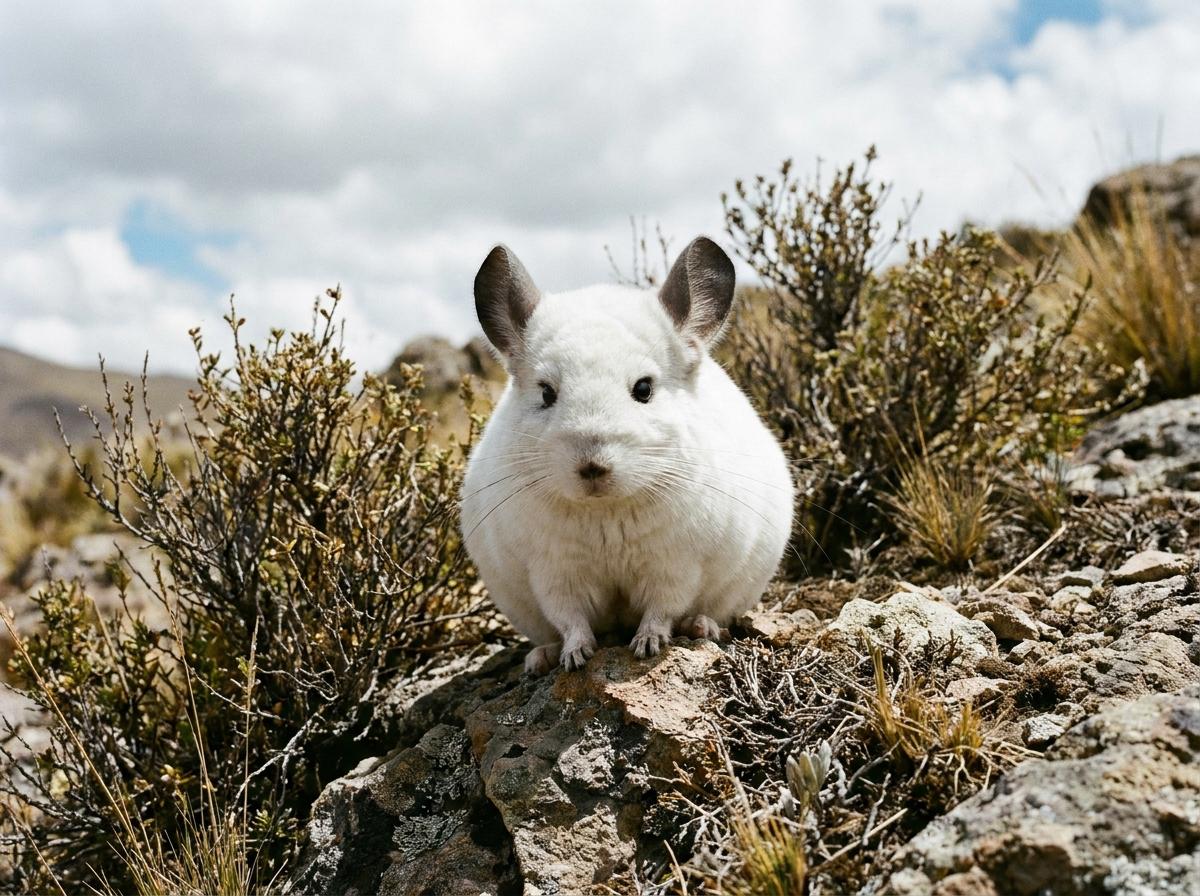
No two Wilson whites look quite alike. One copy of the gene is enough to show, but how much of the coat it turns white varies enormously. In their 2022 paper, Kozlov and Bakiev describe the range they see in white Wilson animals, and it maps onto the names you will see in listings.

- Near white. A white or off-white coat with little visible grey. Some animals keep darker fur on the wrists, lower legs, base of the tail and tip of the muzzle, a pointed pattern the authors compare with Siamese cats and California rabbits.
- Mosaic. White with grey patches scattered over the head, back and sides, above a white belly. Heavily marked animals are often sold as “extreme mosaics”.
- Silver. Dark hair spread evenly over the upper body, so the animal reads as a pale silvery grey rather than patched.
- Nearly standard. An animal that looks like a standard grey apart from a small patch of white on the tail, a paw or the body, which can be the only outward sign of the white gene.
Kozlov and Bakiev also point out that names such as silver, misty and motley describe appearances of the same white Wilson color, not separate mutations. That matters more than it sounds. A silver and a mosaic are both Wilson whites, so putting them together is a white-to-white pairing, however different they look.
Eyes and ears: the quickest check
Look at the eyes first. Kozlov and Bakiev describe the eyes of a white Wilson as black, and teaching material by Stanislaw Socha of Poland’s Siedlce University describes Wilson whites with black eyes and dark ear tips, so the ears read dusky rather than pink. Merck’s professional chinchilla chapter notes that a chinchilla’s eye color, black, pink or red, is set by its coat color genes, which makes eye color the fastest way to sort the white chinchillas you see for sale:
- Dark eyes: a Wilson white, in one of its patterns.
- Ruby, pink or red eyes: beige is in the mix, which makes the animal a pink white, or it is an albino (see the next section).
A coat can fool you in a photo, because lighting turns cream into white and grey into silver. Eye color is much harder to fake, so ask for a clear, close photo of the face in daylight before you trust a color label.
Is a white chinchilla an albino?
Usually not. Albinism means no pigment at all, and a Wilson white has pigment in its eyes, and usually some in its ears or a few hairs as well. Two white-looking chinchillas get called albino:
- The pink white. A Wilson white that also carries beige, covered in its own section below. It combines a white coat with the ruby eyes that come with beige, so it is easy to mistake for an albino.
- A true albino. A separate, recessive albino gene has been described in chinchillas. Kozlov and Bakiev describe albino animals as pure white with light pink eyes, and the notes from a 2002 World Small Animal Veterinary Association congress talk by the French veterinarian Didier Boussarie list albinos among the white mutations. Albino is not among the colors Merck’s professional chapter lists for pet chinchillas, though, so a pink-eyed white offered for sale is more likely to be a pink white. Ask for the colors of both parents.
Not every white-looking chinchilla is a Wilson white, either. Kozlov and Bakiev also describe a recessive near-white with a golden tint, known as Lowe white or goldbar. Because it is recessive, it is inherited differently and does not follow the Wilson white rules below.
How white genetics work
This is the part that protects the animals. Every chinchilla carries two copies of each gene, one from each parent, and the white gene behaves in a way that makes careless pairing costly.
One copy shows, two copies are lethal
Wilson white is dominant, so a chinchilla needs only one copy of the gene to look white. A double dose is lethal. Boussarie’s congress notes put it plainly, describing Wilson white and velvet animals as dominant heterozygotes that carry a lethal gene (the notes are on the Veterinary Information Network), and Kozlov and Bakiev note that a white Wilson always carries the standard gene alongside the white one. Breeders generally report that embryos with two white copies are lost before birth, which shows up as smaller litters. In practice, every Wilson white you will ever meet, whatever its pattern, carries one white copy and one non-white copy.
Black velvet works the same way and is the other color usually described with a lethal double dose; our black velvet chinchilla guide covers it. Beige is the useful contrast: it survives with two copies, and a double-beige animal looks paler than a single-beige one, as the beige chinchilla guide explains.
What each pairing produces
Because every Wilson white carries one white copy, each kit has an even chance of inheriting it from a white parent. These are the averages breeders plan around. They are expectations across many litters, and since a chinchilla litter is one to six kits, averaging two according to Merck, any single litter can come out quite differently.
- Wilson white x standard grey: about half the kits white, half standard. No lethal risk. This is the classic white pairing.
- Wilson white x beige (one beige copy): roughly a quarter each of white, pink white, beige and standard. No lethal risk.
- Wilson white x homozygous beige: roughly half pink white and half beige, because a double-beige parent passes beige to every kit. No lethal risk.
- Wilson white x black velvet: roughly a quarter each of white, velvet, white velvet (often sold as TOV white) and standard. No lethal risk, because white and velvet are different genes and no kit can get two copies of either.
- Wilson white x violet or sapphire: white or standard-looking kits that carry the recessive color. A white violet or white sapphire needs two copies of the recessive gene, so it takes another generation.
- Wilson white x Wilson white: about a quarter of the embryos inherit two white copies and are lost. Of the kits that are born, about two in three are white.
Look closely at that last line. Out of four conceptions, a white-to-white pairing gives on average two white kits, one standard kit and one lost embryo. A white-to-standard pairing gives two white kits and two standard kits. The white pairing produces no extra white kits; it simply loses a quarter of the litter. That is why experienced breeders avoid it.
The hidden white problem
The white-to-white pairings that are hardest to avoid are the ones where one parent does not look white. Every one of these carries the Wilson white gene and counts as a white for pairing:
- silvers and mosaics, however dark;
- pink whites, white ebonies, white velvets (TOV whites), white violets and white sapphires;
- the “nearly standard” animal with a small white patch on the tail, paw or body that Kozlov and Bakiev describe.
An animal that carries both white and velvet, such as a TOV white, deserves extra care: it should go only to a partner with neither gene, because pairing it with any white or any velvet risks a lethal double dose of one or the other.
The defense is records. Wilson white is dominant, so it cannot be carried silently the way violet or sapphire can, but a white with very little white showing can pass for a standard. Before you pair two chinchillas, know each animal’s parents: a standard-looking chinchilla with a white parent deserves a close look for a white patch before you treat it as non-white, and the recessive colors it may carry can come from further back still. On Creatures you can link a chinchilla’s sire and dam to build its pedigree, add parents you do not own as reference animals, and see each relative’s details on the pedigree cards (the help center explains how pedigrees and family links work and how reference animals document lineage). A white parent is easy to forget in your head and hard to miss on a chart.
Pink white and other white combinations
White stacks on top of other colors, and each named white variety below is Wilson white plus one more gene. Kozlov and Bakiev note that combining the dominant colors beige, velvet and white pushes the coat closer to white.

- Pink white. Wilson white plus beige. Kozlov and Bakiev describe this white-beige animal and note that it is traditionally called pink white (older German breeders called a pinkish form “pearl”). Expect a white to cream coat with the ruby to pink eyes of beige and the pinker ears our beige guide describes. A pink white can carry one or two copies of beige, and that changes what it produces: one with two beige copies passes beige to every kit.
- White ebony. Wilson white plus ebony. Ebony darkens the grey in a coat, toward solid black at its strongest, so a white ebony can carry darker markings than a plain white.
- White velvet (TOV white). Wilson white plus black velvet. As our black velvet guide notes, the white tends to lighten and partly mask the dark velvet veiling. It carries two lethal genes, one copy of each.
- White violet and white sapphire. Wilson white on an animal with two copies of a recessive color. Our violet chinchilla guide explains how the recessive half works.
Naming is not standardized, and two sellers can use different words for the same animal. The honest test is the genetic description: ask the breeder which genes the animal carries (“Wilson white, beige, carries violet”) rather than relying on a color name.
Buying a Wilson white
The white worth waiting for is a well-described one from known parents. Breeders who show are a good place to start, because show breeders usually record lineage and have their animals’ coats judged. In the United States, one of the national chinchilla clubs is the Empress Chinchilla Breeders Cooperative, founded in 1945, which runs shows. Rescues are worth checking too, with the caveat that a rehomed white may arrive without parent information. Our guide to where to buy a chinchilla compares the routes, and the Creatures breeder directory lists chinchilla breeders by state.
Questions worth asking about any white:
- Do the eyes match the label? Dark eyes for a Wilson white; ruby or pink for a pink white.
- What colors are both parents? A breeder should know. If the answer is “both white”, ask whether they pair whites routinely, and weigh what that says about the program.
- What does it carry? A white that also carries violet, sapphire, beige or velvet changes every future pairing, so get it in writing.
- Is it healthy? The Merck Veterinary Manual’s advice on selecting a chinchilla applies to every color: bright, clear eyes with no discharge, upper and lower teeth that meet evenly, no wet fur around the mouth or chin, and no wounds or missing fur. Merck also advises a veterinary exam and parasite test before you bring a chinchilla home, and asking whether you can return it if it falls ill.
Price depends on the specific white, the quality of the animal and the breeder’s lines more than on the word “white”. Our chinchilla price guide, checked against published US breeder price lists in August 2026, puts mosaics and white combinations such as white violet and white sapphire among the pricier colors, and it adds up the setup and lifetime costs, which outweigh the purchase price many times over.
Caring for a white chinchilla
A Wilson white needs exactly the care any chinchilla needs. The veterinary references we checked describe no health problem tied to a single copy of the white gene; the lethal effect belongs to the double dose, which no living Wilson white carries. Merck’s owner guide gives chinchillas an average life of about 10 to 15 years, with some pets reaching 20, and an adult weight of about 450 to 680 g (1 to 1.5 lb), with females usually the larger.

The essentials, each covered in depth in its own guide:
- A cool, dry room. Heat is the everyday danger. The Merck Veterinary Manual’s owner guide to routine care says chinchillas can get heat stroke above 80 F and prefer 50 to 60 F, VCA Animal Hospitals puts the optimum at 55 to 68 F with humidity below 40 to 50 percent, and Merck’s professional chapter treats any total above 150, adding the temperature in Fahrenheit to the relative humidity, as dangerous. Our chinchilla care guide explains how to hold a room in that cool range through summer.
- Hay first. Unlimited grass hay with a measured chinchilla pellet keeps the constantly growing teeth worn down. See what chinchillas eat.
- Dust, never water. Merck’s professional chapter suggests a dust box with about an inch of dust two to three times a week for up to 15 minutes. The chinchilla dust bath guide covers dust choice and frequency.
- A roomy multi-level cage with solid shelves. VCA’s minimum is 3 by 2 by 3 feet for one chinchilla and 3 by 2 by 5 feet for a pair. Breeders in the Empress cooperative point out that chinchillas are rock hoppers rather than natural jumpers and that wider is better than taller, so set the shelves as short hops where a missed jump is never a long fall, and give them somewhere to rest that is not wire. The chinchilla cage setup guide walks through size, shelves and bedding.
- Company. A 2024 welfare study of pet chinchillas (Gilhofer and colleagues, Animals) summarizes expert guidance that chinchillas should not be kept alone and can live in pairs or small groups, ideally two to six. Color makes no difference to who gets along; introductions do.
A white coat does change a few things you notice:
- Stains show. Merck lists saliva-stained fur and a wet, crusted chin and front feet among the signs of dental disease. On a grey coat those can hide for a while; on a white one they are obvious, so check the chin and paws weekly and see an exotics vet if they are wet or stained.
- Dirty dust shows too. Merck warns that dust left in the cage gets soiled with droppings and needs replacing. A white that looks dingy is often telling you about its bath and its shelves.
- Fur slip can change the pattern. A frightened or roughly handled chinchilla can drop a patch of fur, and Merck notes that the regrown fur is frequently a different shade. On a white or mosaic, a patch that grows back a different shade is regrowth after the slip, not the color changing, though the slip itself is a reason to handle more gently.
Lifespan, aging and the health risks that shorten a chinchilla’s life are covered in our guide to how long chinchillas live.
Breeding Wilson whites responsibly
Breeding whites well is mostly about the pairing rule and the records behind it. Pair a Wilson white with a non-white partner (a standard grey is the usual choice), never with another white of any pattern, and treat any animal of uncertain parentage as a possible white until its records say otherwise.
The biology sets a slow pace. According to Merck’s professional chapter, gestation averages 111 days, females generally have two litters a year of one to six young (two on average), and young chinchillas reach sexual maturity at about 8 months. Kits are born fully furred with their eyes open, so you can note each kit’s color from its first day. Merck also recommends a solid-bottomed cage for a female close to giving birth.
Color should never be the main selection goal. Dental disease is common in chinchillas, and Merck’s owner guide says dental problems can be hereditary, so chinchillas with them should not be bred. Select for sound teeth, good weight, dense coat and calm temperament first; the white will take care of itself, appearing in about half the kits of a white-to-standard pairing.
Good breeding records make every one of these decisions easier. Give each animal a profile with its color written exactly (for example “white mosaic, carries violet”), link its parents, and log each pairing and litter so the next generation’s pairings are planned from facts. When the kits arrive and need names, the free chinchilla name generator has ideas sorted by style.
Frequently asked questions
What is a Wilson white chinchilla?
A domestic chinchilla carrying one copy of the dominant white gene, usually described as the first color mutation in American chinchilla breeding and named after the breeder who produced it. Its coat ranges from near white to mosaic or silver, and its eyes are dark.
Are white chinchillas albino?
Most are not. A Wilson white has dark eyes and some pigment, so it is not albino. White chinchillas with pink or ruby eyes are more likely to be pink whites (Wilson white plus beige) than true albinos. A separate recessive albino gene has been described, but it is a different gene from Wilson white, so the two are not the same animal.
Can you breed two white chinchillas together?
You should not. Two copies of the white gene are lethal, so about a quarter of the embryos from a white-to-white pairing are lost, and the pairing produces no more white kits on average than white to standard. Remember that silvers, mosaics and pink whites are whites too.
What is the difference between a Wilson white and a pink white?
A pink white is a Wilson white that also carries beige. The beige gives it ruby to pink eyes in place of the Wilson white’s dark eyes, and often a creamier coat.
Is a silver or mosaic chinchilla a Wilson white?
Yes. Silver, mosaic and near white are different appearances of the same Wilson white gene, so each one counts as a white when you plan a pairing.
Do white chinchillas have health problems?
The veterinary references we checked describe no health problem caused by a single copy of the white gene. A Wilson white has the same needs and risks as any chinchilla: heat, dental disease and diet are the big three.
How long do white chinchillas live?
The same as other chinchillas: about 10 to 15 years on average according to the Merck Veterinary Manual, with some pets reaching 20. There is no white-specific lifespan figure.
How much does a white chinchilla cost?
It depends on the type of white, the animal’s quality and the breeder. Our chinchilla price guide gives current US ranges by color group, plus the setup and lifetime costs that make up most of the real expense.
Do this next on Creatures
Whether you are still deciding, waiting for the right white, or planning your next pairing, Creatures keeps the listings, breeders and records in one place.
Get alerted first. Set a free Wilson white listing alert and we will email you when a new one is posted. No account needed to start. See saving searches and using your watchlist.
Look for one now. Wilson whites are listed only now and then, which is why the alert comes first. Check Wilson white listings on the marketplace and search trusted chinchilla breeders and farms in the directory.
Add your chinchilla. Already have a white? Create a free profile for your Wilson white with its exact color and its parents, no account needed to start. The walkthrough is in adding an animal to Creatures.
Keep the records. Add weight, dental, vet and breeding records so changes show up as a trend and pairings are planned from facts. The record sheet opens for any visitor, and a free account saves what you enter. See adding a record and health and medical records, and set weekly weigh-ins or dust changes as repeating reminders with reminders and upcoming care.
Breed whites? Create your chinchilla breeding program’s profile, no account needed to start, then get listed in the breeder directory so buyers looking for Wilson whites can find you.
Compare the colors. Read the chinchilla species guide for every color side by side, and the beige and black velvet guides for two colors whites are often combined with.