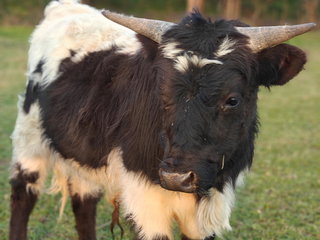
Louie
Cattle
$2,100

Plan a cross
Pick what your buck and doe look like. We'll calculate honest ranges for the Agouti patterns we can model, and keep eyes, markings, and other traits separate when the evidence can't support a number.
Their kids' colors
Here's an example cross to show you what this looks like — a gold buck over a gold doe. Swap in your own goats above.
Each color trait is worked out on its own. We never multiply them together into one made-up 'whole coat' chance.
Each percentage is worked out across the compatible scenarios in this Agouti model, not the odds for one kid, and it covers the Agouti pattern only — not the shade, eyes, markings, or whole coat.
The scenario span for Gold, red, or cream is 75% to 100%. This verdict covers the Agouti pattern only, not the whole coat or the odds for one kid. Solid black specifically requires both parents to carry nonagouti.
Two golds really can throw a black kid — that's a hidden Agouti allele showing up.
Shows up in every compatible scenario in this Agouti model
Possible in some scenarios in this model (we can't rank these)
Each range is the ceiling across the compatible scenarios in this model, not a coin-flip for one kid.
They cover the compatible scenarios in this model without calling any one more likely. The pattern names come from goat-color research in other breeds, not a Nigerian Dwarf gene test.
The numbers are the highest and lowest each pattern reaches across the compatible scenarios in this model, never one likelihood.
It works out the Agouti pattern, not the shade of gold/red/cream, and it isn't a Nigerian Dwarf gene test.
These ranges are the Agouti pattern only. A coat can fit more than one modeled scenario, so ranges can overlap and must never be added together; eyes, white markings, moonspots, and frosted points stay separate.
These are the modeled sire/dam genotype assignments that produce this result. We don't call any one more likely — open a group to see them.
A^wt / A^b × dam A^wt / A^bA^wt / A^b × dam A^wt / aA^wt / a × dam A^wt / A^bA^wt / A^pc × dam A^wt / A^pcA^wt / A^pc × dam A^wt / aA^wt / a × dam A^wt / A^pcA^wt / A^bz × dam A^wt / A^bzA^wt / A^bz × dam A^wt / A^tA^wt / A^bz × dam A^wt / aA^wt / A^t × dam A^wt / A^bzA^wt / a × dam A^wt / A^bzA^wt / a × dam A^wt / aA^wt / A^sm × dam A^wt / A^smA^wt / A^sm × dam A^wt / aA^wt / a × dam A^wt / A^smA^wt / A^wt × dam A^wt / A^wtA^wt / A^wt × dam A^wt / A^bzA^wt / A^wt × dam A^wt / A^bA^wt / A^wt × dam A^wt / A^smA^wt / A^wt × dam A^wt / A^pcA^wt / A^wt × dam A^wt / A^scA^wt / A^wt × dam A^wt / A^tA^wt / A^wt × dam A^wt / aA^wt / A^bz × dam A^wt / A^wtA^wt / A^b × dam A^wt / A^wtA^wt / A^sm × dam A^wt / A^wtA^wt / A^pc × dam A^wt / A^wtA^wt / A^sc × dam A^wt / A^wtA^wt / A^t × dam A^wt / A^wtA^wt / a × dam A^wt / A^wtA^wt / A^sc × dam A^wt / A^scA^wt / A^sc × dam A^wt / aA^wt / a × dam A^wt / A^scA^wt / A^t × dam A^wt / A^tA^wt / A^t × dam A^wt / aA^wt / a × dam A^wt / A^tA^wt / A^bz × dam A^wt / A^bA^wt / A^bz × dam A^wt / A^smA^wt / A^bz × dam A^wt / A^pcA^wt / A^bz × dam A^wt / A^scA^wt / A^b × dam A^wt / A^bzA^wt / A^b × dam A^wt / A^smA^wt / A^b × dam A^wt / A^pcA^wt / A^b × dam A^wt / A^scA^wt / A^b × dam A^wt / A^tA^wt / A^sm × dam A^wt / A^bzA^wt / A^sm × dam A^wt / A^bA^wt / A^sm × dam A^wt / A^pcA^wt / A^sm × dam A^wt / A^scA^wt / A^sm × dam A^wt / A^tA^wt / A^pc × dam A^wt / A^bzA^wt / A^pc × dam A^wt / A^bA^wt / A^pc × dam A^wt / A^smA^wt / A^pc × dam A^wt / A^scA^wt / A^pc × dam A^wt / A^tA^wt / A^sc × dam A^wt / A^bzA^wt / A^sc × dam A^wt / A^bA^wt / A^sc × dam A^wt / A^smA^wt / A^sc × dam A^wt / A^pcA^wt / A^sc × dam A^wt / A^tA^wt / A^t × dam A^wt / A^bA^wt / A^t × dam A^wt / A^smA^wt / A^t × dam A^wt / A^pcA^wt / A^t × dam A^wt / A^scStill reading the study
We record frosted points on its own, apart from Agouti, roan, ticking, and spotting. We won't put a number on it until the full paper is reviewed.
What the readable study abstract reports, cross by cross: frosted × frosted 16 frosted / 5 nonfrosted; frosted × nonfrosted 5 frosted / 4 nonfrosted; nonfrosted × nonfrosted 0 frosted / 4 nonfrosted.
Your goats: Not recorded
The readable publisher abstract reports 16/5, 5/4, and 0/4 offspring, says the results are consistent with a dominant gene, and suggests Fr^d for dominant frosting. Full phenotype boundaries, methods, penetrance, expressivity, homozygote discussion, linkage limitations, and model admission remain gated.
When both parents are one of the five modeled choices, the calculator puts real numbers on the Agouti base pattern. Everything else — brown/chocolate tone, how deep the gold/red/cream is, blue or marbled eyes, white markings, roan, belt, moonspots, frosted points, and age — stays as its own note, because the goat evidence isn't there yet for an honest number.
Nigerian Dwarf color names mix Agouti patterns, pigment depth, white markings, and breeder vocabulary. The calculator accepts all eight base-pattern choices as observations. Five choices enter the Agouti model and can return ranges. Buckskin, Cou Noir, and Sundgau stay descriptive and do not produce a number. Every additional trait stays separate when the goat evidence cannot support an honest result.
These are the base-color observations accepted by the calculator, plus two useful boundaries for reading the result.
These observations can change how a goat looks, but each stays separate from the Agouti ranges.
These are useful observations and cautions, not extra branches to combine with the Agouti result.
Breeder names help describe a goat, but one visible name does not by itself establish a genotype.
When both parents use one of the five modeled choices, the calculator works out each compatible Agouti scenario and reports the lowest and highest result for each pattern. Buckskin, Cou Noir, and Sundgau stay descriptive and produce no number. The pattern mapping comes from goat research in other breeds, not a Nigerian Dwarf gene test.
More than one modeled sire and dam assignment can fit the same visible parent colors. The calculator does not rank those compatible scenarios. It reports their lowest and highest results instead of averaging them or presenting one scenario as more likely.
Yes, under this Agouti model. Some compatible modeled sire and dam assignments for two gold parents produce a solid-black result. The calculator keeps all compatible scenarios and reports their range without claiming that one scenario is more likely.
No commercial goat coat-color test covers these calculator inputs. The current surface uses visible parent patterns only. It does not turn a coat description into an allele or laboratory result.
No. A numerical result covers the Agouti pattern only, not the depth of tan pigment. Cream, gold, red, and near-white appearances are shown only as examples of variation, never as the predicted shade of a kid.
The goat evidence does not support an honest cross result for those traits here. Blue-eye inheritance is not established well enough, moonspot inheritance is not mapped well enough, brown does not have a clean rule for this calculator, and white spotting covers varied patterns. Each remains a separate observation.
No. The calculator accepts those breeder terms as visible descriptions only. They do not select an allele, genotype, or scenario, and they do not produce a range or percentage.