American Spotted
Author: Elliott Garber, DVM · Updated
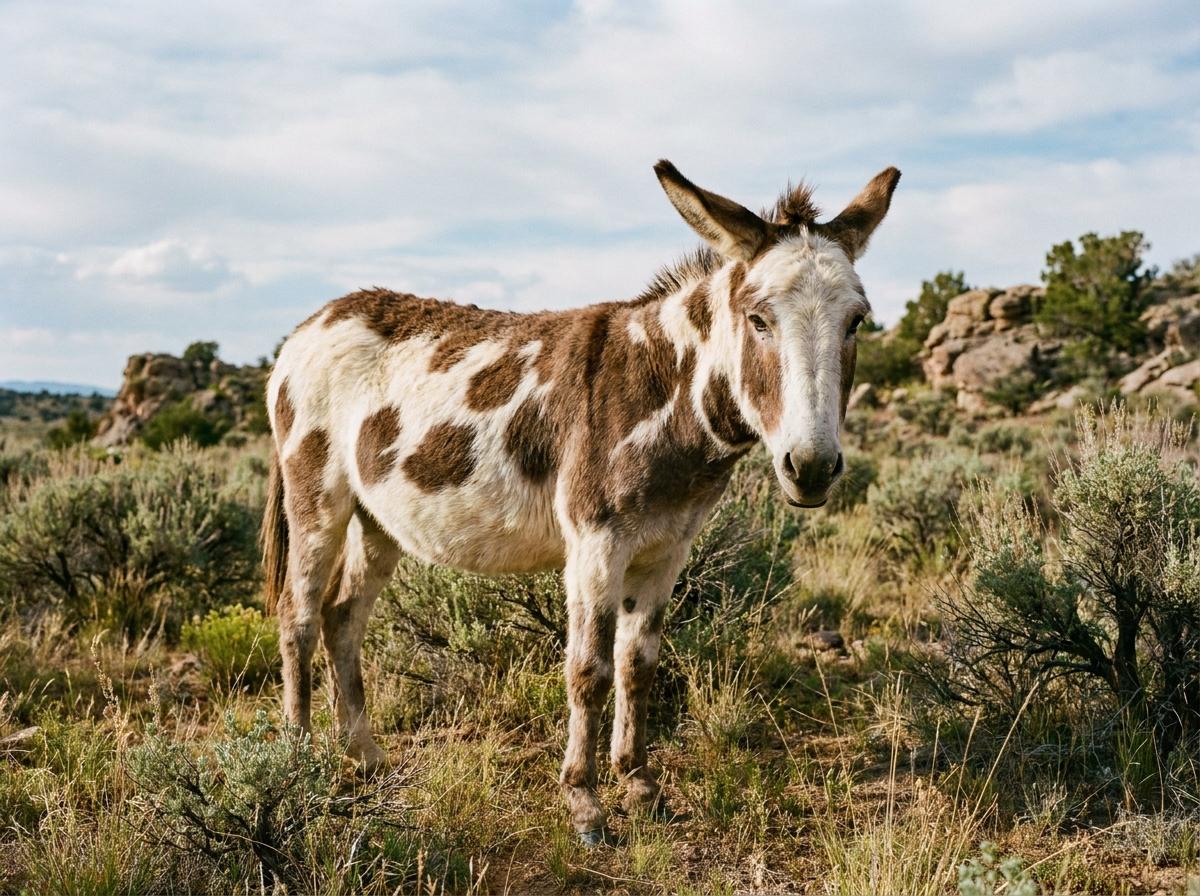
The American Spotted Ass is a spotted, or pinto-patterned, donkey registered by the American Council of Spotted Asses (ACOSA). The single most important thing to understand up front is that “American Spotted Ass” is a color and pattern registration, not a size breed. A donkey qualifies because of how its coat is marked, not because of its bloodline or how tall it stands. Minis, standards, and mammoths can all be American Spotted Asses, and so can spotted mules and hinnies, as long as the animal carries at least two clear spots in the right places. On this page you will find what the designation actually means, where it comes from, how the spotting is inherited, what a spotted donkey looks like, and how to care for one, with links to a deeper miniature-donkey guide and to the tools you need to track and find these animals.
| What it is | A color and pattern registration for spotted donkeys, not a size breed |
|---|---|
| Also called | Spotted ass, spotted donkey, pinto donkey, painted donkey |
| Registry | American Council of Spotted Asses (ACOSA), founded 1966 in Billings, Montana |
| Registration rule | At least two spots, above the legs and behind the throatlatch, shown in photos |
| Eligible animals | Donkeys, mules, and hinnies of any size that meet the spotting rule |
| Coat | White patches combined with brown, black, or gray; ranges from a few white patches to nearly all white |
| Size range | Miniature (36 in or under) through standard (36 to 54 in) to mammoth (over 54 in) |
| Lifespan | Often 30 or more years with good care, per The Donkey Sanctuary |
| Care level | Companion or working equine; forage-based diet, dry shelter, routine hoof and dental care |
Browse listings, public profiles, breeders, or add your animal.
What is an American Spotted Ass?
An American Spotted Ass is a donkey that has been registered with the American Council of Spotted Asses because it carries a spotted, or broken, coat pattern. The name “American Spotted Ass” is a trademark of ACOSA, and the designation describes coat color and pattern rather than a distinct genetic breed.
This distinction matters, so it is worth being precise. In North America there are no true-breeding native donkey breeds in the way there are true horse breeds, and the spotted ass is best understood as a color designation rather than a breed for exactly this reason. Spotting is dominant, so a spotted foal always has at least one parent that carries it, even if that parent shows so little white that it passes for solid. Two spotted parents can still produce a solid foal. What ACOSA registers is the visible result: a donkey marked with spots. If you have been trying to figure out whether “American Spotted Ass” is a breed you can buy the way you buy a specific horse breed, the honest answer is that you are shopping for a pattern that appears across many types and sizes of donkey.
Because the spotting is what counts, the pool of eligible animals is broad. ACOSA maintains a registry for spotted donkeys, mules, and hinnies of all sizes. A 32-inch miniature and a 56-inch mammoth can both be American Spotted Asses if they are spotted. For a broader look at the animal underneath the pattern, the Creatures donkey species page is a good place to compare donkey types and sizes.
The ACOSA registry and how registration works
The American Council of Spotted Asses was founded in 1966 by David Parker in Billings, Montana, and was later incorporated in 1969. It is a nonprofit organization dedicated to promoting and preserving spotted donkeys, and it maintains the registry that gives these animals the “American Spotted Ass” name.
The registration requirement is refreshingly simple. According to ACOSA, to register your donkey, mule, or hinny it “must have at least two spots, visible on a photograph, above the legs and behind the throatlatch.” The application asks for photographs of each side of the animal so the spots can be confirmed, and ACOSA also asks for a couple of generations of pedigree history if you have it, though a full pedigree is not required. In other words, the gate is the pattern, verified by photo, not a documented bloodline.
Two practical points follow from this. First, spots located only on the legs or on the head in front of the throatlatch do not count toward the requirement, which is why sellers describe the qualifying spots as being on the body. Second, because registration is pattern-based and open across sizes and even across mules and hinnies, an ACOSA number tells you the animal is spotted and recorded, not that it belongs to a fixed, closed breed. When you evaluate a specific animal, treat the registration as confirmation of the pattern and always look at the individual donkey in front of you.
What a spotted donkey looks like
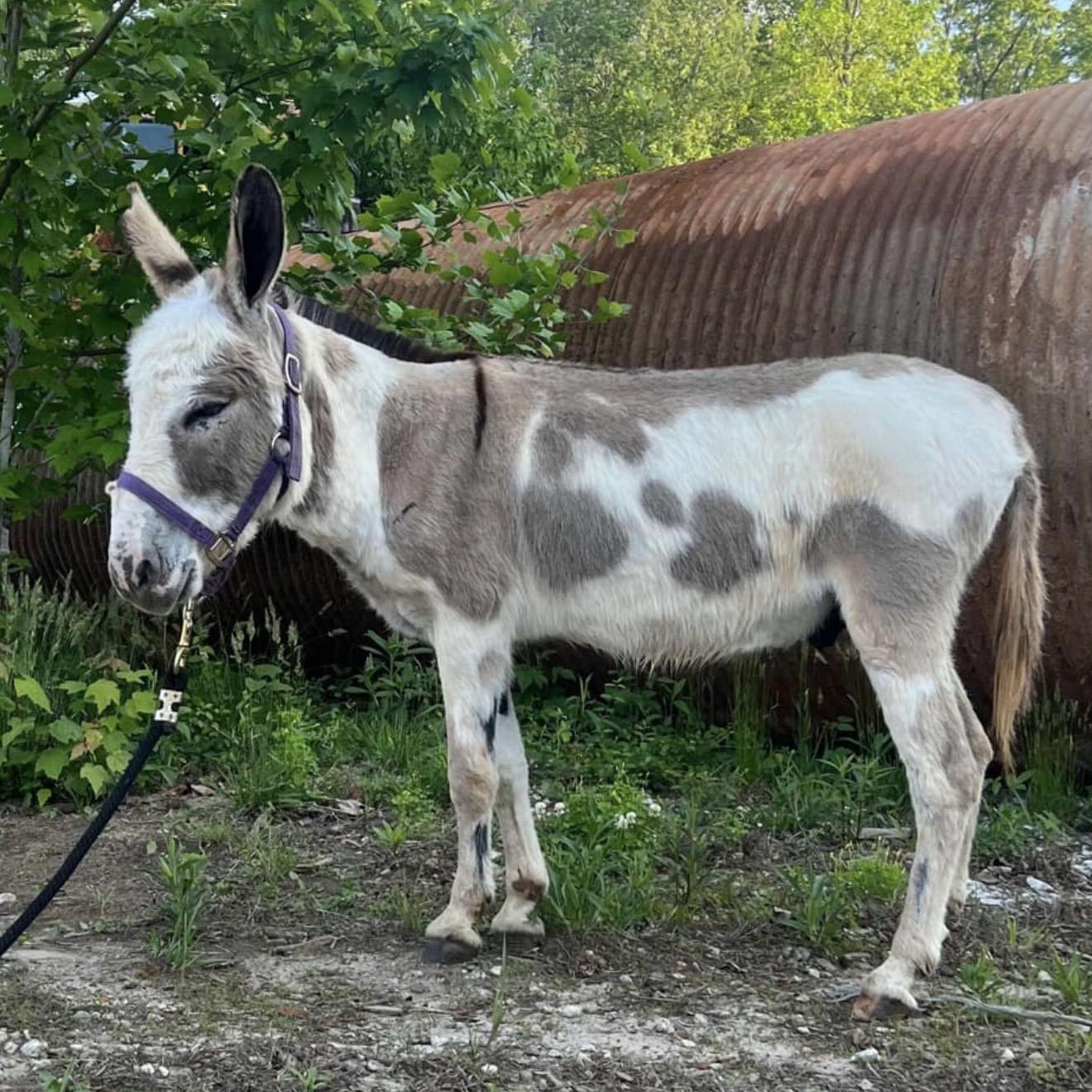
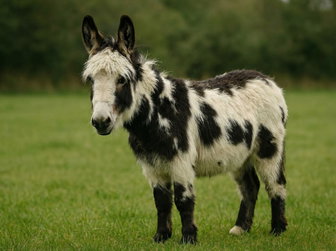
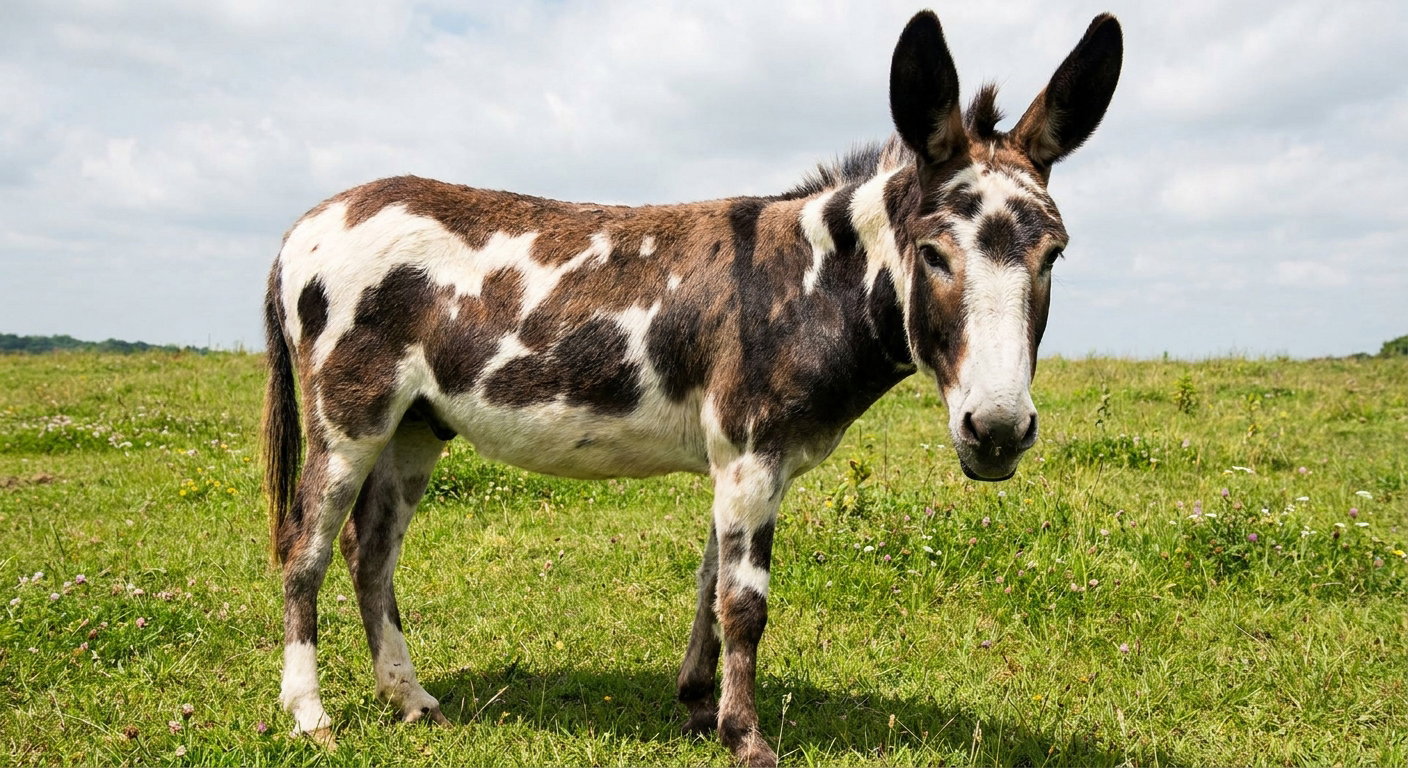
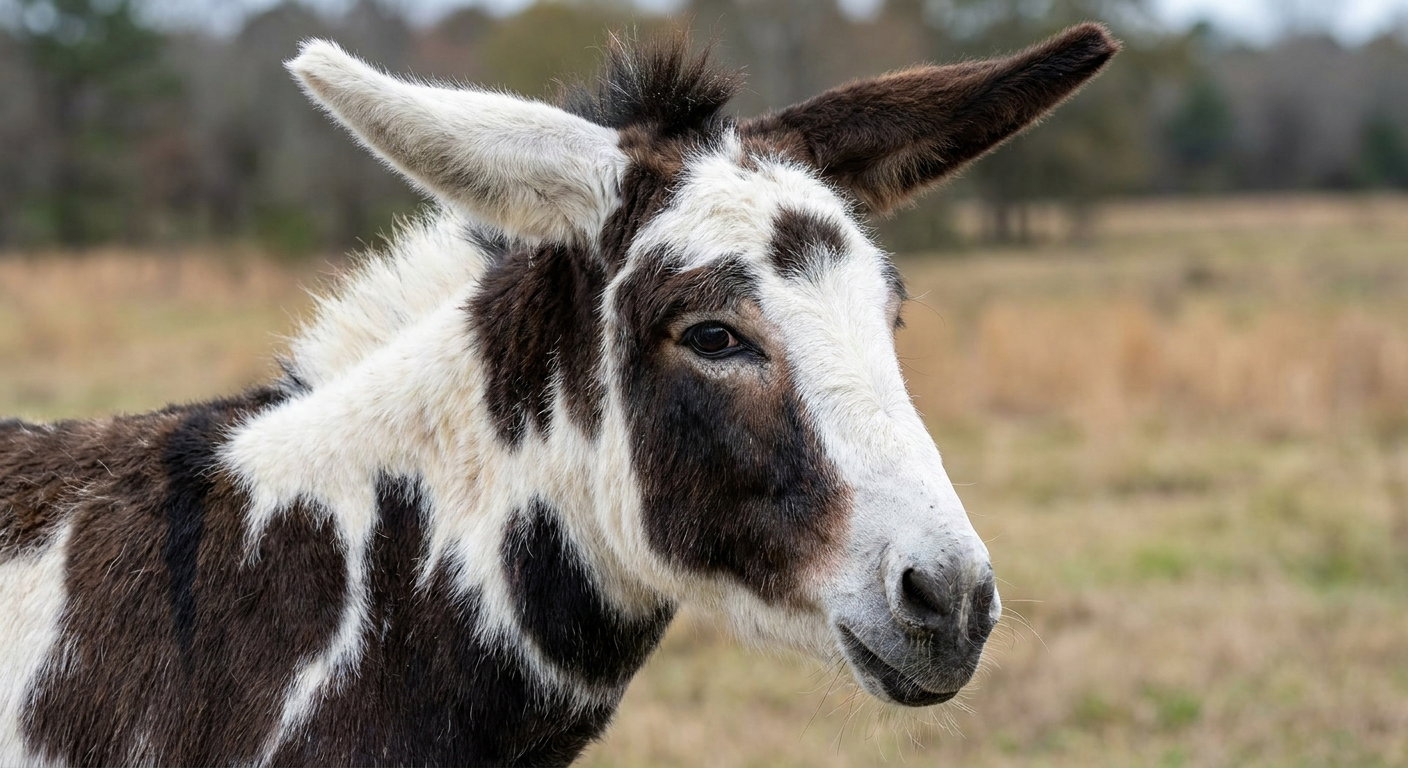
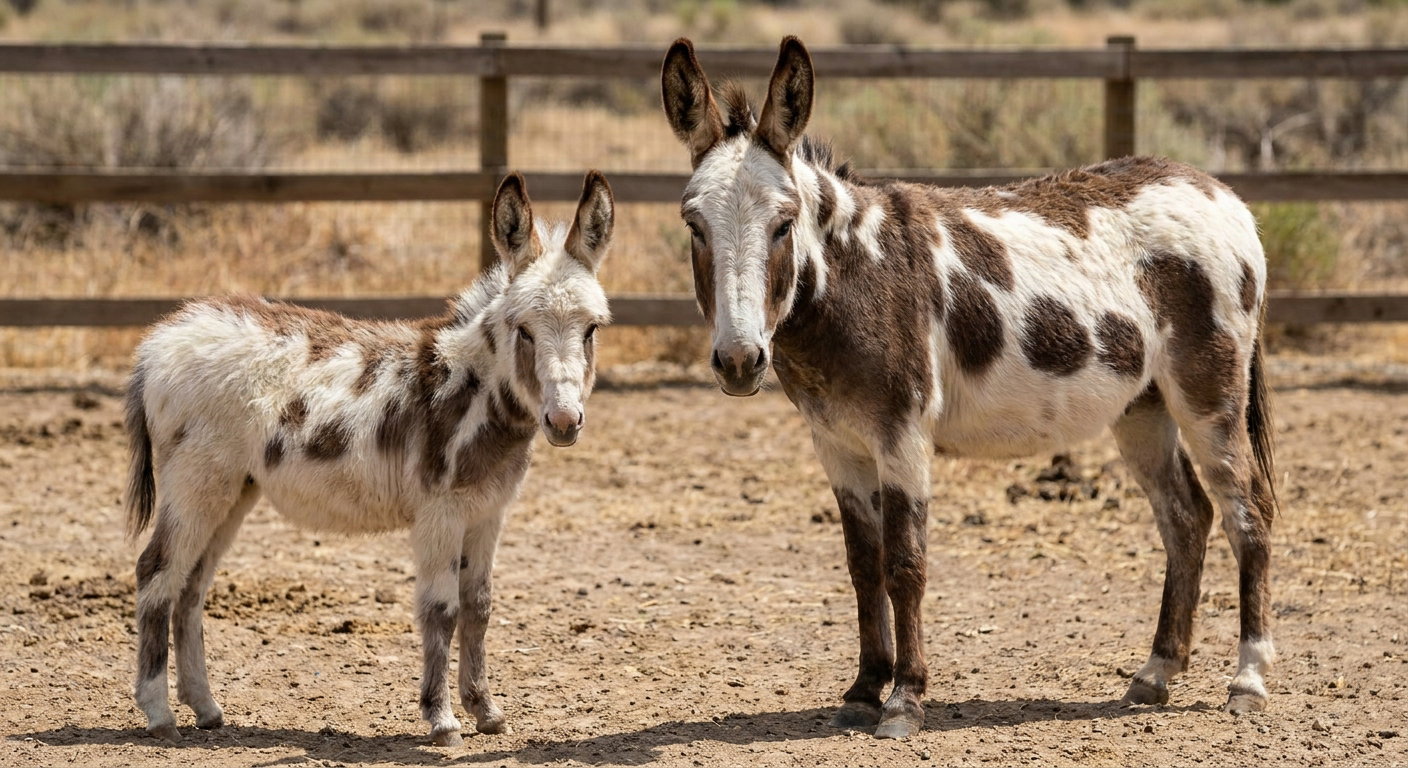
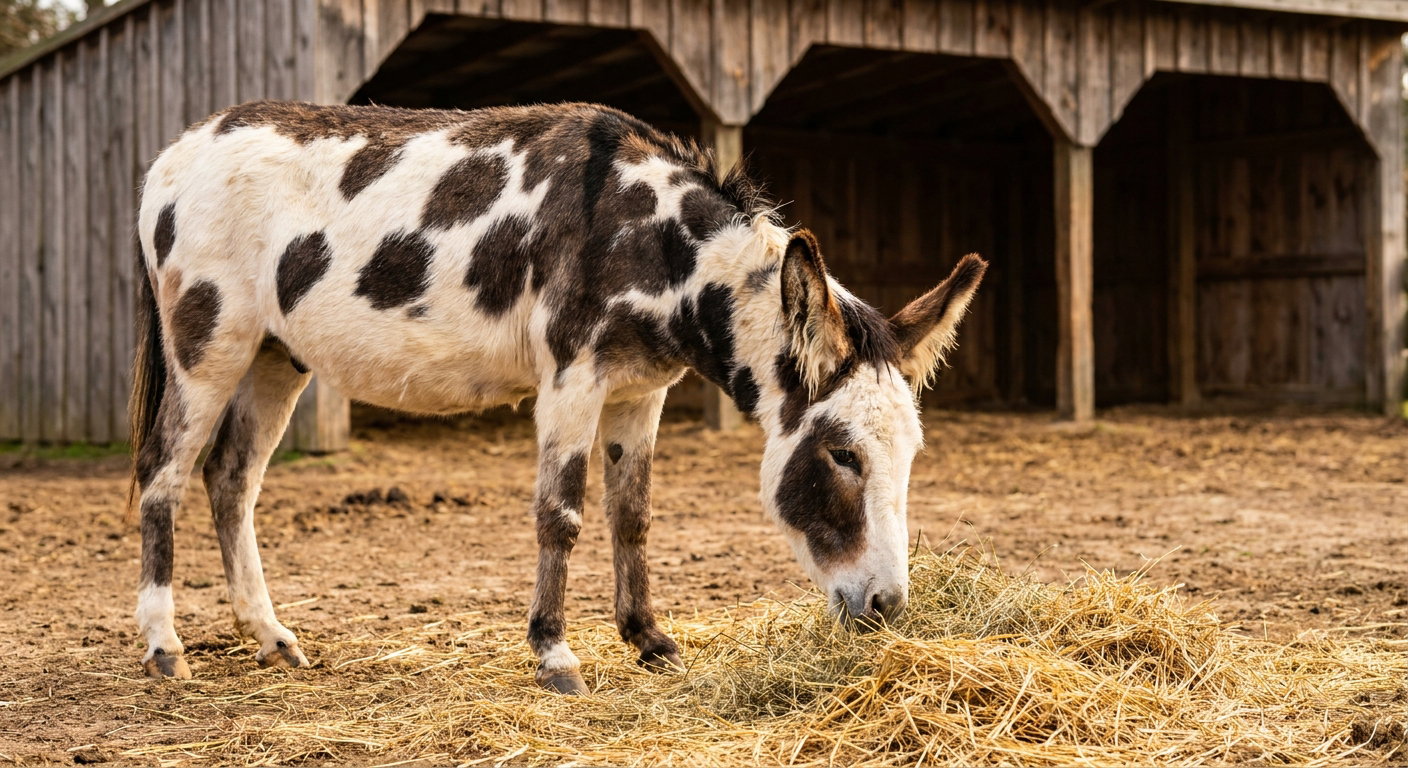
The defining feature is the broken, patchy coat. Spotted donkeys display white combined with patches of brown, black, or gray. The amount of white varies enormously from one animal to the next. Some donkeys are mostly dark with a scattering of white patches, others are roughly half and half in a bold pinto pattern, and at the far end an animal can be almost entirely white with only a few colored spots.
Everything else about the animal is ordinary donkey. You get the long upright ears, the upright mane, the tufted tail, and the sturdy, deep-bodied frame that donkeys are known for. Many donkeys, spotted or not, also carry the classic dorsal stripe and shoulder cross, though on a heavily marked spotted animal those markings can be broken up or hidden by the white. The spotting can appear on any size or type of donkey, which is exactly why the pattern can look so different from one American Spotted Ass to the next.
It is worth clearing up a common misconception about the pattern’s name. Spotted donkeys are sometimes described casually as “tobiano” or “appaloosa” donkeys by analogy with horses, but the donkey’s spotting comes from its own KIT variant, covered next, not from the horse tobiano or appaloosa mutations, so borrowing horse pattern names is a loose description rather than a precise one.
The genetics of donkey spotting
Donkey white spotting has been studied at the DNA level, and the findings help explain both why the pattern is so variable and why responsible breeders test before pairing two white or heavily spotted animals.
Researchers (Haase and colleagues, published in Animal Genetics in 2015) identified two variants in a gene called KIT as candidate causes of white patterning in donkeys. The two phenotypes were named dominant white (W) and white spotting (Ws). Both are inherited in an autosomal dominant fashion, which means a donkey needs only one copy of either variant to show white patterning and will pass that variant to about half of its foals. The UC Davis Veterinary Genetics Laboratory, which offers a donkey dominant white and white spotting test, describes the same picture and notes how much the amount of white can range, from just a few white hairs to an animal that is nearly all white. Dominant white has been documented in very few donkeys. Spotted donkeys carry white spotting (Ws), and every spotted donkey tested in the published studies carries one copy.
There is one serious welfare point that every prospective breeder should know: two copies of white spotting are not viable. The one documented Ws/Ws foal was born all white, with pink skin and blue eyes, and died at about two weeks. For dominant white, UC Davis predicts that two copies are lethal before birth. When two spotted donkeys are bred, about 1 in 4 conceptions inherits two copies of Ws. That holds however little white a parent shows, so test a minimally marked parent before you plan a pairing, and talk the plan through with your veterinarian.
A negative result has a clear scope. A UC Davis N/N result means the donkey carries neither KIT variant on the test (W or Ws). It says nothing about American ivory, roan or frosting, which have no known gene or test. To see the foal colors and the two-copy chance for a spotted pairing, use the Donkey Color Calculator.
It is also worth knowing that the spotting factor does not always breed true. Spotted jacks and jennets regularly produce solid-colored foals, because a spotted donkey carries one copy of the spotting factor and passes it to about half of its foals. That variability is part of why “spotted donkey” is a pattern designation rather than a locked-in breed.
Sizes: mini, standard, and mammoth
Because the American Spotted Ass designation crosses sizes, it helps to know how donkeys are grouped. Height is measured at the withers, the high point of the shoulder. The American Donkey and Mule Society recognizes several size classes.
- Miniature. About 36 inches and under at the withers. Miniatures are popular companion and hobby donkeys.
- Standard. Over 36 and up to 48 inches, which the ADMS splits into small standards (36.01 to 40 inches) and standards (40.01 to 48 inches).
- Large standard. 48.01 to 54 inches for jennets and 48.01 to 56 inches for jacks.
- Mammoth. Over 54 inches for jennets and over 56 inches for jacks. The American Mammoth Jackstock, recognized by The Livestock Conservancy, is the large end of this range and was historically bred for producing mules.
A spotted coat can turn up in any of these classes, so an “American Spotted Ass” might be a knee-high companion animal or a tall working donkey. If your interest is specifically in the small end, the miniature donkey is covered in depth on the Creatures miniature Mediterranean donkey page, which is a good companion read to this one.
Temperament and what they are used for
Spotted donkeys have the same temperament range as donkeys generally, because the spotting is only skin deep. The Donkey Sanctuary, the world’s largest equine welfare charity, describes donkeys as intelligent, sociable, and calm animals capable of independent thinking that form strong bonds with each other and with the people who care for them. That combination of steadiness and sociability is a big part of why donkeys are kept as companions, as gentle animals for families, and as guardians for other livestock, as well as for driving, packing, and light work.
One welfare point that flows directly from their sociability: donkeys do not do well alone. They flourish in the company of other donkeys and form close, lasting bonds, so a single donkey kept without a companion is a common and avoidable welfare problem. If you are drawn to a spotted donkey for its looks, plan to keep it with at least one equine companion.
A spotted coat has no bearing on how an individual behaves. As with any equine, temperament is shaped by handling, socialization, training, and whether the animal is an intact jack, a jennet, or a gelding. Intact jacks in particular need experienced handling and appropriate management.
Care and husbandry
A donkey is not a small horse, and feeding or managing one as though it were is a frequent mistake. Donkeys evolved to thrive on sparse, high-fiber forage in tough environments, so their care is built around plain, fibrous feed, dry footing, companionship, and steady routine maintenance. The summary below covers the structure of good care; defer specific health and medical decisions to a veterinarian who can see your animal.
Feeding
The core of a donkey’s diet is high-fiber, low-sugar forage. The Donkey Sanctuary recommends barley straw as the main forage for many healthy adult donkeys, commonly fed alongside a modest amount of grass hay, because donkeys are prone to obesity and to diseases such as laminitis when overfed rich feed. Lush pasture and grain-heavy diets are a real risk rather than a treat. Constant access to clean water, plus a suitable vitamin and mineral supplement or mineralized block to cover gaps in a forage diet, rounds out the basics. Any donkey that is old, thin, pregnant, working hard, or unwell needs a diet tailored with veterinary or nutrition advice rather than a one-size plan.
Shelter
Here is a fact that surprises many new owners: a donkey’s coat is not waterproof the way a horse’s is. Donkeys do not have the same oils in their coat, so rain soaks in rather than beading off, and prolonged wet and cold is genuinely bad for them. For that reason, welfare guidance is that donkeys should have free access to a dry shelter at all times, both for protection from rain and wind and for shade in summer, and should be kept off deep mud. A simple, well-drained field shelter they can walk in and out of is usually enough.
Hooves and teeth
Donkey feet need regular attention from a farrier or trimmer, commonly on a six to eight week cycle, and daily hoof-picking is a good habit that lets you catch problems like abscesses, thrush, or the early signs of laminitis. A donkey’s teeth grow continuously and can develop sharp edges and overgrowths, so The Donkey Sanctuary advises a dental check by a veterinarian or qualified equine dental technician one to two times a year, with older donkeys often needing checks more often. Keeping records of these routine visits makes it far easier to spot changes over time.
Health and records
Beyond hooves and teeth, routine donkey health care means a parasite-control plan suited to your area, the vaccinations your veterinarian recommends, weight and body-condition monitoring (donkeys hide illness and carry weight in ways that are easy to misjudge), and prompt veterinary attention when something is off, because donkeys are stoic and can mask pain. Good records of weight, feet, teeth, treatments, and any changes turn all of this from guesswork into evidence. You can keep those records, plus reminders for farrier and dental visits, on Creatures. See the section at the end of this page.
Cost and where they fit in the market
Because “American Spotted Ass” is a pattern rather than a fixed breed, there is no single reliable price for one, and we will not invent one. Price tracks the things that actually drive donkey value: size class (a mammoth is a very different animal from a mini), age, training, temperament, health, and how striking and correct the individual animal is. A well-marked, well-handled spotted donkey often commands a premium over a plain solid donkey of the same type simply because the pattern is in demand, but that premium sits on top of the underlying value of the animal, not instead of it.
ACOSA registration itself is inexpensive (the organization lists a modest per-animal fee), so registration is not what makes a spotted donkey cost more. When you shop, weigh the whole animal: its soundness, its feet, its temperament, and whether it comes with a companion or will need one. Two donkeys are the baseline, not two times the luxury.
You can browse current donkey listings on the Creatures marketplace and look for breeders and farms in the Creatures directory. Because a spotted coat is a specific thing to hunt for, a saved listing alert (in the hub below) is often the most practical way to catch the right one when it is posted.
Buying considerations
A striking spotted coat is easy to fall for, so buy on the whole animal, not just the pattern.
- Buy the donkey, not just the spots. Sound feet and legs, good teeth, a healthy weight, and a calm, well-handled temperament matter far more over a 30-year life than exactly where the white patches fall.
- Plan for two. Donkeys need equine company. If you are buying one, either buy a bonded pair or line up a companion before it arrives.
- Ask about breeding history and genetics. If the animal is or may be bred, ask whether the parents were white-spotting tested. Pairing two spotted donkeys, including one with very little white, risks the non-viable two-copy outcome described above.
- Confirm what the registration means. An ACOSA registration confirms the spotting and records the animal; it is not a closed-breed pedigree guarantee. Match the paperwork to the animal in front of you.
- Match the size to your setup. A mammoth and a mini have very different space, feed, and handling needs. Be clear on which size class you are actually buying.
Frequently asked questions
Is the American Spotted Ass a breed?
Not in the strict sense. It is a color and pattern registration through the American Council of Spotted Asses. Because there are no true-breeding native North American donkey breeds, the spotted ass is best understood as a pattern designation that appears across sizes and types of donkey.
What does a donkey need to register with ACOSA?
At least two spots, above the legs and behind the throatlatch, visible in submitted photographs of each side of the animal. Donkeys, mules, and hinnies of any size can register if they meet that rule.
When and where was ACOSA founded?
The American Council of Spotted Asses was founded in 1966 by David Parker in Billings, Montana, and was later incorporated in 1969.
Are spotted donkeys a specific size?
No. Spotting appears in miniature, standard, and mammoth donkeys alike. An American Spotted Ass can be a small companion donkey or a tall working one.
Is it risky to breed two spotted donkeys together?
Yes. About 1 in 4 conceptions from two spotted parents inherits two copies of the white spotting variant, and two copies are not viable: the one documented foal died at about two weeks. Test any parent with even a little white, and check the chances for your pairing in the Donkey Color Calculator.
How long do spotted donkeys live?
Like donkeys generally, they are long-lived. The Donkey Sanctuary reports an average life expectancy of just over 30 years, with many donkeys reaching their 30s and some their 40s. That long life is a real commitment worth planning for.
Do this next on Creatures
Whether you are researching the pattern, hunting for a spotted donkey, or already keeping one, Creatures is the records, marketplace, and directory layer to do it in one place.
Compare donkey types. Start on the Creatures donkey species page, and if you are drawn to the small end, read the miniature Mediterranean donkey guide. Deciding between a spotted donkey and something in a different species entirely? The Hucul pony guide is a useful contrast for a small, hardy equine.
Find a spotted donkey. Browse donkeys on the marketplace and search trusted breeders and farms in the Creatures directory. New to searching? See saving searches and using your watchlist.
Get alerted. A well-marked spotted donkey is a specific thing to find, so set a free spotted donkey listing alert and we will tell you when a matching donkey is posted. No account needed to start.
Add your donkey. Already keeping a spotted donkey? Create a free animal profile in a few minutes. No account needed to start, and the walkthrough is in adding an animal to Creatures.
Track hooves, teeth, and health. Add a care record on Creatures to log farrier visits, dental checks, weight, and treatments. The record sheet opens for any visitor to look around, and a free account saves what you enter. See adding a record and reminders and upcoming care for the how-to.
List your farm. Breeding or selling spotted donkeys? Create a breeder or farm profile (no account needed to start) and get listed in the breeder directory so buyers searching for spotted stock can reach you.
Sell with confidence. Planning to sell? Learn how seller payout works before you list.