Alpaca Breeding: Mating, Pregnancy Checks, Birth and Cria Care
Author: Elliott Garber, DVM · Published
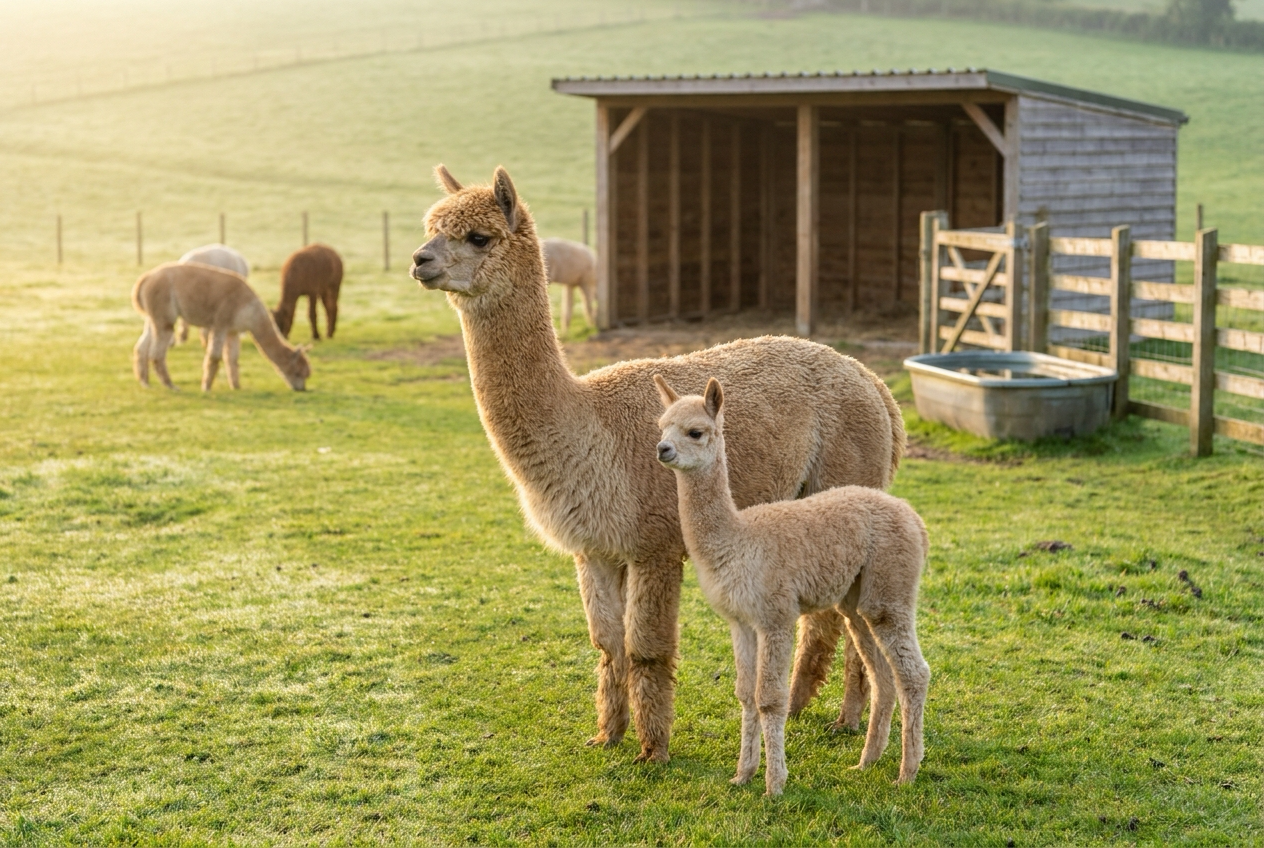
Alpacas are induced ovulators: a female has no regular heat cycle, ovulates roughly a day after mating, and carries a single cria (the name for a baby alpaca or llama) for about 11 months. Good alpaca breeding comes down to choosing mature, well grown animals, recording the exact mating dates and sire, confirming the pregnancy, and planning a daytime birth window with your veterinarian on call.
That dating is where most herd records go wrong, so start with it. Enter a mating date, or the first and last days a male ran with the females, in the free alpaca gestation calculator and it returns the due date and a planning window. It works without an account. Saving the breeding to the female’s record, with reminders for the pregnancy checks and the due date, needs a free Creatures account.
Sources checked November 14, 2026. The reproduction figures below come from the Merck Veterinary Manual’s chapter on llama and alpaca reproduction, a Rutgers Cooperative Extension fact sheet, a camelid dystocia review in the AABP Proceedings, and the Alpaca Owners Association’s own registry pages. Where they disagree, both figures are given. Treatment, internal examination and help with a difficult birth belong with a veterinarian who works with camelids.
| Ovulation | Induced by mating, about 24 to 30 hours later (Merck); no regular heat cycle |
|---|---|
| First breeding, female | Merck: over 24 months and 40 kg; Rutgers: at least 12 months and about 60% of adult weight |
| Herdsire | Usually enters a program at 18 to 24 months, fertile by about 30 months (Merck) |
| Pregnancy checks | Behavior test after day 15; transrectal ultrasound from about day 21 to 28; transabdominal ultrasound from 45 to 60 days |
| Gestation | About 335 to 345 days; Merck gives 342 plus or minus 10 days for camelids, with alpacas somewhat shorter |
| Birth | Usually in the morning; active delivery typically under 30 minutes |
| Cria | One cria; live twins extremely uncommon; about 15 to 19 pounds at birth (Rutgers) |
| Rebreeding | Most females can conceive 14 to 21 days after delivery (Merck) |
How alpacas breed: induced ovulation
A female alpaca does not cycle in and out of heat the way a ewe or doe goat does. Her ovaries keep producing follicles, and the act of mating triggers ovulation. Merck describes an ovulation-inducing factor in the semen that brings on ovulation about 24 to 30 hours after mating, and Rutgers Cooperative Extension’s llama and alpaca fact sheet puts it at about 24 to 36 hours, adding that this lets them be bred at any time of year.
In practice, that changes three things about how you manage breeding:
- There is no heat to watch for. Receptivity is tested by putting the female with a male. Merck notes that a receptive female usually sits down in the breeding position (kushing) within seconds to a few minutes of the male’s arrival.
- Mating is long. It can take up to 45 minutes, according to Merck, and the male makes a steady humming call called orgling while he mounts. Let the pair finish undisturbed in a clean, quiet pen.
- Season is your choice, within limits. Camelids are seasonal in their native range but can breed year round elsewhere. Rutgers advises against breeding during the hot summer months in North America because of heat stress, and Merck notes that camelids often struggle with heat and need shearing before hot weather. Since gestation runs close to a year, the month you breed is roughly the month the cria arrives the following year, so choose the breeding month with the birth weather in mind.
Hand mating or pen breeding
Most breeders hand mate: one male, one female, a known date and a known sire. Some run a male with a group of females for a period instead. Both work, but pen breeding leaves you with a date range rather than a date and, when more than one male is involved, a question mark over the sire.
The registry data shows why that matters. In its parentage validation article (updated 2012), the Alpaca Owners Association reports that “at least 15 percent of initially reported sires are incorrect.” Writing down the exact date and male at the time, every time, is the cheapest protection a breeding program has.
When to breed a female alpaca, and when a male is ready
Merck and Rutgers give different answers for maiden females, so read both before you set your own rule:
- Merck says ovarian activity typically starts at 10 to 12 months, but breeding is usually delayed until a female is over 24 months old and weighs 40 kg (about 88 pounds).
- Rutgers recommends not breeding before at least 12 months and suggests waiting until she reaches about 60% of adult body weight.
What both agree on is that age alone is not the test. A well grown yearling and a small two year old are different animals. Weigh her, score her body condition, and talk the decision through with your veterinarian. The same age-and-weight question comes up in cattle, where our sister guide on when to breed heifers walks through why size at first breeding matters for the rest of a female’s working life.
If you do not have a scale, the free alpaca weight calculator gives a tape estimate from heart girth and body length. It applies a general livestock formula rather than an alpaca-validated one, so treat the result as a trend line for the same animal over time, and use a scale reading when you have one. The help article on estimating weight with the weight calculator explains the measurements.
Herdsires
Most males enter breeding programs at 18 to 24 months and, per Merck, become fertile by about 30 months. Young males are physically unable to breed fully until normal attachments of the penis to the sheath release, which Merck places at 18 to 24 months or later. Rutgers describes full maturity in an alpaca male at two to three years. A young male who mounts eagerly but produces no pregnancies may simply not be ready yet.
Choosing a herdsire is about the traits you want in the crias (fleece, conformation, temperament and the females he will cover), plus his records: which females he has settled, his crias’ birth weights and growth, and whether his parentage is validated with your registry.
Confirming the pregnancy
Because ovulation follows mating, a mating does not prove a pregnancy. Check in stages.
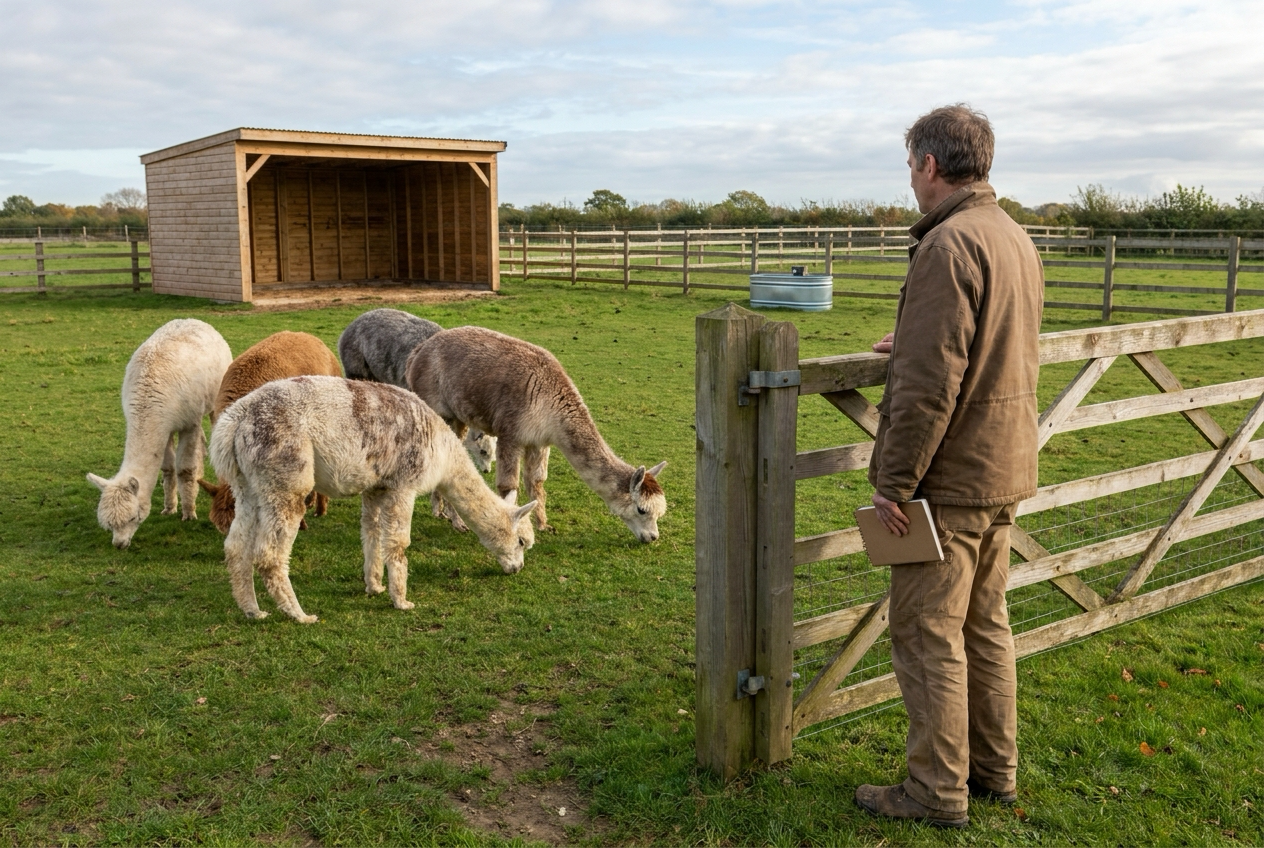
The behavior test (spit-off). After ovulation, the female forms a corpus luteum that produces progesterone, and a female under its influence aggressively refuses the male. Breeders call this a spit-off, because a female who refuses the male often spits at him. Merck says rejection of the male when he is reintroduced more than 15 days after breeding is an indication of pregnancy. Treat it as a first signal. It shows she has ovulated and is under progesterone, not that a healthy pregnancy is continuing, and Merck notes that a persistent corpus luteum causes most false positives on progesterone testing.
Blood progesterone. Your veterinarian can measure serum progesterone. It can confirm ovulation 6 to 9 days after mating and pregnancy more than 21 days after mating, per Merck.
Ultrasound. This is the confirmation most breeders rely on. Merck gives two figures for transrectal ultrasound: it can diagnose pregnancy from approximately 28 days, and a diagnosis is reasonably sure by day 21 once the embryo is seen. Transabdominal ultrasound through the skin can confirm pregnancy from 45 to 60 days after conception. Merck also notes that rectal palpation, which is practical in llamas after 45 days, is usually not safe in alpacas. A later scan to confirm the pregnancy is still viable is worth scheduling with your veterinarian.
Record every check with its date and result, including open (not pregnant) and uncertain results. A female who keeps accepting the male, or who spits off and then turns out open, is exactly the pattern a vet will ask about.
Gestation and the due date
Alpaca gestation averages about 11 months, but the published averages vary a little:
- Merck gives camelids about 342 days plus or minus 10, and says alpacas have a somewhat shorter gestation. Its reproductive parameters table lists 332 to 352 days.
- Rutgers gives an average of 335 days for alpacas and 350 days for llamas.
- The Creatures alpaca gestation calculator uses 345 days as its average and shows a window of 335 to 350 days after breeding. If you keep llamas too, the llama gestation calculator does the same job for them.
The practical answer is to treat the date as a window to watch, not an appointment. Merck says there are few reliable signs that delivery is near, so the window, a camera or regular checks, and the female’s own record from earlier pregnancies are what you have to plan with. That record only exists if you wrote it down last time. The help article on using the gestation calculator shows both the exact-date and exposure-window inputs.
Plan the herd’s preventive care before the due window, not during it. The Merck herd health chapter recommends that pregnant animals receive vaccine boosters 4 to 6 weeks before giving birth, so the cria gets antibodies through colostrum. Your veterinarian sets the actual products and timing for your farm.
Birth: what normal looks like and when to call
Alpacas tend to give birth in daylight. More than 70% of normal births happen in the morning, according to Merck, and the AABP Proceedings review of camelid dystocia (Tibary and colleagues, 2008) reports that in traditional South American herds most births fall between 7 am and 1 pm, while noting this is not always true in North American herds. An afternoon or evening of labor deserves closer attention than a morning one.
The same review lists signs of approaching birth: restlessness, separating from the group, frequent trips to the dung pile, alternating between standing and lying down, and sometimes going off feed. Stage one can go unrecognized. Labor then moves quickly.
| Stage one | Restless, isolating, frequent dung pile visits; typically 1 to 6 hours (Merck) |
|---|---|
| Stage two | Sac appears, then nose and front feet; delivery typically under 30 minutes (Merck) |
| Stage three | Placenta passes, usually within the first hour (AABP review); should be complete within 4 to 6 hours (Merck) |
| First-time mothers | All stages are usually longer (Merck) |
| Call now | Stage one past 6 hours, or no normal progress within 10 minutes after the sac breaks (AABP review) |
| Also call now | Rolling, kicking at the belly, heavy straining without progress, bloody or foul discharge |
Call a veterinarian now if labor stalls. The AABP review says dystocia should be suspected if the first stage of labor exceeds six hours or if the second stage does not progress normally within 10 minutes of the amniotic sac rupturing, and that abnormal bloody, purulent or smelly discharge in a female at term warrants immediate examination. It also flags excessive rolling, kicking at the belly and grunting as possible signs of a problem such as a twisted uterus. Merck calls dystocia uncommon, and the review puts it at 2 to 5% of births, but it can become critical quickly. Have the veterinarian’s daytime and after-hours numbers posted before the due window opens, and do not attempt internal examination or pulling unless your veterinarian has trained you for it.
Cria care in the first days
A cria is born small and wet but quick to get going. Its first day is the one that most needs a watcher and a notebook.
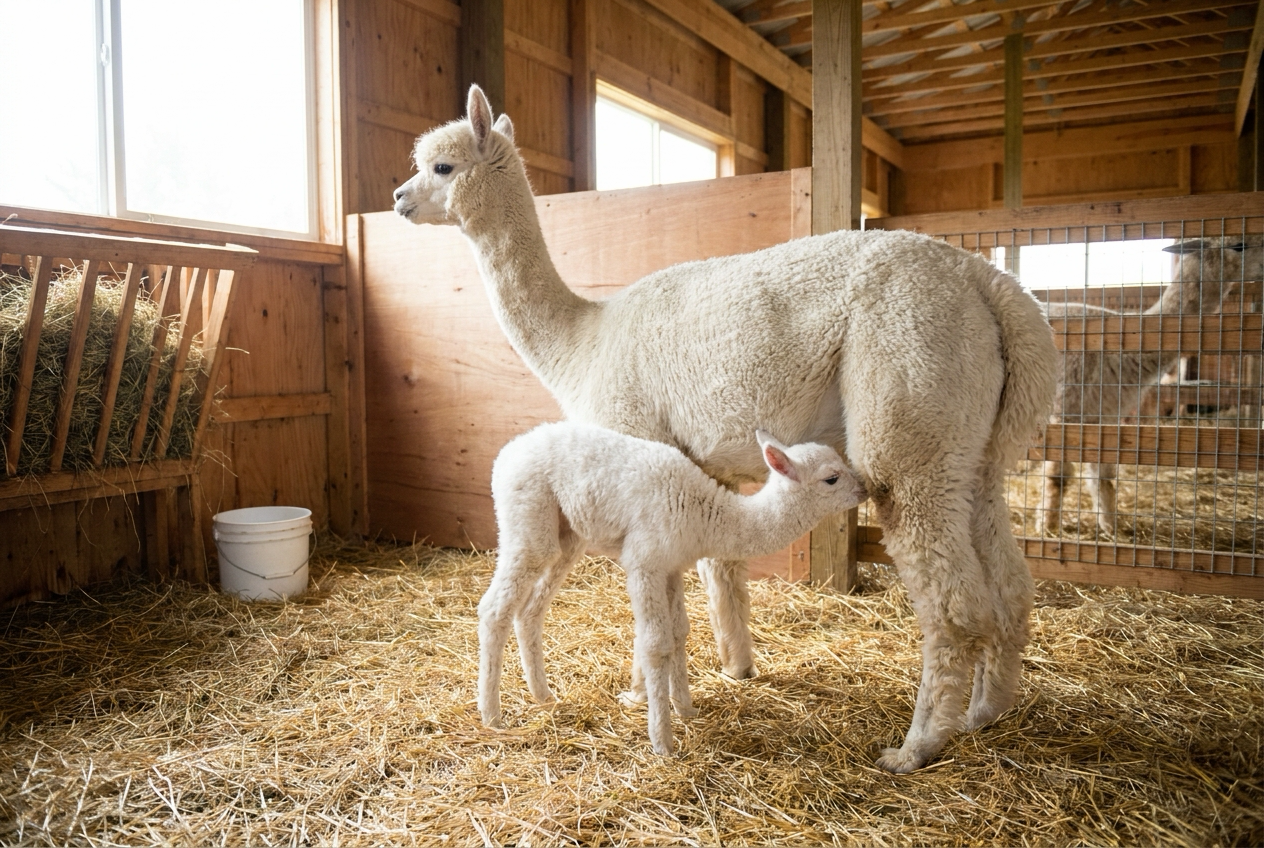
Standing and nursing. Merck’s herd health chapter says crias should be on their feet within 30 minutes and attempting to nurse within 30 minutes to an hour, then nurse in short bouts every 1 to 2 hours for the first few days. Rutgers says an alpaca cria is usually found nursing after the first hour. A cria that is not up and nursing in that window needs a veterinarian’s assessment, not a wait-and-see.
Colostrum and the IgG check. Crias rely on colostrum for their early antibodies. Under Merck’s guidance, newborns should take in 10 to 15% of their body weight in colostrum within 24 hours, ideally by 12 hours, and Merck advises testing for passive transfer of antibodies at 18 to 24 hours. A 2022 study of alpaca colostrum found its IgG concentration falls sharply over the first four days after birth, which is why the first day matters so much. Ask your veterinarian ahead of time how they want the passive-transfer test handled, and what the plan is if the result is low.
Birth weight. Sources vary here too. Rutgers gives 15 to 19 pounds for an alpaca cria; Merck’s reproduction chapter gives 5.5 to 8 kg (about 12 to 18 pounds), while its herd health chapter lists 7 to 11 kg. Weigh every cria at birth on a scale so you have your own figure.
Daily weights. Merck recommends weighing crias daily for the first month. It expects alpaca crias to gain about 100 to 250 grams a day after the first 24 hours and to roughly double their birth weight by one month. A cria that stalls or loses weight is often the first sign that something is wrong with nursing or health, so the weight chart is a health check, not just a growth record.
Weaning. Rutgers gives an average weaning age of 4 to 6 months for llama crias, with closer to six months best for dam and cria. Its fact sheet gives no separate alpaca figure, so set the weaning age with your veterinarian from the cria’s growth and the dam’s condition.
The dam. Note when the placenta passes, and watch her appetite and behavior. Most females can conceive again 14 to 21 days after delivery (Merck), so the next breeding decision arrives quickly. Whether she is ready depends on her condition and recovery, which is a conversation for you and your veterinarian.
Registering the cria
If your herd is registered with the Alpaca Owners Association (AOA), parentage is checked by DNA. AOA says an animal must be validated as the offspring of two AOA registered alpacas using DNA testing, and its registry and parent validation page recommends starting registration by two months of age. It says a certificate takes approximately 3 to 5 weeks once the application is complete, the blood card is in and the fee is paid. Check AOA’s current fee schedule and forms on its site before you submit, because fees change. If you still need a registered name, the free alpaca name generator is a quick way to build a shortlist that fits your farm prefix.
AOA also explains that it validates rather than verifies: a DNA test can show that a reported parent cannot be excluded, not prove it. A correct service date and sire in your breeding record is what lets that test pass the first time.
Keeping alpaca breeding records on Creatures
Creatures is the records layer for this whole cycle, from the mating to the cria’s weights. Here is what you enter and what you get back.
1. Record the mating. Add a breeding record (Breeding & Reproduction) to the female and choose Natural Mating. Pick the herdsire from your animals, or type his name if he belongs to another farm. For a hand mating, enter the date; for pen breeding, enter the first and last days of exposure so the window is honest. Turn on “Track due date and reminders” and Creatures projects the due date and window. The help article on recording a breeding walks through the fields.
2. Follow the pregnancy on the Breeding dashboard. Once a breeding is tracked, the Breeding dashboard shows who is due soon or overdue and lists projected reminders for the alpaca pregnancy checks: the spit-off behavior test and the transrectal and viability ultrasounds. The same reminders appear in Care. See the Breeding dashboard for the layout.
3. Log each check. Add a Pregnancy Check record with the date and the result (pregnant, open or not sure), or a Test Result for a lab progesterone report. The article on tracking pregnancy and progress shows how checks attach to the breeding.
4. Record the birth. “Record birth or hatch” logs the delivery and can create the cria’s own profile, linked to its dam. Recording births covers the outcome fields.
5. Set up the first-day and growth reminders. In Care, the curated “Alpaca cria passive-transfer check” starter puts an IgG test reminder on the cria at about a day old, and the breeding and reproductive care protocols article explains how starters work. Log daily weights as Physical Measurement records, or weigh several crias in one pass with group weighing. Your veterinarian still decides the actual test and any follow-up; a reminder only makes sure the day is not missed.
6. Keep the registry details and pedigree with the animal. A Registration record holds the registry (the Alpaca Owners Association is in the picker), registered name and number; the care, growth and identity records guide shows where it sits. Storing a registration number on Creatures never registers or certifies an animal; AOA’s DNA validation and certificate are the official record. The profile pedigree builds from recorded parents and shows an estimated inbreeding coefficient from the ancestry you have entered, and the free pedigree chart maker lays out a chart for a sale sheet without an account.
If your farm also hosts visitors who want to meet the crias, a bookable tour or visit can sit on the same farm profile; our guide to alpaca farm visits covers what visitors expect. And if you are still planning your first breeding females, how much an alpaca costs works through purchase price and the yearly upkeep of a breeding herd. More alpaca guides and tools are on the alpaca species page.
Frequently asked questions
What is a baby alpaca called?
A baby alpaca is called a cria, the same word used for a baby llama. The young are usually called crias until they are weaned, several months after birth.
How long is an alpaca pregnant?
About 11 months. Merck gives camelids 342 plus or minus 10 days and says alpacas run somewhat shorter; Rutgers gives an alpaca average of 335 days. The Creatures alpaca gestation calculator uses 345 days with a 335 to 350 day window.
Do alpacas go into heat?
Not in the usual sense. Alpacas are induced ovulators, so mating triggers ovulation about a day later. Receptivity is tested by introducing a male: a receptive female sits down in the breeding position.
What is a spit-off test?
It is a behavior test: the female is reintroduced to the male after breeding, and a female under the influence of progesterone refuses him, often spitting. Merck treats rejection more than 15 days after breeding as an indication of pregnancy. It does not confirm a continuing pregnancy, so follow it with ultrasound.
At what age can you breed an alpaca?
Sources differ. Merck says breeding is usually delayed until a female is over 24 months and 40 kg; Rutgers says not before 12 months and about 60% of adult weight. Males usually enter programs at 18 to 24 months and are fertile by about 30 months (Merck).
Can alpacas have twins?
Rarely. Live twin births are extremely uncommon, with most twin pregnancies lost early in gestation, according to Merck.
How soon can an alpaca be bred again after giving birth?
Most females can conceive within 14 to 21 days after delivery, per Merck. Whether a particular female should be rebred that soon depends on her condition and recovery; decide with your veterinarian.
Do this next on Creatures
Keep each female’s matings, checks and crias together, so next season starts from her real history.
- Add your alpaca’s profile for each breeding female and herdsire, with registry details and identifiers. Guest signup can start in this flow. How to add an animal shows the fields.
- Record a breeding with the mating date or exposure window and the sire, to get the due window and check reminders. This opens for visitors; a free account is needed to save it. How to add a record explains the next step.
- Create your farm’s profile so your herd, herdsires and crias sit under one public page. Getting listed in the breeder directory explains what appears.
- Browse the breeder directory to find alpaca farms and compare programs when you are looking for an outside herdsire or new females.
- Save an alpaca listing alert and get an email when new alpacas are listed, since availability changes. Saved searches and your watchlist explains how alerts work.
- Browse alpaca listings when you are ready to compare breeding stock that is for sale now.