






SFP Alice
No Buyer Fees
Cattle
$9,000

Pick the closest picture. Get your breed's color name, what to check, and words for your registration papers.
Updated · How it works and sources
Calculator methodsLoading color choices…
Reload the page or read about goats.
Your goat · See result ↓Choose the closest picture; it is an illustration, not proof of a genotype. Illustrations are not photos of DNA-tested goats; the closest picture is not proof of a goat's color.
Color illustration shown with natural horns. Horn status is entered separately.
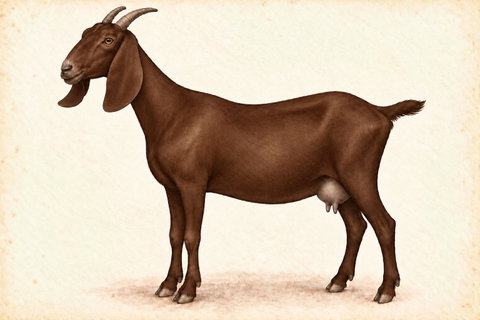
Closest picture, not proof: white can hide the belly, kids change color, and some names overlap.
A solid coat. Look for any tan before calling a goat black; brown coats have brown in place of black.
What to checkBreeders' name; which allele it is has not been tested.
With chamoisee, buckskin or cou clair, a Swiss partner adds pale trim (generally cream to tan) rather than replacing the partner's body pattern; a chamoisee Swiss reads as a chamoisee with light lower legs and light face stripes. Gold covers Swiss.
A gold can carry chocolate without showing it, and where a line's chocolate is recessive it can hide in black goats.
A kid's coat can change as it grows. Keep your own description and check the color again as an adult; ask your registry how to update its record.
Breeds and crosses can show colors not listed here: dominant black, Angora-type or breed-specific white, the Boer white body, other breed patterns.
Shown on a Nigerian Dwarf; your goat's build and colors may differ.
If "blue" means her eyes, pick her coat and add blue eyes.
The profile color suggestion is limited to 120 characters. These words are longer. Remove an extra or choose a shorter combination to use the prefilled suggestion. You can also open the ordinary edit or add form to choose your own wording. Nothing has been shortened.
Brown
Create a free Creatures account to save your goat color result and keep your animal records in one place.
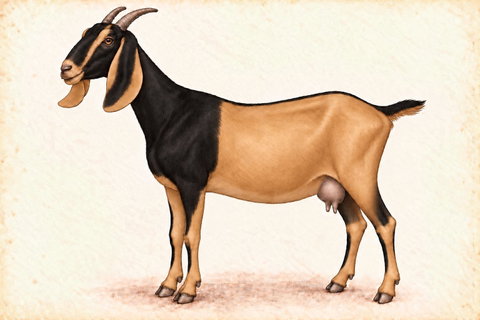
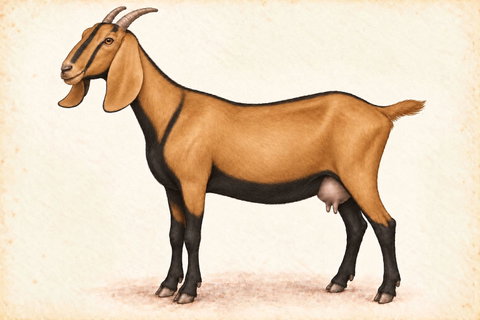
A buckskin usually has a light belly and light lower legs with dark marks down the front; a chamoisee usually has a dark belly and dark lower legs. White markings, chocolate, a coat that darkens with age, combination colors and lighting can hide the difference.
A very dark buckskin vs black: any tan, such as a lighter rump behind the dark cape, means a pattern goat, not black. The cape can darken over the first months; check again at about 6 months.
Cou clair vs buckskin: a light front with a black rear is cou clair; a dark front cape with a light rump is buckskin.
Combination looks: with chamoisee, buckskin or cou clair, a Swiss partner adds pale trim (generally cream to tan) rather than replacing the partner's body pattern; a chamoisee Swiss reads as a chamoisee with light lower legs and light face stripes. Gold covers Swiss.
A bezoar-looking Nigerian Dwarf: Closest: chamoisee buckskin (or buckskin). Bezoar itself has no ND records. Closest describes the look, not a measured likelihood.
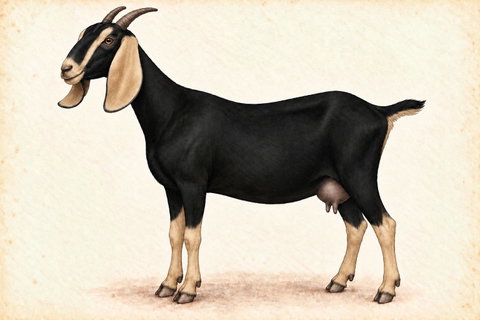
Swiss vs sundgau: check the belly first (dark = Swiss, pale = sundgau), then the muzzle (a Swiss has a light muzzle).
White patches can hide the belly and legs. Check the colored areas and keep Not sure when the feature is covered.
Moonspots can be darker or more strongly colored on kids and fade as they mature; on adults they can look like white spots, and tiny ones get missed. They are pale or tan, not white, and they don't show inside a white patch.
A buckskin's cape can darken over the first months; check again at about 6 months.
Chocolate on gold: chocolate doesn't show on a gold coat, except in any black shading, which turns brown; a gold hiding chocolate can show it through her kids. Black can fade toward brown with sun, age or nutrition. Chocolate can also be hard to recognize in a young kid: some are born nearly black and become clearly brown over the first months.
Eyes: marbled or partly blue eyes count as blue. A light gold-brown eye is still brown; some brown-coated goats have somewhat lighter eyes.
A young kid's eye color can still change; check again when the kid is older (breeders report).
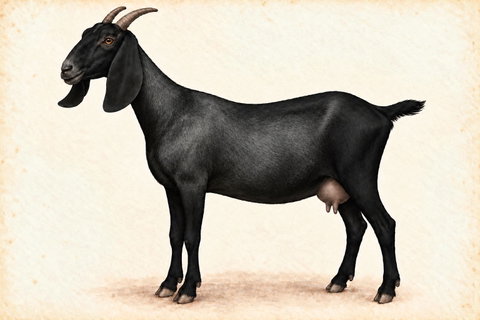
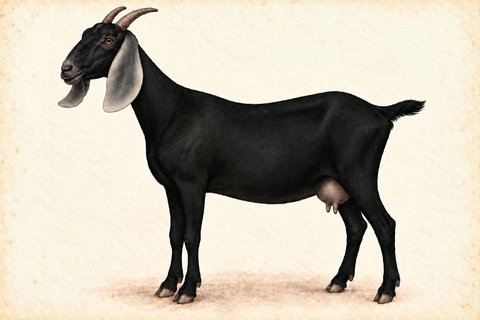
Roan: White hairs mixed through the coat. The amount varies a lot, and the face and lower legs usually have fewer.
Frosted: White hairs on the ears and muzzle.
Frosting can be a few easily missed hairs.
Heavy moonspots (breeders report): Many pale spots can make a coat look gray.
Gray Agouti pattern (other breeds): An even mix of dark and white hairs over the whole goat.
Silver (breeders' word): Some Nigerian Dwarf breeders call a silvery-gray coat "silver", and they describe it differently. Appearance alone doesn't show which of these, if any, a silver goat is, and we haven't found a study showing what causes it.
No. These are representative illustrations. White can hide the pattern, kids change color, and different inherited patterns can look similar. Keep Not sure when the feature is covered.
Use descriptive color and markings words rather than assuming a pattern name is accepted. The editable line counts every character conservatively against ADGA's 69 letters and spaces limit.
A dark cape can cover most of a buckskin's body. Look for any tan, such as a lighter rump, and use the what-to-check panel. White markings, age and lighting can hide useful features.
Breeders use silver for more than one gray look. Appearance alone does not establish its cause, so silver stays a described word without a gene assignment, odds or its own illustration.




