






Example pairings
A polled doe and a horned buck: what can their kids inherit?
Updated · How it works and sources
Assuming the polled doe is fertile, she has one polled copy. With a horned buck, half the kids are expected to be polled and none have polled intersex syndrome.
Their coat colors are worked out separately below. Horns drawn on a color illustration do not tell you either parent's horn genotype.
If the buck has one copy of polled, about 1 in 8 kids is expected to be an intersex goat: genetically female and infertile, and it can look like a doeling, a buckling or something in between. If he has two copies, about 1 in 4. If you don't know which he has, plan for 1 in 4. This assumes the polled doe is fertile (she has kidded, or a test shows one copy). Breeders usually pair a polled goat with a horned one: half the kids are polled (all of them if the polled buck has two copies), and none have polled intersex syndrome. A polled DNA test is offered in Europe (Giessen, Bern). Polled goats and sources
These colors assume this line's chocolate is dominant, neither parent carries dominant black or Angora white, and the recorded parentage is right. Parents are entered as horned with no moonspots unless the example says otherwise.
Guess first, then show the answer
Colors to expect
Chances per kid, assuming this line's chocolate is dominant · change
-
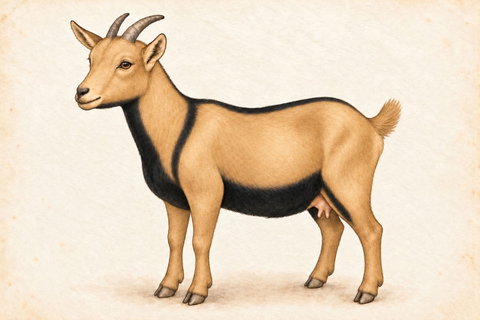 Chamoisee Swiss 25% (1 in 4) to 100% (1 in 1) Possible in every case
-
Other possible colors Colors a parent may hide up to 75% (3 in 4) Depends on hidden genes
- Chamoisee: up to 50% (1 in 2)
- Swiss: up to 50% (1 in 2)
- Black: up to 25% (1 in 4)
Color illustration shown with natural horns. Horn status is entered separately.
Another reading
Under the alternative tan-sides reading of breeders' buckskin, a chamoisee can hide buckskin. Neither reading has been DNA established for Nigerian Dwarfs.
-
Chamoisee Swiss 25% (1 in 4) to 100% (1 in 1) Possible in every case
-
Other possible colors Colors a parent may hide up to 75% (3 in 4) Depends on hidden genes
- Buckskin Swiss: up to 50% (1 in 2)
- Chamoisee: up to 50% (1 in 2)
- Swiss: up to 50% (1 in 2)
- Black: up to 25% (1 in 4)
- Buckskin: up to 25% (1 in 4)
Color illustration shown with natural horns. Horn status is entered separately.
Markings and traits
Polled · 50%
Scrapie susceptibility: one or both parents not tested; offspring odds are not calculated.
Alpha-S1 casein: one or both parents not tested; offspring odds are not calculated.
Congenital myotonia: one or both parents not tested; offspring odds are not calculated.
Assumptions and sources
- Assumes the polled doe is fertile (she has kidded, or a test shows one copy).
- A gold can carry chocolate without showing it; where a line's chocolate is recessive it can hide in black goats.
- No dominant black or Angora-type white is included in this lens.
- Sponenberg notes dominant black may occur in some African breeds; if so, a black relative may not mean 'hides black'.
Family answers that can narrow these odds
- Buck: Could this goat hide black?
- Doe: Could this goat hide black?
Answer these in the full calculator to see how the map changes.
What this tool covers
- Breed-aware Agouti patterns and brown pigment
- Ranges from unknown copies and deciding questions
- Polled intersex syndrome, tested traits and stated assumptions
Limits
- A color name is not a DNA result.
- A partial answer leaves unmodeled mechanisms uncalculated.
- Illustrations describe looks; they are not evidence of inheritance.





