






Example pairings
Will a moonspotted goat have moonspotted kids?
Updated · How it works and sources
If moonspots behave as one dominant gene and the other parent truly has none, a moonspotted parent gives a 50% to 100% chance per kid. This is a stated assumption from breeder and expert experience, not a mapped goat color gene.
Small moonspots fade and are easy to miss, especially in adults. The other parent's absence is an assumption you can change in the full calculator.
These colors assume this line's chocolate is dominant, neither parent carries dominant black or Angora white, and the recorded parentage is right. Parents are entered as horned with no moonspots unless the example says otherwise.
Guess first, then show the answer
Colors to expect
Chances per kid, assuming this line's chocolate is dominant · change
-
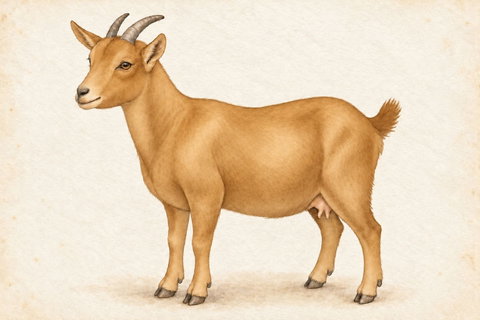 Gold 50% (1 in 2) to 100% (1 in 1) Possible in every case
-
Other possible colors Colors a parent may hide up to 50% (1 in 2) Depends on hidden genes
- Black: up to 50% (1 in 2)
- Buckskin: up to 50% (1 in 2)
- Chamoisee: up to 50% (1 in 2)
- Chocolate: up to 50% (1 in 2)
- Chocolate buckskin: up to 50% (1 in 2)
- Chocolate chamoisee: up to 50% (1 in 2)
Show all 10 colors
- Chocolate cou clair: up to 50% (1 in 2)
- Chocolate Swiss: up to 50% (1 in 2)
- Cou clair: up to 50% (1 in 2)
- Swiss: up to 50% (1 in 2)
Color illustration shown with natural horns. Horn status is entered separately.
Markings and traits
Moonspots · 50% to 100%
Polled · 0%
Scrapie susceptibility: one or both parents not tested; offspring odds are not calculated.
Alpha-S1 casein: one or both parents not tested; offspring odds are not calculated.
Congenital myotonia: one or both parents not tested; offspring odds are not calculated.
Assumptions and sources
- Moonspots are assumed dominant from breeder and expert experience, not published segregation counts; they may be missed.
- A gold can carry chocolate without showing it; where a line's chocolate is recessive it can hide in black goats.
- No dominant black or Angora-type white is included in this lens.
- Sponenberg notes dominant black may occur in some African breeds; if so, a black relative may not mean 'hides black'.
- This assumes the other parent doesn't carry it; change the other parent's entry if that is uncertain.
Family answers that can narrow these odds
- Doe: Could this goat hide black?
- Doe: Could this goat hide buckskin?
- Doe: Could this goat hide chamoisee?
- Doe: Could this goat hide Swiss?
- Doe: Could this goat hide cou clair or cou blanc?
- Doe: Does this goat have two copies of this line's chocolate form?
Answer these in the full calculator to see how the map changes.
What this tool covers
- Breed-aware Agouti patterns and brown pigment
- Ranges from unknown copies and deciding questions
- Polled intersex syndrome, tested traits and stated assumptions
Limits
- A color name is not a DNA result.
- A partial answer leaves unmodeled mechanisms uncalculated.
- Illustrations describe looks; they are not evidence of inheritance.





