






Louie
Cattle
$2,100

Choose the jack and jenny. See every foal color they could produce, and what would narrow the odds.
Updated · How it works and sources
Map ready: 4 colors
Chance per conception. Ranges cover every compatible genotype, with no hidden-carrier frequency assumed.
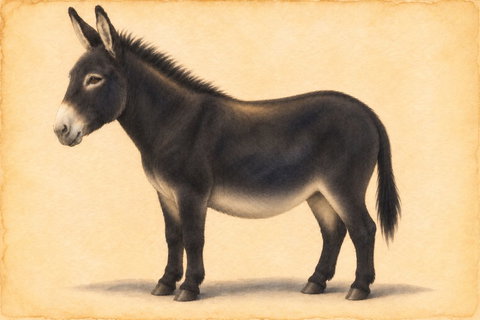 Dark (black or brown) 37.5% (3 in 8) Exact chance
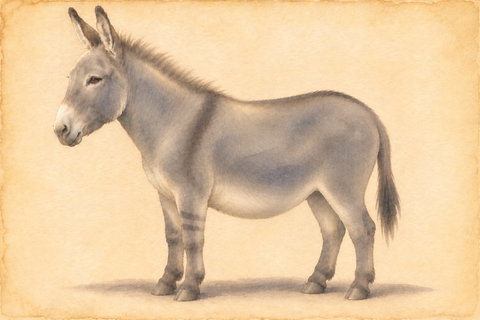 Gray-dun 37.5% (3 in 8) Exact chance
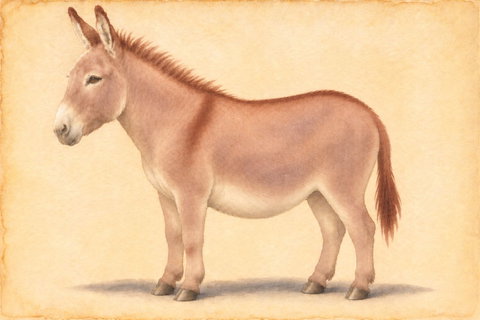 Rose dun 12.5% (1 in 8) Exact chance
NLP may or may not show on red; the color name does not claim it is absent.
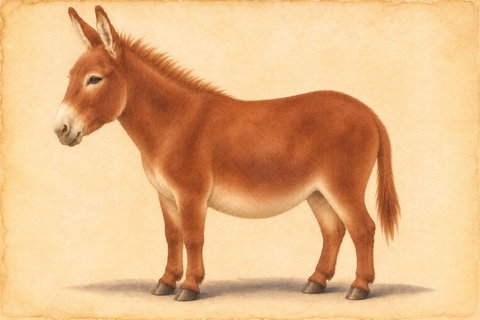 Sorrel 12.5% (1 in 8) Exact chance
NLP may or may not show on red; the color name does not claim it is absent.
A representative watercolor appearance; the dark result includes black or brown. Markings can vary.
Long Hair: test both parents to calculate Poitou FGF5 hair-length outcomes.
The chance applies under the entered family answers and assumptions. Open the methods and sources to see how the color names are mapped.
The chance applies under the entered family answers and assumptions. Open the methods and sources to see how the color names are mapped.
NLP may or may not show on red; the color name does not claim it is absent.
NLP may or may not show on red; the color name does not claim it is absent.
Each range spans every parental genotype that fits your choices. It does not guess hidden carrier frequencies. A family record can prove a copy; no foal of a color so far proves nothing.
Choose a look for each parent or use your recorded donkeys. See exact chances when the copies are known, or ranges across every compatible genotype. Family facts and donkey-specific lab results can narrow the answer.
Yes. If both carry red and non-dun, the chance is 1 in 16 per conception.
No. The cause of brown is not identified, so the prediction names the combined dark (black or brown) look.
Common colors include gray, black, red (sometimes called sorrel), brown, and ivory, plus spotted patterns that sit on top of a base color. Gray-dun is the ancestral dun color. Many donkeys have light points around the eyes, muzzle and belly. The cross can also show on a non-dun donkey.
No. Red is recessive, so a red donkey carries two red alleles and can only pass red on, meaning two red parents produce a red foal. The opposite catches people out: two dark parents can each carry a hidden red allele and produce a red foal.
American ivory is a cream or white coat with blue eyes and pink skin. Its gene is unidentified. The calculator models American ivory as recessive only when ivory is in the family, using breeder records rather than a DNA result. It is different from frosted spotted white, which usually has dark eyes and skin spots, and from tested KIT dominant white. UC Davis has no ivory test.
UC Davis offers donkey Red Factor (Ed/ed), No Light Points (N/NLP), and Dominant White and White Spotting tests. Its Poitou Long Hair test covers two FGF5 variants. These tests identify the variants they cover. Dun, brown, roan and American ivory have no test in that menu, so keep the family’s colors alongside any report.



