






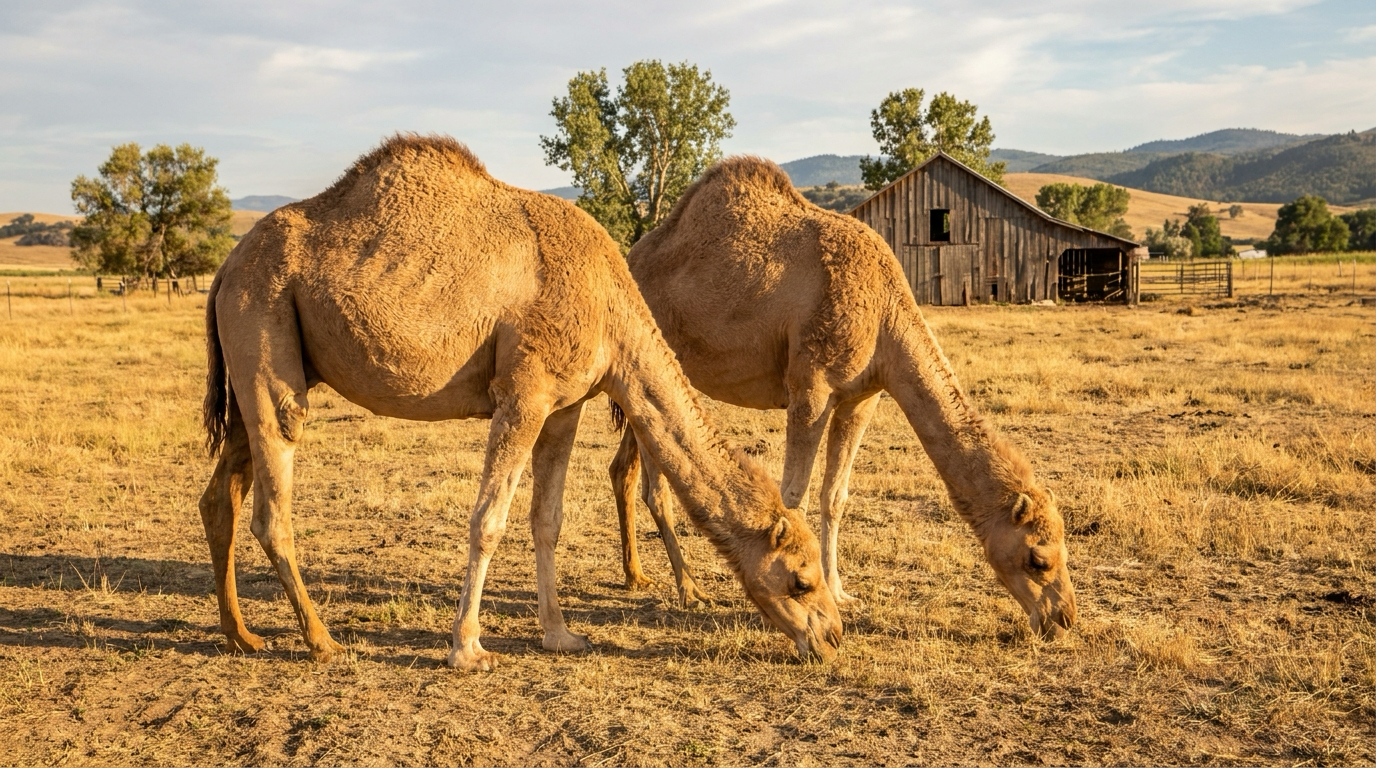
How Much Does a Camel Cost? Dated Prices, Hay, Yards and Lifetime Budget
Author: Elliott Garber, DVM · Published
There is no published price list for camels in the United States, so any single number you read is a guess. What the public record does show is this: the top price at a Kansas alternative-animal auction reported in 2020 was $8,000 for a female camel, a North Carolina breeder of rare white camels told a farm magazine in 2007 that its dromedaries could cost up to $25,000 and its Bactrians up to $50,000, and camels can sell for a small fraction of that elsewhere (the July 2022 online dispersal of a former camel dairy herd in Australia averaged A$249 a head). Put simply, the US records from 1981 to 2020 run from about $4,000 to $8,000 paid at auction, with one breeder’s asks reaching $25,000 for white dromedaries. At the other extreme, a single female calf from a prized bloodline sold for Dh500,000 at an Abu Dhabi auction in September 2025.
The camel is rarely the hardest cost to plan. Camels are social, so the realistic purchase is two. A 1,000 pound camel eats around $450 to $680 of hay a year at August 2026 US prices, needs 8 to 10.5 gallons of water a day, and wants tall, solid handling yards, dry ground and shade, for a life that commonly runs close to two decades. Federal law adds a licensing layer for anyone who sells camels as pets or shows them to the public.
Creatures has no camel listings today and only a handful of camel breeders in its directory, so the useful first step is a free dromedary camel listing alert that emails you when one is posted. Care, temperament and owner profiles live on the Creatures dromedary camel page. Below is each number, where it comes from, and what it leaves out.
| US auction price on record | $8,000 for a female camel, the top price at a Kansas sale barn’s exotic sales (FARM SHOW, 2020) |
|---|---|
| US breeder asking prices | Up to $25,000 for a dromedary and $50,000 for a Bactrian, asked by one North Carolina breeder of rare white camels (FARM SHOW, 2007) |
| Australian camel dairy dispersal | Average A$249 a head, top A$790 (online sale, July 2022) |
| World live camel trade | Around US$400 a head on average (Meat and Livestock Australia, 2014) |
| Elite Gulf racing lines | Dh500,000 for one female calf (Abu Dhabi, September 2025) |
| How many to buy | Two: camels need the company of other camels |
| Hay for one adult | About $450 to $680 a year at the August 2026 US all-hay price of $190 a ton |
| Water | 30 to 40 liters (about 8 to 10.5 gallons) a day per camel |
| Lifespan | Median 17.8 years (San Diego Zoo Wildlife Alliance) |
How much does a camel cost to buy?
Camel prices are not tracked the way hay prices are. USDA publishes a national hay price every month, but no public series follows camel sales, and the Creatures Livestock Value Calculator, which builds ranges from recorded auction sales, does not cover camels: its species list runs from cattle and horses to sheep, goats and alpacas. So the honest way to answer the question is to lay out the dated prices that are on the public record, say who reported each one, and explain why they disagree so sharply.
What US sales records show
The most recent US auction figure we found comes from a 2020 FARM SHOW magazine report on the Clay Center Livestock Sale Barn in Kansas, which had added alternative-animal auctions three years earlier. Co-owner Mitch Langvardt told the magazine that a female camel brought $8,000, the highest price the sale had seen, while a bottle-fed miniature donkey sold for $4,000. That is one animal at one sale, not a market average, but it is a real hammer price with a date and a named source.
Older reports show how long camels have commanded serious money in the US. A 1981 FARM SHOW story recorded a six-month-old camel calf selling for $4,000 at an exotic animal sale near Cape Girardeau, Missouri, and noted that the family it profiled had paid $1,500 for their camel two years before. In a 2007 FARM SHOW profile, Larry Seibel of Ferncroft Farms in Wake Forest, North Carolina, said that because white camels are rare they are expensive: his dromedaries could cost up to $25,000 depending on age and how white they are, and his Bactrians up to $50,000. Those are one breeder’s asking ceilings for rare white animals, not typical prices. His customers were breeders, theater groups and businesses offering camel rides.
Read together, these figures say US camels have sold in the thousands to tens of thousands of dollars for decades, with the top of that range reserved for rare colors such as white and for animals with a job. None of them is a 2026 price. Any asking price you see today is one seller’s number, and the best way to judge it is against what the camel is for and what you know about its health and handling.
Prices outside the US
Outside the US the same animal can sell for far less. In July 2022 a herd of more than 240 camels that had been part of a camel dairy operation was sold online from Rutherglen, Victoria, under the direction of an American investor. On July 12 and 13 the sale cleared 162 head under the hammer at an average of A$249 and a top of A$790, according to Stock and Land. A 2014 report for Meat and Livestock Australia put world trade in live camels at 200,000 to 300,000 head a year at average prices around US$400 a head, mostly between Middle Eastern and North African countries. The same report estimated that supplying an Australian camel for export cost US$1,000 to US$1,500 a head, and named the US camel milking sector as a possible small market of about 50 head a year if a supply chain could be set up.
Cheap camels overseas do not make cheap camels in the US. Export camels have to be tested before quarantine, and the 2014 report’s own numbers show the cost of supplying one from Australia running several times the world average price.
At the very top, prized Gulf bloodlines sell for far more. At the Abu Dhabi International Hunting and Equestrian Exhibition in September 2025, a female calf from a celebrated bloodline sold for Dh500,000 after a bidding war, and 15 camels at that auction brought Dh1.77 million in total, the Khaleej Times reported. Those prices have nothing to do with a pasture camel in Texas, but they explain the eye-catching headlines.
Dromedary or Bactrian
Almost every camel you will be offered is one of two domestic species. The dromedary has one hump and the Bactrian camel has two. San Diego Zoo Wildlife Alliance’s camel fact sheet gives dromedaries at 5.9 to 6.6 feet tall at the shoulder and 880 to 1,320 pounds when grown, and Bactrians at 5.2 to 5.9 feet and 990 to 1,100 pounds. It also notes that about 90 percent of the world’s camels are dromedaries.
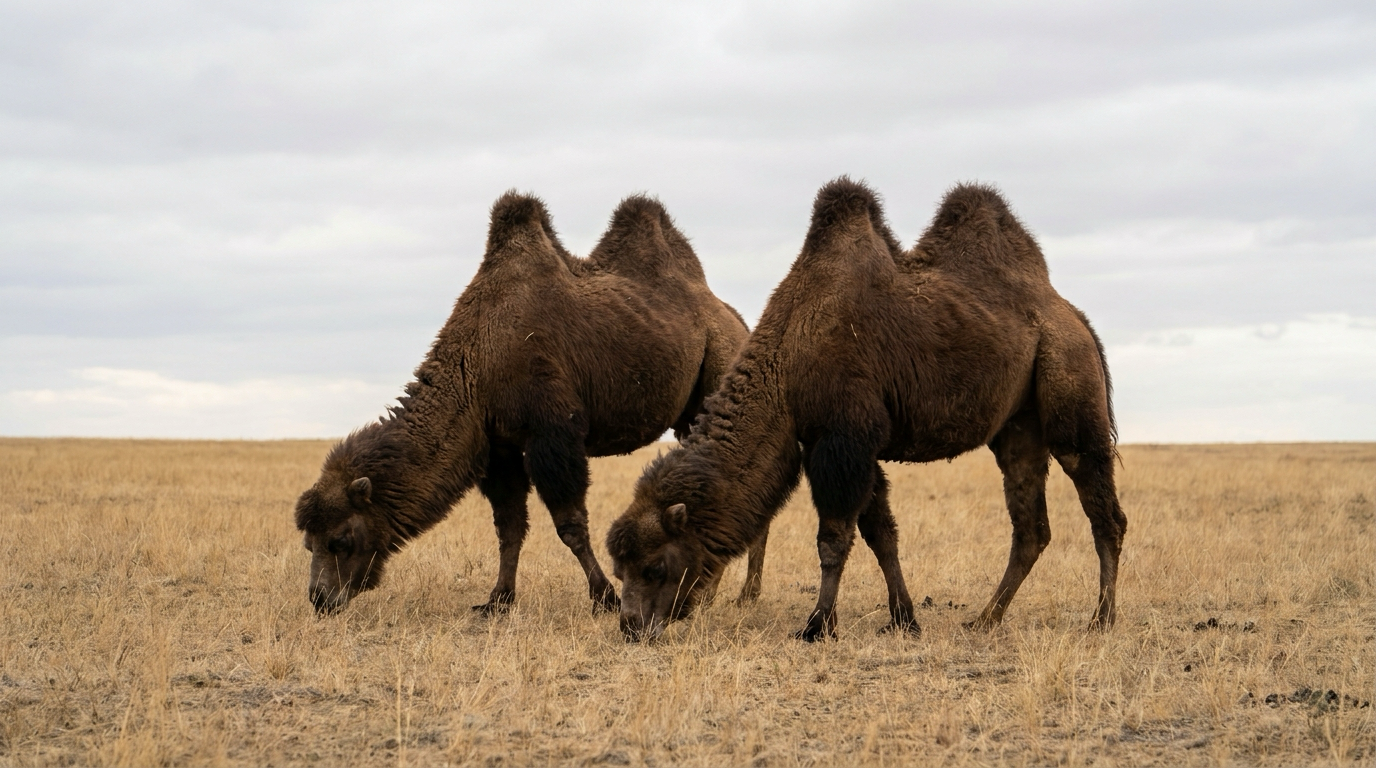
Bactrians are the rarer of the two worldwide, but we found no dated US sales that show what, if anything, they add to the price: the one breeder quote above was for rare white camels. The wild two-humped camel is a different matter: the San Diego Zoo describes wild Bactrian camels as at critical risk, and a domestic Bactrian sold as a farm animal is not one of them.
What moves the price
Four things explain most of the gap between a few thousand dollars and a five-figure camel:
- Sex and breeding use. Females that can produce calves tend to carry the most value in a breeding or dairy herd. Camels mature slowly (females at about 3 years and males at 5 to 7, per San Diego Zoo) and carry a calf for 12 to 14 months, so a proven breeding female represents years of the seller’s feed and time.
- Training and handling. A camel that leads on a halter, stands quietly for the vet, loads into a trailer and accepts a saddle is worth more to a ride or exhibition business than an untouched animal of the same age, and it is safer for a first-time owner.
- Color and type. White and unusual colors draw a premium, as the North Carolina breeder described in 2007.
- Who is selling and where. A dispersal at a sale barn, a breeder selling young stock, and a dairy selling a cow out of milk are three different markets, and moving a camel across several states adds trucking and health-paperwork costs to whichever price you pay.
Setup cost: what has to exist before the trailer arrives
No public source puts a dollar figure on a camel setup, and the honest reason is that it depends almost entirely on what you already have. A farm with sound cattle or horse yards, a run-in shed and good pasture may need modest changes. A bare lot needs everything. What can be sourced is the list of things a camel requires, which you can then price for your own property.
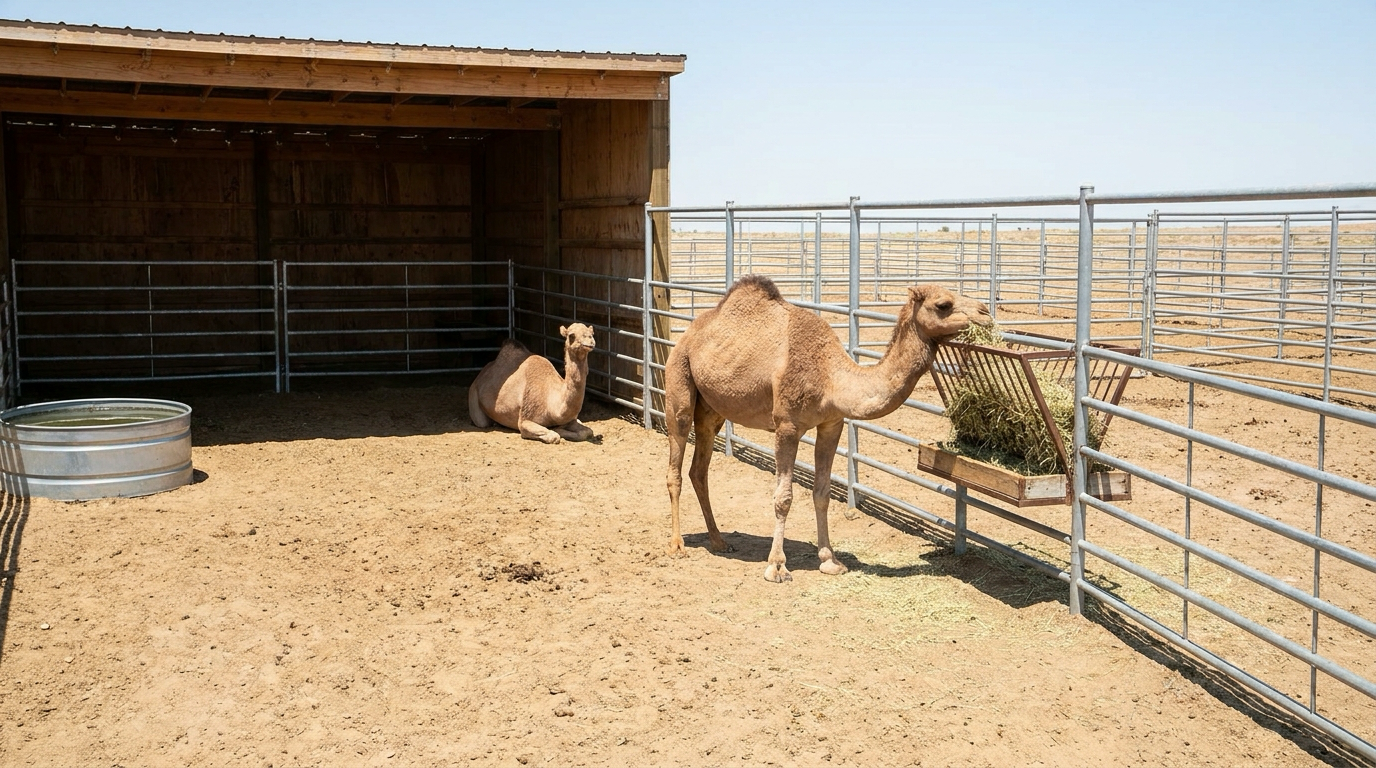
The best single source we found is Australia’s Model Code of Practice for the Welfare of Animals: The Camel (SCARM Report 61), written for a country that manages camels at scale. Its requirements translate directly into setup costs:
- A companion camel. The code lists social contact with other camels, with enough room to stand, walk freely, lie down and get away from an aggressor, among the basic welfare requirements. For most buyers that turns the purchase price into two purchase prices. The exception the code makes is for bulls, covered below.
- Handling yards built higher than for cattle. The code says cattle yards can be used for camels with a few changes: race walls raised to 1.8 meters (about 6 feet), and bows over the race and gate slides raised to 2.4 meters (about 8 feet). Holding yards must have no protruding objects, must let every animal lie down, and must allow exercise if camels are held longer than a day.
- Dry ground. Camels need yards that are not wet or boggy, and the code calls a raised mound of sand essential where yards get wet. It also warns against keeping camels for long on hard, abrasive surfaces that can damage their foot pads.
- Shade and shelter. Protection from sun and rain is essential in hot climates, and although camels handle cold once acclimatized and grown into their winter coat, the code requires a dry shelter they can escape into.
- Feeders off the ground and a reliable water supply. The code recommends feeding in troughs raised off the ground, which cuts waste, keeps camels from eating dirt or sand, and reduces the spread of intestinal parasites.
Pasture and perimeter fencing, a trailer big enough for an animal over six feet tall at the shoulder, and a catch area where a vet can work safely are the other large lines. Get local quotes for each before you commit to a camel, because together they can easily exceed the animal’s price.
Ongoing monthly and yearly costs
Hay and feed
Camels eat less for their size than cattle, a point the authors of one feeding study make citing earlier work. In that 2019 study of six lactating dromedaries weighing about 920 to 980 pounds, published in Tropical Animal Health and Production, dry matter intake ranged from 1.30 to 1.96 pounds per 100 pounds of body weight per day. For a 1,000-pound camel that is roughly 13 to 20 pounds of dry matter a day, or about 2.4 to 3.6 tons a year.
USDA’s Agricultural Prices report released September 29, 2026 put the August 2026 US price received for all baled hay at $190 a ton, up $29 from a year earlier. At that price, 2.4 to 3.6 tons comes to about $450 to $680 a year for one camel. Treat that as a floor rather than a quote: baled hay carries some moisture, some gets wasted, and the farmer’s price received is lower than what you pay delivered. Where you live matters as much as the camel. In the same report, August all-hay prices ran from $89 a ton in North Dakota to $275 in New Mexico, which puts the same camel’s hay at roughly $660 to $990 a year in New Mexico.
The Australian welfare code describes the same need in farm terms: camels fed in yards need a high-bulk diet of about a third of a bale of hay per camel per day, with any pellets or supplements introduced gradually, and fresh green feed such as cut alfalfa introduced slowly to avoid bloat. It also calls coarse salt or soft salt blocks essential for camels on fed diets, a small but permanent line in the budget.
Water
The code puts an average-sized camel’s needs at 30 to 40 liters of clean water a day, about 8 to 10.5 gallons, and says limiting water without a specific reason is unacceptable. San Diego Zoo notes that a camel can drink up to 32 gallons at one session. In practice that means a large trough on a reliable supply, plus a way to keep it from freezing in a northern winter.
Vet care, feet and handling
No public fee schedule covers camel vet care, so this line has to stay qualitative. Camels are large, strong and unfamiliar to many livestock practices, so find a veterinarian who will work on camelids before you buy, ask what they charge for a farm call and a routine visit, and plan a reserve for an emergency in an animal this size. Decisions about vaccines, parasite control and treatment belong to that vet. The welfare code also flags foot pads and the kneeling pads camels rest on as areas to watch, which is one more reason the yard surface matters.
The costs that define ownership
Three things decide whether a camel is a realistic animal for you, and none of them shows up on the purchase price.
Space and companionship. A lone camel is a welfare problem under the Australian code, so the true entry cost is two animals, two shares of hay and water, and yards big enough for both to lie down and move apart.
Bulls and the rut. An intact male is a different purchase from a female or a castrated male. The welfare code warns that bulls in rut have no fear and are a particular danger to other camels and to people, should be held away from other camels while in rut, and, unless they are part of a breeding herd, should be kept apart from other camels altogether. A 2018 case series from northwestern Nigeria describes camels as usually calm but aggressive and difficult to handle in the rutting season, with bites to the head, face and arms among the injuries it describes. If you are not set up to manage a breeding bull safely, do not buy one.
Time. San Diego Zoo gives a median life expectancy of 17.8 years, and the North Carolina breeder in the 2007 FARM SHOW profile put captive camels at up to 40 years. Either way, a camel bought young is a commitment measured in decades, not seasons.
What a camel really costs over its life
Because there is no sourced setup figure and no camel vet fee schedule, a full lifetime total would be invented precision. The parts that can be sourced still make the point. Over a 17.8-year median life, hay alone at the August 2026 national price comes to roughly $8,000 to $12,100 for one camel, or about $16,000 to $24,200 for the pair the welfare code calls for, before salt, supplements, water, bedding, trailer, fencing, vet care or any change in hay prices. Add two purchase prices that, on the US evidence above, can run from several thousand dollars each into five figures.
In other words, the camel is a large one-time cost, and the hay, yards and companion are larger ones that never stop. Budget for the second group first.
Is it legal to own a camel?
Often, but it depends on what you do with the camel and where you live. Under the federal Animal Welfare Act, USDA’s licensing guide names the camel as an exotic animal: anyone who sells even one camel for a regulated purpose, such as exhibition or the pet trade, must be licensed as a dealer, while sales solely for breeding or agricultural use, such as improving food and fiber, do not need a license. The same guide exempts a traditional nativity scene with a camel among farm animals, but says that anyone offering camel rides at carnivals or exhibiting camels alongside farm animals for nonagricultural purposes must be licensed. If you plan to sell, give rides or display your camels to the public, check with USDA APHIS first.
State and local rules sit on top of that. They differ from place to place, counties and cities may zone large or exotic animals out entirely, and moving a camel across state lines brings its own health paperwork. Before you put down a deposit, ask your state department of agriculture or state veterinarian and your local zoning office. This is general information, not legal advice.
Buying well
- Price the yards, shelter and second camel first. If those do not fit the budget, no camel price will.
- Ask what the camel has been trained to do. Leading, tying, standing for the vet and loading are worth paying for, and a seller should be willing to show each one.
- Ask about sex and breeding status in writing. Know whether you are buying a female, a castrated male or an intact bull, and what that means for your facilities.
- Ask for health records and the seller’s vet. A seller who can name the camel’s veterinarian and show its records is easier to trust than one who cannot.
- Check licensing if the seller is selling for pets or exhibition. Under the Animal Welfare Act, a camel dealer selling for those purposes needs a USDA license, so ask to see it.
- See the camel at home if you can. How the seller’s other camels look, how they are fed and how they handle tells you more than a photo.
Once a camel is home, record its purchase price, health history and weights from day one, and if it still needs a name, the free camel name generator has more than 70 ideas to start from.
If you are comparing camels with smaller camelids, the alpaca cost guide and llama cost guide work through the same herd math at a much lower price, and the emu cost guide covers another large exotic where fencing outweighs the purchase price. For other unusual livestock budgets, see how much a miniature horse costs and how much a mini cow costs.
Frequently asked questions
How much does a camel cost in the US?
There is no current US price index. The dated public records we found range from a $4,000 calf at a Missouri exotic sale in 1981, to a breeder of rare white camels asking up to $25,000 for a dromedary and $50,000 for a Bactrian in 2007, to an $8,000 top price for a female camel at a Kansas sale barn reported in 2020. Expect thousands of dollars, and judge any asking price against the camel’s sex, training and health.
Why did camels sell so cheaply in Australia?
One sale cannot explain a market, but the pattern fits the wider evidence: Meat and Livestock Australia put average world live camel trade prices around US$400 a head in 2014, and even the online dispersal of a former camel dairy herd in July 2022 averaged A$249 a head. Export testing, quarantine and long-distance transport would add far more than that to any camel shipped from there.
Is a Bactrian camel more expensive than a dromedary?
There is no dated US sales evidence that settles it. About 90 percent of the world’s camels are dromedaries, so Bactrians are the rarer animal, but the only breeder quote we found (2007) came from a seller of rare white camels, and its asking ceilings ($25,000 dromedary, $50,000 Bactrian) are one seller’s numbers, not a species premium.
Can you keep just one camel?
Not well. Australia’s camel welfare code lists social contact with other camels as a basic welfare requirement, so plan and budget for at least two, unless you are housing a breeding bull, which the code says should be kept apart.
How much does it cost to feed a camel?
Roughly $450 to $680 a year in hay for one 1,000-pound camel at the August 2026 US average price of $190 a ton, before waste, delivery, salt and supplements. In high-price states the same camel can cost close to $1,000 a year in hay.
Do this next on Creatures
Whether you are still pricing your first pair of camels or already buying their hay, Creatures keeps the search, the records and the reminders for each animal in one place.
Get alerted when a camel is listed. Creatures has no camel listings right now, so an alert is the way to hear about the next one. Set a free dromedary camel listing alert and Creatures emails you when one is posted. No account needed to start. See saving searches and using your watchlist for how alerts work, and making an offer on a listing for what to do when one appears.
Check the directory and marketplace. The dromedary camel breeder directory lists the camel breeders and farms on Creatures, and the full Creatures breeder directory filters every species by state. The dromedary camel marketplace and Bactrian camel marketplace show any current listings.
Add your camel. Already have one, or about to? Create a free camel profile to hold its birth date, sex, parents, photos and purchase history. No account needed to start, and the walkthrough is in adding an animal to Creatures.
Track weights and vet visits. Add a record for each weigh-in, vet visit or health check, and set reminders so Creatures tells you before the next one is due. The record sheet opens for any visitor to look around, and a free account saves what you enter. See adding a record, health and medical records and reminders and upcoming care.
Breed or sell camels? Only a few camel breeders are listed, so a profile stands out to buyers searching for one. Create a free breeder or farm profile. No account needed to start, and getting listed in the breeder directory explains how listings work.




