






Louie
Cattle
$2,100

Start with the grown, freshly shed coat in daylight. Compare the muzzle, eye rims and hooves as well as the hair. A picture helps name an appearance; a test or family record establishes inherited copies.
Planning a pairing? Try the Highland Cow Color Calculator or read how it works.
Sign in to suggest color words for your cattle.
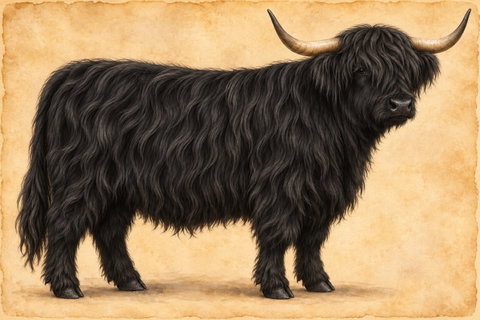
Inherited copies · At least one dominant-black copy (ED), with no Highland dilution copies. The other MC1R copy stays open.
What to check · Look for a black grown coat with dark muzzle and hooves. Red tips on a calf or an old coat do not establish a red-base genotype.
Registry words · Black · AHCA: Colors in Highland Cattle
Save this color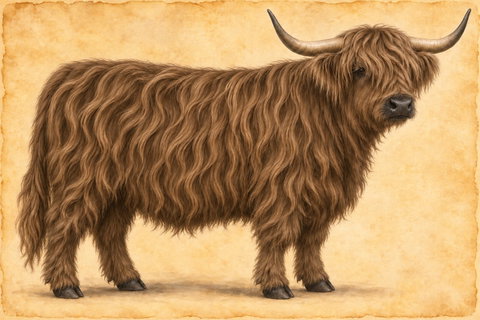
Inherited copies · A black base with one Highland dilution copy (Dh). This is different from recessive Dexter dun.
What to check · Compare the warm brown coat with the dark muzzle and hooves. A young dun calf can look red or steel gray; check again as its grown coat develops.
Registry words · Dun · UC Davis VGL: cattle PMEL17 dilution
Save this color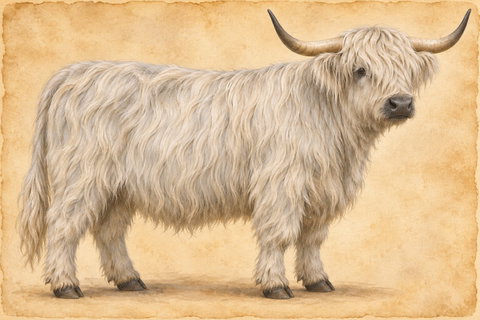
Inherited copies · A black base with two Highland dilution copies (Dh/Dh). The hidden MC1R copy is not fixed by the coat.
What to check · The hair is pale, but the muzzle, eye rims and hooves keep dark pigment. Use those landmarks to distinguish silver from white.
Registry words · Silver; silver dun · UC Davis VGL: cattle PMEL17 dilution
Save this color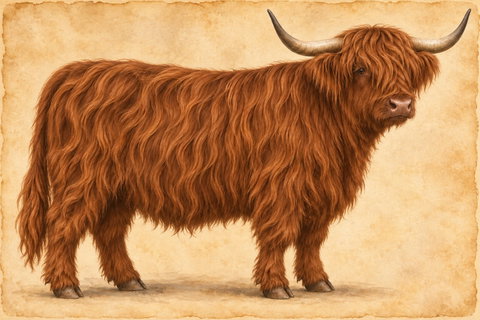
Inherited copies · No dominant-black copy and no Highland dilution copies. A red Highland can be e/e, E+/e or E+/E+.
What to check · Compare the red grown coat and muzzle with the yellow and dun examples. Red alone does not say whether wild type E+ or recessive red e was inherited.
Registry words · Red · UC Davis VGL: cattle MC1R
Save this color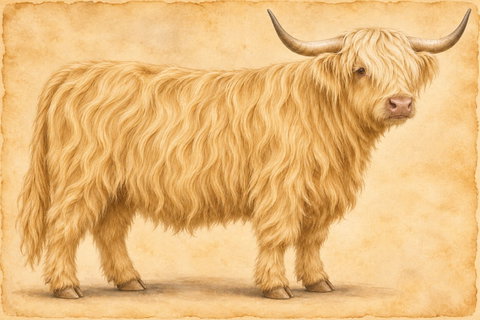
Inherited copies · A red-family base with one Highland dilution copy (Dh). Hidden E+ and e copies stay open.
What to check · Look for golden or pale red hair and a pale muzzle. Check faint darker hairs separately before using the yellow brindle wording.
Registry words · Yellow · UC Davis VGL: cattle PMEL17 dilution
Save this color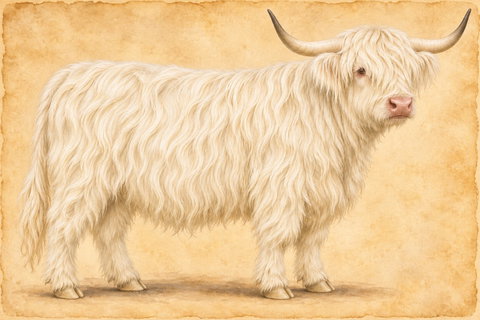
Inherited copies · A red-family base with two Highland dilution copies (Dh/Dh). A white body in a park-pattern cross does not establish this genotype.
What to check · Compare the pink muzzle and eye skin and pale hooves with the dark pigment of silver. If the nose pigment is unclear, keep white or silver open.
Registry words · White; cream where that is the registry wording · UC Davis VGL: cattle PMEL17 dilution
Save this color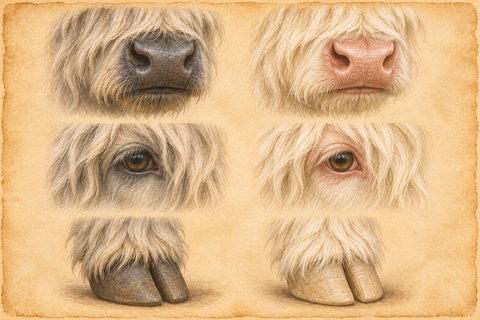
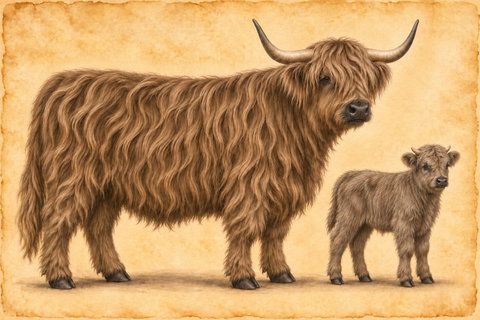
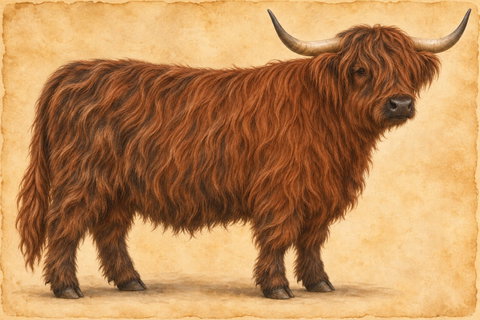
Inherited copies · At least one wild type E+ copy, no dominant-black ED, and no Highland dilution for this red example. Those copies permit brindle but do not guarantee visible stripes.
What to check · Look for fine, irregular dark hairs through a red-brown coat. Brindle is not present at birth, and a long winter coat can hide much of the pattern.
Registry words · Brindle; red brindle · AHCA: Colors in Highland Cattle
Save this color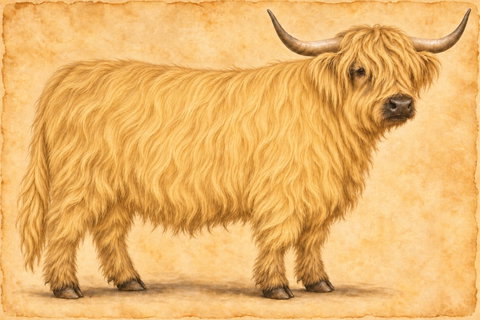
Inherited copies · A brindle-compatible red-family base with one Highland dilution copy. The dark hairs are diluted too.
What to check · Compare the lower legs and hindquarter with plain yellow in the freshly shed coat.
Registry words · Yellow brindle · AHCA: Colors in Highland Cattle
Save this color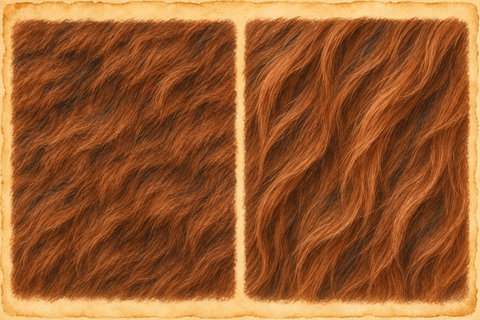
Park-copy inheritance changes the white pattern; the point color has its own base and dilution. Two park copies may leave very little point color, but do not guarantee an almost-white coat. The plates show color on a Highland body and imply no crossbred body type or horn status.
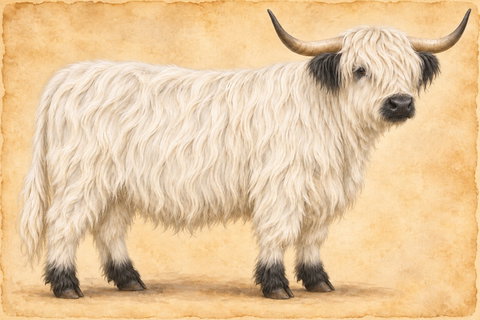
Inherited copies · A park-pattern copy or copies, with a black base and no Highland dilution. One or two park copies cannot be determined just from marking extent.
What to check · Check the ears, muzzle, eye rims and lower legs for black pigment. The white body does not establish the underlying red/black result.
Registry words · White with black points · Brenig et al.: White Park and White Galloway color
Save this color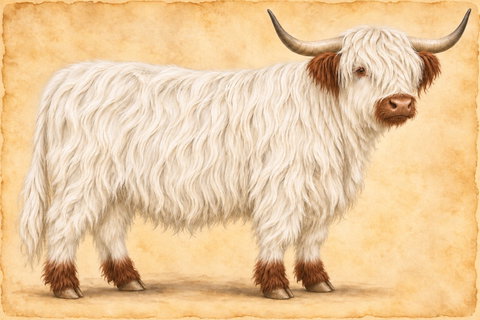
Inherited copies · A park-pattern copy or copies, with a red-family base and no Highland dilution. E+ and e remain distinct possibilities.
What to check · Look at the ears and lower legs for red hair, and at the muzzle for red-brown or pale pigment.
Registry words · White with red points · Brenig et al.: White Park and White Galloway color
Save this color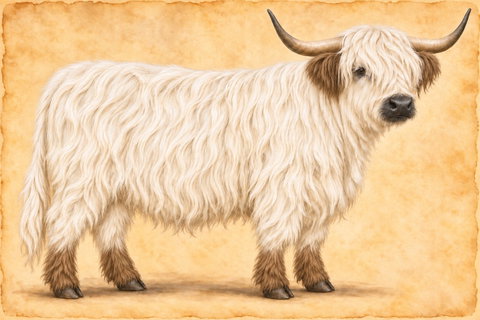
Inherited copies · A park-pattern copy or copies, with a black base and one Highland dilution copy.
What to check · Compare the brown ears and lower legs with the charcoal muzzle and dark hooves.
Registry words · White with dun points · Brenig et al.: White Park and White Galloway color
Save this color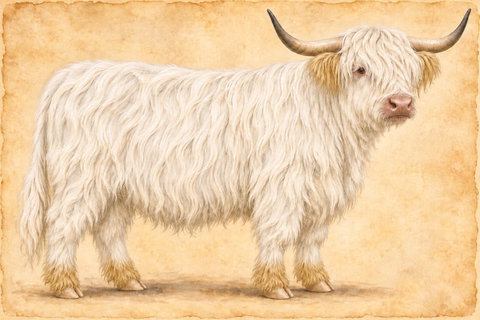
Inherited copies · A park-pattern copy or copies, with a red-family base and one Highland dilution copy.
What to check · The yellow ears and lower legs can be faint against the white body. Compare the pink muzzle with the dark pigment of silver points.
Registry words · White with yellow points · Brenig et al.: White Park and White Galloway color
Save this color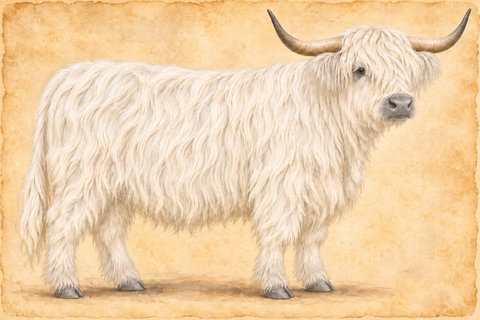
Inherited copies · Very little point color can reflect park-copy dose or diluted points. Nearly white does not fix an MC1R pair, a dilution dose or the number of park copies.
What to check · This example has pale silver points, a gray muzzle and gray hooves. White with pale red-family points can instead have pink pigment; compare the solid white example.
Registry words · Nearly white; describe any remaining point color · Brenig et al.: White Park and White Galloway color
Save this colorSilver and silver dun describe the same Highland dilution. Keep bus dubh, frosting and parti-color as descriptive or registry wording; they do not establish a tested allele pair. Record the contrasting hair or white areas you see, and use the words your registry asks for.
Brindle is not present at birth. Dun calf shades can change as they mature. A white Highpark calf does not establish a red-family base or a Highland dilution dose.
They describe the same black-based, two-copy Highland dilution. AHCA uses silver; silver dun is also used in Canada and in lab interpretation. Check the dark muzzle, eye rims and hooves rather than the word alone.
Keep these as descriptive or registry words with the coat record. They do not establish a tested allele pair in this model. Describe where the contrasting hair or white areas occur and use the wording your registry asks for.
Not always. Dun calves can look red or steel gray, and brindle is not present at birth. Record the current appearance and check the grown coat before treating it as family evidence for a pairing.
No. Save this color opens the ordinary profile editor with suggested color words. You can change those words before saving. Gene states stay in the separate genetics record.



