


White-Headed Vulture
Trigonoceps occipitalis
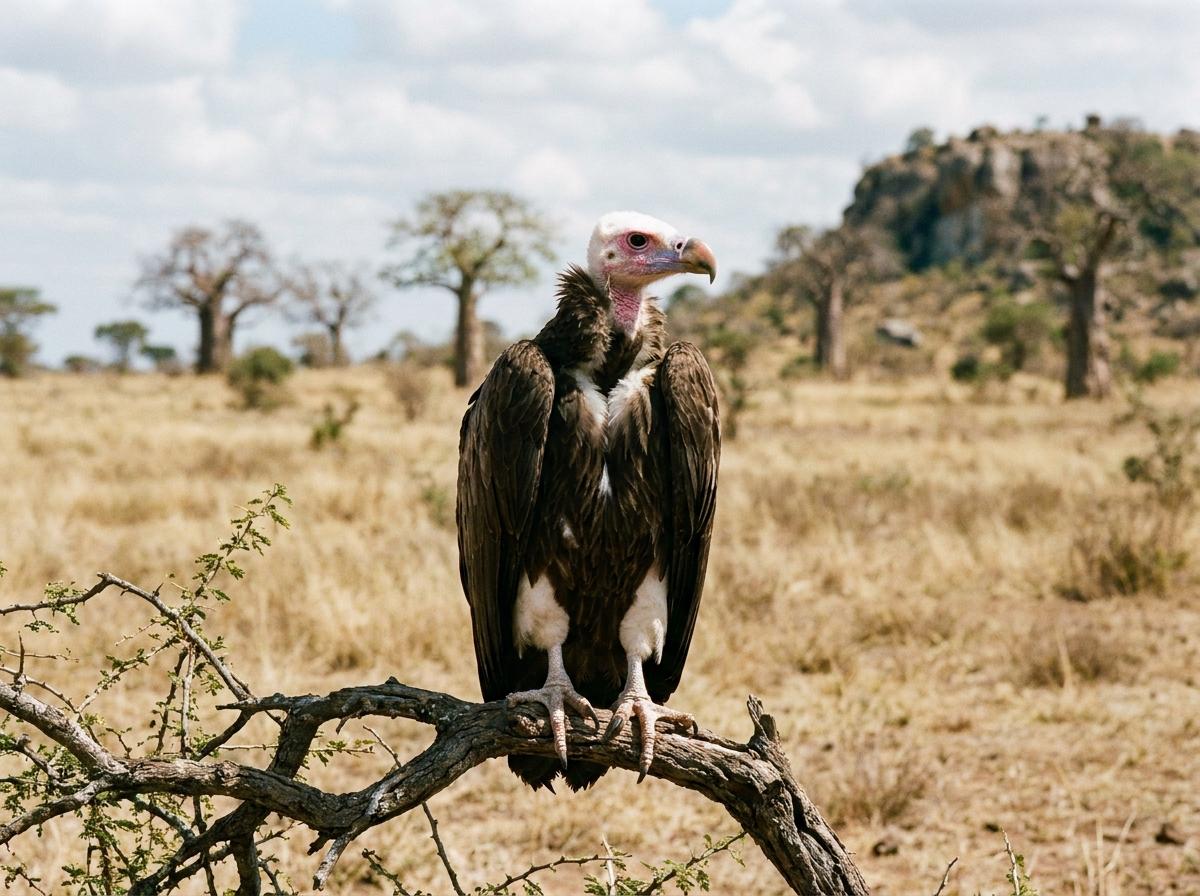
Across African savannas, open woodland, and semiarid country, the white-headed vulture (Trigonoceps occipitalis) is one of the more solitary vultures at a carcass. Adults show a pale bare head, dark body, white belly, and strong two-toned wings in flight, making them more contrasting than many other scavengers. They are often seen singly or in pairs rather than in dense flocks, and they nest in trees. Although they scavenge carrion, white-headed vultures may also take small live prey, eggs, and scraps left by larger predators.
Management of this critically endangered species is mainly a conservation and zoo responsibility, not private ownership. Poisoned carcasses set for predators are one of the main dangers, along with habitat change, persecution, collisions, and disturbance at nest sites. Field teams use nest monitoring, satellite tracking, anti-poisoning response, and community work with livestock owners to reduce losses. In rehabilitation or zoo care, the priorities are spacious flight aviaries, clean carcass-based diets from safe sources, minimal stress, and careful pairing because adult raptors can be territorial.
Colors: Black, Black and White, Brown, Cream, Gray, Orange Head, Pink Head, Red Head, Tan, White, Wild Type, Yellow Head