


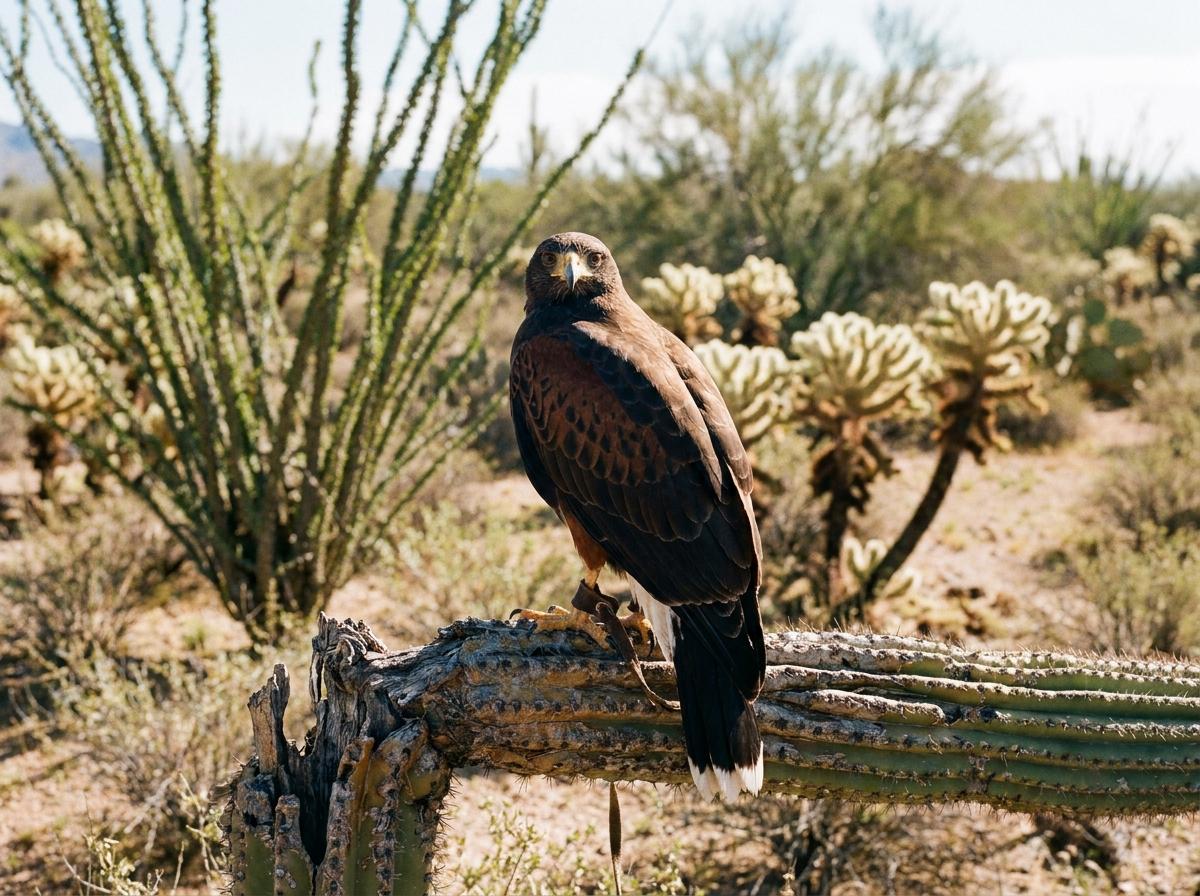
Harris's Hawk
Parabuteo unicinctus
Harris's hawk, Parabuteo unicinctus, is a social raptor of deserts, scrublands, savannas, and open woodland from the southwestern United States through Mexico and much of Central and South America. It is dark brown with chestnut shoulders and thighs, yellow facial skin and legs, and a blackish tail marked with white at the base and tip. Unlike many hawks, it commonly hunts cooperatively, with family members flushing, chasing, and surrounding rabbits, birds, lizards, or other prey. That social behavior has made it especially familiar in modern falconry.
Falconers value Harris's hawks because they can work closely with people and, in skilled hands, may hunt in pairs or small casts, but they remain regulated birds of prey rather than companion animals. Captive management involves a secure mews or weathering area, daily exercise, careful flying weight, and a diet based on whole prey. Birds kept for breeding need compatible pairs, quiet nesting space, and attention to heat, damp, and foot health. Zoos also use the species in flight demonstrations because it shows natural group behavior well. Wild populations are generally adaptable, though local nesting success can be affected by habitat loss, electrocution risks, and disturbance.
Colors: Dark, Wild Type