


Miniature Donkey Size: How Small Are They Compared to Standard Donkeys?
Author: Elliott Garber, DVM · Updated
Donkey Size Classifications: From Miniature to Mammoth
Donkeys are not a one-size-fits-all animal. The species spans a wide range of heights, from miniature Mediterranean donkeys standing under 36 inches to mammoth donkeys that can rival a draft horse. Understanding these size categories is essential if you are buying, breeding, or registering donkeys, because height determines breed classification, registration eligibility, and suitability for different roles.
For a full overview of the smallest category, see our miniature donkey breed guide.

The Four Size Categories
The American Donkey and Mule Society (ADMS) recognizes four distinct size classifications for donkeys. Height is always measured at the withers, the highest point of the shoulder where the neck meets the back.
Miniature: 36 Inches and Under
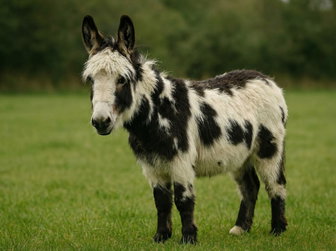
Miniature Mediterranean donkeys must stand 36 inches or under at the withers to qualify for registration with the ADMS through the Miniature Donkey Registry (MDR). The National Miniature Donkey Association (NMDA) sets the breed standard. Most miniatures fall between 32 and 36 inches and weigh between 200 and 450 pounds, depending on build and bone structure.
These donkeys trace their origins to the islands of Sicily and Sardinia. Robert Green imported the first seven Mediterranean miniature donkeys to the United States in 1929, and nearly all registered miniatures in North America descend from that original stock and subsequent imports. Today, miniatures are kept primarily as companion animals, therapy animals, and show animals. They are not suitable as livestock guardians (they are simply too small to deter predators) and should not be confused with standard donkeys used in that role.
Standard: 36.01 to 48 Inches
Standard donkeys stand between 36.01 and 48 inches at the withers and typically weigh 400 to 600 pounds. This is the most common size category worldwide and includes many of the working donkeys found across Africa, Asia, and Latin America. In the United States, standard donkeys are used for trail riding, packing, driving, and livestock guarding. Their moderate size makes them versatile across multiple roles.
Large Standard: 48.01 to 54 Inches (Jennets) / 48.01 to 56 Inches (Jacks)
Large standard donkeys occupy the gap between standard and mammoth classifications. Jennets (females) must measure between 48.01 and 54 inches, while jacks (males) can measure up to 56 inches. These donkeys weigh 500 to 800 pounds and are popular for riding, driving, and as breeding stock. The ADMS splits this classification by sex because jacks tend to be taller than jennets within the same size category.
Mammoth: Over 54 Inches (Jennets) / Over 56 Inches (Jacks)
Mammoth donkeys are the largest classification. Jennets must exceed 54 inches and jacks must exceed 56 inches. Many mammoth jacks stand 58 to 62 inches or taller and weigh 900 to 1,200 pounds. The American Mammoth Jackstock was developed in the United States beginning in the late 1700s, when George Washington imported large European jack stock to breed with mares for mule production. Mammoths are used for breeding mules, riding, driving, and farm work.
How Height Is Officially Measured
Official height measurement for registration purposes follows a specific protocol. The donkey must stand on firm, level ground with all four feet squarely beneath it. A measuring stick or calibrated height tape is placed at the highest point of the withers, perpendicular to the ground. The measurement is taken in inches (donkeys are not measured in “hands” like horses, though some people use that convention informally).
For miniature donkeys, the official measurement for registration is taken at age three, when skeletal growth is considered complete. Foals and yearlings may be measured for tracking purposes, but their final registered height is determined at maturity. This is important for buyers: a yearling measuring 33 inches may finish at 35 or 36 inches as an adult. Reputable miniature donkey breeders will be transparent about a young donkey’s projected adult height based on parentage and growth curve.

The “Micro Mini” Subset
Within the miniature classification, some breeders market donkeys under 30 inches as “micro minis.” This is not a separate breed or an official ADMS or NMDA classification. It is simply a marketing term for the smallest individuals within the miniature range.
Donkeys at the extreme small end of the size spectrum can be excellent animals with correct conformation and proportional build. However, buyers should be cautious. The NMDA has expressed concern about breeding very small individuals (under 30 inches) through successive generations, because this practice increases the risk of producing offspring with skeletal deformities associated with dwarfism. A well-proportioned 28-inch donkey is a different animal entirely from a 28-inch donkey with disproportionate limbs and a large head caused by chondrodysplasia. Understanding this distinction is critical. See our article on dwarf donkeys vs. miniature donkeys for a full explanation.
Weight Ranges by Size
Weight varies significantly within each size category depending on bone structure, body condition, and individual genetics. Here are typical ranges for donkeys in appropriate body condition (not overweight):
- Miniature (under 36 inches): 200 to 450 pounds
- Standard (36 to 48 inches): 400 to 600 pounds
- Large standard (48.01 to 56 inches): 500 to 800 pounds
- Mammoth (over 54/56 inches): 900 to 1,200 pounds
For miniature donkeys specifically, weight management is a constant priority. Their efficient metabolism and desert-adapted physiology mean they gain weight easily on the pasture and hay rations that would be appropriate for a similarly sized horse or pony. Obesity is the most common health issue in miniatures, contributing to laminitis, joint stress, and hyperlipemia risk. See our feeding guide for detailed nutritional recommendations.
Growth Patterns in Miniature Donkeys
Miniature donkey foals are born weighing 15 to 25 pounds and standing roughly 18 to 22 inches tall. Growth is most rapid in the first year, when foals typically reach 80% to 90% of their adult height. The second and third years involve slower growth with continued bone density development and muscular filling out.
Key growth milestones:
- Birth: 18 to 22 inches, 15 to 25 pounds
- 6 months: Approximately 70% to 80% of adult height
- 12 months: Approximately 85% to 90% of adult height
- 24 months: Near full height, still filling out in body condition
- 36 months: Skeletal maturity. Official measurement taken for registration.
Jacks tend to be slightly taller than jennets at maturity, typically by 1 to 2 inches. However, there is substantial overlap, and a tall jenny from large parents may easily exceed a short jack from small parents.
Miniature Donkeys Compared to Miniature Horses
People frequently ask how miniature donkeys compare to miniature horses. While both are small equines, they differ in several important ways:
- Build: Miniature donkeys are stockier with broader chests, shorter backs, and heavier bone relative to their height. Miniature horses have lighter, more refined builds proportional to full-sized horses.
- Height standard: Miniature donkeys are measured in inches at the withers (36 inches or under). Miniature horses are measured in inches or hands and can be up to 34 or 38 inches depending on the registry.
- Lifespan: Miniature donkeys commonly live 25 to 35 years. Miniature horses typically live 25 to 30 years.
- Temperament: Donkeys are more cautious and deliberate. What people call “stubbornness” is actually a strong self-preservation instinct. They assess situations before reacting. Horses are more reactive and flight-oriented.
- Social needs: Miniature donkeys must have at least one other donkey companion. Horses, goats, or other animals are not adequate substitutes for a donkey’s social needs.
If you are considering adding a miniature donkey to your property, browse current miniature donkeys for sale on Creatures. Searching for the right name? Try our donkey name generator for inspiration. And remember: donkeys are herd animals. Plan to bring home at least two.